.webp)

Rejection Sensitive Dysphoria (RSD): Why Rejection Can Feel So Painful and How to Cope

Key Takeaways
- Rejection Sensitive Dysphoria (RSD) is severe emotional distress or pain in response to real or perceived rejection or failure.
- RSD isn’t a formal diagnosis
- RSD was initially associated with ADHD, but it’s increasingly recognized as occurring within the autistic community.
- Common triggers of RSD include real or perceived rejection, failure, criticism, abandonment, exclusion, teasing, or confrontation.
- Neurodivergent-affirming therapies can be an effective way of managing RSD.
Note: RSD is a popular term for an experience of unusually intense distress around rejection or perceived rejection, but it has not been established in research as a distinct clinical condition separate from rejection sensitivity or related emotional regulation difficulties.
It’s perfectly normal for breakups to hurt, criticism to sting, and being excluded to feel lousy. But for people with rejection sensitive dysphoria, or RSD, real or perceived rejection can cause severe emotional pain. This is something I’ve dealt with for as long as I can remember.
The shame, humiliation, anger, and sadness I felt when I thought I was being rejected would easily ruin my day. From there, I’d start mentally catastrophizing everything, assuming the worst possible scenario was inevitable. I didn’t have a name for this until I was diagnosed with ADHD in my 30s.
Once I found out that neurodivergent people (including autistic people and those with ADHD) often experience RSD, the extreme emotional responses I was having suddenly made sense. RSD isn’t a formal diagnosis, but a pattern of experience recognized by clinicians and neurodivergent people alike.
In this article, we'll discuss how to recognize RSD and explain why it shows up differently depending on neurotype (autistic, ADHD, neurotypical, etc). We'll also detail concrete coping strategies and paths to support.
What is rejection-sensitive dysphoria?
RSD is the experience of extreme emotional pain as a result of real or perceived rejection, failure, or criticism. It can also occur because of real or perceived loss of approval or respect, teasing, or disappointing important people in our lives.
In fact, “dysphoria” is the Greek word for “unbearable,” says William W. Dodson, MD, an adult psychiatrist specializing in ADHD. However, according to Gina Romero, LCSW, the owner of Wandering Pine Wellness, neurodiversity-affirming approaches call for us to shift away from using the term “dysphoria.”
“The word ‘dysphoria’ can imply something is wrong or disordered, when in reality, rejection sensitivity is a really common experience for ADHD and autistic folks,” she explains.
Rejection sensitive dysphoria was initially acknowledged in relation to ADHD, but it's now increasingly recognized as a common autistic experience too, says Dr. Kelly Whaling, a clinical psychologist and research lead at Prosper Health.
Kit, 45, found out she had RSD during her assessment and diagnosis for autism. “We spoke about my experiences with being accused of being too ‘touchy’ and taking any slight form of criticism as the end of the world,” she says. Her psychologist attributed it to her black-and-white thinking (a phenomenon common in autism) making her feel like a bad person if she received even slight criticism.
Is RSD real?
RSD is commonly used to describe particularly intense emotional responses to actual or perceived rejection. These experiences may overlap with what researchers call rejection sensitivity, as well as broader patterns of emotional regulation. However, research has not established RSD as a distinct clinical condition or determined where, if anywhere, the boundary between RSD and rejection sensitivity lies.
“This does not mean RSD is not real. It very much is, and people experience tremendous challenges because of it,” says Dr. Whaling. “But professionally, we are still trying to best understand how to define and categorize it.”
RSD vs. rejection sensitivity
RSD isn’t the same as ‘rejection sensitivity.’
“Rejection sensitivity and rejection sensitive dysphoria have a similar relationship, in that rejection sensitivity appears to be a painful experience faced by all individuals, while rejection sensitive dysphoria is a clinically significant manifestation of rejection sensitivity,”Dr. Whaling says.
Signs and symptoms of rejection sensitive dysphoria
There are a number of common emotional and physical experiences associated with RSD.
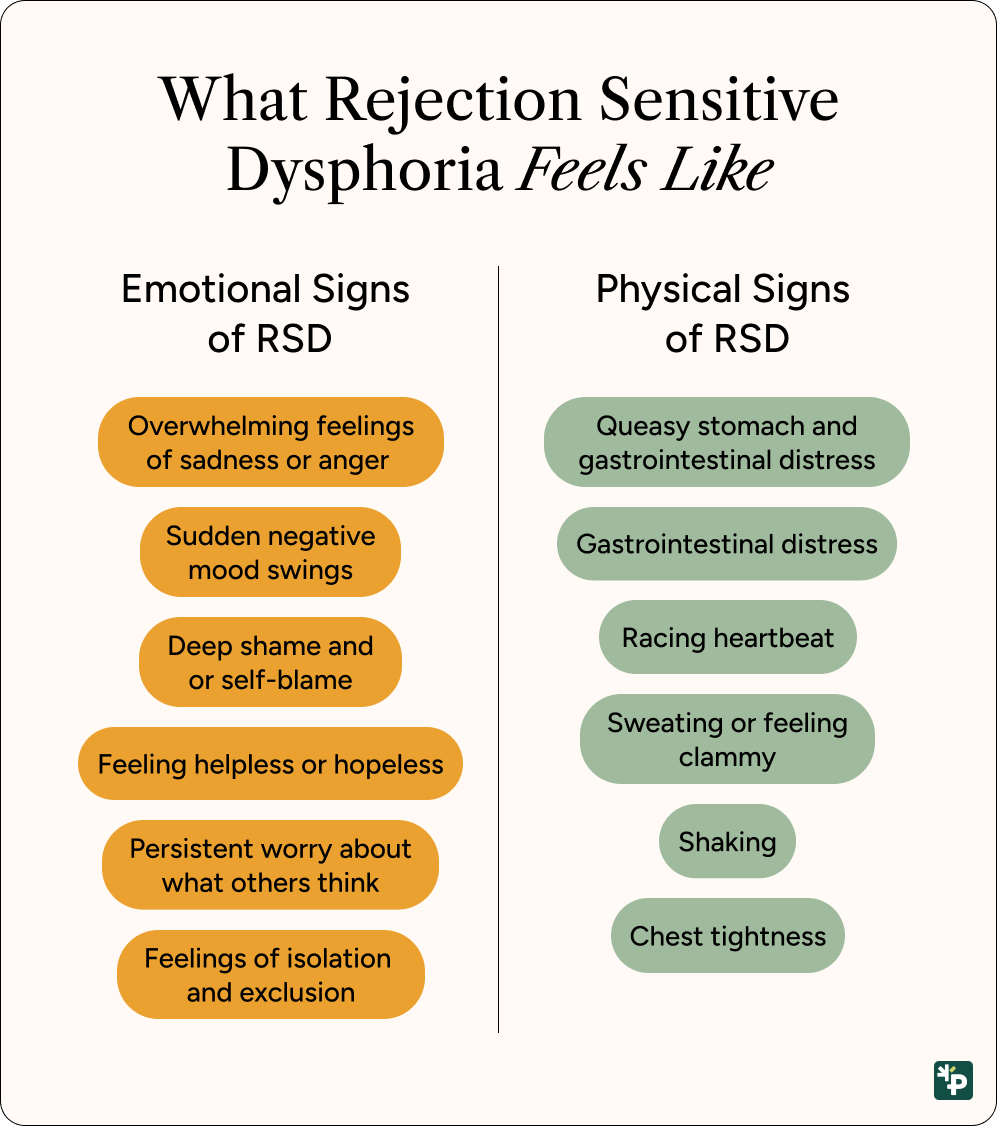
Emotional signs of RSD
Although RSD affects everyone differently, here are a few of the ways it can alter your mood or emotional state:
- Extreme and overwhelming feelings of sadness or anger after real or perceived rejection or failure
- Sudden mood swings, including the onset of severe anxiety or depression
- Deep shame, humiliation, or self-blame after a real or perceived rejection
- Feelings of helplessness or hopelessness when facing real or perceived rejection
- Constant fear and worry about what others think
- Feelings of isolation, alienation, and exclusion
Physical signs of RSD
A 2026 study in PLoS One found that RSD often triggers unpleasant bodily sensations. These may be similar to symptoms with anxiety, including:
- Queasy or “sour” stomach, gastrointestinal distress, or having a “knot” in your stomach
- Racing heartbeat
- Sweating or feeling clammy
- Shaking
- Tightness or feeling stabbed/punched in the chest
- Hunched over posture
- Grimacing
- Crying
“It feels like a dark blanket envelops me and my mood,” says Marni, 54, who is autistic and has RSD. “All self-confidence vanishes, and I sink into depressive anxiety where my whole body feels heavy, with an emphasis on my chest caving in and my facial expression unable to smile. There's tension in my forehead as worry takes over.”
For Ayla, 34, RSD feels like “panic and shame crash together” and take over her whole body. “My chest tightens, my stomach drops, and I just want everyone to get away from me,” she says. “It’s like my brain forgets logic and decides I am the mistake, not that I made one.”
Important to note: The study above found that some people mask their RSD. Over time, this can cause you to feel disconnected from your emotions, other people, and even yourself.
How rejection sensitive dysphoria connects to ADHD and autism
While RSD was first identified and popularized by Dodson as a symptom of ADHD, it’s not exclusive to those with the condition. It’s increasingly recognized as occurring within the autistic community. According to Dr. Whaling, more research into RSD and how it manifests in people with autism vs ADHD is needed, but there are some key differences.
In the context of autism
Because autistic people often experience alexithymia—where you might have trouble identifying, labeling, and describing emotion—you might know you’re hurt, but have trouble identifying why or figuring out what to do about it. This can make rejection especially confusing and distressing.
On top of that, many autistic brains love patterns and predictability. Black-and-white thinking can lead you to view occasional failures or rejections as indicative of your worth. For these reasons, it’s understandable if exclusion triggers your mind to “loop through the scenario, scan memories for other social failures creating a pattern and narrative of inadequacy and social rejection,” Dr.Whaling notes.
Finally, rejection sensitive dysphoria in autism may cause you to mask more to try to prevent rejection or failure from happening again. That’s because autistic people often develop social “rules” based on past experiences. For example, if you’ve been shamed for your special interests in the past, you may think, “I can never talk about my passions because I get too excited.”
In the context of ADHD
Rejection sensitive dysphoria in ADHD can be a little different. For example, for those with ADHD but not autism, there may be an element of impulsivity in their response to RSD. “ADHD brains struggle with putting the brakes on actions and with creating space between impulse and behavior,” Dr. Whaling explains.
“As a result, the ADHDer might act on their feelings of rejection sensitivity quickly through things like quitting a job in the middle of a performance evaluation, or getting into an argument with a romantic partner, and then come to regret these impulsive actions.”
In addition, certain traits of ADHD, such as forgetfulness and distractibility, can increase someone’s risk of being criticized, corrected, or receiving negative feedback. This can make someone more sensitive to rejection or failure in the future.
Behaviorally, RSD in ADHD can manifest as people-pleasing, overcompensating, or avoiding any situation where rejection might be possible.
When someone is diagnosed with both ADHD and autism
Co-occurring ADHD and autism (AuDHD) can amplify rejection sensitive dysphoria.
“Many autistic folks spend a lifetime being misunderstood, excluded, or expected to mask in order to be accepted,” Romero says. “Over time, these experiences can lead to a heightened sensitivity to perceived rejection, activating trauma responses. This can show up as hypervigilance and fear, even in situations that seem low-stakes from the outside.”
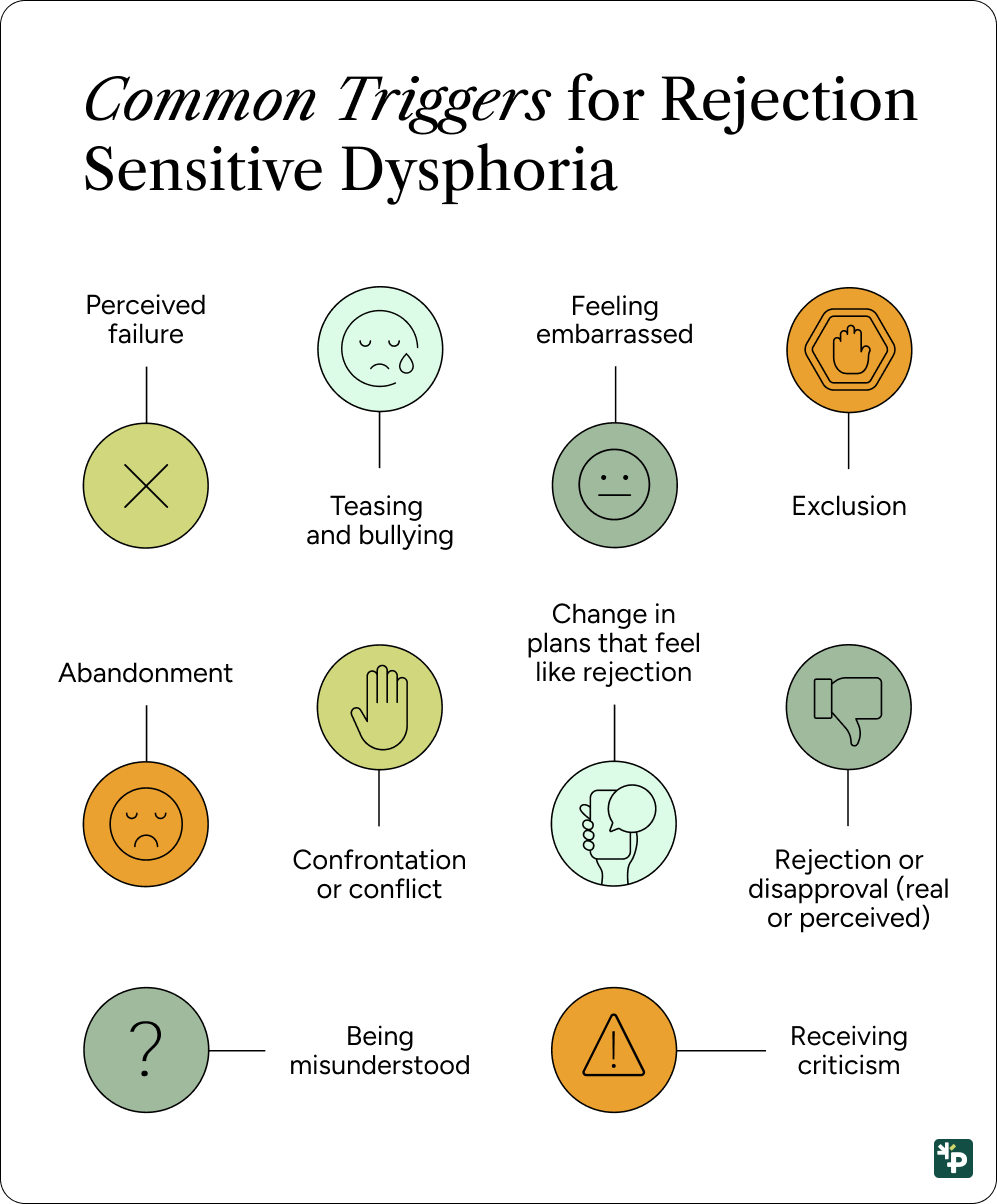
Common triggers of rejection sensitive dysphoria
“The rejection that triggers RSD can be actual/real, simply perceived or interpreted by the individual as such when others might not perceive a rejection to have occurred, or sometimes can even be just the mere possibility/opportunity for rejection,” Dr. Whaling explains.
Some examples of RSD triggers common in autistic adults, according to Romero, are:
- Interpreting a small change in someone’s tone, facial expression, or body language as rejection or criticism
- Ruminating after a perceived social misstep or mistake
- Feeling overwhelmed or shutting down after receiving constructive feedback
- Reading delayed replies (texts, emails, etc.) as signs of disapproval, disinterest, or rejection
- Experiencing emotional distress when plans are changed or canceled, even with valid reasons
- Over-apologizing
- Feeling unsafe or unworthy in relationships, even when no actual rejection has occurred
For Ayla, pretty much anything that feels like disappointment can trigger RSD. She describes a recent experience during a shoot for an art show when an image wasn't coming out the way she'd hoped. She melted down because she was worried that she failed her entire team.
For Marni? “I hate silence—someone giving me the silent treatment is the worst for triggering my RSD.”
While understanding RSD triggers is a crucial first step, we should also learn how to regulate our intense emotional reactions.
Emotional and psychological effects of rejection sensitive dysphoria
Because RSD is itself a symptom—not an official diagnosis—there isn’t a list of criteria someone needs to meet.
That said, here are some common emotional, psychological, and behavioral traits associated with RSD:
- Disproportionate responses or reactions to rejection
- People-pleasing in order to avoid possible conflict or rejection, and/or to seek approval of others
- Negative self-talk
- Avoiding social situations and/or communicating with others
- Replaying any perceived failure in your mind
- Abandoning projects, jobs, or relationships at the first sign of criticism or perceived rejection
- Avoiding tasks or responsibilities that come with the potential for failure or criticism
- Having trouble standing up for your own feelings and needs
- Having a perfectionist mindset
RSD and Masking
Emotional sensitivity plays a role for RSD in autism. RSD, masking, and autistic burnout are closely connected.
“Many autistic folks mask to avoid rejection,” Romero explains. “This constant self-monitoring—often fueled by fear of judgment or exclusion—can create chronic stress that can lead to autistic burnout. Rejection sensitivity isn’t the only driver, but it’s a common reason why autistic folks mask, and why it’s so hard to let go of.”
Even when someone intellectually knows it's safe to unmask, their nervous system may disagree, especially if past experiences of rejection were traumatic or repeated over time.
This is the case for Ayla. “RSD makes masking worse because you’re constantly trying to manage people’s reactions to avoid rejection,” she says. “It’s like emotional whiplash on repeat, and it drains you until there’s nothing left.”
If you’re experiencing emotional distress, due to rejection or otherwise, the 988 lifeline is available to provide support through phone, text, or chat.
How rejection sensitive dysphoria affects relationships
In the context of relationships, rejection sensitive dysphoria can be tricky to navigate. This is true of friendships, romantic relationships, and in the workplace, Romero says.
Friendships
RSD in friendships can take many forms including:
- Overanalyzing texts, tone, or pauses in communication
- Withdrawing to avoid perceived rejection before it can happen
- Feeling devastated by canceled plans or minor changes in behavior
- Misunderstanding or misinterpreting someone’s words or actions as rejection
- Avoiding social situations
Romantic relationships
Similarly, RSD can manifest in romantic relationships in ways like:
- Seeking constant reassurance from a partner and constant fear your partner will break up with you
- Reacting strongly to perceived emotional distance or disinterest
- Avoiding vulnerability
- Over-apologizing or over-explaining to repair imagined ruptures
- Interpreting a partner’s need for space or independence as rejection
- Feeling intense shame or panic after conflict (even small disagreements)
In the workplace
RSD can also affect workplace relationships, including:
- Struggling with feedback
- Avoiding leadership roles to avoid potential rejection
- Avoiding taking on projects to avoid potential failure
- People-pleasing or overcommitting to avoid disappointing others
- Constant fear of doing something to get fired
Note that many signs of RSD can overlap with anxiety disorders, obsessive-compulsive disorder, or personality disorders. If symptoms interfere a lot with your daily life, it may be worthwhile to discuss them with a psychiatrist.
How to navigate relationships with RSD
According to Romero, here are some effective ways to navigate relationships when you have RSD:
Name it: Learning to identify experiences of RSD can help create space between the feeling and the reaction. Self-awareness is the first step in managing RSD in relationships.
Pause before reacting: RSD tends to trigger immediate responses. Giving yourself a moment to check the facts can prevent unnecessary spirals.
Communicate openly: If it feels safe, let trusted people know how RSD shows up for you. “Be honest and blunt—sugarcoating just confuses everyone,” Ayla says. “I tell my husband exactly what I’m thinking instead of assuming he’ll figure it out. Clarity helps both of us.”
Boundary-setting: Try setting limits on how much social interaction you can handle or how often you extend your help to others if you’re a people-pleaser. This creates a sense of safety and predictability in relationships, which can reduce the fear of rejection.
Work with a neurodiversity-affirming therapist: This could be helpful in individual, couples, or family therapy. It’s so important to work with a therapist who doesn’t shame you for being neurodivergent. Instead, they focus on building understanding, reducing shame, and supporting nervous system regulation. A therapist familiar with RSD and autism—such as those here at Prosper Health—can help find the right techniques for you.
Coping strategies for managing rejection sensitivity dysphoria
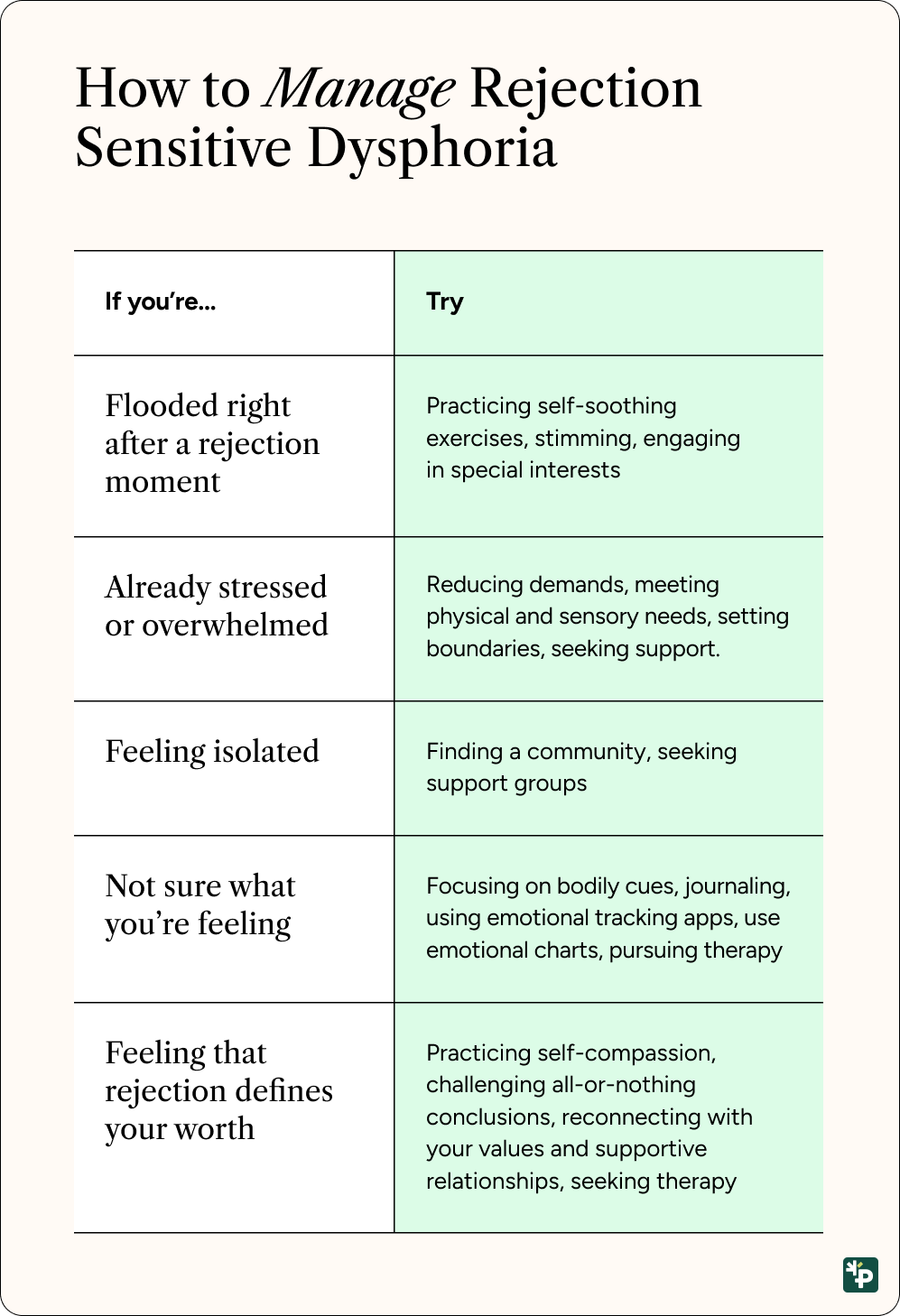
Managing rejection sensitive dysphoria is possible with the right tools and strategies, including:
Understanding and naming emotions
One of the first steps in managing RSD is developing a better understanding of emotional triggers. You may benefit from learning to recognize and label your emotions accurately, which can help de-escalate intense feelings of rejection. Tools like emotion-tracking apps or journaling can help you better identify these emotions.
Reducing stress levels
Reducing your overall nervous system load can make you less emotionally vulnerable so you’re better able to tolerate RSD when it does happen. “When you’re chronically stressed, sleep deprived, hungry, or sensory overwhelmed, you’re way more vulnerable to RSD,” Dr. Whaling says. “Prioritize sleep, eat regularly, manage sensory input, and build in recovery time.” Setting boundaries may also help manage stress and reduce RSD.
Practicing self-soothing
Practicing self-soothing techniques, such as engaging with special interests or stimming, can help manage the intense emotions that RSD can trigger.
Engaging in activities
Engage in activities that boost self-esteem and provide a sense of accomplishment. For example, you might partake in a hobby or work on creative projects. This can help reduce the emotional impact of perceived rejection, as well as stress and the chances of burnout.
Building mastery and positive experiences
Develop areas of expertise and engage in activities that give you satisfaction independent of others’ judgments. Create things, learn skills, and engage with your interests. Build evidence that you have value beyond social acceptance.
Values clarification helps too. “Get really clear on what matters to you outside of being liked or approved of,” Dr. Whaling says. “What do you care about? What kind of person do you want to be? When you’re oriented toward your values rather than others’ judgments, rejection still hurts but it’s less catastrophic.”
Finding a community
A research article published by the Institute of Neurodiversity in 2025 suggests that having an accepting, affirming community where you’re safe being yourself can help tremendously.
“Reach out to them and share, whether it’s a neurodiversity affirming Discord server, or an autistic in person support group, or just a friend to play video games with,” Dr. Whaling says. “Having those connections makes such a difference.”
Check out organizations such as the Autism Self Advocacy Network (ASAN) and the Autistic Women & Nonbinary Network (AWN).
Practicing self-compassion
Practicing self-compassion is essential for everyone, but it’s especially helpful for those with RSD, which heavily impacts self-esteem. It’s important to remind yourself that rejection is a common experience that virtually everyone has. It doesn’t reflect personal worth.
“The best thing I can do is to tell myself ‘you are enough’ as often as possible,” Kit says. “I personally want to put more effort into having more alone time and downtime to pursue the things I want to, rather than living for others and trying to gain validation through people-pleasing.”
Therapy and treatment options for rejection sensitive dysphoria
You don’t have to manage RSD alone. There’s no specific protocol for rejection sensitive dysphoria treatment, but therapy and medications may help.
Therapy
Working with a neurodiversity-affirming therapist like the ones at teletherapy provider Prosper Health can improve emotion regulation and perspective-building related to RSD. Here are some types of therapy that can be useful when adapted specifically for autistic adults:
- Cognitive behavioral therapy (CBT): CBT is a great option. The goal of CBT is to change unhelpful thoughts and behaviors to those that are healthier. Two specific types of CBT, Acceptance and Commitment therapy (ACT) and Dialectical Behavior Therapy (DBT), may be especially effective for RSD.
- Acceptance and Commitment therapy (ACT): Instead of trying to eliminate the painful feelings from RSD, which is a losing battle, ACT teaches you to change your relationship with those feelings. ACT allows you to build the capacity to have the painful feelings and still move forward with your life.
- Dialectical Behavior Therapy (DBT): “DBT was literally designed for emotional dysregulation, so it’s incredibly well-suited for RSD,” Dr. Whaling says. The four modules (mindfulness, distress tolerance, emotion regulation, and interpersonal effectiveness) each target different aspects of the RSD experience. “You’re learning to observe your emotions without being consumed by them.”
Medication and RSD
At this point, there is no on-label, FDA-approved RSD medication. Because RSD isn’t a formal diagnosis, there’s no pathway for medications to be approved for it directly, Dr. Whaling explains.
That said, prescribers may use medications off-label to target the underlying mechanisms that contribute to RSD. For example, medication providers might prescribe ADHD medications, like stimulants or non-stimulants, if they feel the RSD is associated with the broader emotional dysregulation and impulsivity that comes with ADHD. Anxiety medications can apply in this context as well.
“Many ADHDers find that medication—stimulants or non-stimulants—can indirectly help with emotional regulation, which may reduce the intensity or frequency of RSD-related reactions,” Romero explains.
On the other hand, there’s no medication for autism specifically, but clinicians may prescribe medicine for co-occurring mental health challenges that contribute to RSD.
The bottom line
Rejection sensitive dysphoria is real and can cause excruciating emotional and sometimes even physiological pain during real or perceived rejection. It’s incredibly common among neurodivergent individuals.
RSD can affect friendships, romantic relationships, and your interactions in the workplace. The good news is that it can improve over time with the right coping strategies.
Neurodiversity-affirming therapists, like the ones at Prosper Health, can also help people with RSD find relief from these severe emotional reactions.
Frequently Asked Questions
What causes rejection sensitive dysphoria?
Rejection sensitive dysphoria is triggered by real or perceived rejection or disapproval. See specific examples under “Common triggers of rejection sensitive dysphoria.”
Can RSD improve over time?
So far there haven’t been any longitudinal studies of RSD or randomized controlled trials of clinical interventions of pharmacologic interventions specifically targeting RSD. So, data aren’t available to answer this question.
However, according to clinicians like Dr. Whaling, RSD can improve over time. You can hasten the process with the right support, coping strategies, and therapy. Neurodiversity-affirming therapies like ACT and DBT can help.
Can you get RSD without ADHD?
Yes, you can get RSD without ADHD. In fact, RSD is common among autistic individuals.
Sources
- https://www.additudemag.com/rejection-sensitive-dysphoria-adhd-emotional-dysregulation/
- https://www.dodsonadhdtreatment.com/
- https://www.nytimes.com/2025/04/17/well/mind/rejection-sensitive-dysphoria.html
- https://chadd.org/wp-content/uploads/2016/10/ATTN_10_16_EmotionalRegulation.pdf
- https://www.sciencedirect.com/science/article/pii/S0273229721000538
- https://pmc.ncbi.nlm.nih.gov/articles/PMC10569543/
- https://add.org/rejection-sensitivity/
- https://www.liebertpub.com/doi/epub/10.1089/aut.2020.0083
- https://www.researchgate.net/profile/Edward-Modestino/publication/382531593_Rejection_Sensitivity_Dysphoria_in_Attention-DeficitHyperactivity_Disorder_A_Case_Series_Case_Series/links/66a23e8d75fcd863e5d98f26/Rejection-Sensitivity-Dysphoria-in-Attention-Deficit-Hyperactivity-Disorder-A-Case-Series-Case-Series.pdf
- https://journals.sagepub.com/doi/abs/10.1177/13623613251376893
- https://pmc.ncbi.nlm.nih.gov/articles/PMC12822938/
- https://journals.sagepub.com/doi/full/10.1177/27546330251394516
Related Posts

Autism and Empathy: What the Research (and Autistic People) Actually Say
We often make assumptions about others’ internal states based on their external behaviors. For example, if it seems like you’re shivering, one might guess that you’re cold. The assumption might be correct much of the time, but these assumptions are not always accurate. It’s also possible that you could be shivering but not cold, or cold but not shivering.
Likewise, if you’re autistic, you may find your behaviors misunderstood because you communicate differently from what some people expect. People might misperceive your feelings and intentions. This is common for autistic people, and that’s part of why there are harmful misconceptions about autism and empathy — specifically, that autistic people have none.
The question “Do people with autism have empathy?” prevails in blog posts and articles. The reality is that autistic people do have empathy, and in fact, many have heightened empathy. This is true even if its expression presents differently, says Anna Kroncke, PhD, a licensed psychologist with Prosper Health.
The autism lack of empathy myth causes a lot of confusion, especially for neurodivergent people who aren’t diagnosed in childhood. You may hear for years that you’re “cold” or “insensitive,” even when you have the best of intentions, and have no idea why. Or, the fact you have empathy may lead you to doubt the possibility you’re autistic to begin with.
In this article, we'll discuss what research shows about autism spectrum disorder, empathy, how to recognize it in your own life, and how having empathy doesn't rule out the possibility of being autistic.

Navigating Love: A Guide to Dating Someone with Autism
Relationships are complex and often rewarding, offering connection, intimacy, and growth. This can be doubly true when you’re dating someone with autism.
If you’re neurotypical, you might notice that an autistic partner needs more alone time or is especially sensitive to sensory stimuli. To be clear, these traits aren’t exclusive to autistic individuals, nor are they universal among them. However, there are a couple of common examples of how autistic people often differ from neurotypical partners.
When present, these patterns reflect differences in how autistic people process information, communicate, and experience the world. It might take time to understand these differences, but unique cognitive profiles can add new and exciting dynamics to a relationship.
Communication and processing differences are core aspects of autism, so “navigating them is inevitably going to be a central part of the relationship,” says Dr. Kelly Whaling, Research Lead and Licensed Clinical Psychologist at Prosper Health.
A healthy relationship is rooted in honest communication, mutual understanding, and accommodation. That said, it’s common for people to misread autistic individuals’ behaviors through the lens of neurotypical norms.
So, in this article, we’ll discuss what to know about autism and romance, how factors like masking and social overwhelm impact relationships, and the perks of dating someone autistic. We'll also discuss what healthy support and mutual adaptation can look like, and the difference between processing differences and incompatibility.

Understanding Autism and Relationships: Navigating Love, Family and Friendship
Many autistic people experience relationship challenges—whether they’re romantic or platonic—in environments shaped around non-autistic social norms. Some unwritten rules and behaviors don’t necessarily come naturally to neurodivergent people.
Christal Castagnozzi, a clinical and school psychologist who received a late autism diagnosis, says that while she had friends growing up, there was an “underlying sense of being misunderstood.” She feels she “struggled to access deeper, more meaningful connections,” and ultimately believed she didn’t belong, even when her friends included her in their social activities.
Even in romantic relationships, Castagnozzi says she had difficulty “interpreting cues, flirting, [her partner’s] intentions, and emotional subtext.”
If any of these experiences sound familiar, you are not alone. But more importantly, the challenges of autism and relationships are not a personal failing. They are often due to differences in communication style, sensory processing, social expectations, and mutual misunderstanding between autistic and non-autistic people. Castagnozzi says what made a difference for her was forming relationships with neurodivergent individuals who provided “less pressure to mask and more space for directness and authenticity.”
In this article, we’ll examine how autism shapes all kinds of relationships, the roots of certain challenges, and practical strategies for effectively navigating relationships.


