.webp)

Key Takeaways
- Since autism influences how people think, communicate, and process the world, it naturally affects dating and relationships.
- Autistic partners may have different styles of communication, flirting, texting, emotional expression, and social interaction. They may also differ in sensory needs.
- It's common for autistic people to need alone time, have more direct communication styles, struggle with ambiguity, and cancel plans. None of this necessarily means that they don’t love you or that your relationship is unhealthy.
- Many autistic people bring honesty, deep focus, new perspectives, and authenticity to relationships.
- Fostering a successful neurodiverse relationship requires mutual understanding and support, open communication, and a willingness to adapt.
Key Takeaways
- Since autism influences how people think, communicate, and process the world, it naturally affects dating and relationships.
- Autistic partners may have different styles of communication, flirting, texting, emotional expression, and social interaction. They may also differ in sensory needs.
- It's common for autistic people to need alone time, have more direct communication styles, struggle with ambiguity, and cancel plans. None of this necessarily means that they don’t love you or that your relationship is unhealthy.
- Many autistic people bring honesty, deep focus, new perspectives, and authenticity to relationships.
- Fostering a successful neurodiverse relationship requires mutual understanding and support, open communication, and a willingness to adapt.
Relationships are complex and often rewarding, offering connection, intimacy, and growth. This can be doubly true when you’re dating someone with autism.
If you’re neurotypical, you might notice that an autistic partner needs more alone time or is especially sensitive to sensory stimuli. To be clear, these traits aren’t exclusive to autistic individuals, nor are they universal among them. However, there are a couple of common examples of how autistic people often differ from neurotypical partners.
When present, these patterns reflect differences in how autistic people process information, communicate, and experience the world. It might take time to understand these differences, but unique cognitive profiles can add new and exciting dynamics to a relationship.
Communication and processing differences are core aspects of autism, so “navigating them is inevitably going to be a central part of the relationship,” says Dr. Kelly Whaling, Research Lead and Licensed Clinical Psychologist at Prosper Health.
A healthy relationship is rooted in honest communication, mutual understanding, and accommodation. That said, it’s common for people to misread autistic individuals’ behaviors through the lens of neurotypical norms.
So, in this article, we’ll discuss what to know about autism and romance, how factors like masking and social overwhelm impact relationships, and the perks of dating someone autistic. We'll also discuss what healthy support and mutual adaptation can look like, and the difference between processing differences and incompatibility.
Why dating dynamics can feel different in neurodiverse relationships
Dating dynamics can feel different in neurodiverse relationships because each partner has unique brain wiring, which means they think, communicate, and behave in their own way. Since partners are coming from different perspectives, they may have trouble understanding each other at times. Some factors that may cause confusion in neurodiverse relationships include:
- Direct communication: Many autistic individuals have direct, literal communication styles that aren’t necessarily shared by neurotypical partners.
- Different flirting styles: Neurotypical flirting often relies more on indirect communication and nonverbal cues. This may be challenging for some autistic people to pick up on.
- Discomfort with ambiguity: Some autistic individuals report being uncomfortable with ambiguous social cues.
- Social exhaustion: Autistic people may tire more easily from social interactions.
- Sensory needs: Many autistic people are either more or less sensitive to sensory stimuli than the average person, so an autistic person’s sensory needs may differ from their neurotypical partner’s.
- Processing differences: Many autistic people need more time to process information, especially as it relates to conflict and repair. “This may seem like going quiet or shutting down,” says Bailey Pilant, Psychotherapist at The Wave Mental Health Counseling PLLC. An autistic person may also need more or less time to process emotions.
- Differing relationship rhythms: Some autistic people describe becoming intensely focused on a new relationship as a special interest. “It can feel great to be the center of someone else’s universe,” says Pilant, but it can also be overwhelming for both parties.
- Attraction: Although autism and attraction don’t go strictly hand-in-hand, autistic people have a higher likelihood of identifying as LGBTQ or asexual.
People often ask specifically about “high-functioning autism” and romantic relationships. “High-functioning autism” is an outdated and problematic term, as it implies a hierarchy based on which autistic individuals behave most “normally” when really autism is distinguished by levels of support needs.
In any case, many stereotypes about autistic people are inaccurate or oversimplified, especially when it comes to autism and dating. Every autistic person is unique, and so are their relationships. Autism doesn’t prevent meaningful connection.
It’s important to add that being autistic doesn’t mean someone doesn’t care about others. Many autistic people do have difficulty understanding the needs and feelings of neurotypicals, but the opposite is also true. Misunderstandings are mutual and a result of differences in brain wiring, not deficits on the part of autistic individuals.
Common dating behaviors that are often misunderstood
Here are some common autistic behaviors that may be difficult at first for neurotypical partners to understand:
Needing alone time
When a partner withdraws, especially after a date, it’s easy to worry they may be disinterested. For autistic people, however, this behavior is often because of social or sensory exhaustion.
“There may be a need for more time to recharge or be by themselves,” says Tyana Tavakol, licensed therapist in CA and FL and virtual private practice owner of Uncovering You.
Often, the need for “alone time” is due to the amount of energy it can take to interact with others. Many autistic people feel the need to mask, or try to meet neurotypical social norms, to fit in. This often leads to burnout, so they may need some time by themselves to refill their social battery.
Inconsistent communication
Sometimes, it may take an autistic person mere seconds to respond to texts. Other times, you might wait much longer. This doesn’t necessarily mean they’re not emotionally invested.
Preparing a meaningful response takes careful thought and energy, so some autistic people wait until they feel fully capable of doing so. They may even prefer texting or other forms of asynchronous communication over having conversations in “real time.”
Cancelling plans
Some autistic people have a habit of cancelling plans—yet another sign of needing time alone. This is often for the reasons described above, especially the energy required to go out and interact socially. Your partner may be struggling with burnout, sensory overload, or social anxiety.
Direct communication
Many autistic individuals communicate in a blunt, direct manner instead of relying on implied communication. They often view honesty as a sign of care and respect, not cruelty. In fact, they may not even recognize that their words could potentially be hurtful.
An autistic partner may also be very upfront about their needs. Carina, an autistic adult, notes that she often asks her girlfriend to do something “an unlimited number of times.”
“It comes across as making her feel bad deliberately, when really I just want to make sure that she follows through on promises she made,” Carina says. “I have a very rigid set of rules in my brain and a strong sense of justice, even within relationships.”
Difficulty reading flirting or ambiguity
Among neurotypicals, flirting typically involves nonverbal and indirect communication. These cues are hard for some autistic people to understand, especially if they prefer explicit communication.
Many autistic people don’t realize when neurotypicals are flirting with them until they’re told outright. Dating for autistic adults can involve a steep learning curve when it comes to understanding neurotypicals’ nonverbal cues.
It’s also not uncommon for autistic people to express interest in ways you might not necessarily perceive as flirting. This might include offering practical help or sharing a special interest in depth, says Dr. Whaling. In some cases, an autistic person may be upfront and say outright how they feel.
Emotional expression
Some autistic people express emotions and love differently. For example, they may be less likely to show outward displays of affection, such as fond words and physical touch, notes Tyana. Instead, says Dr. Whaling, an autistic partner might express love through actions such as showing up consistently, being helpful, or spending time with you in a specific way.
For certain autistic people, it can be genuinely difficult to identify and express emotions. This is called alexithymia. However, many autistic people still have very deep feelings in relationships. They may be particularly sensitive to rejection, criticism, or feelings of unfairness or uncertainty.
Some autistic people also struggle with emotional regulation. “I cry a lot,” says Carina, “and in a previous relationship my partner thought that when I cried I was trying to manipulate her, when really I just have a very hard time regulating my emotions.”
Meltdowns and shutdowns can also occur.
Having sensory differences
As we mentioned before, autistic people often have different sensory needs. This can result in behaviors such as wearing headphones during meals to reduce sounds, using only specific towels, or quietly throwing away a shirt because the fabric is unbearable.
“These are not acts of ingratitude or control, usually,” says Whaling. “They are a person managing a nervous system that experiences the physical world very differently.”
This also applies to physical intimacy and sex. An autistic person might not want to be touched at certain times or in certain ways. In fact, types of touch that most people find neutral or pleasant may feel exhausting or uncomfortable. This is all a matter of personal preference.
Strengths autistic people can bring to romantic relationships
While a relationship between people of different neurotypes may require some adjustment at first, many autistic people bring strengths to relationships. Here are just some examples:
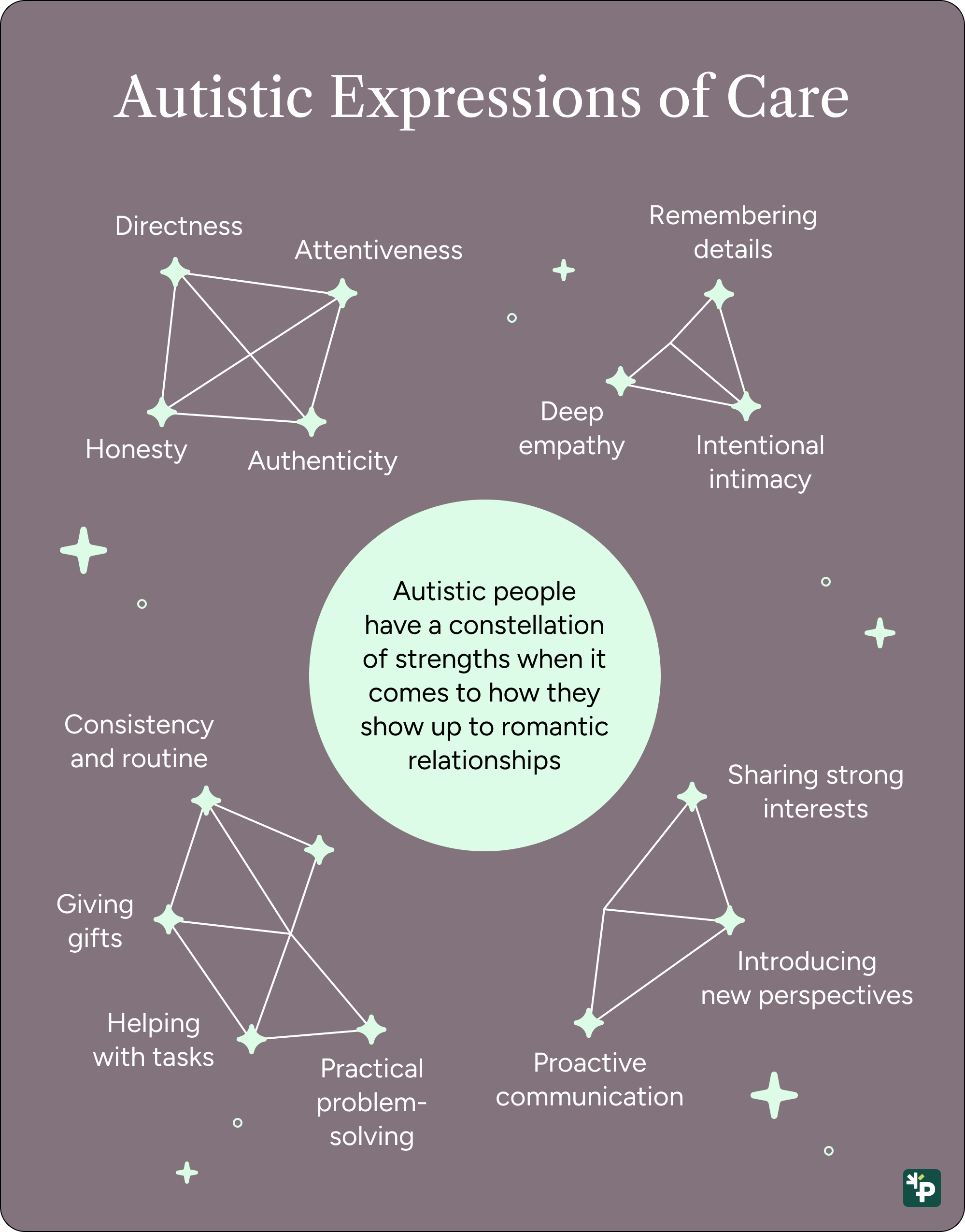
- Honesty and directness: Many autistic people are upfront with their thoughts and feelings, and less interested in “playing games.”
- Deep focus and attentiveness: Autistic people often have monotropism, which means they focus more thoroughly on a smaller number of topics than neurotypicals typically do. Thus, your autistic partner may be deeply focused and attentive towards your relationship.
- Thoughtful acts of care: If an autistic partner is sensitive to their own sensory needs, they may be highly attuned to yours, as well, says Tavakol. They might pay attention to your preferences (such as your favorite flavors, aesthetics, and music) and use this knowledge to provide thoughtful gifts or acts of care.
- New perspectives: An autistic partner might introduce fresh perspectives and ways of thinking.
- Authenticity: Autistic people often question and act outside of social norms. This can offer you the opportunity to do the same so that you can live according to your authentic values, says Tavakol.
- Shared interests and enthusiasm: Many autistic people get great joy out of their special interests. If you happen to share one or more of these interests, an autistic partner may bring a level of enthusiasm you’ve never seen before.
- Intimacy: An autistic partner may engage with you in activities they wouldn't with others, such as recharging by your side instead of by themselves, says Tavakol. This can foster a deeper sense of intimacy and closeness.
- Balance: “Sometimes, what initially feels like friction turns out to be helpful for both partners,” says Whaling. Take the example of someone who thrives with routine and structure but doesn’t have the motivation to enact it themselves. They may very much appreciate an autistic partner who likes to create systems.
How to support each other in a neurodiverse relationship
Neurotypical and neurodivergent individuals often come to relationships with different needs. Each partner’s support needs are valid, but sometimes, partners’ needs don’t line up perfectly. “A healthy relationship depends on both partners noticing each other’s needs, taking those needs seriously, and being willing to respond with care,” says Dr. Whaling.
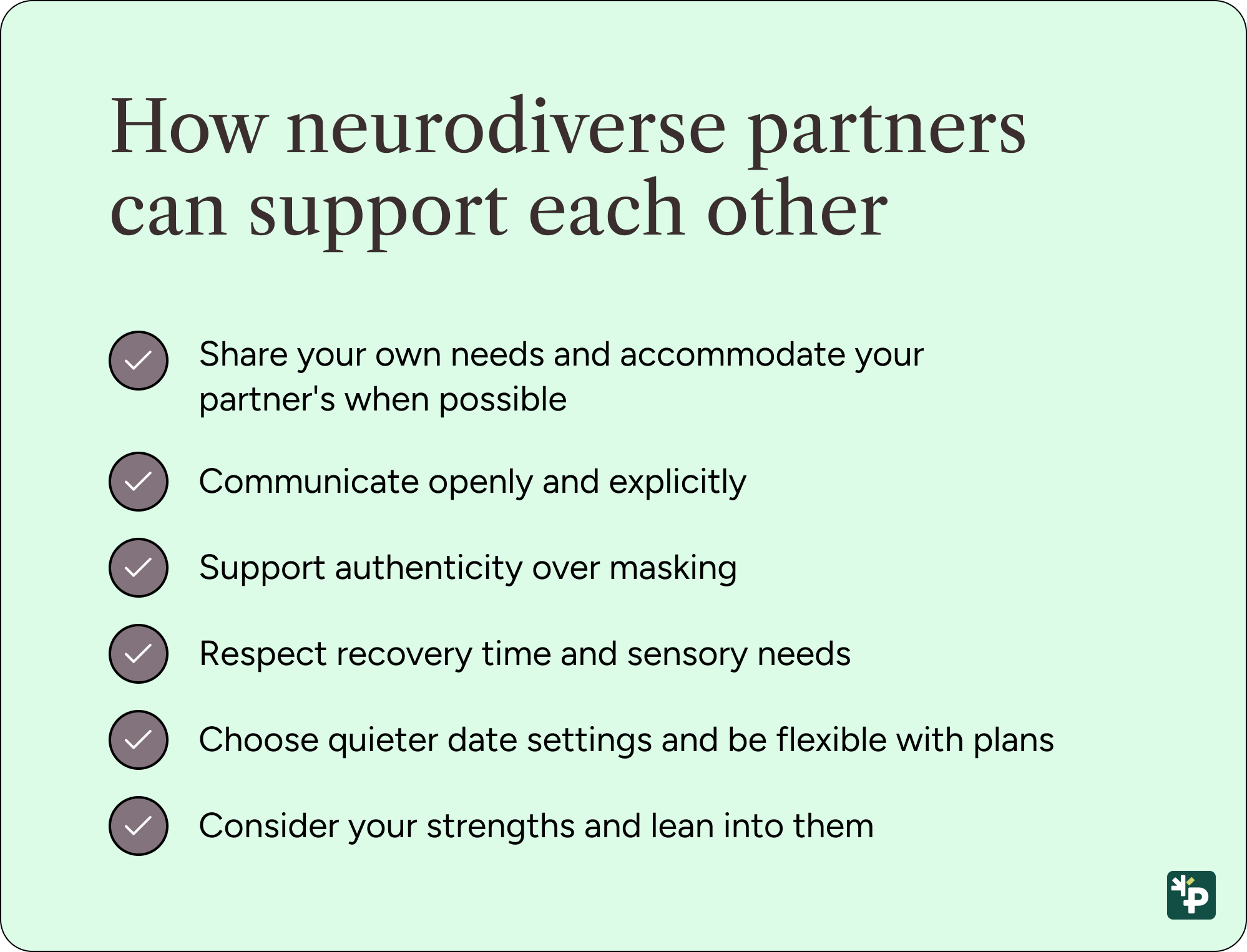
Research suggests that feeling understood and responded to is associated with relationship satisfaction for autistic people and their partners. Responsiveness requires explicit communication and, in many cases, intentional strategies to bridge communication differences. Each partner accepts and, when possible, accommodates the other. Here’s what this may look like.
Communicate explicitly
Communication is one of the most important aspects of relationships in general, but especially in those that are neurodiverse. In fact, you may want to schedule specific times to check in and communicate. Carina, for example, says she finds it helpful to set aside time each week to talk about how she and her partner are feeling in their relationship.
Since many autistic people don’t easily register indirect social cues, it’s important that communication is explicit, direct, and honest. For instance, you might tell your partner explicitly, “When plans change suddenly, I need help understanding what happened,” or “I need reassurance that we’re okay.” Likewise, your partner might ask for time to decompress before meeting up.
In any case, both you and your partner should feel comfortable asking direct questions, clarifying expectations, making direct requests, and checking for understanding. “Both people should put in genuine effort to understand each other,” says Whaling.
Support authenticity instead of constant masking
As we noted before, many autistic people feel pressured to mask, or hide their neurodivergent traits to fit in with society. Constantly having to hide your true self is not only exhausting but actively harmful to mental health, noted a 2021 study in Autism in Adulthood.
Many autistic people end up masking in relationships, as well. This can cause an autistic person to feel overlooked and misunderstood. A supportive relationship should be a safe haven where a person can unmask and be who they truly are.
Respect recovery time and sensory needs
When it comes to helping a partner feel safe and comfortable, respecting recovery and sensory needs is crucial.
To start, Tavakol suggests asking your partner what types of environments recharge or drain them. For instance, they might feel drained in the loud area of a restaurant but comfortable in a quieter area. If you live together, you might even set up a quiet space in your home.
You may also ask your partner if there’s anything specific they’d like for you to ask permission before doing. Maybe they want you to get permission before cuddling, touching their hair, wrapping your arms around them, or inviting other people to hang out with you.
Direct communication can be hard for someone who’s overstimulated, so it’s a good idea to ask your partner in advance if there are any signs that suggest they’re becoming overwhelmed. You may even come up with a deliberate signal they could use, and ask in advance what they’d find most helpful in those moments.
While everyone is different, here are some accommodations that many autistic people find helpful:
- Leaving events separately when necessary
- Planning recovery time after outings
- Reducing background noise during hard conversations
- Respecting solitary recharge time
“These supports often make the difference between a person staying regulated enough to remain present and becoming so overloaded that connection is no longer possible,” says Whaling.
Share your own needs
As much as you accommodate your partner’s needs, your own needs are important, too. If you feel that they aren’t met, you should share that with your partner. For instance, if your partner ever does or says something that hurts your feelings, it may not be intentional. Let your partner know how it made you feel.
Likewise, if your partner isn’t expressing empathy in the manner you prefer, you should be specific about what you want. If you feel your partner talks too much about their special interests at the expense of other topics, you should raise this concern during a neutral moment. Perhaps you could set up a system where your partner can bring up a special interest a certain number of times per day, so there’s room to discuss other topics, suggests Tavakol.
Negotiate
Negotiation in neurodiverse relationships may involve directly meeting needs or adapting around them with love and compromise.
Whether you’re the autistic or neurotypical partner, it’s generally a good idea to accommodate your partner’s needs when you’re comfortable doing so. The goal “is not to feign authenticity,” says Whaling, “but to recognize that performing certain acts of care, precisely because they matter to the partner, is itself a meaningful expression of love and commitment.”
Of course, this doesn’t apply in all situations. For instance, nobody should feel obligated to engage in sexual activities they’re not comfortable with.
In many other cases, though, it’s possible to accommodate each partner even when needs and preferences clash. Imagine an autistic person who needs time to refill their social battery, and a partner who craves connection at that moment. They might negotiate by briefly acknowledging each other at the door and then setting aside quiet time.
Consider your strengths
Genuine care, practical support, and complementary roles can enhance neurodiverse relationships, says Dr. Whaling. This doesn’t always mean abiding by gender roles, personal habits, or family expectations.
Instead, Dr. Whaling recommends dividing your responsibilities based on what you each do well. Maybe your partner is more skilled in logistics and planning, and you’re more experienced in emotional language or repair after conflict, or vice versa. You can prepare a system in which your partner takes more responsibility for one, while you manage more of the other.
When relationship challenges may need more support
Here are some signs that a relationship may benefit from professional support:
- You’re having trouble understanding each other even with explicit communication
- You or your partner struggle to accommodate the other’s needs
- You’d like support navigating alexithymia
- There are more conflicts than periods of enjoyment for a month or longer
- Conflicts arise over and over about the same topics
A counselor must be chosen wisely. It’s essential that the counselor understands autism and relationships, and doesn’t treat neurodivergent traits as defects. Look into neurodiversity-affirming therapy.
It’s also important to differentiate between communication differences and unhealthy (or even abusive) relationship patterns. The key differences are often “in the intent, consistency, and willingness to adapt,” says Dr. Whaling, adding that unhealthy dynamics tend to escalate over time.

Burnout, anxiety, masking exhaustion, and even emotional shutdown cycles are common among autistic individuals. Meanwhile, contempt, coercion, or chronic invalidation (among others) are examples of unhealthy behaviors.
If you’re concerned that a relationship may be abusive, it’s a good idea to see an individual therapist and consider ending the relationship.
Keep in mind, though, that even well-meaning individuals may not be a good match. Just think of ketchup and coffee. Many people agree they’re both great—they just wouldn’t go well together. In some cases, someone has needs that a specific partner simply can’t accommodate, or their personalities simply don’t mesh. This doesn’t make either partner a bad person, but it can mean they’re incompatible, especially if it causes a great deal of distress.
However, if each partner wants the relationship to continue, professional support can help them improve communication, develop coping skills, understand each other, and come up with strategies to meet each partner’s needs. It can also help relieve distress related to the relationship.
How Prosper Health can help
Relationships with autistic people can be different, but often just as rewarding, as relationships between neurotypicals. However, since each person has a different cognitive profile, it makes sense if misunderstandings pop up from time to time. The good news is that clear and direct communication can bring you and your partner closer together.
Are you autistic, or suspect that you are? Prosper Health offers virtual diagnosis and therapy to support autistic individuals through all areas of life, including having relationships and dating with autism. Click the link below to learn more.
Frequently asked questions (FAQs)
How does autism affect romantic relationships?
Autism affects romantic relationships by bringing a different cognitive profile into the mix. Compared to the neurotypical norm, autistic partners may have differences in communication, processing, and social or sensory needs.
Why does my autistic partner need so much alone time?
Autistic people often have a limited social battery. This is because social interaction can require substantial cognitive and sensory effort.
Can autistic people struggle with texting or flirting?
It’s not uncommon for autistic people to have texting and flirting habits that differ from the neurotypical norm. For example, some autistic people prefer to text asynchronously. They may also not recognize indirect or ambiguous flirting.
Sources
https://www.guttmacher.org/sites/default/files/research_article/file_attachments/4717115.pdf
https://onlinelibrary.wiley.com/doi/10.1002/aur.2604
https://pmc.ncbi.nlm.nih.gov/articles/PMC10576901/
https://pmc.ncbi.nlm.nih.gov/articles/PMC8992921/
https://pmc.ncbi.nlm.nih.gov/articles/PMC6331035/
Related Posts

Understanding Autism and Relationships: Navigating Love, Family and Friendship
Many autistic people experience relationship challenges—whether they’re romantic or platonic—in environments shaped around non-autistic social norms. Some unwritten rules and behaviors don’t necessarily come naturally to neurodivergent people.
Christal Castagnozzi, a clinical and school psychologist who received a late autism diagnosis, says that while she had friends growing up, there was an “underlying sense of being misunderstood.” She feels she “struggled to access deeper, more meaningful connections,” and ultimately believed she didn’t belong, even when her friends included her in their social activities.
Even in romantic relationships, Castagnozzi says she had difficulty “interpreting cues, flirting, [her partner’s] intentions, and emotional subtext.”
If any of these experiences sound familiar, you are not alone. But more importantly, the challenges of autism and relationships are not a personal failing. They are often due to differences in communication style, sensory processing, social expectations, and mutual misunderstanding between autistic and non-autistic people. Castagnozzi says what made a difference for her was forming relationships with neurodivergent individuals who provided “less pressure to mask and more space for directness and authenticity.”
In this article, we’ll examine how autism shapes all kinds of relationships, the roots of certain challenges, and practical strategies for effectively navigating relationships.

Autism and Empathy: What the Research (and Autistic People) Actually Say
We often make assumptions about others’ internal states based on their external behaviors. For example, if it seems like you’re shivering, one might guess that you’re cold. The assumption might be correct much of the time, but these assumptions are not always accurate. It’s also possible that you could be shivering but not cold, or cold but not shivering.
Likewise, if you’re autistic, you may find your behaviors misunderstood because you communicate differently from what some people expect. People might misperceive your feelings and intentions. This is common for autistic people, and that’s part of why there are harmful misconceptions about autism and empathy — specifically, that autistic people have none.
The question “Do people with autism have empathy?” prevails in blog posts and articles. The reality is that autistic people do have empathy, and in fact, many have heightened empathy. This is true even if its expression presents differently, says Anna Kroncke, PhD, a licensed psychologist with Prosper Health.
The autism lack of empathy myth causes a lot of confusion, especially for neurodivergent people who aren’t diagnosed in childhood. You may hear for years that you’re “cold” or “insensitive,” even when you have the best of intentions, and have no idea why. Or, the fact you have empathy may lead you to doubt the possibility you’re autistic to begin with.
In this article, we'll discuss what research shows about autism spectrum disorder, empathy, how to recognize it in your own life, and how having empathy doesn't rule out the possibility of being autistic.

Neurotypical vs. Neurodivergent Experiences: Understanding Neurodiversity
Neurodivergence is a term coming into increasingly popular use—but what does it mean? With a growing number of people identifying as neurodivergent, it’s important to understand what neurodivergence is, how neurodiversity adds value to our institutions and communities, and the challenges a neurodivergent person often experiences in a neurotypical world.


