.webp)


Key Takeaways
- Social anxiety disorder is an intense fear of one or more situations in which a person may be judged or scrutinized by others.
- Autism and social anxiety carry many similarities, including differences in communication and social behavior
- These conditions commonly co-occur. As many as half of autistic individuals experience social anxiety.
- Autism and social anxiety are categorized as different types of conditions with different characteristics, such as sensory differences and physical anxiety symptoms, respectively.
- The diagnostic processes for autism and social anxiety are fairly different, but both diagnoses have many support options in common.
Like many undiagnosed autistic people, Chelsey Flood spent most of her life feeling “different” and not knowing why. Other people picked up on it, too. She developed terrible social anxiety, constantly questioning whether or not she was coming across as “normal.”
When Flood received a late autism diagnosis, the pieces started coming together. “I began to better understand why social interactions sometimes felt so challenging,” she says.
Flood’s experience is a common one that pops up often in the discussion of social anxiety vs autism. Many autistic people have social anxiety disorder at some point, notes Dr. Jacqueline Shinall, PsyD, a clinical psychologist with Prosper Health.
With that said, not everyone who has one of these conditions necessarily has the other. The signs of autism and social anxiety can look similar on the surface, but they have different causes. Social anxiety is driven by fear of negative judgment or perception from others, while autism involves innate differences in behavior and communication.
Some people are misdiagnosed with one condition, when really, they have the other. Knowing whether you have social anxiety, autism, neither, or both is crucial to getting the support you need. Only a licensed mental health professional can help you determine which is the case for you.
In the meantime, we’ll explore the difference between social anxiety and autism, the overlap between the two, how clinicians tell them apart, and the supports available for both.
What is autism?
Autism is a neurodevelopmental condition that affects an individual’s brain and nervous system, leading to differences in behavior and communication. Here are some signs of autism in adults and children:
- Communication and social approaches: Neurotypical social norms may not be intuitive to autistic people, who may interpret social cues differently. They often prefer direct communication styles and approach communication in a more literal way.
- Sensory regulation: Autistic people often experience sensory differences, meaning they’re more or less sensitive to sensory inputs like bright lights or loud noises.
- Cognitive processing: Many autistic people tend to have detail-driven and logical, principled thinking. They often excel at recognizing patterns.
- Repetitive behaviors: Many autistic individuals have a strong preference for repetition and sameness. They may struggle to adapt to unforeseen changes to their plans and routines.
- Special interests: Most autistic people have intense interests that they spend a great deal of time exploring with deep focus.
Autism is a lifelong neurotype (cognitive profile) that looks different depending on the individual. Not all of the above characteristics apply to every autistic person. Also, many autistic people “mask” or hide their autistic traits both consciously and unconsciously.
Society is largely built for neurotypical people (those with a neurotype traditionally considered “normal”), so autistic people often need additional supports to fully thrive. However, the level of support needed will vary from person to person.
What is social anxiety?
Social anxiety disorder (SAD), formerly called social phobia, is an anxiety disorder that involves a debilitating fear of social judgment. People with social anxiety feel very self-conscious and anxious in one or more social situations, such as having conversations, eating around others, or public speaking.
The fear is out of proportion to the actual risks of the situation and it interferes with important aspects of life. Here are some common symptoms of social anxiety disorder:
- Avoidance: Many people with social anxiety disorder avoid their triggers whenever possible. This can get in the way of work, friendships, relationships, and more.
- Anxiety: When triggers can’t be avoided, people with SAD endure them with an intense feeling of anxiety and dread. They can be incredibly harsh critics of their own behaviors afterwards, assuming that other people are judging them.
- Physical sensations: Anxiety often manifests physically as well as emotionally. Physical symptoms include elevated heart rate, nausea, muscle tension, shakiness, and more.
Why autism and social anxiety can look similar on the surface
Social anxiety and autism are distinct, but they share many traits and behaviors. Here are some examples:
- Avoiding eye contact: Eye contact can feel unnatural to autistic people, while for people with social anxiety disorder, it can evoke nervousness and fear.
- Difficulty with social skills: Both groups can struggle with starting conversations, engaging in small talk, and talking to strangers. This is due to innate communication differences for autistic people, and anxiety for people with SAD.
- Low self-esteem: Low self-esteem and social anxiety are strongly linked. Self-esteem issues are common among autistic people, as well, but this is often due to bullying and social exclusion. Autistic people may also develop low self-esteem if they compare themselves to neurotypical expectations and feel they “fall short.”
- Preference for predictable social environments: Both groups fare better when they know details about a social situation in advance. This gives them a chance to prepare themselves. Autistic people also tend to prefer routine in general.
- Social performance: High-masking autistic individuals conceal their autistic traits to gain social acceptance and avoid mistreatment and stigma. People with social anxiety may also feel compelled to perform certain behaviors or traits to be accepted by others.
- Withdrawing from or avoiding social interactions: Both groups are more likely to avoid social settings, especially ones with new people or big crowds. People with social anxiety do this to prevent situations where they may be judged or humiliated. Meanwhile, autistic people stay away from these settings to avoid sensory overload or the exhaustion of navigating neurotypical communication styles.
While these common traits can make the conditions look similar on the surface, they have very different causes and motivations. The characteristics are driven largely by anxiety for people with SAD. For autistic people, however, the traits are often due to differences in innate brain wiring, or develop as natural reactions to living in a world built for neurotypicals.
Social anxiety vs. autism: What’s the difference?
Autism and social anxiety disorder are overlapping but distinct conditions.
The biggest difference between social anxiety and autism is how they are classified. Autism is considered a neurodevelopmental condition, while social anxiety disorder is classified as a mental illness. Here are some other differences:
- Symptoms: SAD affects an individual’s emotions, mood, thoughts, and behaviors. Autism is more pervasive. It can affect a person’s social, language, and motor skills, as well as attention, activity levels, cognitive processing, learning, and other behaviors.
- Developmental history: Even if they aren’t diagnosed until adulthood, people are born autistic and typically show traits in childhood. Meanwhile, SAD can develop at any point in life due to genetics, brain structure, or negative experiences such as being bullied.
- Trajectory: Autism is an intrinsic, lifelong part of who somebody is. As a mental illness, SAD can come and go throughout a person’s life, especially with treatment.
Social Anxiety Experience
Everyone’s social anxiety is different. It may happen in all situations, or only in specific ones.
Let’s imagine a woman who suffers from social anxiety within groups. She might accept an invitation to a group outing only because she doesn’t want to hurt her friend (she’s declined out of nervousness many times before).
She fears embarrassment, but she feels it’ll happen no matter what she does. As much as she wants to seem confident and poised, her cheeks betray her by blushing furiously whenever she’s nervous.
She feels sick to her stomach the morning of the outing, and when it’s finally over, she scrutinizes herself over everything she said or did. These ruminations feed a sense of hopelessness and low self-esteem.
This sort of experience is familiar to Flood, who says, “Meeting up with a couple of dear friends or even talking to someone on the phone would cause my adrenaline to rise and I would have a nervous sweat.”
Autistic Social Experience
When you encounter an autistic adult, their behaviors might vary. Some have obvious differences in communication, whereas others may be mistaken for neurotypical. Even in the latter case, what you’re seeing is a mask.
A high-masking autistic person might consciously remind themselves of what’s expected of them in social situations.
“Make eye contact.”
“Ask questions.”
“Don’t talk too loud.”
This can be exhausting. According to Flood, “The effort of trying to track what’s expected of me while also [appearing] natural leads to a heightened awareness and stressed out kind of feeling.”
Social misunderstandings are common, and they can be embarrassing and frustrating. An autistic person might feel guilty if they say or do something that inadvertently hurts someone else. They may also misinterpret social cues, or find themselves unable to read them.
Due to sensory differences, autistic people may get overstimulated in certain environments. For Flood, this happens when a setting is too bright and loud. This can go beyond being a comfort issue, and become a social one, as well. “When I am overwhelmed my social skills are impacted,” says Flood.
If an autistic person is invited to a potentially overstimulating environment, they may decline—not necessarily because they don’t want to hang out, but because they need a less overwhelming setting.
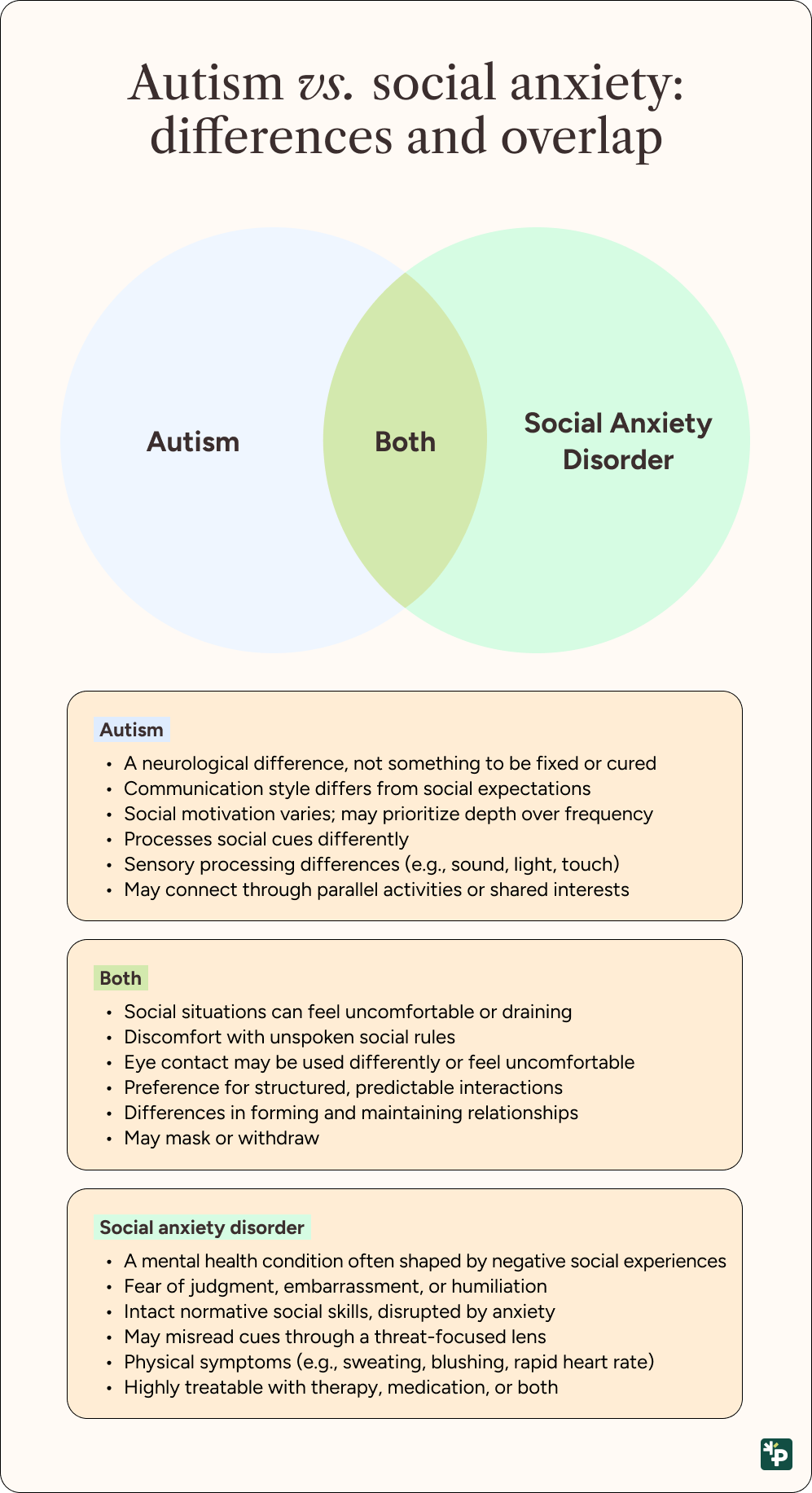
Note: The examples above show how social anxiety and autism may present for some people, but everyone is different. Moreover, not every autistic person experiences social anxiety.
Why autistic adults are often misdiagnosed with social anxiety
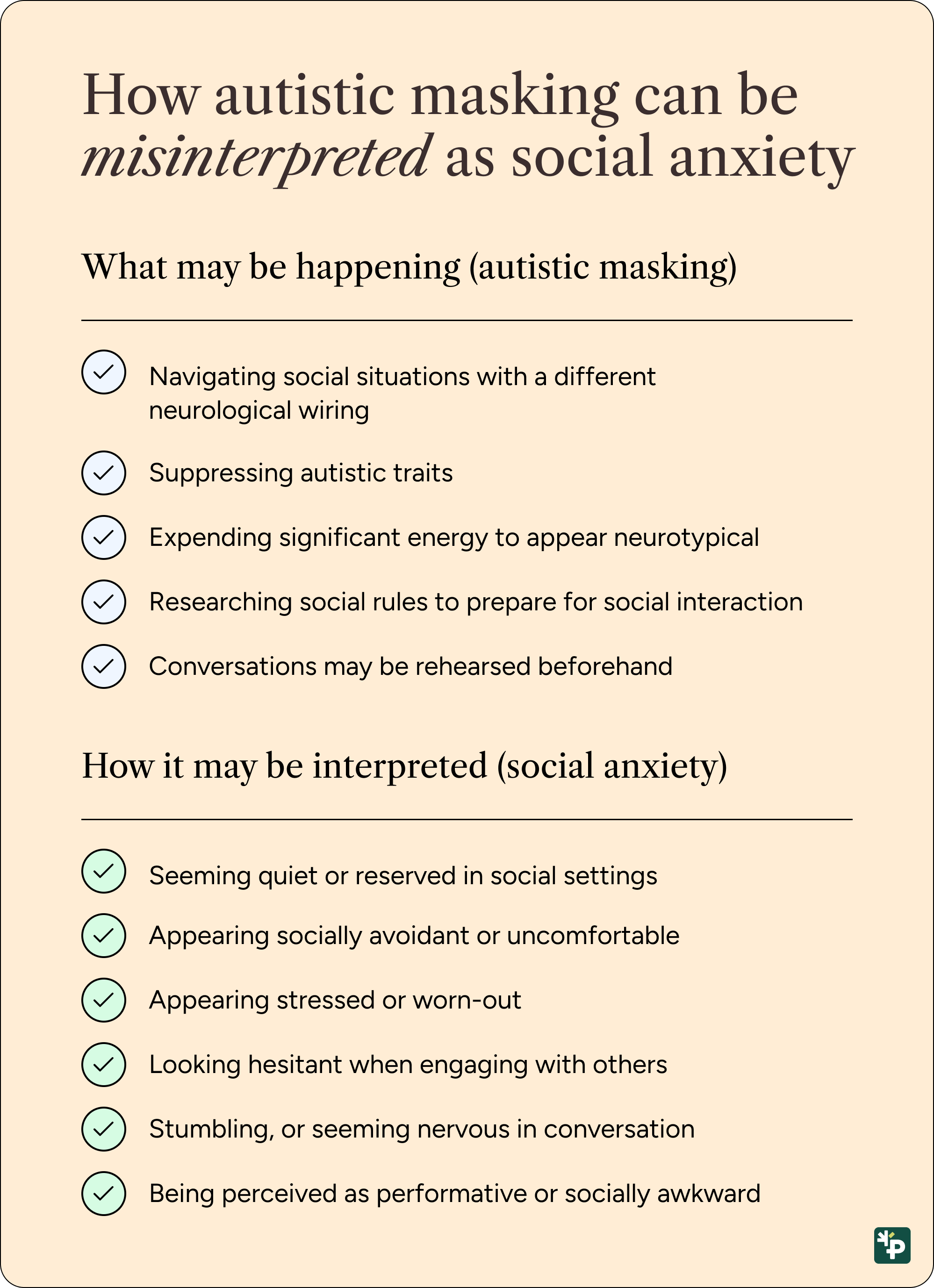
Autism often goes misdiagnosed, and social anxiety is one of the most common misdiagnoses. As we noted previously, they share a lot of common traits. This can fool clinicians, especially when clinicians focus solely on symptoms instead of their causes, which are often different.
In particular, social anxiety and masking may look alike. People who mask may research social skills, prepare for conversations, copy other people's social behaviors, and use other strategies to try to seem neurotypical.
Constantly trying to mask one’s true self can take a lot of energy, so some autistic people keep quiet in social settings or end up avoiding them altogether. A clinician who’s not familiar with autism and masking may mistake this as social anxiety disorder.
Lastly, autism is often misperceived as a childhood disorder. If the diagnosis is missed in childhood, clinicians may not consider autism as a possibility for adult clients.
Can someone have both autism and social anxiety?
Yes! In fact, this is incredibly common. Researchers estimate that up to 50% of autistic individuals have social anxiety. This is much higher than the estimated 12% lifetime prevalence of social anxiety among all U.S. adults.
This is hardly surprising, as many autistic people have a history of being bullied and excluded. “Over time,” says Shinall, “these experiences can create a learned expectation that social situations will go poorly, which naturally leads to anxiety around future interactions.”
These experiences can also put a damper on self-esteem. When you see everybody else fitting in, and you’re not, it’s easy to wonder, “What’s wrong with me?”
The Role of Masking and Sensory Issues
Masking can be stressful and anxiety-provoking, as neurotypical social cues may not come naturally to autistic people.
“Autistic people often have to work quite hard in social situations,” Flood observes. Socializing can feel like taking an exam where the risk of failure is embarrassment and social exclusion.
In addition, most social environments are built with neurotypicals in mind. Loud noises, bright lights, and crowds may lead to sensory overload and anxiety.
How clinicians tell the difference
Clinicians diagnose autism and social anxiety using the criteria laid out in the Diagnostic and Statistical Manual of Mental Disorders, Fifth Edition (DSM-5). Here is how autism-informed clinicians diagnose someone with one or the other:
How social anxiety is diagnosed
Social anxiety is typically diagnosed using a clinical interview to see whether you fit the following criteria:
- Consistent, intense fear or anxiety about one or more social situations, rooted in fear that the situation(s) will lead to judgment or embarrassment
- The anxiety or fear is out of proportion to the situation at hand
- The anxiety or fear interferes with day-to-day life
- The anxiety or fear is not attributable to a medical condition, medications, or other substances
The clinician will ask about your symptoms, how they affect your life, and how long they have lasted.
That last question is key. If social cues initially felt more natural and later became difficult, this may point toward social anxiety, but clinicians consider multiple factors. It suggests that your social differences might not be innate but triggered by fear, which is a core difference between social anxiety and autism.
How autism is diagnosed
Since some clinicians aren’t very familiar with autism in adulthood, you will need to seek out an experienced, knowledgeable clinician who can diagnose autism in adults.
Evaluation is more intensive for autism than it is for social anxiety. It’ll determine whether you meet the following DSM-5 criteria:
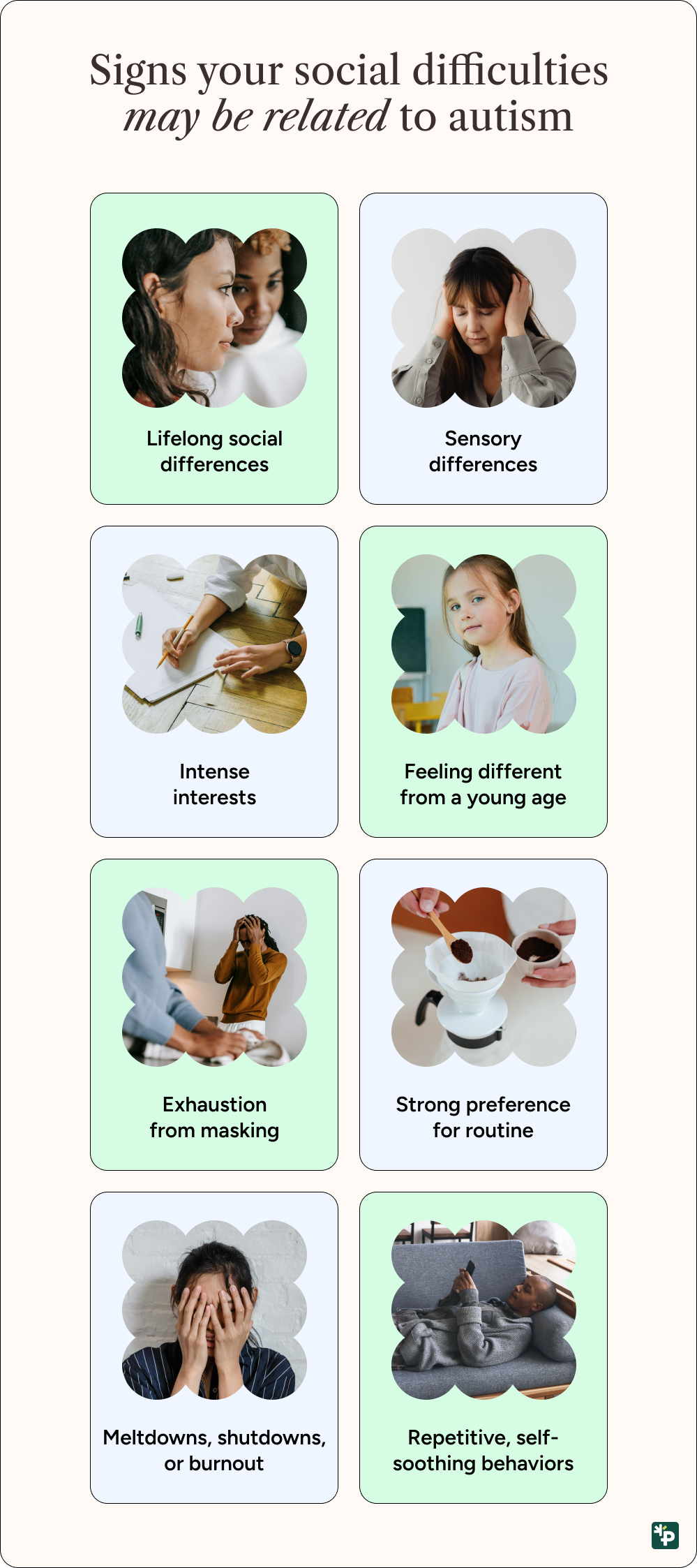
- Criterion A: Persistent differences in social communication and interaction across multiple contexts, as manifested by each of the following, either currently or historically:
- Differences in social-emotional reciprocity
- Differences in nonverbal communicative behaviors
- Difficulty developing, maintaining, and understanding relationships
- Criterion B: At least two of the following characteristics, either currently or historically:
- Stereotyped or repetitive movements, use of objects, or speech
- A strong preference for sameness and routine
- Intense, restricted interests
- Sensory hyper- and/or hyposensitivity
- The above behaviors and traits are present during early childhood, interfere with daily life, and are not better explained by intellectual developmental disorder or global developmental delay.
Clinicians investigate this using cognitive testing, assessments, and questionnaires. They interview you and, if possible, people close to you. If you’ve had social difficulties since childhood, you might be diagnosed with autism, as it’s more likely that these differences are innate.
Of course, some people meet the criteria for both autism and social anxiety disorder, and may be diagnosed with both.
What support options are available for social anxiety and autism?
Several supports are available for autistic people and individuals with social anxiety. Many of the same interventions can help people with either diagnosis, but their intents differ.
Treatments for social anxiety disorder are meant to reduce symptoms, ideally until a person no longer meets diagnostic criteria.
Affirming supports for autism, on the other hand, typically don’t seek to change autistic traits, says Shinall. Rather, the focus is on treating co-occurring anxiety and depression while also supporting autistic individuals’ coping and self-advocacy skills.
Supports for Social Anxiety Disorder
Social anxiety disorder is most commonly treated with the following:
- Cognitive behavioral therapy (CBT): CBT helps people identify and interrupt unhelpful or harmful patterns of thought and behavior. For individuals with social anxiety, CBT challenges the negative beliefs they have about themselves and others. It also helps them gradually face social situations through exposure.
- Medication: Antidepressants are the medication most commonly prescribed to manage social anxiety. They build up in a person’s system over time. Clinicians may also prescribe medications for clients to take in the moment to relieve acute anxiety symptoms.
People with social anxiety can also develop coping strategies to deal with anxiety.
Supports for Autism
Affirming support for autistic people isn’t about "curing" autism but helping autistic people live well in a world built for neurotypicals. Here are some supports that are available:
- Neurodiversity-affirming therapy: These therapists embrace clients’ neurodivergence and help them develop the tools they need to thrive. They may provide emotional support and encouragement in times of distress, and even offer CBT, as depression and anxiety are very common among autistic adults.
- Occupational therapy: This therapy can help clients learn essential skills.
- Assistive technology: Some autistic people benefit from sensory aids or communication tools such as augmentative and alternative communication (AAC).
- Sensory-friendly spaces and events: Some community centers, libraries, and other locations offer spaces with dimmer lighting or reduced noise.
Combined Supports
Support for autistic people with social anxiety should address both their autism and social anxiety. However, CBT for autistic social anxiety is a little different from treatment for typical social anxiety. Here are some adjustments that clinicians might make, according to Shinall:
- Providing guidance on neurotypical social expectations and communication styles (when helpful)
- Developing social scripts if needed
- Using more visual cues and less abstract ideas
- Using more direct communication
- Focusing on self-advocacy and boundary-setting
- Addressing sensory issues
- Being more flexible with the use of tools
“Treatments for autistic adults that work on social skills should be focused on helping the individual to feel more comfortable and authentic in their interactions while navigating societal expectations,” says Shinall.
An example is eye contact. Clinicians may try to increase eye contact for people with social anxiety disorder. If a client is autistic, this may feel unnatural, so an affirming clinician will only spend time on eye contact if the client identifies it as a concern, and may teach compensatory strategies such as looking at a person’s forehead.
Environmental and Community Supports
Autistic people and those with SAD both benefit from real world supports. These include workplace or academic accommodations and affirming communities. Support groups are also a valuable resource that can offer a sense of belonging while enabling people to develop social skills in a safe environment.
“Having environments that are more accepting and better aligned with someone’s needs can significantly reduce both anxiety and day-to-day stress,” says Shinall.
How Prosper Health can help
If you’re autistic––or think you might be––Prosper Health can provide assessments and support. Prosper Health therapists know how to support autistic people through many common challenges, including social anxiety, autistic burnout, and more. They can work with you to develop an individualized treatment plan to reduce your anxiety and help you thrive.
Frequently Asked Questions
Can social anxiety seem like autism?
Yes, social anxiety can lead to characteristics that are common among autistic people. These include discomfort with strangers and preference for social predictability. Social anxiety may also cause people to avoid social situations. This means they may not have as many opportunities to hone social skills.
Can you be autistic and understand social cues?
Autistic people may have difficulty reading neurotypical social cues. However, many autistic people learn social cues by observation or even research.
Can you have autism and social anxiety?
Yes. Up to half of autistic people have social anxiety disorder at some point.
Sources
https://www.prosperhealth.io/blog/adult-autism-signs
https://www.prosperhealth.io/blog/autism-masking
https://www.nimh.nih.gov/health/publications/social-anxiety-disorder-more-than-just-shyness
https://pmc.ncbi.nlm.nih.gov/articles/PMC11001629/
https://www.sciencedirect.com/science/article/pii/S1750946718300643
https://www.prosperhealth.io/blog/who-can-diagnose-autism-in-adults
Related Posts

Alexithymia and Autism
Everyone will, at some point in their lives, find themselves at a loss for words when describing how they’re feeling. When it occurs on occasion, it’s human nature. However, if the challenge to name or express emotions is a prevailing theme in someone’s life, it may be a sign of alexithymia. While primary alexithymia is relatively uncommon, the odds of having alexithymia traits are much higher in autistic people.

OCD and Autism: Understanding the Differences, Overlaps, and Support Options
Having autism and obsessive-compulsive disorder (OCD) can be confusing for people with both conditions, especially because there are so many similarities between OCD and autism. It can also be a puzzle for people trying to figure out if they have autism or OCD.
However, overlapping traits, such as repetitive behaviors, can sometimes lead to an overall misunderstanding of the support people with these co-occurring conditions may need. This is mainly because although the characteristics of both autism and OCD are alike, the underlying reasons behind those behaviors are rather different.
As with autism, people with an OCD diagnosis are considered neurodivergent because they respond to the world differently than neurotypical individuals.
No matter where you are in your journey toward understanding OCD and autism (whether you’re considering an evaluation or have recently received a diagnosis), this article unpacks the differences between these conditions, as well as where they overlap. In addition, we’ll discuss understanding what it means to have both autism and OCD, as well as the supports available to you.

ADHD vs. Autism: Understanding the Differences and Overlaps
There is not a day that goes by that I don’t ask the question, “Is it ADHD or autism?”
As the parent of an AuDHD child—AuDHD being a colloquial term used to describe the dual diagnosis of both autism and ADHD—I still have difficulty differentiating between the two diagnoses. Is her stimming an autism or an ADHD trait? Which of her Individualized Education Plan (IEP) accommodations at school are tailored to her autism, and which ones are tailored to her ADHD? How is her ADHD medication affecting her autism traits?
My experience is with my 9-year-old daughter, but this dilemma is equally accurate for many adults. If you’re neurodivergent in any capacity, you’ve likely had moments where you’re comparing your characteristics, trying to determine if they could be a sign of autism, ADHD, or both.
AuDHD is becoming increasingly common among neurodivergent people, and those with both diagnoses deserve a clear understanding of autism and ADHD, and what it means when they co-occur.
That said, the two conditions are not the same! Many people will only get diagnosed with one condition or the other, so it's essential to understand how they differ.


