.webp)


Key Takeaways
- Overstimulation, otherwise known as sensory overload, occurs when at least one of the body’s senses is overstimulated by the environment.
- Between 64% and 96% of autistic people experience overstimulation, but many people who aren't autistic experience it too.
- Overstimulation does not mean there’s anything wrong with your brain. You may just need to take a break and come up with some strategies to help avoid sensory overload in the future.
Key Takeaways
- Overstimulation, otherwise known as sensory overload, occurs when at least one of the body’s senses is overstimulated by the environment.
- Between 64% and 96% of autistic people experience overstimulation, but many people who aren't autistic experience it too.
- Overstimulation does not mean there’s anything wrong with your brain. You may just need to take a break and come up with some strategies to help avoid sensory overload in the future.
As an author, much of my life is spent at crowded bookstores, meeting readers and signing books. Sometimes I go to conventions, where sensory input is dialed up to eleven: cue buzzing lights, loud crowds, music, and bright colors.
Without fail, after any stressful author event, as an autistic person, I hit a point of overstimulation, where I reach a maximum capacity for sensory input. Often, I become overwhelmed and incapacitated, sometimes shutting down. It can take time to reduce overstimulation, but I’ve learned to anticipate my sensory needs, so I avoid it as much as possible.
Overstimulation is something that many people experience—especially those who are neurodivergent. In this article, we’ll cover why some people get more overstimulated than others, and how to take steps to support your unique brain the next time sensory input becomes overwhelming.
What does it mean to be overstimulated?
Put simply, overstimulation occurs when a person experiences a stimulus or stimuli that they are unable to manage and process. Overstimulation is not a diagnosis, but it is a real nervous system state that can lead to changes in behavior, sensory acuity, decision-making, and problem-solving.
“Being overstimulated means the brain is essentially flooded—too many sounds, sights, smells, textures, social demands, or emotions coming in at once without adequate time or capacity to process them all,” explains Jacqueline Shinall, PsyD, psychologist at Prosper Health.
In turn, overstimulation can cause irritability, restlessness, poor concentration, and difficulty with communication. In those individuals with neurodevelopmental conditions like autism, Sensory Processing Disorder (SPD), and ADHD, overstimulation thresholds may be lower; indeed, sensory sensitivity may even make up a core feature of ADHD.
Another way to think of it is as your nervous system reaching its capacity. "“When you’re overstimulated, your brain is processing more sensory, emotional, or cognitive input than it can effectively handle in that moment. It’s not about weakness–it’s about bandwidth," says Daniel Clark, PhD, PsyD, psychologist at Park West Psychology.
Interestingly, up to 30% of the population may also have a trait called Sensory Processing Sensitivity (SPS), which makes them more responsive to both negative and positive environmental changes.
How is overstimulation different from everyday stress or anxiety?
Overstimulation does overlap with everyday stress and/or anxiety, but it's also different because overstimulation is about sensory and information processing.
“Overstimulation is a response to excessive sensory input in which the brain’s ability to process the information is beyond its capabilities. Different from stress or anxiety, overstimulation can occur in non-threatening spaces and does not result from perceived risk,” adds Dr. Shinall.
Overstimulation comes from reaching processing capacity, whereas stress is a psychological response to perceived threats, demands, or worries.
For example, you can be overstimulated in a situation that’s not objectively stressful for everyone, or even positive, like a birthday party. Even if you want to be there, the sensory overload of the party may be too much for your brain to process.
Dr. Clark also says that stress and overstimulation can feed each other. “Anxiety amplifies sensory sensitivity, and overstimulation triggers stress responses,” he explains.
Chronic overstimulation can lead to stress, however. Constant overwhelm can trigger feelings of stress and anxiety and reduce someone's ability to regulate themselves when moments of overstimulation occur.
Why do some people get overstimulated more easily than others?
First of all, it’s important to know that all brains are different—overstimulation and sensory sensitivity aren’t deficits; they’re just the way your unique brain functions.
With that said, certain brains—like those of autistic people, people with ADHD, or people with other neurodevelopmental differences—can have lower thresholds and more acute sensory responses. For example, some research suggests that autistic people’s brains may actually be wired differently when it comes to physiological responses, and therefore filter sensory stimuli differently than neurotypical brains.
Sensory processing differences
Those who struggle with sensory input may experience an effect called ‘amplification,’ where their brain doesn’t filter out background noise or other unimportant sensory input but rather amplifies it so it’s all the same level of intensity.
“Autistic individuals often get overstimulated more easily because their brains process sensory information differently,” says Dr. Shinall. “For example, they may experience certain sensory input (sound, texture, lighting) more intensely or have difficulty filtering information (such as external sounds, lights, etc.) that tends to come naturally for other people.”
I personally experience this as an autistic person. At a restaurant, I often struggle because of all the noises: dishware clinking, music, background conversations, and conversations at my own table, are amplified to be the same level of loudness. It’s very hard to function when I’m out at a loud restaurant, and I often become overstimulated.
Background noise doesn’t fade for everyone, especially if you have sensory processing differences. “Nervous systems are genuinely wired differently. Some filter sensory input more effectively—like turning down the volume on background noise automatically. Others amplify it—every sound, texture, light gets processed at full intensity. Neither is better or worse; they're just different operating systems,” confirms Dr. Clark.
Nervous system sensitivity
All brains process input differently—and all brains have different thresholds of sensory input that they can manage.
There are two main variations of nervous system sensitivity: hyposensitivity and hypersensitivity.
“Nervous systems that filter sensory input are sometimes thought to be hyposensitive to sensory input. This typically means that someone needs greater sensory input to register sensations,” adds Dr. Shinall. “Someone whose nervous system tends to amplify sensory input is typically hypersensitive to sensory input because they are essentially registering more input than their brain can handle.”
The recovery time to emerge from overstimulation is different for everyone (and even can vary by event: it takes me longer to recover from a book convention than a dinner out, for example, because the former has more variables). Over time, overstimulation can snowball, leading to fight-or-flight activation and eventually burnout.
Nervous systems can also be sensitized by past traumas, too.
“Neurodivergent folks, particularly those with autism or ADHD, often have nervous systems that either don't filter effectively or actively amplify input. Add trauma history, and you've got a nervous system that's already running in high alert mode, making the threshold for overstimulation much lower,” explains Dr. Clark.
The role of habituation
Habituation plays a role in filtering out overwhelming sensory input for many individuals.
“Habituation is the ability to get used to repeated stimuli through gradual exposure, and can help teach the nervous system to respond less intensely over time,” Dr. Shinall explains.
Yet for many with sensory processing differences, habituation is not as accessible. While in the past, research suggested that autistic people, for example, could “outgrow” sensory differences, newer studies indicate that almost 95% of autistic adults still experience sensory hyperreactivity and overwhelm that can greatly impact their mental health and day-to-day functioning.
For example, Dr. Shinall says, a neurotypical person may be able to filter out the sound of a refrigerator buzzing after a few days in a new space. But “autistic people cannot habituate to very overstimulating environments,” she says.
In those with sensory processing differences, habituation does not exist the same way it does for allistic individuals.
“Many neurodivergent nervous systems don't habituate as efficiently. That sound stays just as loud and present hour after hour. It's exhausting because there's no automatic ‘tune out; function,” confirms Dr. Clark.
While over time, some things may become more tolerable, many times, those with sensory processing differences mask their overstimulation.
Signs your nervous system is overstimulated
Nervous system overstimulation shows up in all body systems: physical, cognitive, emotional, and behavioral. The following are some common signs.
Physical signs
- Muscular tension
- Headaches
- Nausea
- Fatigue
- Shakiness
- Temperature dysregulation
Cognitive signs
- Brain fog
- Difficulty in decision making
- Difficulty finding words
- Difficulty following conversations
Emotional signs
- Irritability
- Tearfulness
- Feeling ‘raw’
- Emotional flooding (when emotions suddenly become overwhelming)
Behavioral responses
- Withdrawal from things and people you love
- Snapping at people
- Stimming more often
- Escape-seeking
- Shutdown/burnout
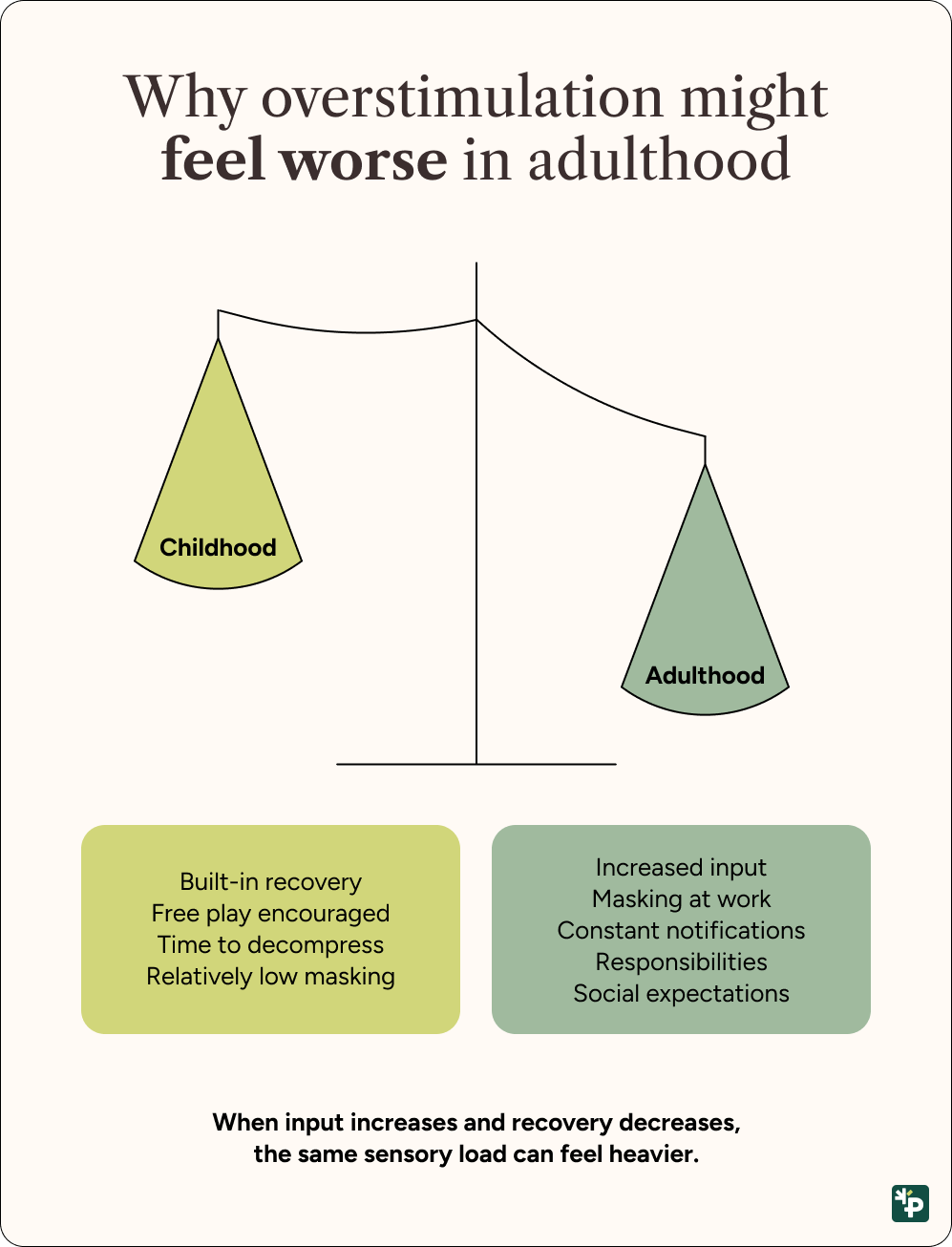
Why overstimulation can get worse in adulthood
In neurotypical brains, overstimulation often decreases with age. That’s because neurotypical brains can filter out sensory stimuli more effectively.
Yet neurodivergent brains don't prune as many neural connections as well as their neurotypical peers, potentially including those relating to sensory stimulation. Thus, overstimulation can get worse with age. Adults have more responsibilities, which they may struggle to manage under the added weight of sensory hypersensitivity.
“By adulthood, years of chronic masking create cumulative exhaustion and lower the threshold for overwhelm, while simultaneously the demands intensify,” Dr. Shinall says.
Masking and constant self-monitoring
Constantly monitoring your behavior to hide overstimulation is absolutely exhausting. Studies have shown that masking can make both autistic and non-autistic folks miserable, because pretending is a challenging part of mental load. People mask in any number of ways: socially, professionally, and emotionally, and each comes with a host of challenges.
“Many neurodivergent adults spent their youth learning to "pass" as neurotypical—suppressing stims, forcing eye contact, pushing through sensory discomfort. That takes enormous energy,” confirms Dr. Clark.
Chronic stress and burnout
Burnout isn’t simply being tired. Autistic burnout is a state of intense exhaustion caused by ongoing sensory overload, constant masking, and existence in a neurotypical world, for example. Constantly mediating sensory overwhelm becomes untenable after years, and adults reckoning with multiple responsibilities can find it hard to recover.
“There's no energy left in the tank. The coping strategies that worked at 20 stop working at 35,” says Dr. Clark.
Increased demands with fewer buffers
I spend long days staring at computer screens, managing professional relationships, hanging out with my kids (and doing school drop-offs and pick-ups!), and these are just a few of the sensory inputs that directly impact my life. There’s no one else to step in, usually, when these responsibilities get overwhelming. That’s why sensory input can become so overstimulating.
Adult responsibilities, like jobs, relationships, households, finances, can leave an adult with sensory processing differences overstimulated and with a nervous system that’s already working overtime just to exist in spaces not designed for it, explains Dr. Clark.
How overstimulation relates to autism, ADHD, and trauma
Overstimulation is common in those with neurodivergent brains. Autistic people, people with ADHD, trauma, or overlapping diagnoses, can often struggle with overstimulation. However, there’s nothing wrong with having a brain that is different; it’s all about learning to manage with your unique set of strengths—and understanding the underlying causes of overstimulation.
“Autistic people, people with ADHD, and those with trauma can all experience overstimulation, and the physical, emotional, behavioral signs can look similar, but the root of the overstimulation is different,” says Dr. Shinall.
Autism and sensory processing
In autism, sensory processing differences are a diagnostic feature, rather than a secondary behavior. Sensory processing differences are part of the DSM-5 diagnostic criteria, and include hyper- and hypo-sensitivity to stimuli.
In autistic folks, “the nervous system processes sensory input differently—often more intensely and with less filtering,” says Dr. Clark.
This can mean that autistic people struggle to filter out background noise, bright lights, and other sensory stimuli. It can become profoundly overwhelming very quickly, and autistic meltdowns or even shutdown can occur after snowballing overstimulation episodes.
Autistic people process “sensory information more intensely, [have] difficulty filtering stimuli, and habituate less easily to repeated input,” Dr. Shinall adds.
Autistic adults are often forced to mask in social and work situations, which can also contribute to burnout.
ADHD and attentional overload
Attention Deficit Hyperactivity Disorder (ADHD) is defined by either an attentional difference, hyperactive/impulsive behaviour, or both, and also often comes with differences in sensory processing. Individuals with ADHD often have trouble filtering out unwanted or unnecessary; they can be either hyper- or hypo-responsive to that stimuli.
“Difficulty regulating attention means you can't easily tune out irrelevant stimuli. Everything demands attention equally,” explains Dr. Clark.
Dr. Shinall concurs, explaining that overstimulation with ADHD can feel cluttered.
Those with ADHD may “have difficulty inhibiting responses to stimuli, which means distractions pulling focus and creating mental clutter. ADHD overstimulation often feels chaotic and scattered, with too many thoughts, and difficulty prioritizing what to attend to.”
Sometimes, those with ADHD can have executive dysfunction, which can be directly related to overstimulation; this may become a challenge when they multitask. Multitasking when overstimulated can eventually lead to strain and further loss of executive dysfunction.
Trauma and hypervigilance
Overstimulation also shows up in those with trauma. Trauma “rewires the nervous system to stay in threat-detection mode. Your baseline arousal is already elevated, so it takes less to push you over the edge,” says Dr Clark.
Trauma can cause hypervigilance—when your brain and body seek threats as a protective measure often—which can lead to overstimulation. If your brain never rests, it can never recover from repeated stimuli.
“Trauma can lower the overall threshold for overstimulation because the nervous system is chronically activated, making it harder to regulate responses to everyday stimuli. There are sometimes specific triggers related to traumatic memories that may lead to overstimulation (such as loud noises),” explains Dr. Shinall.
In some cases, emotional overstimulation can lead those with trauma to depersonalize, which is when someone feels physically, emotionally, and cognitively detached from their own body.
What actually helps when you get overstimulated easily?
If you’re feeling overstimulated, there’s a good chance you’re seeking some relief.
“The first and most effective strategy is typically to reduce the sensory input and demands as quickly as possible. Depending on the situation, that could look differently across contexts,” suggests Dr. Shinall.
Here are some suggestions that help with overstimulation in the moment:
- Dim the lights
- Use noise-canceling headphones
- Splash cold water on your face
- Use a weighted blanket
Seek to reduce your sensory input rather than increase capacity for stimulation. With practice, you can build habits for regulation, but in the moment, seeking relief is beneficial.
Over time, certain sensory accommodations can be built in to stop overstimulation before it even begins.
Here are some skills you can work on to reduce overstimulation:
- Journal about the things that make you overstimulated
- Track your patterns (what does your overstimulation look like)
- Schedule in downtime between events
- Use somatic practices or meditation daily to reduce stress
“Someone experiencing overstimulation should never be told to ‘tough it out,’ not only is that not possible due to an overactive nervous system, but that adds pressure on the individual which can exacerbate overstimulation,” says Dr. Shinall.
When to consider professional support
Overstimulation is a part of life for most, but even more so for neurodivergent individuals. But if overstimulation is becoming unmanageable, it may be time to seek support from a professional.
“When overstimulation is significantly interfering with your functioning—you're avoiding necessary activities, relationships are suffering, you're constantly in shutdown or meltdown, or you're using harmful coping strategies,” it may be time to reach out to a therapist or other mental health care professional, says Dr. Clark.
Dr. Shinall concurs.
“Constant overstimulation can quickly lead to burnout,” she adds. Because of that, it’s important to seek help as soon as possible if it is impacting your daily life.
Remember: getting support for overstimulation isn’t a negative—in fact, it’s one of the best things you can do to support your mental health.
The bottom line
Overstimulation is a common challenge, but especially for those with neurodivergent brains, or who have autism, ADHD, trauma, or other differences. If left unaddressed, overstimulation can lead to burnout or shutdown, and can add a significant weight to adult mental load. But, with proper attention, overstimulation and sensory sensitivities can be managed to the betterment of your mental health.
Frequently asked questions (FAQs)
Can a non-autistic person be overstimulated? Yes, non-autistic people (otherwise known as allistic people) can be overstimulated. Everyone has the capacity to be overstimulated, which is when sensory input outpaces our brain’s ability to cope, but autistic people, people with ADHD, and other differences like trauma often have extra challenges with overstimulation.
Is overstimulation a form of anxiety? No, overstimulation is not a form of anxiety, though it can contribute to anxiety and often form a loop of overwhelm. Anxiety is when your brain’s alarm bells go off to a perceived threat, whereas overstimulation concerns sensory and information processing load. One can feed into the other.
What does overstimulation feel like? Overstimulation can manifest physically with signs like shakiness, headaches, fatigue, and even temperature dysregulation, and can even cause cognitive and emotional challenges like brain fog and irritability, or behavioral challenges like withdrawal.
Sources
https://www.ncbi.nlm.nih.gov/books/NBK563136/
https://pmc.ncbi.nlm.nih.gov/articles/PMC12808265/
https://www.mdpi.com/2076-3425/7/8/108
https://link.springer.com/article/10.1186/s11689-016-9162-9
https://pmc.ncbi.nlm.nih.gov/articles/PMC9213348/
https://pmc.ncbi.nlm.nih.gov/articles/PMC8992921/
https://www.cdc.gov/autism/hcp/diagnosis/index.html
https://www.sciencedirect.com/science/article/abs/pii/S0010440X17302365?via%3Dihub
https://pubmed.ncbi.nlm.nih.gov/21461781/
https://pmc.ncbi.nlm.nih.gov/articles/PMC10864435/
https://www.nature.com/articles/s41380-024-02776-2#:~:text=In%20vivo%20PET%20imaging%20with,8.17%2C%20p%20%3D%200.01).


