.webp)

Meltdowns in Autistic Adults: Why They Happen, What They’re Like, and How to Live with Them

Key Takeaways
- Prevention and supportive strategies are key. The best approach is prevention through reducing sensory overwhelm in all environments (home, work, public) and addressing basic needs.
- Meltdowns are an involuntary neurological response, not tantrums. An autistic meltdown is described as the "brain's emergency brake", or an involuntary, nervous-system response to intense sensory or emotional overload. They are not goal-driven tantrums.
- Adult meltdowns can be outward or silent. While some meltdowns involve external signs like crying, yelling, or intense stimming, many adults experience autistic shutdowns, which are more internalized but equally debilitating reactions.
- Triggers are diverse and cumulative. Meltdown triggers are unique to the individual but often fall into categories: Sensory triggers, emotional, and social triggers. and chronic stress from masking (hiding autistic traits) or autistic burnout.
Key Takeaways
- Prevention and supportive strategies are key. The best approach is prevention through reducing sensory overwhelm in all environments (home, work, public) and addressing basic needs.
- Meltdowns are an involuntary neurological response, not tantrums. An autistic meltdown is described as the "brain's emergency brake", or an involuntary, nervous-system response to intense sensory or emotional overload. They are not goal-driven tantrums.
- Adult meltdowns can be outward or silent. While some meltdowns involve external signs like crying, yelling, or intense stimming, many adults experience autistic shutdowns, which are more internalized but equally debilitating reactions.
- Triggers are diverse and cumulative. Meltdown triggers are unique to the individual but often fall into categories: Sensory triggers, emotional, and social triggers. and chronic stress from masking (hiding autistic traits) or autistic burnout.
When many people hear the word “meltdown,” they might envision a kicking-and-screaming child, lashing out because their parent or caregiver said “no.”
While that is an accurate description of a typical child meltdown, a meltdown in an autistic adult is entirely different, and not to be confused. In fact, in many cases, meltdowns in autistic adults can look like the antithesis of a childhood tantrum. Instead of engaging in "why won't you give me what I want!?" goal-oriented behaviors that are synonymous with tantrums, autistic adults usually need to get away from people and into a calm, dark, safe space during a meltdown.
The most important thing to remember about an autistic meltdown is that it’s not a choice, but an involuntary nervous-system response to intense overload or stress. If someone is experiencing a meltdown, they are not intentionally acting out: They are dealing with complex emotions just like the rest of us, and don’t deserve the ongoing stigma that is attached to autism—and by extension, meltdowns.
Victoria Mindiola (they/theirs/she) is an autistic person who works as an inclusion consultant and educator, focusing on advocacy for neurodivergent students. When Mindiola experiences an autistic meltdown, they say they frantically need “to find a place that is safe and dark and quiet and empty of people.”
Unfortunately, the stigma around autism and meltdowns remains because adult-focused research and resources are still lacking. While there’s plenty of research available on autistic meltdowns in children, there is limited data from the perspective of autistic adults.
In this article, we’ll provide a comprehensive breakdown of autistic meltdowns in adults: What they are, why they happen, how to identify early signs, and how to support yourself or someone else.
What is an autistic meltdown?
Despite its (initially) negative-sounding connotation, an autistic meltdown is the brain’s natural reaction to an excess of stimuli. “An autistic meltdown is an involuntary neurological response to overwhelming stress,” explains Ashley Peña, LCSW, “It’s what happens when the brain reaches a point where it can't process any more sensory, emotional, social, or cognitive input.”
Since autistic brains process sensory and emotional information differently than neurotypical brains, “often with less filtering and more intensity,” says Peña, the nervous system will shift into “survival mode” when the brain exceeds capacity.
A meltdown can feel like—and look like—you’re at the point of no return, even though there’s a completely scientific explanation: “Once the threshold is crossed, the sympathetic nervous system takes over and heart rate increases, reasoning drops, and ‘fight/flight/cry/yell/freeze’” responses take over,” continues Peña. “You can’t talk yourself out of this kind of response once it’s happening.”
One way to visualize an autistic meltdown is by thinking of it as “the brain’s emergency brake,” says Peña. These responses may feel scary or embarrassing, but “the body is actually trying to release extreme internal tension, prevent further sensory or emotional input, and reset the overwhelmed nervous system.”
Meltdowns vs. shutdowns vs. panic attacks
Autistic meltdowns are distinguishable from tantrums and other outbursts in several ways, specifically through intent:
- Autistic meltdown vs. tantrum “A tantrum is goal-driven,” explains Peña. Kids (and adults) throw tantrums when they want something to change. But meltdowns happen “when the nervous system is overloaded.”
- Autistic meltdown vs. shutdown: Meltdowns are usually (but not always) more of an outward “explosion,” while shutdowns resemble an inward “collapse.” “In shutdowns, many people become quiet, still, nonverbal, or withdrawn,” says Peña.
- Autistic meltdown vs. panic attack: “Panic attacks are fueled by sudden fear when the body thinks it’s in danger,” says Peña. Meltdowns, on the other hand, stem from overwhelm—not necessarily fear—and often have a longer buildup.
- Autistic meltdown vs. other outbursts: Regular emotional outbursts don’t only result from overwhelm. They can also stem from frustration or anger. But autistic meltdowns come from “neurological overload, not emotion alone,” says Peña.
Understanding the differences between an autism meltdown and, say, a tantrum is critical for supporting an autistic adult. “Calling a meltdown a tantrum, attention-seeking, or dramatic leads to punishment, shame, or pressure to ‘hold it together,” observes Peña. This kind of dismissive response a) doesn’t help regulate the nervous system and b) can potentially make the situation worse by increasing neurological overload, “making recovery longer,” says Peña.
What do autistic meltdowns look like in adults?
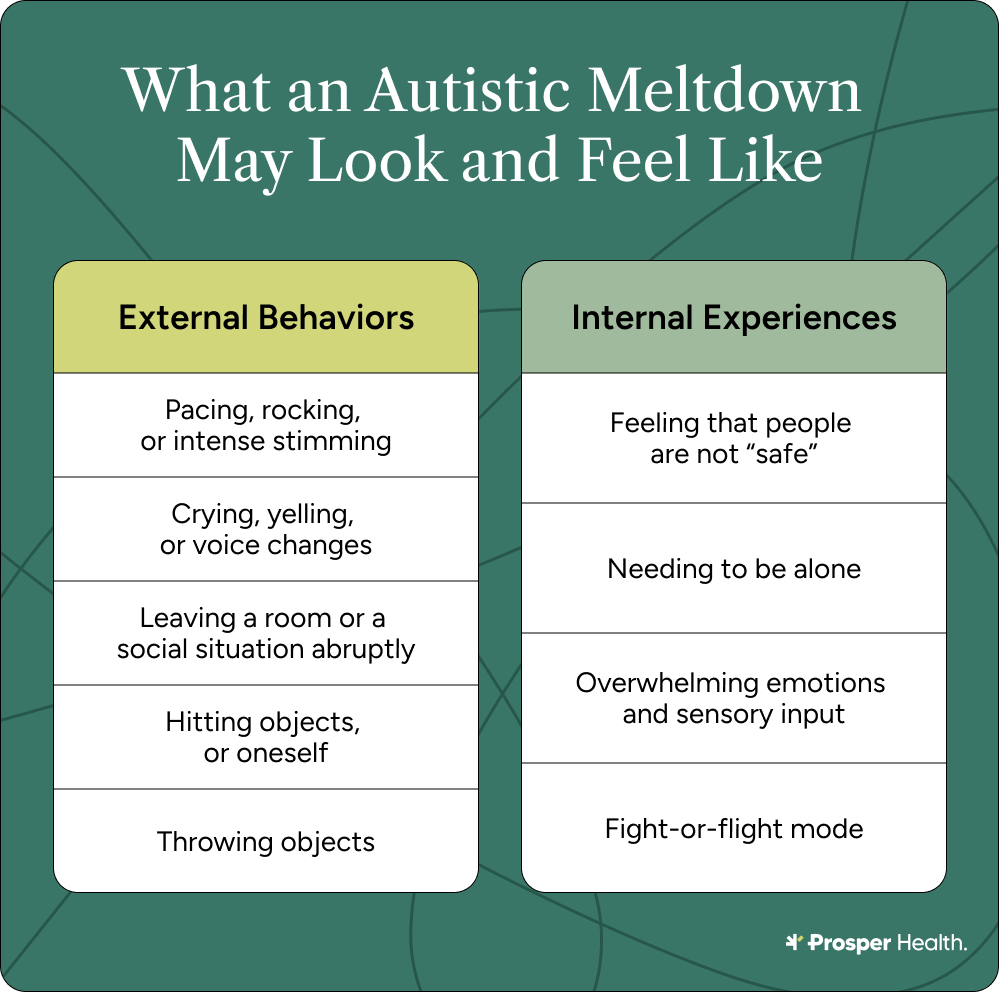
While each experience is unique, Peña says common external signs of an autistic meltdown can include:
- pacing, rocking, or intense stimming
- crying, yelling, or voice changes
- leaving a room or a social situation abruptly
- hitting objects or self
“Adult meltdowns often look different than children’s,” she emphasizes. “They can be more controlled or subtle, but still very real.”
Autistic meltdowns in adults can also appear more silent or internal. These reactions are often referred to as “shutdowns,” explains Jacqueline Shinall, PsyD, a clinical psychologist at Prosper Health. In these cases, the adult can lose the ability to communicate effectively. The main difference between a “meltdown” and a “shutdown” is “rather than externalizing their behaviors, they tend to internalize them,” says Dr. Shinall.
Some examples of an autistic shutdown, according to Peña, include:
- going quiet or nonverbal
- dissociating or staring blankly
- shutting down physically
- withdrawing from conversation
But just because a shutdown is internal, that doesn’t mean it’s any less debilitating: Because the autistic person is unable to communicate their needs, “others may not see that they are struggling and therefore may not be responsive in a way that is helpful to the autistic adult,” says Dr. Shinall.
What do autistic meltdowns feel like?
Again, while each person’s experience with autistic meltdowns is unique (there’s no such thing as a “cookie-cutter” meltdown), understanding what even one person goes through can help to erase the stigma.
For Mindiola, an autistic meltdown is “a sudden avalanche of feelings and sensory input that shuts down my logic and kicks my flight into high gear. Everything becomes too much all at once and needs to erupt like a volcano under high pressure.”
Coming out of the meltdown can be challenging as well, because Mindiola says they don’t often remember what happened, other than their “overwhelming need” to not only protect themself, but the people around them from their emotional outbursts.
“I've always been afraid of being seen as a threat, or what lasting harm my meltdowns would have on the people I love,” they say.
Common triggers: What causes autistic meltdowns?
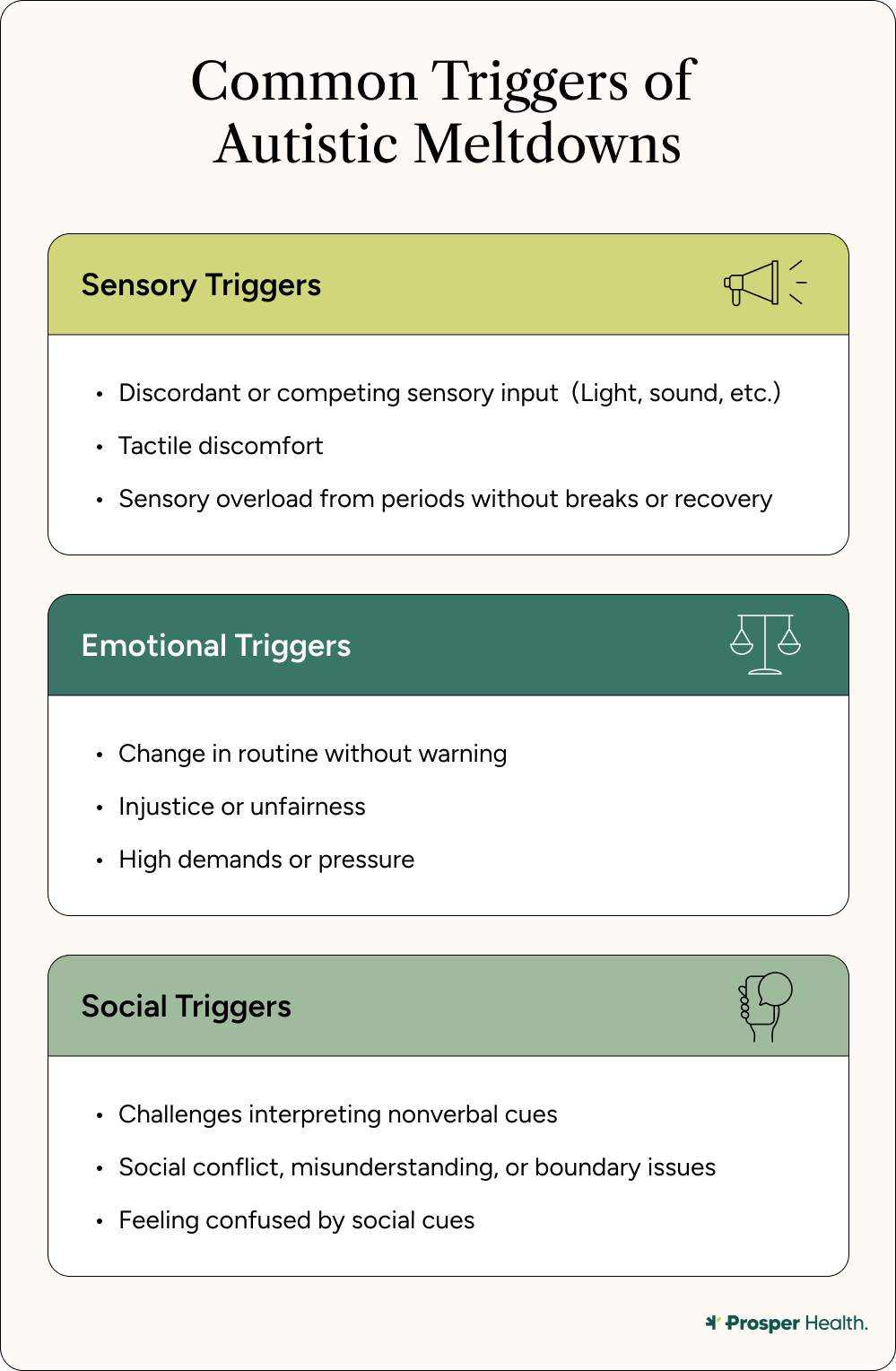
Autistic meltdown triggers vary by individual: For Mindiola, their triggers include discordant sound and light input.
For Laura*, who is also autistic, it’s a “change in routine without warning,” or “not having access to my safe food.” These may seem insignificant to neurotypical people, but as Mindiola explains, their triggers often appear small, but they usually “realize much later that things had been building for hours and sometimes days prior.”
Even though everyone’s triggers are unique, some common factors cause sensory meltdown in adults, which Dr. Shinall explains below:
Sensory triggers
Sensory overload can be broken down into several categories because, notes Dr. Shinall, “it impacts functioning across all domains simultaneously. It's a whole-system neurological event, not an isolated experience.”
- Emotional regulation: Sensory overload directly impacts the brain’s emotional regulation systems. So when an autistic adult experiences it, “they may be more likely to have larger reactions to smaller frustrations,” explains Dr. Shinall. To someone unfamiliar with autistic meltdowns or sensory overload, this behavior can be perceived as “overreacting.” But it is critical to remember that someone experiencing sensory overload is not overreacting. Instead, “their nervous system is completely overwhelmed and cannot access the parts of their brain that help with emotion regulation,” says Dr. Shinall.
- Cognitive functioning: Sensory overwhelm can also have an impact on cognitive functioning. “Many autistic people describe having significant challenges articulating and expressing their thoughts and feelings when they are feeling sensory overload,” says Dr. Shinall. This can also affect their ability to make decisions, make plans, or answer questions. “This is due to their brain being so overwhelmed by sensory input that they cannot access certain parts of their brain (such as language processing areas),” she explains. Such a level of overload can also extend to challenges understanding spoken language, paying/maintaining attention, or accessing your memory.
- Physical functioning: Autistic adults experiencing sensory overload often describe physical pain, says Dr. Shinall. This can include ear discomfort due to loud/specific sounds, or “full-body discomfort in response to specific input.” Other people may feel like their “skin is crawling,” or that their nervous system is “buzzing.” Sensory overload can also cause symptoms like nausea, headaches, and body aches. Once the period of sensory overload has passed, however, Dr. Shinall notes that “autistic adults often feel exhausted or fatigued and need time to recover.”
Emotional and social triggers
Since autistic people often process their emotions differently, even something as trivial (for neurotypical people) as a change in schedule can trigger an autistic meltdown. “Research suggests differences in amygdala reactivity and connectivity with regulatory regions,” says Dr. Shinall. “The emotional experience itself may be more intense, while the brain's ability to modulate or down-regulate that intensity may be reduced.”
Some common emotional triggers can include:
- Injustice or unfairness: “This tends to trigger meltdowns because it does not align with the way their brain understands fairness,” explains Dr. Shinall. “And there is typically no solution to that injustice.”
- Change in plans, unexpected interruptions, or uncertainty: These typical life changes can lead to autistic meltdowns, “often due to the loss of predictability and control,” says Dr. Shinall.
- Empathy overload: Contrary to popular belief, autistic people feel empathy. Oftentimes, so much so that they can “have a hard time differentiating their own emotions, which leads to significant emotional overwhelm and potential meltdown,” says Dr. Shinall.
- Alexithymia: The inability to understand your own emotions, coupled with feeling intense emotions, can lead to meltdowns.
- Reduced interoception: Interoception is an awareness of your body’s internal senses (Am I hungry? Do I need to pee?). “Some people with autism cannot always tell how they are feeling until the emotion is very strong, such as once they have reached the point of a meltdown,” says Dr. Shinall.
Some common social triggers can include:
- Uncertainty or ambiguity in reading self and others: “Not knowing how others feel, being uncertain about the meaning behind their words or behaviors, can further lead to meltdowns,” says Dr. Shinall.
- Challenges interpreting nonverbal cues: Potential misunderstandings and hypervigilance in social settings can lead to an overactive nervous system and a subsequent meltdown. Unlike neurotypical people, who interpret nonverbal cues more naturally, autistic people use “a significant amount of cognitive load to interpret or read others’ nonverbal cues,” says Dr. Shinall.
- Not understanding social boundaries: Difficulties understanding relationships, discerning if someone is being genuine, conflict in relationships, and worry about social rejection or exclusion, can all lead to meltdowns.
Masking, stress, and autistic burnout
“Masking can be a major trigger for meltdowns,” says Dr. Shinall. This is primarily due to how much energy it takes to hide one's autistic traits, whether it’s at school, work, or other social situations. This can include not stimming (self-soothing behaviors like hand-flapping or vocalizations), or pretending to understand a conversation or laughing when others do, despite not grasping the joke or comment.
After hours of masking their characteristics, autistic people can feel burnt out or exhausted. “It requires significantly more cognitive effort to engage in masking behaviors, which can lead to meltdowns,” says Dr. Shinall.
Autistic burnout “is a state of chronic exhaustion and loss of functioning that develops from prolonged stress, masking, and living in environments that don't accommodate autistic needs,” says Dr. Shinall. While burnout doesn’t necessarily cause or trigger meltdowns, she does acknowledge that “there is a much higher rate of meltdowns in people experiencing autistic burnout.” This is likely because your internal resources are depleted, leading to a reduced threshold or tolerance—ultimately resulting in a meltdown.
How to support yourself during and after a meltdown
Autism meltdown strategies will differ depending on whether you’re in the midst of a meltdown or if you’re recovering from one. Both Peña and Dr. Shinall have provided several tips to help you move through the meltdown as smoothly as possible.
During a meltdown
- Try to identify your early warning signs:
- increased heart rate
- fists tensing
- shortness of breath
- increased stimming
- feeling “buzzy” or overstimulated
- difficulty making decisions, answering questions, speaking
- challenges with executive function
- Suddenly feeling like lights are too bright, smells are intolerable, clothing feels unbearable, etc.
- Move to a calm space (if possible), and reduce sensory input with items like noise-canceling headphones, sunglasses, and/or a hoodie. Laura says she removes herself from the situation and/or listens to music.
- Have a grounding phrase you can repeat when necessary, like, "I am safe, and this will pass."
- Engage in activities that help you regulate (e.g., deep pressure, stimming, rhythmic movements, or other activities)
- Physical distractions like cold water on the hands or face also help the nervous system reset.
- Ensure all basic needs are met (e.g., you’ve had enough to eat, drink, used the bathroom, etc.)
- Have a pillow to punch or something safe to bite on-hand, for redirection, if you experience aggressive or self-injurious behaviors during meltdowns.
After a meltdown
- Rest and decompress
- Avoid self-blame
- Engage in comforting stims
- Hydrate and eat easily digestible food
- Continue reducing noise, lights, and social interaction until you feel better
- Consider steps that could better support the prevention of a meltdown in the future
Communication scripts for mid-and post-meltdown
In many cases—like Laura’s, for example—people need to be left alone whenever they have an autistic meltdown. Therefore, Peña has also provided some quick and easy scripts that can either be spoken or written down and shown when needed. This way, you can communicate your feelings and needs to the people around you before you’re in full meltdown mode:
- “I’m overloaded. I need space and quiet.”
- “I can’t talk right now. Give me a few minutes.”
- “I’m heading toward a meltdown. I need to step away.”
- “I need the lights/noise reduced.”
- “I need clear instructions one at a time.”
However, even a one-sentence script may be too difficult for some people pre- and mid-meltdown, so you may want to consider strategies like a single code word or even a hand gesture instead.
How to support someone else during a meltdown
While Prosper Health offers in-depth advice on how you can help an autistic adult during a meltdown, Mindiola has some super-quick guidance below that should steer you in the right direction:
What to do
- Let the meltdown run its course.
- Do what you can to make sure that the person is safe and free from outside influences that may not understand what is happening.
- Give them time to recover.
- Stay calm.
- Remember that supporting an autistic adult can mitigate the occurrence of meltdowns.
What not to do
- Don’t try to fix the meltdown
- Don’t raise your voice
- Don’t make sudden movements
- Don’t insist on eye contact
- Don’t physically restrain the autistic adult
What are long-term prevention and coping strategies?
Prevention and coping strategies for autism meltdowns will depend on the cause of an individual’s meltdowns, explains Dr. Shinall. Working with a neurodiversity-affirming therapist can help autistic adults identify common and challenging triggers, and subsequently establish coping and long-term prevention strategies.
As previously mentioned, sensory overload is a common trigger for meltdowns in autistic adults. “The most effective strategy would be to reduce the potential for sensory overwhelm,” advises Dr. Shinall. Below are some of her strategies:
Reducing sensory overload at home
- Controlling lighting (dimmers, lamps instead of overhead lights, blackout curtains, avoiding fluorescent bulbs)
- Managing sound environment (soundproofing, white noise machines, quiet spaces designated for recovery
- Temperature control
- Reducing visual clutter
- Choosing comfortable furniture and fabrics
- Sensory tools readily available (weighted blankets, fidgets, noise-canceling headphones)
Reducing sensory overload at work
Requesting accommodations for:
- Flexible seating (away from high-traffic areas, doors, or noise sources)
- Lighting adjustments (reduced overhead lights, light covers)
- Use of headphones or earplugs
- Flexible scheduling to avoid peak sensory times
- Remote work options when possible
- Access to quiet spaces for breaks
- Reduced open-office exposure
Reducing sensory overload in public
- Planning visits during less busy times
- Bringing tools for reducing sensory input (sunglasses, earplugs, headphones)
- Sensory/fidget toys
- Knowing exit strategies
- Choosing sensory-friendly businesses when possible
- Limiting time in unavoidably overwhelming environments
Dr. Shinall also emphasizes the importance of building breaks into your day, engaging in calming or soothing behaviors, and saying no to places that will cause sensory overload (when possible).
The bottom line
Autistic meltdowns are not something that needs “fixing.” They are an involuntary nervous system overload, and they should never be met with shame or anger, but instead compassion and patience. “Most importantly: Autistic meltdowns are not failures,” reflects Peña. “They are the body asking for safety, clarity, and rest.”
The best way to help with autistic meltdowns, says Dr. Shinall, “is to use methods to help prevent them.” However, she continues, once a meltdown has begun, “there is not necessarily a way to immediately stop it,” which is why it’s critical to have strategies in place beforehand.
“Early signs can be subtle, notes Peña, “especially in adults who mask, so familiarize yourself with what to look out for and do not punish the individual, as that will only make the meltdown worse and typically the recovery longer.”
If you feel meltdowns are affecting your quality of life, Prosper Health can help. We offer neurodiversity-affirming therapy that can be the key to the support and tools you need to care for your well-being. Get started here.
Frequently Asked Questions (FAQs)
What does an autistic meltdown look like?
An autistic meltdown is unique to each person who experiences one, but keep in mind, for safety-planning purposes, that some people can get aggressive toward others during a meltdown. Some meltdown signs can include:
- pacing, rocking, or intense stimming
- crying, yelling, or voice changes
- leaving a room or a social situation abruptly
- hitting objects or self
What triggers autism meltdowns?
Triggers vary by individual, and can include sensory overload (when your senses are overwhelmed by too much environmental input), emotional/social triggers like a change in routine, and stress from masking and/or autistic burnout.
How do I calm an autistic meltdown?
Some strategies include:
- Identifying your early warning signs (increased stimming, increased heart rate, feeling overstimulated)
- Moving to a calm space and reducing sensory input (with items like noise-canceling headphones, sunglasses, and/or a hoodie).
- Using a grounding phrase like, "I am safe and this will pass."
- Engaging in activities that help you regulate (e.g., deep pressure, stimming, rhythmic movements, or other activities)
Why do autistic people have meltdowns?
Sensory overwhelm is the main reason why autistic people have meltdowns. They are an involuntary reaction to nervous system overload.
Can autistic meltdowns be silent?
Yes. These kinds of autistic meltdowns are more internalized and referred to as autistic shutdowns. Signs of silent meltdowns/shutdowns can include:
- going quiet or nonverbal
- dissociating or staring blankly
- withdrawing from conversation
*Name changed to protect the participant’s identity
Sources
https://embrace-autism.com/meltdowns-and-shutdowns/
https://pmc.ncbi.nlm.nih.gov/articles/PMC8992913/
https://journals.sagepub.com/doi/abs/10.1177/13623613221145783
https://www.prosperhealth.io/blog/what-are-the-levels-of-autism-support
https://www.prosperhealth.io/blog/sensory-overload-in-autistic-adults
https://pmc.ncbi.nlm.nih.gov/articles/PMC2997252/
https://www.sciencedirect.com/science/article/pii/S1750946721001884
https://pmc.ncbi.nlm.nih.gov/articles/PMC8456171/
https://www.autismbc.ca/blog/autistic-adults/helping-an-autistic-loved-one-through-a-meltdown/
https://catalystgrp.co.uk/blog/autistic-meltdown-triggers-and-support
https://www.prosperhealth.io/blog/neurodiversity-affirming-therapy
Related Posts

Masking Autism: What It Is and Why It’s Exhausting
Imagine you’re hanging out with a group of friends. On the outside, this scenario looks like a typical get-together: Everyone is laughing, making eye contact, and visibly comfortable with one another.
But for some people, there is a very good chance that much of their behavior is the result of masking, or a concealment of their autistic traits. Sure, these people may come off socially at ease, but a debilitating dance is taking place behind their eyes.
“After I've been hanging out with people, I need to take a nap for one to two hours…my brain literally needs to shut off. I feel like a computer that needs to reboot,” says Aura Marquez, an author living with autism.
Marquez says she’s been masking since she was in late elementary school: “It’s gotten to the point where I can’t turn it off.”
Masking autism is how many neurodivergent people navigate a neurotypical world, so it’s important to understand the reasons behind this practice in order to minimize stigma. While masking may provide some benefits, it’s important to also remember the toll this behavior takes on one’s mental health.
That why learning how to also unmask, under the right conditions, is essential to helping autistic people feel comfortable in their own skin. This article will explore options for those who wish to stop masking, as well as support for those who do mask.
.png)
What Is Stimming? A Guide to Autistic Self-Regulation and Expression
Self-stimulatory behavior, or "stimming", is a physical behavior used by autistic and other individuals (including those who are allistic) to regulate emotional or sensory stress, sensory seek, and/or express their emotions. In autistic people, stimming is often repetitive and is a way to calm their minds and bodies.
Personally, I have stimmed my entire life in many ways. Notably, I am always carrying a rolling stim toy with me. It helps to ground me when I get anxious, or when the noises in a room are too loud or overwhelming.
Everyone stims, whether they realize it or not. If you’ve ever bounced your knee while bored, or clicked a pen open and closed, you’ve stimmed. But for autistic folks, stimming serves a key role in sensory and emotional management. It’s not something to fix, but rather something to understand.
In this article, we’ll explain what stimming is, why it happens, and how to support yourself or someone around you who stims.

Sensory Overload in Autistic Adults: Why It Happens and How to Cope
For autistic and neurodivergent adults, sensory overload can feel like it hits all at once. Imagine you’re in a crowded restaurant. At first, the talking all around you becomes intrusive, and you can’t concentrate on the person across from you, no matter how hard you try. Then, the repeated sound of clinking of glasses and forks on porcelain intensifies, grating at your nerves, and the smell of perfume on the woman next to you becomes unbearably strong.
Suddenly, you’re in full-body panic mode because this combination of sensory experiences is simply too much. Allistic people can compartmentalize and block out these types of input, but autistic people often cannot.
Sensory processing differences—formerly referred to as a “sensory processing disorder”—are the variations in how the brain receives, interprets, and responds to information gained through your senses from the environment and the body. Autistic people’s sensitivity to stimuli will vary depending on the individual.
Sensory overload, on the other hand, can happen when a neurodivergent person’s brain becomes so overwhelmed by sensory information in an environment (think: sights, sounds, smells, textures) that their body goes into a state of panic and fight or flight mode.
“Sensory overload, or strong sensory input, can often be described as ‘physically painful’ or ‘making my skin crawl’ by autistic adults,” says Jackie Shinall, PsyD, head of reliability and quality assurance at Prosper Health. “For example, they don’t necessarily feel anxious or stressed by the input, but rather uncomfortable overall, especially physically.”
While anyone can experience sensory issues and sensory overload, they are especially common among autistic adults and neurodivergent people more broadly. In fact, a 2021 study published in the Journal of Autism and Developmental Disorders surveyed autistic adults and found that 93.9% reported being extra sensitive to sensory experiences. Autism and sensory overload often go hand-in-hand.
If you have questions about sensory overload in autistic adults, you’ve come to the right place. In this article, we'll cover what sensory overload is, why it happens, what it feels like, and how to prevent and recover from it.


