.webp)


Key Takeaways
- Autistic burnout is real, though not a clinical diagnosis: Autistic burnout results from the chronic stress of living in a neurotypical-oriented world. It can look like long-term exhaustion, loss of function, and reduced tolerance to stimuli.
- Recovery requires immediate relief and long-term strategies: Masking reduction when possible, canceling nonessential demands, and creating sensory-safe spaces for rest. Long-term strategies focus on self-knowledge, identifying triggers, accommodations, and building autistic community.
- Masking and environment are primary causes: Key factors contributing to autistic burnout include masking, constant exposure to unsafe environments, sensory overload, and associated cumulative stress.
Key Takeaways
- Autistic burnout is real, though not a clinical diagnosis: Autistic burnout results from the chronic stress of living in a neurotypical-oriented world. It can look like long-term exhaustion, loss of function, and reduced tolerance to stimuli.
- Recovery requires immediate relief and long-term strategies: Masking reduction when possible, canceling nonessential demands, and creating sensory-safe spaces for rest. Long-term strategies focus on self-knowledge, identifying triggers, accommodations, and building autistic community.
- Masking and environment are primary causes: Key factors contributing to autistic burnout include masking, constant exposure to unsafe environments, sensory overload, and associated cumulative stress.
When autistic author Denea Marable experiences autistic burnout, she says it feels like she’s underwater. “I tend to move more slowly, I’m prone to sensory overwhelm, and I have challenges speaking. It’s tougher for me to focus when I’m in autism burnout; I feel as if the world is passing me by.”
Autistic burnout is a state of intense exhaustion and loss of function caused by the stress of ongoing sensory overload, constant masking, and pressure to exist in a neurotypical world without adequate accommodation.
For healthcare professional Jodes* (they/them), who has autism and ADHD, autistic burnout has a multilayered, almost snowball-like effect on their day-to-day life. “It looks like being in a consistent fog, and the pressure of the fog pushes you down, feeling so tired it's hard to move,” they explain.
Jodes also says their autistic burnout impacts their ability to complete daily living skills and tasks. Their burnout additionally causes a need for more sleep, increased procrastination, meltdowns, and migraines––as well as verbal shutdowns.
But Jodes’ and Marable’s stories just go to show that autistic burnout in adults is quite common, even more so in late-diagnosed adults.
If you’re someone who experiences autistic burnout, you deserve to understand why it occurs and its root causes. In this article, we’ll cover what autistic burnout is, why it happens, the early signs to look for, and the supportive steps you can take to recover and protect your well-being.
What is autistic burnout?
In 2020, autistic researcher Dora Raymaker, Ph.D., and their team defined autistic burnout as “a syndrome resulting from chronic life stress and a mismatch of expectations and abilities without adequate supports. It is characterized by pervasive, long-term (typically 3+ months) exhaustion, loss of function, and reduced tolerance to stimulus.”
The key to understanding autistic burnout is acknowledging the challenges neurodivergent people have living in a neurotypical world. Although most people––autistic and non-autistic alike––experience burnout stemming from physical and/or mental exhaustion, those with autism don’t always have the necessary support when burnout happens.
According to Dr. Kelly Whaling, Research Lead and Licensed Clinical Psychologist at Prosper Health, autistic burnout occurs when “the demands of navigating a world not designed for autistic people consistently outweigh available coping resources, particularly around things that are core to the autistic experience like sensory processing or social communication.”
What are signs of autistic burnout in adults?
The signs of autistic burnout in adults are many and varied, and can look different from person to person.
Autistic burnout, however, “can look a lot like depression,” warns Dr. Whaling. “If left unaddressed, burnout can be associated with the development or exacerbation of clinical depression.” So it’s important to familiarize yourself with the signs that fall into a diverse number of categories.
Below, Dr. Whaling and Debra Kissen, Ph.D, a licensed clinical psychologist and the CEO and founder of Light on Anxiety CBT Treatment Centers, provide several examples of signs of autistic burnout in adults:
Behavioral signs
- Withdrawal from social interactions
- Unable to initiate or complete responsibilities/tasks (even enjoyable ones)
- Increased reliance on routines or rituals—note for those with co-occuring ADHD and autism that this may be challenging due to increased executive dysfunction
- Demand avoidance, which is a persistent resistance to daily tasks like eating, sleeping, and going to work/school
- Shutdowns or meltdowns are more easily brought on
Physical signs
- Extreme fatigue and changes in sleep patterns—this can manifest either in excessive sleeping or getting no sleep at all
- Decreased quality of sleep
- Increased sensitivity (sounds feel louder, lights feel harsher)
- Increased pain, muscle tension, headaches, and digestive distress. (Jodes says that if they force themself to talk, then their “whole mouth goes stiff, and I will drool, and swallowing becomes impacted as well.”)
Cognitive signs
- Decrease in executive function—difficulty planning, initiating, or finishing tasks
- Word-finding issues, slower processing speed, and difficulties accessing memories
- Forgetfulness and disorientation
- Difficulty switching tasks
- Trouble understanding instructions or social cues that were previously manageable
Emotional signs
- Heightened irritability or overwhelm—feeling more frazzled or on edge
- Emotional numbness or flatness
- Increased anxiety
- Feelings of hopelessness
- Lower tolerance for uncertainty or change
- Heightened sensory sensitivities
- More intense overwhelm from multiple things occurring at once

What does autistic burnout look like in day-to-day life?
One way to explain what dealing with autistic burnout is like is to think of your body and mind as running on a battery. When that battery is drained, your body and mind will experience chronic exhaustion. This chronic exhaustion can then seep into everyday tasks at work, in your relationships, while doing errands, and even while engaging in self-care.
While autistic burnout is different for everyone, Dr. Whaling notes that there are some common patterns as well.
Below, Dr. Whaling and Dr. Kissen provide examples of what autistic burnout looks like in several day-to-day situations:
Autistic burnout at work
If you’re experiencing autistic burnout at work, you may notice that tasks that once felt manageable now feel much more difficult. This can mean you’re suddenly staring at an email for 20 minutes (or longer), unable to start a response, or realizing that it’s impossible to adapt to small changes, like a moved meeting or updated software. You may also find yourself forgetting deadlines or losing track of conversations. Other examples include calling in sick more than usual or making uncharacteristic mistakes.
Dr. Whaling also points out that in some cases, people can end up quitting their jobs suddenly, because the burnout becomes unsustainable.
Autistic burnout in relationships
Autistic burnout can sometimes appear more marked in relationships because neurodivergent individuals demonstrate differences in social interactions compared to their neurotypical peers.
“Autistic burnout tends to exacerbate these relational challenges,” says Dr. Whaling. “Simultaneously, relationships themselves can contribute significantly to burnout development due to their high cognitive and emotional demands.”
Some examples of how autistic burnout manifests in relationships include:
- Canceling social plans because the idea of interpersonal interactions feels too draining
- Becoming quieter or more literal; having difficulty “performing” expected social roles
- Needing more alone time
- Taking longer to respond to text messages
Also, autistic people who prefer to lead more solitary lives may feel they can't connect in their preferred ways, like being unable to attend local game groups or reply to comments in online communities, explains Dr. Whaling. She goes on to say that those who are in intimate relationships may find it challenging to be as physically affectionate or emotionally available as they usually are. If that happens, conflicts can increase because the communication capacity that was previously accessible is no longer available.
This doesn’t mean, however, that social support isn’t a necessary and protective resource. But Dr. Whaling says it’s a delicate dance of finding the right balance and structure that works for each person, maximizing support while minimizing depletion.
Autistic burnout while doing errands
Autistic burnout can also significantly impact essential daily functioning tasks, such as errands.
“Tasks people had systematized fall apart because they can't execute the systems anymore,” explains Dr. Whaling.
As a result, the tasks that may seem commonplace to neurotypical people become nearly impossible:
- Grocery stores feel overwhelming due to the lights, noise, and decision-making
- Laundry or dishes pile up because initiating tasks feels impossible
- An increased difficulty in managing bills or scheduling appointments
This is due to the overwhelming sensory fatigue caused by burnout, so much so that the places that were once in someone’s “manageable” category are now intolerable. Meaning, even with tools like noise-canceling headphones and a specific routine, a trip to the grocery store feels like too much.
Autistic burnout while engaging in self-care
Even things like basic hygiene and nutrition can fall to the wayside during burnout. Some people may skip meals due to a lower awareness of body cues, like hunger. The same goes for showering, which can suddenly feel too taxing as well. Explains Dr. Whaling: Maybe an individual had specific routines that made showering tolerable, and those routines stopped working. The accommodations people made for themselves stop being enough because capacity has dropped so dramatically.
What causes autistic burnout?
Unfortunately, there are several autistic burnout causes, primarily because we live in a neurotypical world that is not inherently designed to support neurodivergent individuals. Both Dr. Whaling and Dr. Kissen offer their insights on these factors below.
Masking
The sad truth is that autistic masking and burnout go hand-in-hand, even though many autistic adults need to engage in masking (aka hiding their autistic traits) regularly. “Sustained masking forces the brain to over-function—tracking social cues, suppressing natural behaviors, and compensating for sensory overload—draining energy reserves,” explains Dr. Kissen.
Inaccessible environments
Since, according to Dr. Whaling, most spaces are designed for neurotypical sensory and social processing, autistic people constantly face barriers from inaccessible environments. This means they have to cope with stressful triggers such as fluorescent lighting, open offices, unpredictable schedules, and unclear social expectations.
Cumulative stress
The bottom line is that those small daily stressors add up, and “autistic individuals often push through until a critical threshold is passed,” says Dr. Kissen. Adds Dr. Whaling: What exacerbates the situation is that there aren’t built-in recovery periods [with cumulative stress]. Without adequate time to recover, stress keeps building until the system can't sustain it anymore and collapses.
Marginalized community stress (LGBTQIA+, AFAB, BIPOC)
Autistic individuals with marginalized identities are not only navigating autistic burnout, but they’re also dealing with additional layers of stress caused by “discrimination, microaggressions, and additional layers of masking,” says Dr. Whaling. This can ultimately result in a more severe form of burnout.
Dr. Whaling also explains that autistic burnout in women and people assigned female at birth (AFAB) occurs because these individuals often face pressure to meet social-emotional labor expectations. LGBTQIA+ autistic people are navigating identity and potential discrimination from individuals and systems, whereas BIPOC autistic people face racist and ableist stereotypes simultaneously and misdiagnosis at higher rates.
Co-occurring conditions
Any commonly co-occurring condition to autism, whether it’s ADHD, anxiety, PTSD, depression, or chronic pain, will “increase baseline stress and reduce capacity to compensate,” says Dr. Kissen.
Adds Dr. Whaling: The compounding effect of multiple conditions means the threshold for burnout is reached more quickly.
Life transitions/instability
Any major life transition, like starting school, changing jobs, moving homes, or a relationship change, requires “rapid adaptation,” says Dr. Kissen. This is often more adaptation than “the nervous system can sustain.”
In addition, Dr. Whaling points out that research consistently shows that life transitions are major burnout triggers, with many autistic adults reporting their first burnout occurring during significant life changes like transitioning to adulthood, starting college, or becoming a parent.
Sensory overload
Sensory overload, or sensory burnout, occurs when “constant incoming sensory data without adequate recovery forces the brain into survival mode,” explains Dr. Kissen. The result is a rapid draining of energy that can lead to autistic burnout.
Incomplete stress cycles
“Incomplete stress cycles happen when autistic people experience stress but can't complete the body's natural stress response,” says Dr. Whaling. You’re then stuck in an active state of stress without any resolution. For autistic people, many stressors don't have clear endpoints or ways to discharge that stress, so it accumulates in the body and nervous system. This unresolved stress can then contribute to autistic burnout.
Interoception/alexithymia difficulties
Interoception is the understanding of your body’s internal senses (when you’re hungry, a need to pee, etc.). Alexithymia occurs when someone lacks awareness of their own feelings. Both alexithymia and reduced interoception are common in autism. So, explains Dr. Whaling, when someone can't accurately read their body's signals or identify what they're feeling, they can't respond to needs. Therefore, if someone has limited interoception and/or alexithymia, it can mean that some autistic people might not recognize their own internal states until they’re past their limit, and thus end up in autistic burnout.
Why is autistic burnout often misunderstood and misdiagnosed?
One of the major reasons autistic burnout is often misunderstood and misdiagnosed is that it’s not a clinical diagnosis. “Because burnout isn’t in the [Diagnostic and Statistical Manual of Mental Disorders, aka DSM-5-TR], there’s no standardized way to assess or diagnose it,” says Dr. Whaling. Plus, she says there is limited research examining the difference between autistic burnout and burnout experienced by non-autistic people. So with no clear literature, “recognition depends entirely on the individual clinician.”
There’s also a significant amount of overlap with conditions like depression and anxiety, which can make confirming autistic burnout challenging. “While [autistic burnout, depression, and anxiety] involve exhaustion and reduced functioning, autistic burnout has distinct characteristics that depression doesn't fully explain, like the increased sensory sensitivity, loss of previously developed skills, and the specific relationship to masking and environmental demands,” says Dr. Whaling.
Adding to the potential for misdiagnosis and misunderstanding is the fact that “many clinicians are not trained in adult autism or autistic neurology,” says Dr. Kissen. Compound that with an overall cultural expectation to mask one’s autistic traits, and autistic burnout can easily be dismissed. “Masking hides distress,” notes Dr. Kissen. This can cause people to “assume exhaustion is due to personality or attitude rather than neurological overload.” And in the workplace, autistic burnout—which usually involves skill loss—is “often misread as regression or noncompliance,” says Dr. Kissen.
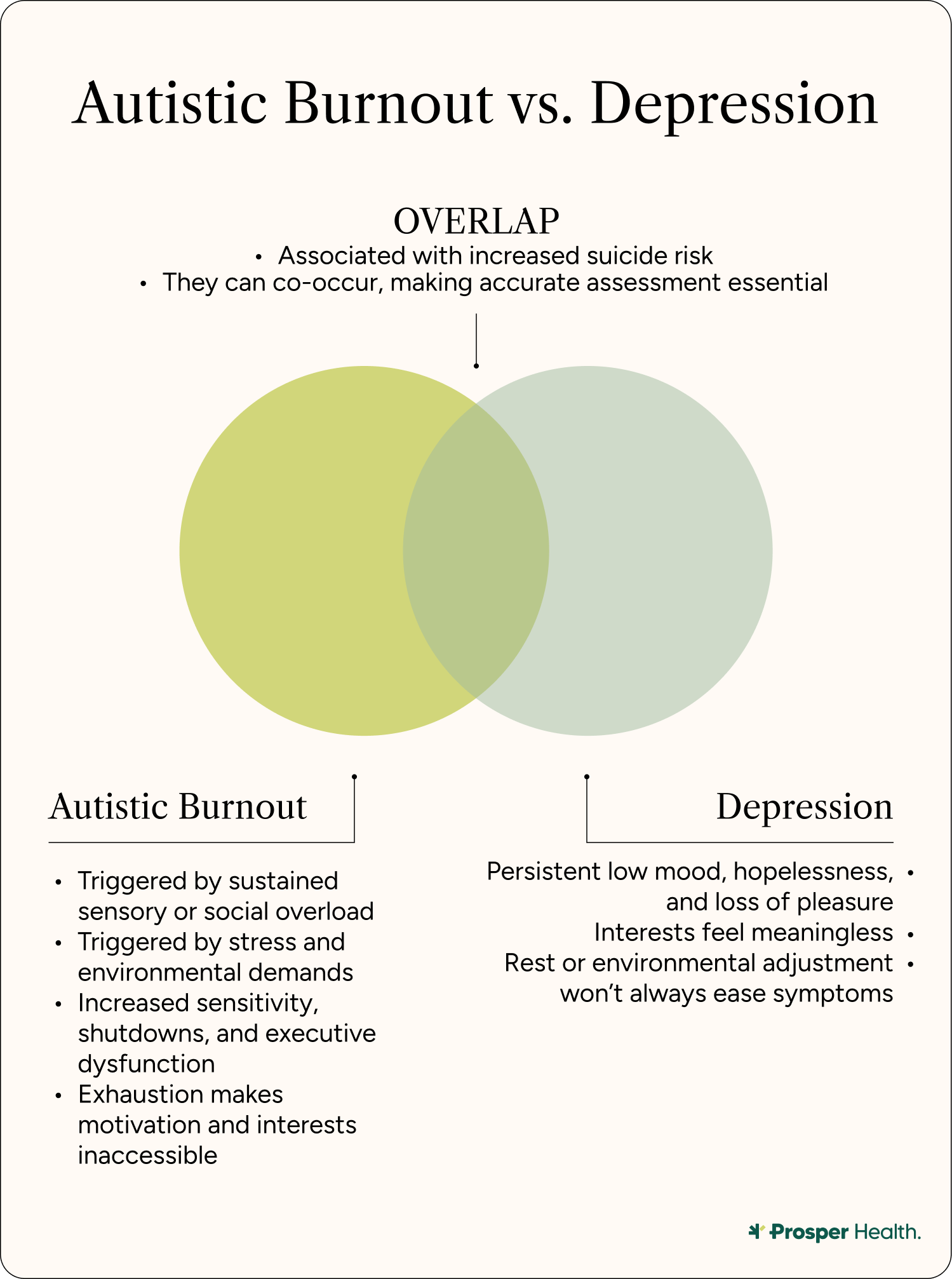
What’s the difference between autistic burnout and depression?
While autistic burnout and depression can overlap, it’s critical to remember that they’re “fundamentally different phenomena,” says Dr. Whaling. Aside from the fact that autistic burnout isn’t a clinical diagnosis and depression is, the other major difference is that burnout “results from the interaction between neurological differences (biological) and an environmental mismatch (social),” continues Dr. Whaling. Depression, meanwhile, is a mood disorder that can have various causes and isn’t necessarily tied to environmental demands in the same way.
Dr. Kissen breaks down the additional key differences of autistic burnout vs. depression below, noting that both autistic burnout and depression can co-occur, “making accurate assessment essential.”
Autistic burnout
- Triggered by sustained overload, masking, sensory strain, and stress
- Motivations and interests often remain but are inaccessible due to exhaustion
- Relief improves with reduced demands, sensory regulation, and rest
- Often accompanied by increased sensory sensitivity, shutdowns, and executive dysfunction
Depression
- Involves persistent low mood, hopelessness, and loss of pleasure
- Interests feel meaningless (not just hard to access)
- Symptoms may not improve with rest or environmental adjustments
- May include suicidal ideation or deep emotional despair
How to recover from autistic burnout
There are several recommended autistic burnout recovery approaches, most of which fall into two categories: immediate relief and long-term strategies. “Immediate relief strategies focus on damage control and managing the acute crisis,” explains Dr. Whaling. Longer-term strategies focus on rebuilding life in sustainable ways.
Immediate relief
The first step in immediate recovery is reducing masking. “Research consistently shows that reducing masking is crucial for recovery, so autistic people in burnout need explicit permission to drop the mask and exist authentically without apology,” says Dr. Whaling. She goes on to say that autistic individuals will also benefit from a sensory-safe space where [they] can retreat and regulate, emphasizing the need for physical and cognitive rest.
However, this may not be so simple for people who have spent most of their lives masking. Prosper Health offers tips here for how to unmask safely.
In addition, here are some quick and easy ways autistic adults can address their burnout immediately, courtesy of Dr. Kissen:
- Cancel nonessential demands temporarily
- Reduce sensory load—dim lights, use noise-canceling headphones, wear simplified clothing
- Use predictable routines to reduce decision fatigue
- Engage in low-demand comfort activities
- Take sensory breaks (deep pressure, movement, warmth, quiet)
- Ask for work accommodations (reduced hours, asynchronous communication, fewer tasks)
Longer-term recovery
Introspection can be a crucial part of the longer-term recovery process for autistic adults. “People may need to track energy and capacity honestly, via journaling or in a spreadsheet, and learn their actual needs/limits, not what they wish they were or what society expects them to be,” observes Dr. Whaling. (This energy/capacity tracking is called “load budgeting.”) “Research shows that self-knowledge and pattern recognition are foundational for prevention and recovery.”
Here are some additional longer-term recovery recommendations courtesy of Dr. Kissen:
- Identify burnout triggers and patterns
- Build buffer time between tasks and transitions
- Establish sensory-friendly spaces at home or work
- Strengthen interoceptive awareness (body scans, noticing hunger/thirst/fatigue)
- Build community with other autistic people
- Seek therapy with a neurodiversity-affirming clinician
What are long-term prevention strategies for autistic burnout?
Several of Dr. Whaling and Dr. Kissen’s long-term recovery strategies dovetail nicely with their prevention recommendations, as these strategies can help stave off future incidents of autistic burnout.
- Self-knowledge and pattern recognition: This practice “helps identify early warning signs so burnout can be prevented rather than recovered from,” says Dr. Kissen.
- Masking reduction, where possible: Any reduction of the constant neurological and emotional effort to appear non-autistic is beneficial to autistic adults.
- Accommodations and self-advocacy: Self-advocacy “shifts environments to meet actual needs, reducing the need to power through unsustainable expectations,” says Dr. Kissen.
- Load budgeting: Tracking your capacity can prevent accidental over-commitment and help maintain a stable energy balance.
- Community connection: Being part of an autistic community “reduces isolation, validates experiences, and offers practical coping strategies from people who understand autistic stress patterns,” says Dr. Kissen.
How to support someone in autistic burnout
Understanding what burnout is will be crucial in helping autistic adults navigate this experience. The more you know your autistic loved one, the better equipped you’ll be.
“The main thing to remember is that everyone's needs are different,” says Jodes. “Everyone's support needs are different, so it's essential to know and understand the person.” They also recommend having patience, compassion, and zero judgment.
“Don’t try to rush yourself or your autistic loved one through [autistic burnout],” adds Marable.
A good general rule of thumb is to look to the autistic adult for guidance: “Give space without abandonment, ask before giving advice, lower the social and sensory load of interactions, and avoid sudden changes without warning,” advises Dr. Kissen. She also suggests that you ask your autistic loved one what would make things easier at that moment, as well as offer concrete assistance (meals, errands, quiet company). This is much more helpful than saying something vague like, “Let me know if you need anything!”
“Studies show that practical support matters more than general offers, as autistic people in burnout often can't initiate requests or figure out what specific help they need,” notes Dr. Whaling.
Validate your autistic loved one’s experience by saying something like, “Your brain and body are overwhelmed.” At the same time, don’t pepper them with empty platitudes that could make them feel worse. Dr. Kissen recommends avoiding the following phrases:
- “You seem fine.”
- “You’ve got this!”
- “Just be more positive.”
- “You don’t look burned out.”
The bottom line
The most important thing to remember about autistic burnout is that it is not a personal failing. Instead, it’s the outcome of living in a world that doesn’t recognize or support neurological overload.
“Autism burnout means your brain needs recovery from sensory input and executive function demand,” Marable says. “This may mean that you accomplish less during this time, but remind yourself that your value is not in your productivity.”
If you are experiencing autistic burnout, “you’ll probably deal with ongoing periods of burnout and recovery throughout your life,” says Dr. Whaling. But that doesn’t mean you’re consigned to an endless, repetitive cycle without hope. Life with periodic instances of autistic burnout simply means “you're a person trying to cope with living in a world that wasn't designed for you.”
Still, she emphasizes, “many autistic people have found ways to live more sustainably and authentically, and you can too.”
If you’re dealing with autistic burnout, Prosper Health is here to help. Our virtual diagnostic evaluations and neurodiversity-affirming therapy services provide mental health support for autistic and neurodivergent adults––plus, they’re covered by insurance, making care more affordable.
With Prosper’s support, recovering from autistic burnout––and preventing further burnout in the future––is possible.
Frequently Asked Questions (FAQs)
What does autistic burnout look like?
Autistic burnout is unique to every individual, but there are some common signs:
Behavioral signs
- Withdrawal from social interactions
- Unable to initiate or complete responsibilities/tasks (even enjoyable ones)
- Increased reliance on routines or rituals
Physical signs
- Extreme fatigue and changes in sleep patterns
- Decreased quality of sleep
- Increased pain, muscle tension, headaches, and digestive distress
Cognitive signs
- Decrease in executive function
- Forgetfulness and disorientation
- Difficulty switching tasks
Emotional signs
- Heightened irritability or overwhelm
- Emotional numbness or flatness
- Increased anxiety
What is autistic burnout?
Although burnout can stem from any level of physical and/or mental exhaustion, autistic burnout occurs when chronic life stress is exacerbated by a lack of overall support for neurodivergent needs, resulting in significant mental and physical exhaustion.
What causes autistic burnout?
There are several potential causes of autistic burnout, including masking, inaccessible environments (for neurodivergent people), cumulative stress, marginalized community stress (LGBTQIA+, AFAB, BIPOC), co-occurring conditions, life transitions/instability, sensory overload, incomplete stress cycles, and interoception/alexithymia difficulties.
How long does autistic burnout typically last?
There is no universal timeline for autistic burnout recovery because there is very little research available on this topic. But the best way to approach burnout recovery is through understanding, which can help people make meaningful, long-term changes. According to Dr. Whaling, mild burnout that is caught early might resolve quickly with environmental modifications and reduced demands. But moderate-to-severe burnout can take longer, possibly a year or more, depending on your situation.
What is the difference between autistic burnout and normal burnout?
While both autistic and non-autistic people can experience burnout, the main difference is the overarching lack of support available for neurodivergent brains.
*Contributor wishes to be referred to by their nickname for privacy reasons
Sources
https://pubmed.ncbi.nlm.nih.gov/41207162/
https://www.pcc.edu/disability-cultural-alliance/2023/11/10/lets-talk-autism-with-dr-dora-raymaker/
https://www.prosperhealth.io/blog/pathological-demand-avoidance
https://www.prosperhealth.io/blog/what-is-audhd
https://www.prosperhealth.io/blog/autism-masking
https://www.prosperhealth.io/blog/autism-meltdowns
https://www.dralicenicholls.com/what-causes-autistic-burnout/
https://www.prosperhealth.io/blog/what-cooccurs-with-autism
http://pmc.ncbi.nlm.nih.gov/articles/PMC8992925/
https://my.clevelandclinic.org/health/articles/interoception
https://pmc.ncbi.nlm.nih.gov/articles/PMC8456171/
https://www.sciencedirect.com/science/article/abs/pii/S0028393223000039
https://neurodivergentinsights.com/autistic-burnout-vs-depression/
Related Posts
.png)
What Is Stimming? A Guide to Autistic Self-Regulation and Expression
Self-stimulatory behavior, or "stimming", is a physical behavior used by autistic and other individuals (including those who are allistic) to regulate emotional or sensory stress, sensory seek, and/or express their emotions. In autistic people, stimming is often repetitive and is a way to calm their minds and bodies.
Personally, I have stimmed my entire life in many ways. Notably, I am always carrying a rolling stim toy with me. It helps to ground me when I get anxious, or when the noises in a room are too loud or overwhelming.
Everyone stims, whether they realize it or not. If you’ve ever bounced your knee while bored, or clicked a pen open and closed, you’ve stimmed. But for autistic folks, stimming serves a key role in sensory and emotional management. It’s not something to fix, but rather something to understand.
In this article, we’ll explain what stimming is, why it happens, and how to support yourself or someone around you who stims.

Masking Autism: What It Is and Why It’s Exhausting
Imagine you’re hanging out with a group of friends. On the outside, this scenario looks like a typical get-together: Everyone is laughing, making eye contact, and visibly comfortable with one another.
But for some people, there is a very good chance that much of their behavior is the result of masking, or a concealment of their autistic traits. Sure, these people may come off socially at ease, but a debilitating dance is taking place behind their eyes.
“After I've been hanging out with people, I need to take a nap for one to two hours…my brain literally needs to shut off. I feel like a computer that needs to reboot,” says Aura Marquez, an author living with autism.
Marquez says she’s been masking since she was in late elementary school: “It’s gotten to the point where I can’t turn it off.”
Masking autism is how many neurodivergent people navigate a neurotypical world, so it’s important to understand the reasons behind this practice in order to minimize stigma. While masking may provide some benefits, it’s important to also remember the toll this behavior takes on one’s mental health.
That why learning how to also unmask, under the right conditions, is essential to helping autistic people feel comfortable in their own skin. This article will explore options for those who wish to stop masking, as well as support for those who do mask.

Meltdowns in Autistic Adults: Why They Happen, What They’re Like, and How to Live with Them
When many people hear the word “meltdown,” they might envision a kicking-and-screaming child, lashing out because their parent or caregiver said “no.”
While that is an accurate description of a typical child meltdown, a meltdown in an autistic adult is entirely different, and not to be confused. In fact, in many cases, meltdowns in autistic adults can look like the antithesis of a childhood tantrum. Instead of engaging in "why won't you give me what I want!?" goal-oriented behaviors that are synonymous with tantrums, autistic adults usually need to get away from people and into a calm, dark, safe space during a meltdown.
The most important thing to remember about an autistic meltdown is that it’s not a choice, but an involuntary nervous-system response to intense overload or stress. If someone is experiencing a meltdown, they are not intentionally acting out: They are dealing with complex emotions just like the rest of us, and don’t deserve the ongoing stigma that is attached to autism—and by extension, meltdowns.
Victoria Mindiola (they/theirs/she) is an autistic person who works as an inclusion consultant and educator, focusing on advocacy for neurodivergent students. When Mindiola experiences an autistic meltdown, they say they frantically need “to find a place that is safe and dark and quiet and empty of people.”
Unfortunately, the stigma around autism and meltdowns remains because adult-focused research and resources are still lacking. While there’s plenty of research available on autistic meltdowns in children, there is limited data from the perspective of autistic adults.
In this article, we’ll provide a comprehensive breakdown of autistic meltdowns in adults: What they are, why they happen, how to identify early signs, and how to support yourself or someone else.


