.webp)

Support Needs, Not Labels: A Guide to “Levels” and “Types” of Autism

Key Takeaways
- Levels of autism refer to the degree of support an autistic person needs.
- Level 1 autism “requires support,” Level 2 autism “requires substantial support,” and Level 3 autism “requires very substantial support.”
- Those diagnosed with autism are assigned a level of support needs so that they can access services and resources.
- Experts agree that autism spectrum levels serve as a more inclusive system since support needs can change over time.
- Accommodations should be flexible and based on the individual's autistic experience.
As a person diagnosed with autism as a child and then again as an adult, I’ve witnessed firsthand the way the Diagnostic and Statistical Manual of Mental Disorders (DSM) has changed to affirm autistic people. In 2013, the DSM updated its resources with an eye to supportive care.
Experts now categorize individuals based on levels of autism spectrum disorder (one, two, or three). These levels indicate varying degrees of support needs, which are often fluid and can change over time.
People can now navigate autism support without labels like “high-functioning” or “low-functioning.” It’s a notable step forward in recognizing the individuality of care and nuances of treatment. This can be useful whether someone's diagnosed, self-identified, or still exploring.
Let’s discuss levels of autism, why they're relevant, and how your level can look different depending on the day. We’ll also address how these levels relate to older diagnostic terms like Asperger's.
This article is for everyone—whether you have an assigned level, are reconciling an older diagnosis with today's terminology, or haven't been formally diagnosed at all.
What are the levels of autism?
Autism spectrum disorder (ASD) is a neurodevelopmental condition that influences social interaction, communication, learning, and behavior.
Levels of support are based on two core diagnostic domains for ASD. The first is social and communication abilities (known as “social affect”). The second is restricted or repetitive patterns of behavior and interests (RRB). The latter may include self-soothing and self-regulatory behaviors or stimming.
While intellectual or language impairment can factor into autism diagnosis, they’re not integrated into the overall judgment of autism support needs. Someone can be diagnosed with two levels, as well. For example, a person might be diagnosed as Level 1 for social affect and Level 2 for RRB.
Additionally, an autistic person’s support needs can be impacted by multiple factors like:
- Environmental changes
- Day-to-day demands placed on the individual
- Emotional states
These levels aren’t a hierarchy of worth.
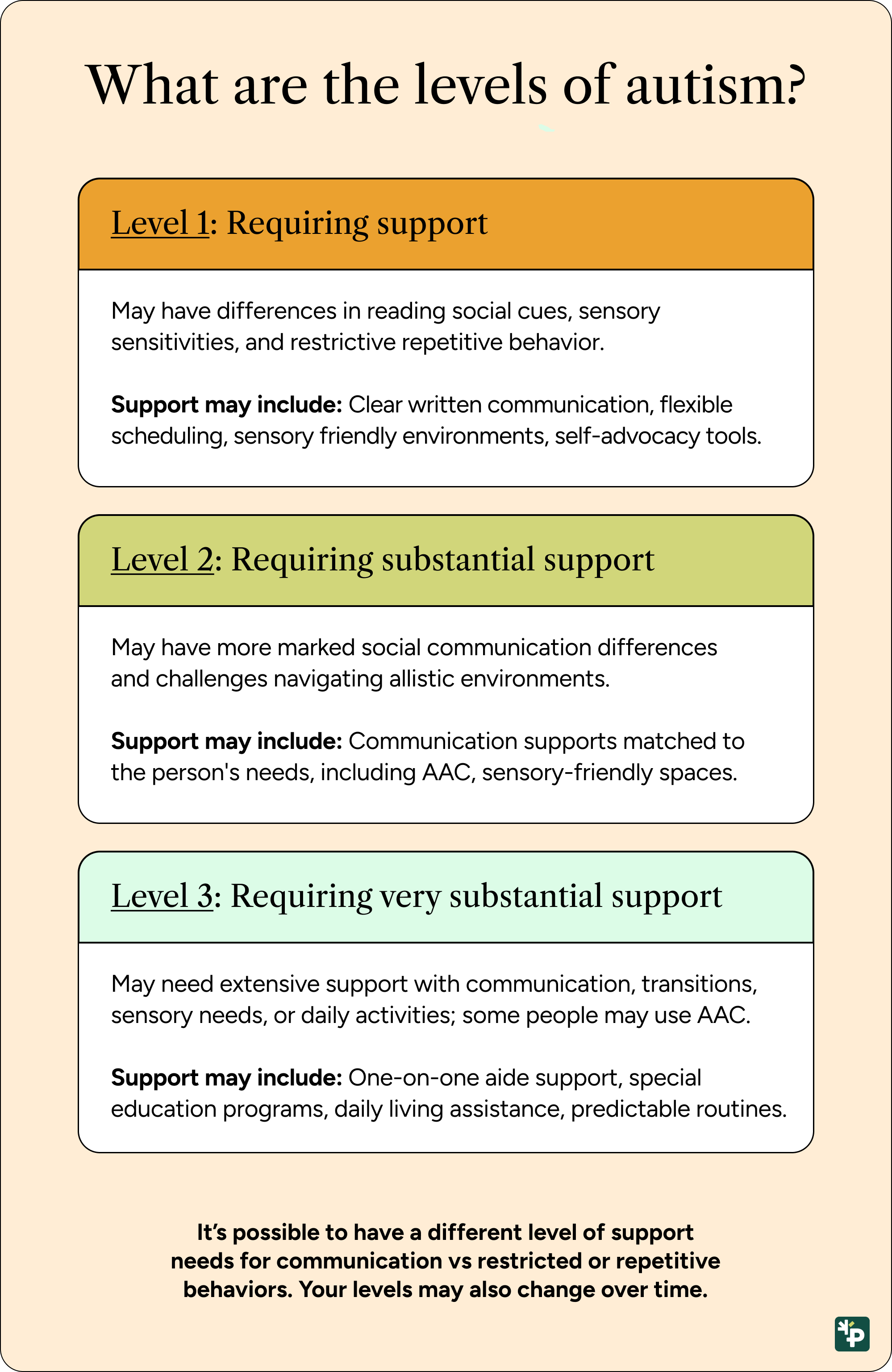
Now, here are the specific autism levels explained:
Level 1 Autism: Requiring Support
Support is needed even at the “lowest” level of autism support needs. That’s because autism isn’t a momentary difficulty but a systemic disability. Those with Level 1 autism require support in social communication and RRB, including:
- Understanding neurotypical social functioning, cues, and norms
- Executive functioning such as switching or initiating tasks
- Managing heightened sensitivities to sensory input like loud noises, textures, strong smells, flavors, etc.
- Moving through environments where the majority of people are neurotypical
- Managing restrictive and repetitive behaviors, especially in social contexts
If you’re a level 1 autistic person, you might struggle socially or in unstructured environments. For example, you may change topics or prefer to solely speak about a couple of specific topics, like special interests. Of course, autism looks different for everyone.
In any case, Hattis says that this level of support is all about reminders and structure. Some people with level 1 autism “can cope with work and personal relations but require reminders about social situations and have difficulty in managing the unexpected,” Hattis explains.
Here are some accommodations that may be useful:
- Clear, written communication
- Quiet, sensory-friendly areas to manage overwhelm
- Flexible (or clearly communicated) scheduling whenever possible
- Tools to advocate for yourself in social and work settings
Level 2 Autism: Requiring Substantial Support
Those diagnosed with Level 2 support needs have more pronounced differences in communication and RRB. For example, someone might use nonverbal communication only minimally.
If you have level 2 support needs, you’ll require more structure and communication support in allistic (non-autistic) environments. A few examples are:
- Extra support in school environments
- Supported employment settings
- Daily structures with managed predictability
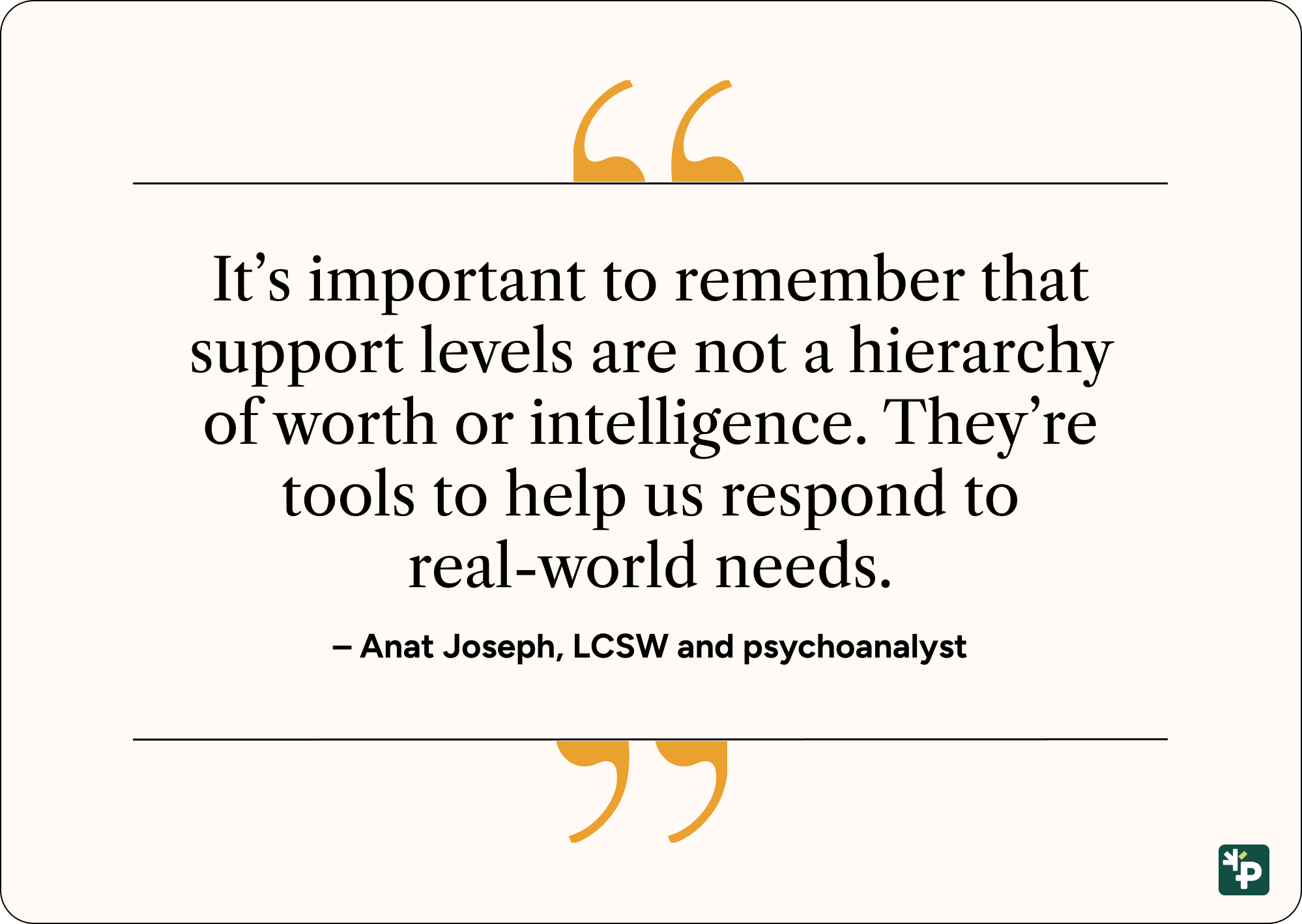
It’s essential to gradually build coping skills and social understanding. “Emotional validation is just as important as practical help,” explains Anat Joseph, LCSW and psychoanalyst.
Here are some tools you might seek if you have level 2 support needs:
- Ongoing neurodiversity coaching
- Visual or kinesthetic communication aids
- Clear scheduling
- Social worker support for autonomy
- Sensory-friendly community spaces and housing
- Occupational therapy
Level 3 Autism: Requiring Very Substantial Support
Those diagnosed with Level 3 support needs have significant daily functioning challenges. For instance, someone might be non-speaking and need augmentative and alternative communication (AAC), such as a tablet, to express themselves. This isn’t always the case, though.
If you have level 3 support needs, you might benefit from:
- One-on-one support from an aide or other therapist
- Special education programs
- Assistance with daily living skills like cooking or getting dressed
- Consistent and predictable routines
- Space to stim or use repetitive behaviors to self-soothe
- A range of mental health professionals
- Community inclusion
- Help with restrictive, repetitive behaviors that interfere with functioning
Level 3 autism is a significant disability and may require full-time care. But that doesn’t mean you’re any less worthy of support. In fact, the best support is an inclusive community. Remember, the levels of autism aren’t a hierarchical system.
“The level of autism support indicates the degree to which a person needs daily assistance to succeed in the world,” Hattis explains. “Not the level of their intelligence or potential.”
Whether you have Level 1 or Level 3 autism is immaterial to your value as a human being.
Why support levels aren't fixed
Even though the new DSM-5 levels of autism are more holistic and nuanced than previous editions, it’s important to note that needs are fluid.
Levels can change over time
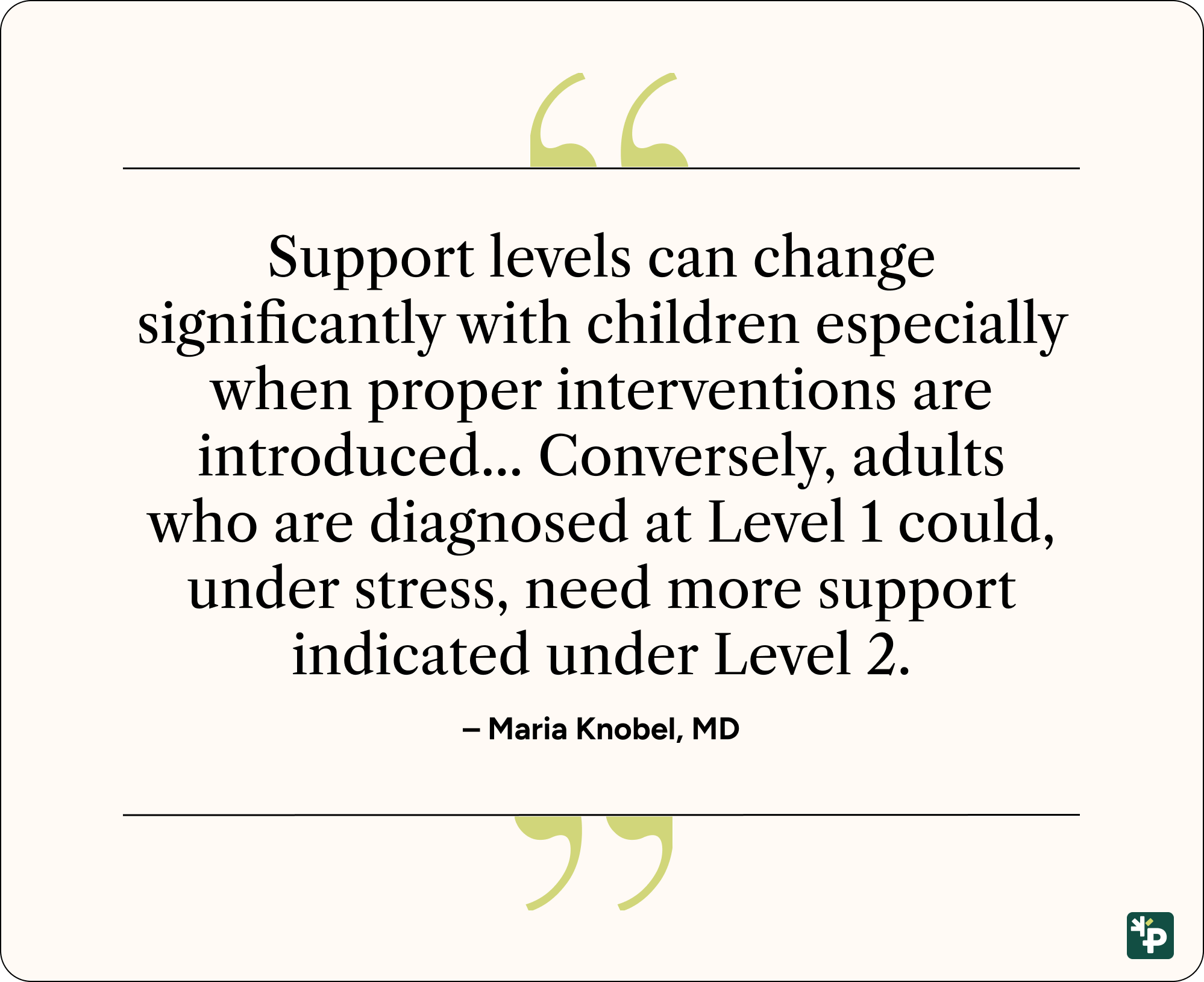
Maria Knobel, MD, Board Certified General Practitioner and founder of Medical Cert UK, says that "care might change over time, especially if an autistic person is in the care of a medical professional or therapist." In other words, these autism levels are considered flexible, as a person’s needs might change. They’re in no way related to intelligence.
She continues, “Different types of support are dynamic, and can be scaled up or down depending on context, asset availability, and efficacy (health)."
Therefore, it’s important to think about environmental modifications that make daily functioning easier. Qualified mental health professionals can make suggestions. In my personal experience, a quiet room is necessary to do my work, so my partner and I have come up with a plan to reduce any intrusions.
Spiky profiles
Some autistic people have “spiky profiles”—that is, our abilities vary across domains. For instance, while someone might have excellent functioning verbally, they might struggle with sensory processing.
“This can be confusing to others because the person may appear highly capable in one setting and deeply challenged in another,” Joseph explains. “Recognizing this helps us avoid assumptions and offer the right type of support where needed.”
As the proud owner of a spiky profile, I can function well socially for a time, but find auditory and kinesthetic sensory input often overwhelming. After hours in public, I might experience something called verbal shutdown. My ability to speak and be spoken to degrades rapidly.
My personal support plan relies on noticing when my shutdown begins so I can take a step away, especially from auditory input. But in a clinical setting, I might appear functional because I’m not underneath a constant barrage of input. In this way, I might appear to be at a Level 1, but occasionally I might be better suited for Level 2.
Masking
Masking refers to how autistic individuals might act more allistic to successfully navigate social settings. It can lead to autistic burnout, a condition in which autistic individuals, no matter their support level, require a period of rest to recover.
As a high-masking autistic person may appear more allistic at times, and suffer burnout at other times, masking can affect how professionals perceive their support needs.
Types of autism vs. levels of autism
Are you wondering, “Are there different types of autism in adults?" It’s possible you’re looking for historical classifications like Asperger's Disorder or terms such as “high-functioning” or “low-functioning.”
Generally speaking, these terms are no longer used because they don’t account for the nuances of autism. Experts replaced “types of autism” with “levels of autism,” recognizing that autistic people have different support needs that can change over time.
Historical diagnoses
Before its fifth edition, the DSM used the term Pervasive Developmental Disorders (PDD) to describe a group of developmental conditions such as autism.
The DSM-5 merged some diagnoses such as Asperger’s Syndrome and Child Disintegrative Disorder into the "Autism Spectrum Disorder" umbrella. It also put Rett Syndrome in another category altogether. More on how these terms were used historically:
- Asperger’s Syndrome, thought to be a “high-functioning” subset of PDD, was named for the Austrian physician Hans Asperger (who collaborated with Nazis). The diagnostic criteria included symptoms of autism without significant delays in cognitive development. As it’s an ableist conception linking social worth to intellectual ability, it shouldn’t be used to describe autism.
- Child disintegrative disorder (CDD) involves the loss of learned language and social skills at some point between the ages of 10.
- Pervasive Developmental Disorder Not Otherwise Specified (PDD-NOS), a term for people who met criteria for PDD but not a more specific diagnosis, was also absorbed into the ASD umbrella.
- Rett Syndrome, which appears primarily in females, is a rare neurological disorder that disrupts brain development.
A note on “High functioning” and “Low functioning” language
One thing becomes clear when developing a support plan for autistic individuals. Support needs can vary widely and change, so an individual needs-based approach is necessary.
“Talking about “abilities” or “functioning” (like “high-functioning” autism) can be misleading and overly simplistic,” says Joseph. “A person may have high cognitive skills but still require support navigating daily routines or managing sensory sensitivities. Support needs give us a fuller picture—it’s not about intelligence, it’s about the practical realities of someone’s life.”
Finding support for autistic adults
Factors like masking, spiky profiles, and levels of autism help determine what kind of care you might need. Support options may include:
- Evaluation and diagnosis: These are useful if you haven’t been diagnosed yet, and they open the door to more resources.
- Occupational therapy: Occupational therapy can help you manage sensory sensitivities and improve motor skills, especially if you have a spiky profile.
- Peer or community support: If you spend a lot of time masking, peer or community support offers a chance to be yourself in a community that accepts you.
- Self-advocacy resources: These resources can help you live a self-determined life, making and working towards your own goals.
- Executive functioning coaching/tools: Executive functioning coaching can help you develop skills and set goals. Tools include agendas, planners, and visual reminders.
- Therapy: Neurodiversity-affirming therapy services such as those provided at Prosper Health can help you with aspects of life such as emotional regulation, effective communication, and social interaction. They can also help you manage any co-occurring conditions like anxiety or depression.
If you’re an autistic adult who wants to explore your support needs, Prosper Health can help in identifying your spiky profile, discerning whether or not you’re masking regularly, and whether you’re in autistic burnout. If you suspect you may be autistic but haven't been diagnosed yet, Prosper Health can help with that as well.
Frequently Asked Questions (FAQ)
How many levels of autism are there?
There are three levels of autism, broken down by support needs and impairment on a daily basis.
How do you know if you have level 1 or 2 autism?
Support needs are predominantly used in therapeutic settings, and therefore are typically assigned during an autism diagnostics process. Those with Level 1 autism typically do not need as much day-to-day support as those diagnosed with Level 2. Autism support levels can change over time, however.
What does level 2 autism look like?
People with level 2 autism have substantial support needs. This looks different for everyone, but an example is someone who speaks only in simple sentences, doesn’t talk about much except special interests, and has a lot of difficulty coping with change.
What is Asperger’s?
Asperger’s Syndrome was a term historically used to describe people with severe social difficulties, restricted or repetitive behaviors or interests, and normal language and cognitive development. Now, experts generally refer to people with Asperger’s Syndrome as autistic.
Why do some sources mention 5 levels of autism?
These sources may be referring to the five disorders that were classed under the umbrella of “Pervasive Developmental Disorders” (PDD) in the DSM-4. These included autism, Asperger’s Syndrome, Child Disintegrative Disorder, Rett’s Syndrome, and PDD-NOS. The DSM-5 absorbed all of these disorders under the “Autism Spectrum Disorder” umbrella. The one exception was Rett’s Syndrome, which the DSM-5 moved to its own category.
Sources
American Psychiatric Association. (1994). Diagnostic and statistical manual of mental disorders (4th ed.). American Psychiatric Publishing, Inc..
American Psychiatric Association, D. S. M. T. F., & American Psychiatric Association, D. S. (2013). Diagnostic and statistical manual of mental disorders: DSM-5 (Vol. 5, No. 5). Washington, DC: American Psychiatric Association.
Autism severity and its relationship to disability. International Society of Autism Research. 2023.
Restricted and repetitive behaviors in autism spectrum disorders: The relationship of attention and motor deficits. Developmental Psychology. 2017.
Brief Report: DSM-5 “Levels of Support.” Journal of autism and developmental disorders. 2014.
A Systematic Review of the Assessment of Support Needs in People with Intellectual and Developmental Disabilities. International Journal of Environmental Research and Public Health. 2020.
Cognitive Profile in Autism and ADHD: A Meta-Analysis of Performance on the WAIS-IV and WISC-V. Archetypes of clinical neuropsychology: the official journal of the National Academy of Neuropsychologists. 2023.
A Conceptual Analysis of Autistic Masking: Understanding the Narrative of Stigma and the Illusion of Choice. Autism in Adulthood: challenges and management. 2021.
Asperger syndrome. National Autistic Society. 2023.
Just the Facts: The DSM-5 and Autism Spectrum Disorder. VCU Autism Center for Excellence. 2015.
Related Posts

What is Autism Spectrum Disorder? A Comprehensive Guide to Understanding Autism
Autism spectrum disorder (ASD) is a neurodevelopmental disorder. This means it’s a developmental disability involving an individual's neurological system. It is not a mental disorder or mental illness. ASD affects how people communicate, behave and process sensory information.
Some people believe that the term "spectrum" means everyone falls somewhere on the spectrum of autism. This is because autistic traits are human traits. Many people do have some features of autism, but this does not mean they have enough features of autism, at a high enough level, to be clinically diagnosed as autistic. In actuality, the term “spectrum” helps to highlight that there are many ways that autism can affect people differently. There’s a wide range of how autism presents in someone’s life. For example, there are some autistic people who need significant support, while others can live more independently. This is why clinicians now categorize autistic individuals based on levels (one, two, or three). These levels indicate varying degrees of support needs, which are often fluid and can change over time.
The diagnosis “autistic disorder” was added to the Diagnostic and Statistical Manual of Mental Disorders (DSM-III-R)––a reference manual for mental health providers—in the late 1980s.
However, the DSM-5, released in 2013, resulted in a major change in language surrounding autism. Autism spectrum disorder (ASD) is now an overarching diagnosis, encompassing the older diagnoses of Asperger’s syndrome, pervasive developmental disorder-not otherwise specified (PDD-NOS), and autistic disorder.
Increasing awareness and understanding autism
People used to think autism spectrum disorder was rare, but many people are realizing it’s more common than they thought.
The Cleveland Clinic estimates that 1 in 36 children in the U.S. is autistic, and the CDC estimates that 2.21% of U.S. adults are autistic.
However, these percentages may actually be higher due to factors like misdiagnosis, underdiagnosis or late diagnoses. These occurrences are particularly common among certain groups, such as girls and women, people of color and those from marginalized communities.
This doesn’t mean autism is more common now than it used to be. Rather, autism awareness among healthcare providers is higher, especially now that there’s better access to tools and resources for continued learning. The general public knows more about autism, too. These advances help foster better understanding for autistic people as well as their families, friends and communities.

What is Identity-First Language, and Why Use It?
Most of us were taught that it is best to use “person-first language” when referring to disabilities. Person-first language intentionally separates a person from the disability, as in saying “person with diabetes” rather than “diabetic person.” This intends to emphasize the individual over their disability, showing that the disability does not define the person. However, not everyone views their disability as something that can, or should, be separated from them.
This is why identity-first language—as in saying “autistic person” rather than “person with autism”—is important to the autistic community. Many autistic people prefer identity-first language because it acknowledges that being autistic is a core part of who they are.

Understanding Neurodiversity Affirming Therapy: A Guide
Neurodiversity is a growing movement that celebrates neurodivergent perspectives and the many different ways people think and engage with the world. As the cultural conversation around neurodiversity has expanded, some institutions have begun evaluating ways to better include and uplift neurodivergent people. These changes are desperately needed, especially in mental health services. Neurodiversity-affirming therapy offers neurodivergent people mental health support that recognizes our value and embraces our inherent strengths.


