.webp)


Key Takeaways
- PDD-NOS (Pervasive Developmental Disorder Not Otherwise Specified) is an outdated diagnostic label used for people who exhibited clinically significant autistic traits but did not fully meet the rigid criteria for autistic disorder or Asperger’s syndrome under the DSM-IV.
- In 2013, four conditions—PDD-NOS, autistic disorder, Asperger’s syndrome, and childhood disintegrative disorder—were all combined into a single diagnosis in the DSM-5: Autism Spectrum Disorder (ASD).
- Someone who received a PDD-NOS diagnosis before 2013 would most likely be diagnosed with ASD today.
- Reassessment is usually unnecessary unless updated documentation is needed for accommodations or supports.
- Some autistic adults still identify with PDD-NOS because it was their original diagnosis and feels accurate to them.
Key Takeaways
- PDD-NOS (Pervasive Developmental Disorder Not Otherwise Specified) is an outdated diagnostic label used for people who exhibited clinically significant autistic traits but did not fully meet the rigid criteria for autistic disorder or Asperger’s syndrome under the DSM-IV.
- In 2013, four conditions—PDD-NOS, autistic disorder, Asperger’s syndrome, and childhood disintegrative disorder—were all combined into a single diagnosis in the DSM-5: Autism Spectrum Disorder (ASD).
- Someone who received a PDD-NOS diagnosis before 2013 would most likely be diagnosed with ASD today.
- Reassessment is usually unnecessary unless updated documentation is needed for accommodations or supports.
- Some autistic adults still identify with PDD-NOS because it was their original diagnosis and feels accurate to them.
Information about autism spectrum disorder (ASD) has evolved significantly over the past couple of decades. With those changes comes the realization for some people that they may have received diagnoses that are not only confusing but are now considered outdated.
PDD-NOS, or Pervasive Developmental Disorder Not Otherwise Specified, is one of those diagnoses. If you’re someone who may have encountered this term in your records or research, it’s perfectly reasonable to scratch your head over this diagnosis—and to want a better understanding of what it means.
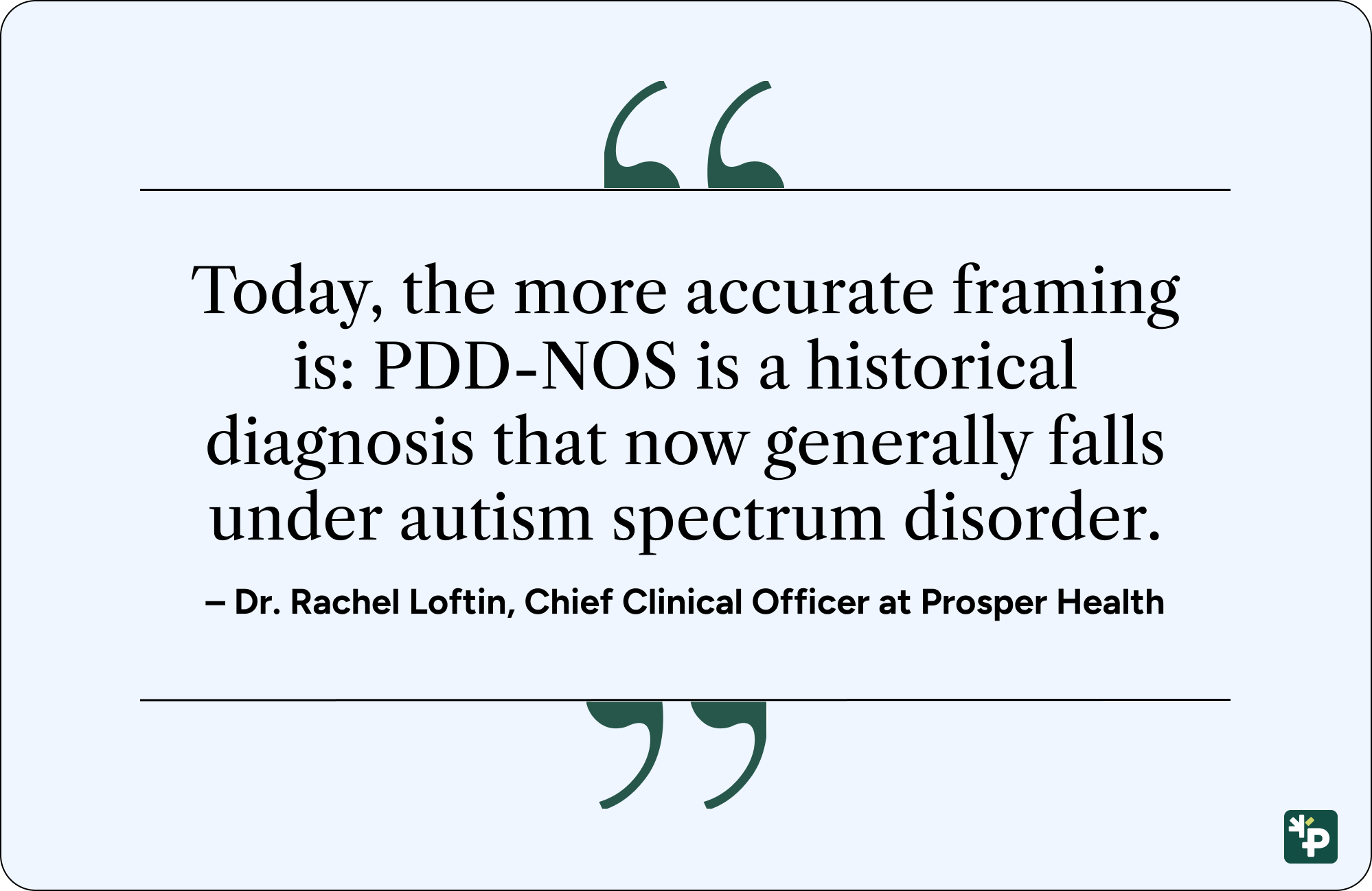
The PDD-NOS diagnosis was eliminated in 2013, when it was reclassified in the Diagnostic and Statistical Manual of Mental Disorders (DSM-5) under the ASD umbrella. While officially an outdated term, PDD-NOS is still meaningful, especially to those who may have received this diagnosis before 2013.
This article will explain what exactly PDD-NOS is, why the diagnosis no longer exists (and is now part of an autism spectrum disorder diagnosis), and how autistic adults can think about the term in a more affirming way.
What is PDD-NOS?
PDD-NOS was a diagnostic category in the DSM-IV (replaced with the DSM-5 in 2013) used for people with clinically significant autism-related differences who did not fully meet criteria for autistic disorder or another specific pervasive developmental disorder.
Common traits included:
- Repetitive movements or sounds like self-regulatory behavior, aka “stimming” (hand-flapping, body rocking, vocal stimming, using fidget toys)
- Challenges engaging in conversation and using language to express thoughts
- Differences in eye contact
- Difficulties with voice pitch and volume
- Emotion regulation challenges
Before 2013, “PDD-NOS was used when someone had clinically significant autistic traits but did not fully meet criteria for autistic disorder,” or the other two conditions that were eventually reclassified into autism, explains Dr. Rachel Loftin, Chief Clinical Officer at Prosper Health. “It was often treated as a ‘catch-all’ or ‘atypical autism’ diagnosis.”
How PDD-NOS was different from other diagnoses
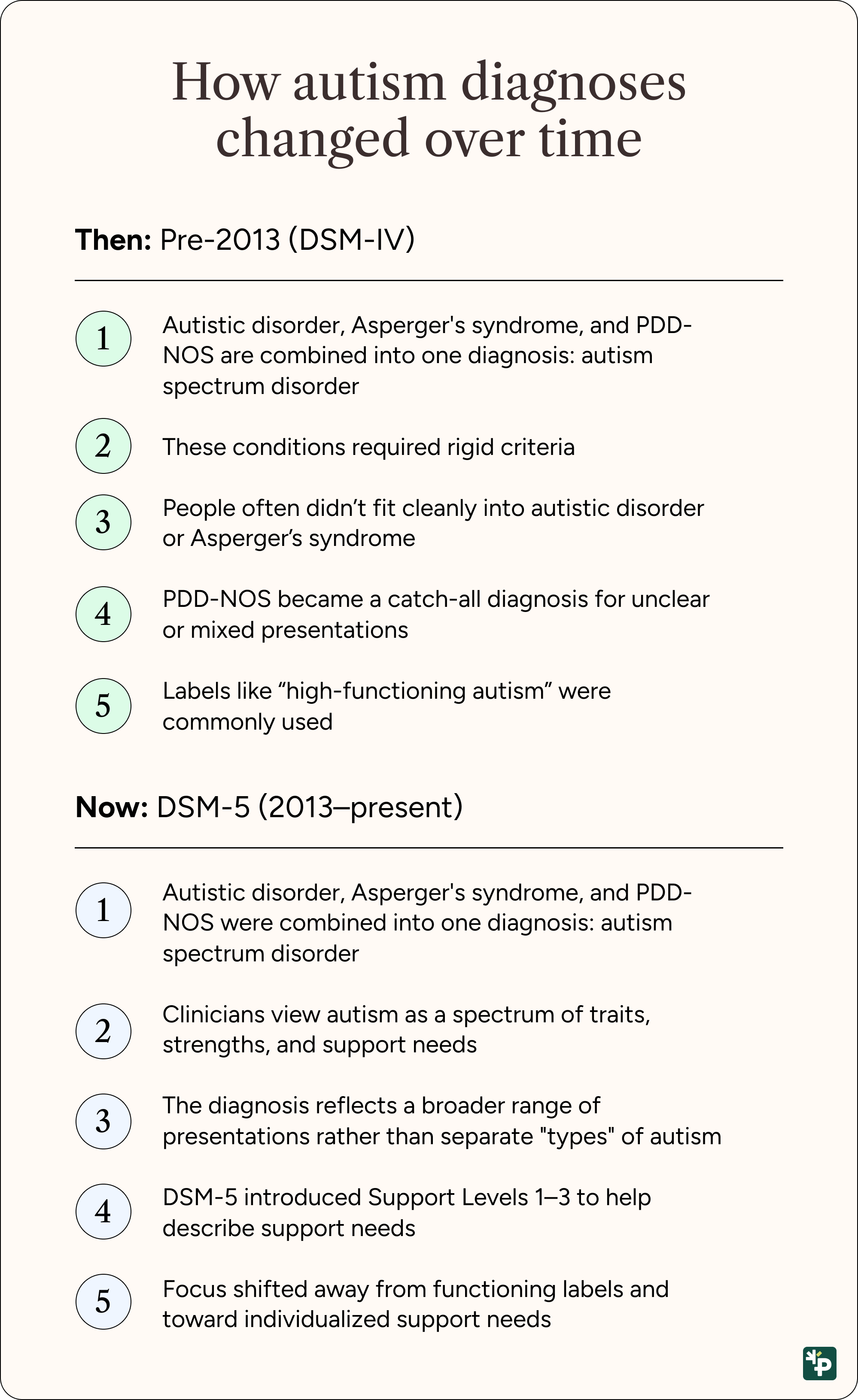
In 2013, four separate conditions were reclassified into one umbrella diagnosis: autism spectrum disorder (ASD).
Those conditions were PDD-NOS, childhood disintegrative disorder (a rare condition characterized by late-onset—three years of age or older—developmental delays in language, social function, and motor skills), Asperger’s syndrome, and autistic disorder.
PDD-NOS differed from Asperger’s syndrome and autistic disorder in the following ways:
PDD-NOS vs. Asperger’s: The central DSM-IV distinction was that Asperger's syndrome (also a now-outdated term) required autistic social/behavioral features, but without clinically significant language delay and without significant cognitive delay.
Common Asperger’s traits (which weren’t otherwise different from autistic disorder) included:
- Trouble with nonverbal communication, like analyzing body language
- Difficulty building and maintaining relationships with peers
- Preferring to spend time alone or not seeking out company
- Having intense and narrow special interests
- Needing to follow strict routines
“Under DSM-IV, Asperger’s was generally used for people who otherwise met criteria for autistic disorder but did not have a history of significant language delay or intellectual disability,” explains Dr. Loftin. Most people who received this diagnosis would be considered, in terms of levels of autism support, someone with Level 1 or lower support needs.
PDD-NOS vs. autistic disorder: Even though many traits of PDD-NOS are now classified under the ASD umbrella, it was considered a separate condition before 2013. According to the DSM-IV, to receive an autistic disorder diagnosis required meeting the following criteria through at least six examples:
- Social interaction impairment
- Communication impairment
- Repetitive behaviors
While the DSM-IV described these criteria as “impairments” in social interaction and communication, many autistic people and clinicians now use terms such as social communication differences instead.
Before it was folded into the ASD diagnosis, PDD-NOS was a typical diagnosis for people who didn’t fully meet the criteria for autistic disorder. But Dr. Loftin emphasizes that PDD-NOS shouldn’t be considered “‘almost autism’ or ‘not really autism.’ It was an older diagnostic category for people with real developmental and autism-related support needs.”
Why PDD-NOS was often confusing
The main reason why PDD-NOS existed—and what made the diagnosis so confusing—was that the diagnostic system (prior to 2013) had rigid boxes for autistic disorder and Asperger’s syndrome. As Dr. Loftin explained earlier, PDD-NOS became the catch-all category for lower support needs autistic people because many people didn’t cleanly fit into either the “autistic disorder” or “Asperger’s syndrome” category.
“PDD-NOS functioned as a residual diagnosis,” says Dr. Loftin. In many cases, clinicians could recognize a “clinically significant developmental/autism-related profile,” but since the profile didn’t fully fit the other named categories, people would receive a PDD-NOS diagnosis instead. “In practice, [PDD-NOS] was often used for people whose traits were real and meaningful but did not match the narrower DSM-IV definitions precisely.”
Dr. Loftin also highlights how a PDD-NOS diagnosis “could feel inconsistent across clinics,” because autism doesn’t have “perfectly sharp boundaries.” To its credit, PDD-NOS reflected the gray area common in autism: “Autistic traits are human traits,” says Dr. Loftin, “and clinicians have long struggled with how to define the threshold between broad human variation and a clinically significant autism profile.”
How autism diagnoses have changed
In 2013, with the publication of the Diagnostic and Statistical Manual of Mental Disorders, 5th edition (DSM-5), PDD-NOS, autistic disorder, Asperger’s syndrome, and childhood disintegrative disorder were all reclassified to a single diagnosis: Autism spectrum disorder (ASD).
“The official rationale for the DSM-5 change was that autism-related diagnoses were better understood as part of a single autism spectrum rather than entirely separate conditions,” says Dr. Loftin. “The American Psychological Association (APA) stated that the revised ASD diagnosis was intended to be more accurate, more scientifically useful, and more consistent with evolving research.”
Dr. Loftin also noted a practical issue regarding autism diagnoses before the DSM-5 classified all conditions into ASD: Varying clinics and research sites would often interpret diagnoses like Asperger’s and what was then referred to as “high-functioning autism” (a now-outdated term) differently.
“Researchers increasingly recognized that these categories lacked clear or consistent boundaries,” she says. Still, clinicians could agree that someone was “on the spectrum,” even if there was a disagreement over which DSM-IV label was the best fit.
Ultimately, by classifying multiple overlapping conditions into a single autism diagnosis, says Dr. Loftin, the DSM-5 “could better capture the wide range of autistic presentations.”
What does a PDD-NOS diagnosis mean today?
Someone who would’ve received a PDD-NOS diagnosis well over a decade ago would most likely be diagnosed with autism now.
“A well-established DSM-IV diagnosis of PDD-NOS generally maps to autism spectrum disorder today,” confirms Dr. Loftin.
While it’s true that PDD-NOS no longer exists in the diagnostic system, the only thing that has changed is the labels, not the person who may have once received this diagnosis. An autism diagnosis also provides an emphasis on support needs, whether it’s low, moderate, or high, instead of a focus on category labels.
Do you need to be reassessed if you were diagnosed with PDD-NOS?
This is ultimately a personal decision, but according to Dr. Loftin, a reassessment may be useful if you need updated documentation for any of the following:
- Accommodations
- School
- Disability benefits
- Workplace supports
- Diagnostic clarity
Other than those reasons, a new diagnosis isn’t usually necessary: “A person does not need to be reassessed simply because the terminology changed,” says Dr. Loftin. “A prior PDD-NOS diagnosis can still be clinically meaningful, especially when it was made through a thorough evaluation.”
If you are interested in a reassessment, however, Prosper Health can help you get tested for autism as an adult.
Why do people still use or identify with the term PDD-NOS?
From a timeline perspective, some people may continue using the term PDD-NOS when describing the diagnostic history of autism.
But even though Dr. Loftin admits that she doesn’t hear it that often anymore, certain adults may still feel more comfortable saying they have PDD-NOS.
The primary reason, she explains, is that PDD-NOS feels synonymous with their identity: It was part of their original diagnosis, appearing in older records prior to 2013.
Despite no longer existing as a diagnosis, PDD-NOS is still a term that helps some adults understand themselves, “or feels more accurate to their lived experience than current labels,” says Dr. Loftin.
When support may be helpful
Support for PDD-NOS in adults can certainly be helpful, but not because of your diagnosis label. Whether you have an older PDD-NOS diagnosis or a more recent autism one, professional support is a good idea if any of your traits are affecting your quality of life.
Dr. Loftin recommends seeking help if you’re experiencing any of the following challenges:
- Issues with sensory needs
- Autistic burnout
- Executive functioning
- Communication differences
- Relationship differences
- Difficulty with transitions, emotional regulation, self-advocacy, school/work accommodations
- Any co-occurring conditions such as anxiety, depression, ADHD, or trauma
Help for PDD-NOS and autism comes in a variety of options, including individualized therapy, social skills support, occupational/education accommodations, and neurodiversity-affirming communities.
The bottom line
Just because PDD-NOS was eliminated as a diagnosis, your experience still matters.
If you were diagnosed with PDD-NOS before 2013, all that’s changed is the label used to describe your condition (in most cases, that’s now autism). Still, understanding how this now-eliminated diagnosis does inform your identity, and can help you navigate your social and communication differences.
Whether it’s PDD-NOS or “autistic,” how you identify is entirely your choice. You know yourself best, and no matter which label you prefer, support is available through Prosper Health.
Not only do we provide neurodiversity-affirming therapy for autistic adults, but if you were previously diagnosed with PDD-NOS and would like to be reassessed under the new ASD umbrella, we also offer fully virtual autism assessments.
Contact us today to get started.
Frequently asked questions (FAQs)
Is PDD-NOS a form of autism?
Yes, PDD-NOS is considered a form of autism because starting in 2013, this condition was folded into the autism spectrum disorder (ASD) diagnosis. It’s a term once used to describe a group of developmental delays affecting social and communication skills. Common traits included repetitive movements or sounds like “stimming,” differences in eye contact, and challenges engaging in conversation.
Is PDD-NOS no longer a diagnosis?
PDD-NOS was eliminated as a diagnosis in 2013 when it was reclassified in the DSM-5 under the autism spectrum disorder (ASD) umbrella. The traits used to identify PDD-NOS are now part of the autism diagnosis criteria instead.
Was PDD-NOS a misdiagnosis?
No, PDD-NOS was not a misdiagnosis. Before 2013, if someone had clinically significant autistic traits but didn’t fully meet the criteria for autistic disorder or Asperger’s syndrome, they would likely receive a PDD-NOS diagnosis.
Do I need a new diagnosis if I had PDD-NOS?
Not necessarily. You may want to consider reassessment if you need updated documentation for therapy, accommodations, school, disability benefits, workplace supports, or diagnostic clarity. But just because the terminology changed doesn’t mean you need a new diagnosis, especially if you received your PDD-NOS diagnosis from a thorough evaluation.
Sources
https://my.clevelandclinic.org/health/diseases/pervasive-developmental-disorders
https://www.prosperhealth.io/blog/autism-and-stimming
https://www.prosperhealth.io/blog/vocal-stimming
https://pmc.ncbi.nlm.nih.gov/articles/PMC3401658/
https://my.clevelandclinic.org/health/articles/asperger-syndrome
https://www.prosperhealth.io/blog/pdd-nos-vs-aspergers-syndrome
https://www.prosperhealth.io/blog/what-are-the-levels-of-autism-support
https://www.michigan.gov/-/media/Project/Websites/autism/Folder1/DSMIV.pdf?rev=c90fd6b26d0e4cc3a198b128de1fc654
https://www.prosperhealth.io/blog/special-interests-and-autism
https://www.prosperhealth.io/blog/autistic-burnout
https://www.prosperhealth.io/blog/executive-functioning-in-autism
https://www.prosperhealth.io/blog/autism-and-relationships
https://www.prosperhealth.io/blog/how-to-get-tested-for-autism-as-an-adult
Related Posts

Navigating the Autism Spectrum: Insights into PDD-NOS and Asperger's Syndrome
For autistic adults, understanding your diagnosis and the labels that may have once applied can be a powerful step toward self-awareness and advocacy. If you were diagnosed before 2013, the terms PDD-NOS (pervasive developmental disorder-not otherwise specified) and Asperger’s syndrome may feel deeply familiar. While these diagnoses were cut from the DSM-5, they continue to hold meaning, especially for individuals who identify with the traits and lived experiences associated with them.
By understanding the distinctions and overlaps between PDD-NOS and Asperger’s, autistic adults can find relatable community experiences and make informed decisions about support and self-care. Exploring these diagnostic categories with a nuanced lens not only sheds light on where one fits within the broader autism spectrum but also affirms the diverse ways autism manifests across individuals.

Understanding 'High-Functioning' Autism: Traits and Misconceptions
As our understanding of the autism spectrum evolves, so does the language associated with autism spectrum disorder (ASD). And that language matters.
Right before my daughter was diagnosed with ASD, I felt like everyone around me was using the phrase “high-functioning autism” to describe her relatively moderate support needs. It also seemed to confirm why it took several years to receive an autism diagnosis at all. I soon learned, however, that describing someone with “high-functioning autism” was not only incorrect but harmful.
For starters, “high-functioning autism” isn’t even a clinical diagnosis, though the term is pervasive enough that some people may mistake it for one.
What the best-intentioned people usually mean when they say “high-functioning” is Level 1 or low support needs, which often refers to someone who needs circumstantial support with social communication and restricted or repetitive patterns of behavior and interests (RRB).
Specifically, that can mean help with managing the need for sameness, recognizing neurotypical social functioning and cues, and managing sensory sensitivities. Autistic people who are Level 1 may also engage in masking, which can make someone seem to have fewer support needs than what is actually sustainable.
Nasiyah Isra-Ul (they/she) is an autistic professional and disability advocate who believes that the once-prevalent “high-functioning autism” label prevented them from receiving the support they needed throughout their childhood and young adulthood. It could also explain why they received a late autism diagnosis as an adult.
If you’re curious about signs of high-functioning autism in adults, you’re in the right place! But we won’t be using that problematic term, and neither should you. In this article, we’ll explain why the term is outdated, what people actually mean by it, and what the most common autistic traits look like for adults with Level 1 autism support needs or who mask heavily.

Support Needs, Not Labels: A Guide to “Levels” and “Types” of Autism
As a person diagnosed with autism as a child and then again as an adult, I’ve witnessed firsthand the way the Diagnostic and Statistical Manual of Mental Disorders (DSM) has changed to affirm autistic people. In 2013, the DSM updated its resources with an eye to supportive care.
Experts now categorize individuals based on levels of autism spectrum disorder (one, two, or three). These levels indicate varying degrees of support needs, which are often fluid and can change over time.
People can now navigate autism support without labels like “high-functioning” or “low-functioning.” It’s a notable step forward in recognizing the individuality of care and nuances of treatment. This can be useful whether someone's diagnosed, self-identified, or still exploring.
Let’s discuss levels of autism, why they're relevant, and how your level can look different depending on the day. We’ll also address how these levels relate to older diagnostic terms like Asperger's.
This article is for everyone—whether you have an assigned level, are reconciling an older diagnosis with today's terminology, or haven't been formally diagnosed at all.


