.webp)


Key Takeaways
- Relationship challenges are a difference, not a personal failing. Difficulties in navigating relationships are typically due to a mismatch between non-autistic and autistic communication styles—a concept known as the "double empathy problem"—rather than a lack of empathy.
- Direct communication and explicit expectations are vital for clarity. Autistic people often prioritize clear, literal language and may find non-autistic communication, which relies heavily on subtext, tone, or implied meaning, confusing or exhausting.
- Sustainability relies on authenticity and boundaries. Healthy connections are the ones where an autistic person trusts others enough to begin unmasking, and where essential boundaries around time, energy, and sensory needs are set and respected.
Key Takeaways
- Relationship challenges are a difference, not a personal failing. Difficulties in navigating relationships are typically due to a mismatch between non-autistic and autistic communication styles—a concept known as the "double empathy problem"—rather than a lack of empathy.
- Direct communication and explicit expectations are vital for clarity. Autistic people often prioritize clear, literal language and may find non-autistic communication, which relies heavily on subtext, tone, or implied meaning, confusing or exhausting.
- Sustainability relies on authenticity and boundaries. Healthy connections are the ones where an autistic person trusts others enough to begin unmasking, and where essential boundaries around time, energy, and sensory needs are set and respected.
Many autistic people experience relationship challenges—whether they’re romantic or platonic—in environments shaped around non-autistic social norms. Some unwritten rules and behaviors don’t necessarily come naturally to neurodivergent people.
Christal Castagnozzi, a clinical and school psychologist who received a late autism diagnosis, says that while she had friends growing up, there was an “underlying sense of being misunderstood.” She feels she “struggled to access deeper, more meaningful connections,” and ultimately believed she didn’t belong, even when her friends included her in their social activities.
Even in romantic relationships, Castagnozzi says she had difficulty “interpreting cues, flirting, [her partner’s] intentions, and emotional subtext.”
If any of these experiences sound familiar, you are not alone. But more importantly, the challenges of autism and relationships are not a personal failing. They are often due to differences in communication style, sensory processing, social expectations, and mutual misunderstanding between autistic and non-autistic people. Castagnozzi says what made a difference for her was forming relationships with neurodivergent individuals who provided “less pressure to mask and more space for directness and authenticity.”
In this article, we’ll examine how autism shapes all kinds of relationships, the roots of certain challenges, and practical strategies for effectively navigating relationships.
Autism in the context of relationships
There are two important truths about autism and relationships. One is that fulfilling friendships, romantic partnerships, and family and workplace relationships are absolutely possible for autistic people. The other is that they will likely look different than common social expectations around relationships.
“The way connections are built, maintained, and expressed in allistic populations rarely aligns with the way autistic people experience the world,” explains Dr. Kelly Whaling, Research Lead and Licensed Clinical Psychologist at Prosper Health.
This misalignment can be seen in how autistic people relate to others. Common autistic characteristics that sometimes cause challenges in relationships include:
- Communication differences: Some autistic people prefer clear, direct approaches that others may see as too blunt.
- Sensory processing differences: Certain social environments may be overstimulating for autistic people.
- Social expectation mismatches: Autistic people, to fit in better with their non-autistic peers, sometimes engage in masking (hiding their autistic traits), causing their needs to be overlooked.
- Need for routine/sameness: Unexpected changes to routines or plans can be stressful for some autistic people, especially without preparation time.
At the same time, “there are huge strengths to being autistic in relationships,” says Dr. Whaling, who cites common autistic traits like loyalty, truthfulness, and deep focus as valuable relationship assets.
In the past, autistic behaviors like sensory processing differences and direct communication were considered “deficient,” which (incorrectly) fueled the idea that autism and relationships didn’t mix.
“Autistic people often crave meaningful relationships,” confirms Dr. Whaling, “whether friendships, partnerships, or family connections, and their desire for connection deserves understanding and support.”
But it’s through understanding these differences—and that’s what they are, differences, not deficits—that autistic and non-autistic people can form healthy, dynamic relationships.
Why relationships can feel difficult (and why it’s not just you)
Forming and maintaining relationships may come more easily to neurotypical people, but several invisible factors impact autistic people, like implicit rules and unspoken expectations, says Castagnozzi.
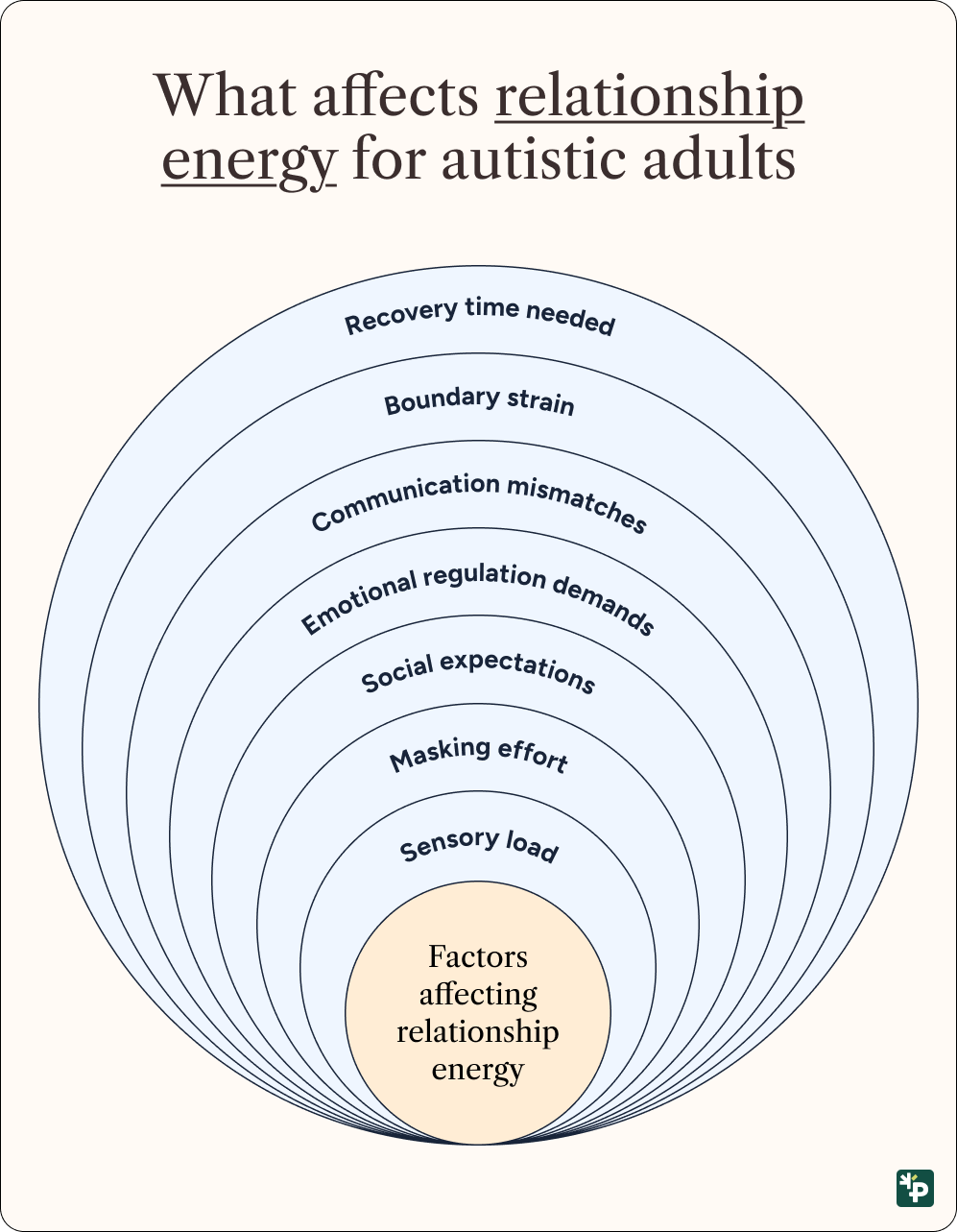
Throw in masking, possible sensory overload, and other cognitive processing differences, and suddenly, one social interaction turns into a physically and mentally draining experience.
Below, Dr. Whaling offers deeper insights into the common reasons why relationships can feel difficult for autistic people:
The double empathy problem
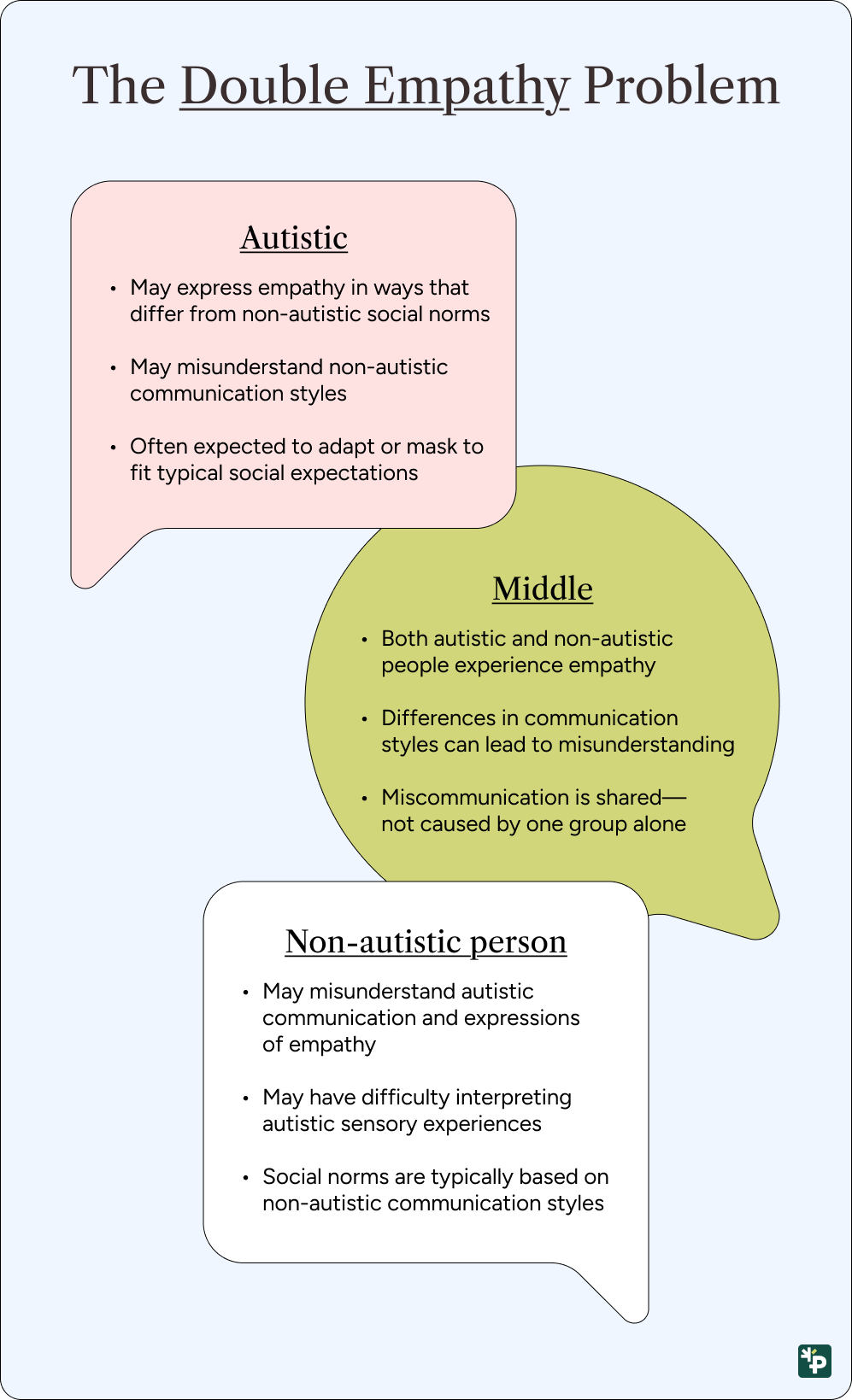
For many years, autistic people were told their relationship challenges resulted from a lack of empathy. The “double empathy problem” argues against this idea. Instead, this theory suggests that communication breakdowns stem from both autistic and non-autistic people. Both groups have empathy, but neither group fully understands the other’s communication approach. Plus, each group may also demonstrate empathy differently from the other.
What this can look like:
- An autistic person explains something clearly and directly to a non-autistic person, but the non-autistic person thinks the autistic person has a cold demeanor
- An autistic person responds to a non-autistic person’s distress with practical suggestions, but the non-autistic person feels the autistic person doesn’t care about their feelings.
Why it happens: Autistic people may find non-autistic social cues unclear or inconsistent, while non-autistic people can struggle just as much to read autistic communication. Each group tends to understand its own neurotype more intuitively.
What to remember: Just as autistic people may find non-autistic social cues unclear, non-autistic people can misread autistic communication as well. Compassion, understanding, and checking in with the other person can make a world of difference in your relationship.
Communication differences and mismatched expectations
What this can look like:
- An autistic person might prefer direct, literal language, while finding hints, sarcasm, or implied meanings exhausting or confusing to interpret.
- Autistic people may also value a high level of honesty, which non-autistic people could perceive as bluntness.
Why it happens: Communication challenges between autistic and non-autistic people arise because much of non-autistic communication relies heavily on subtext. Non-autistic people tend to employ voice tone, timing, facial expression, gestures, or implied meaning of what is left unsaid. Autistic communication, by contrast, tends to prioritize clarity and explicit meaning.
What to remember: Healthy relationships are built through finding people whose styles align with yours, and by creating clear, explicit agreements about how you each prefer to connect. Non-autistic people can show their support by speaking more directly and by not relying on hints or implications.
Sensory needs and nervous system differences
What this can look like:
- Canceling plans because the environment feels overwhelming—for instance, instead of a quiet lounge, the plan might entail going to a loud, bright, crowded bar.
- Needing time to recover after socializing may be misinterpreted as a lack of interest
Why it happens: There are significant differences in how the autistic nervous system processes sensory input and regulates energy. Sensory stimuli are often processed with greater intensity, making environmental factors feel overwhelming. Social interaction also places sustained demands on cognitive processing systems and causes fatigue.
What to remember: Autistic people's sensory and energy needs are real and valid. And prioritizing clear, direct communication about needs and boundaries can better support a sustainable connection. Autistic people can share their sensory preferences, while non-autistic people can demonstrate flexibility and respect limits.
Masking and its effect on connection
What this can look like:
- Rehearsing conversations, forcing emotional expressions that may not come naturally, forcing eye contact, suppressing natural movements and reactions like self-stimulatory behavior, or “stimming.”
- Pushing yourself to attend social events that don’t interest you to appear easygoing and engaged.
Why it happens: Masking often develops early in response to social pressure, misunderstanding, or past experiences of rejection. But filtering or adjusting your behavior in this way can feel like other people don’t fully know the real you.
What to remember: Some research has shown that long-term masking is associated with higher rates of exhaustion, burnout, anxiety, depression, and reduced connection to one’s sense of self. However, it remains a common strategy to maintain safety in unaccommodating environments. Relationships tend to be more sustainable when an autistic person trusts others enough to begin unmasking, allowing for more authentic connections.
How these differences show up in real relationships
Autism and friendships
Making friends can be challenging due to behavioral and communication differences between non-autistic and autistic people. But this shouldn’t stop autistic people from having strong, lasting friendships.
Below, Castagnozzi further explains these challenges and strategies:
Why this can be hard
Autistic people may be dealing with the cumulative impact of masking, sensory load, and cognitive processing differences. Since social interactions can require more energy and more post-processing for autistic people, they can sometimes lead to fatigue or burnout.
Other concerns for autistic people in social settings can include:
- A fear of being misunderstood
- A hyperawareness of social performance
- Uncertainty about how they’re being perceived
These concerns can make meeting new people and maintaining new relationships feel high-stakes.
What this can look like
- Significant masking: Adapting how you communicate with and respond to others, saying the “right” things, and being agreeable.
- The cost of masking: Masking may make relationships look successful on the outside, while the autistic person feels less secure or authentic internally.
- Mood fluctuations: Drawing on her own experiences, Castagnozzi says this created a confusing dynamic for others, because she would oscillate between being emotionally honest and quiet and withdrawn due to overwhelm.
What helps in these situations
- Explicit communication, flexibility, and acceptance: These three factors help relationships become more accessible.
- Finding your tribe: Many autistic individuals find that relationships with other neurodivergent people feel more intuitive. This is partially because there is less reliance on unspoken social rules and more tolerance for differences in communication and regulation.
- Listening to your needs: Castagnozzi acknowledges that there are times when she deeply wants connection and engagement, and others when she needs significant solitude to recover after social or sensory overload. Therefore, for her, low-maintenance, flexible relationships have been essential.
Autism and family relationships
Family members may know their autistic loved ones well, but they might not fully understand them. “Family relationships are often the most complex terrain autistic people navigate,” says Dr. Whaling, explaining that family dynamics often involve longstanding misunderstandings about autistic traits.
“These relationships come with years, often decades, of patterns that were formed without an understanding of autism.”
Below, Dr. Whaling further explains these challenges and strategies:
Why this can be hard
Many autistic adults grew up in environments where their differences were interpreted through more neurotypical lenses: They were seen as “difficult,” “bossy,” “overly sensitive,” “uncooperative,” or “not trying hard enough.” Unfortunately, these interpretations don’t suddenly disappear when a loved one obtains an autism diagnosis.
What challenges/differences can look like
- Demanding family life expectations: Gatherings, holidays, and other family obligations that tend to involve unstructured social time, high levels of sensory input, and limited opportunities to opt out without consequence. In many instances, participation is interpreted as caring, while absence, even if it’s for the autistic person’s well-being, is interpreted as withdrawal.
- Diagnosis misinterpretations: In some situations, family members will dismiss their loved one’s autism diagnosis with comments like, “You seem normal to me.” These responses can be harmful because the family members a) don’t understand that what they perceived as “normal” was often the result of years of masking or b) due to their own misunderstanding of autism.
What helps in these situations
- Setting boundaries: While this may be initially confusing for some family members, the purpose is to make these relationships more sustainable. These shifts are not rejections of the relationship, and they’re proof that autistic family members do care:
- Shorter visits
- Opting for texting over phone calls
- Stepping back from certain traditions
These subtle changes are often ways of preserving connection, not avoiding it.
Autism and romantic relationships
Autistic people vary widely in how much social connection they want, how they express care, and what kinds of relationships feel fulfilling. Autism in relationships can also add extra-confusing layers, but, says Dr. Whaling, “relationship satisfaction is often high in long-term partnerships for autistic adults, particularly where there is mutual understanding.” When both partners—whether they’re both autistic or mixed neurotypes—are willing to learn, adapt, and meet each other with curiosity, there’s a greater chance of relationship success.
“In fact, honesty and trustworthiness are often considered some of the most valuable attributes in relationships involving autistic individuals,” says Dr. Whaling.
But autism and communication difficulties in adults are no strangers to romantic relationships.
Below, Dr. Whaling further explains these challenges and strategies:
Why this can be hard
Autistic relationship problems can manifest for several reasons. Whether a neurotypical person is dating someone with autism, or it’s a case of autistic couples, dating can be tough for some because it tends to rely heavily on subtleties like flirting, reading signals, and interpreting ambiguity. This can make the early stages of romantic connection feel more like guesswork than connection, with many autistic adults describing this process as more exhausting than it appears to be for others.
What challenges/differences can look like:
- Alexithymia: This common autistic trait makes it challenging to name, recognize, or process emotions. People with alexithymia may not be able to answer seemingly simple questions like, “How are you feeling?” or “What do you need?” Keep in mind, however, that alexithymia is not unique to autism, and not all autistic people experience it.
- Misinterpreted needs: Some autistic adults in relationships may need periods of solitude for their own comfort, but this can be misinterpreted as withdrawing from their partner.
- Burnout or overwhelm: Romantic partnerships may suffer the most from a person’s burnout or overwhelm because this relationship is their closest and most immediate environment.
- Potential safety concerns: Autistic people, particularly women, trans individuals, and those assigned female at birth (AFAB), face elevated risks of exploitation or coercion in romantic contexts.
What helps in these situations
- Finding common ground: A relationship that grows out of shared interests, friendships, or repeated interactions already has a strong foundation. This will reduce the reliance on implicit cues.
- Honest, direct communication: Relationships often become more stable and less prone to misunderstanding when both parties explicitly communicate their needs with each other. If you need daily alone time, extra processing time, or just have a direct question, tell your partner.
- Discussing your intimacy preferences: Autism and intimacy are topics that deserve your attention as well, especially if you have any sensory preferences. Any intimacy or sexual concerns are better addressed explicitly than left unspoken.
Autism and work relationships
While many autistic people excel in roles that match their skills and interests, the social environment in workplaces can cause significant challenges.
“Many autistic adults find workplaces to be socially complicated and often not accommodating,” says Dr. Whaling, who points to “arbitrary” unwritten rules, like small talk, navigating hierarchy, and maintaining visibility, that can affect career growth.
Below, Dr. Whaling further explains these challenges and strategies:
Why this can be hard
For autistic people, their strong work accomplishments may be overshadowed by their difficulty navigating implicit social expectations in workplace culture. Some autistic adults may feel compelled to engage in sustained masking to succeed in these environments, which can lead to significant exhaustion, often extending beyond the workday into evenings and weekends.
What challenges/differences can look like:
- Sensory factors in the workplace: Open-plan offices, fluorescent lighting, and shared spaces can make the workday physically taxing. This can then impact communication and connectedness between colleagues.
- Subjective behavioral judgments: Behaviors such as remaining quiet in meetings, avoiding small talk, or not engaging in social workplace rituals/activities can be misread by colleagues and managers as disinterest or a lack of competence.
What helps in these situations
- Communicating your needs openly: Your colleagues will be more likely to understand who you are if you make your needs clear at the outset. This can be requesting environmental accommodations, clear, explicit instructions, or certain social boundaries.
- Fostering a supportive workplace culture: Both employers and autistic employees can encourage more open dialogue about accommodations and different working styles.
Practical strategies for navigating relationships
Many practical strategies can make relationships more manageable for autistic people over time. But no matter what kind of relationship you’re navigating, the goal here isn’t to “fix” yourself. Instead, it’s to build relationships that work for you. Castagnozzi and Dr. Whaling offer several suggestions below:
Communicate directly
Even though saying what you mean, asking for what you need, and being clear about your limits is often framed as blunt or rude, it’s actually more respectful and effective than relying on guesswork. This kind of direct communication reduces confusion and allows both people to respond to what is being said rather than trying to interpret the implied meaning.
Direct communication examples:
- “I process things better if we talk about them directly.”
- “If I go quiet, I’m overwhelmed, not disengaged.”
- “I’ve had a long week, and I’m at capacity. I need to reschedule.”
- “When you say you’re fine, I take that literally, so please tell me if something’s wrong.”
- “I’d like to see you more often. Could we plan something regularly?”
Define expectations clearly
Dr. Whaling notes that a significant amount of relational conflict comes not from major disagreements, but from mismatched and unspoken assumptions. So explicitly defining your expectations can prevent a lot of misunderstandings. Naming these expectations creates shared understanding, which makes relationships more stable, predictable, and ultimately sustainable.
This can look like:
- Clarifying communication preferences, like texting instead of phone calls
- Explaining personal needs within relationships, like alone time
- Setting clear limits in family and work contexts, such as attending only part of an event or requesting written instructions instead of verbal ones.
Set boundaries without guilt
Boundaries around time, energy, and sensory needs are essential for sustainability, especially for autistic individuals, who often have more limited social and sensory reserves. By being upfront about your needs, those who respect and care for you can better understand that these limits are necessary.
Boundaries can look like:
- Giving yourself time before accepting invitations
- Limiting the number of social commitments you take on
- Being clear about what you can and cannot manage during moments of stress
- Leaving environments that are overwhelming without feeling obligated to apologize
Focus on repair, not perfection
No relationship is free from misunderstanding. Miscommunication, hurt feelings, and moments of disconnection occur in all relationships. What distinguishes healthy relationships is not the absence of these moments, but the ability to return to them and work on repairing any rifts.
This can look like:
- Acknowledging something that caused harm
- Clarifying what someone meant
- Revisiting a conversation after having time to process
- Planning for recovery time after socializing
- Building relationships that allow for flexibility
- Reducing masking where possible
- Seeking environments and people where you can show up more authentically
Build relationships that actually work for you
Contrary to popular belief, there isn’t a “correct” way for relationships to look. Sustainable relationships for autistic people may appear different to others, such as having a small number of close friendships instead of a wide social circle. What’s important is that you are comfortable and that your needs are being met.
Here are some strategies for building strong, sustainable relationships:
- Seek out low-demand friendships with flexible communication expectations
- Find people who respect your rhythms rather than expect consistency
- Look for romantic relationships that prioritize independence and explicit communication
- Build family relationships that reflect what is realistically manageable, rather than what tradition dictates
- Seek out autistic and neurodivergent communities, as they can provide a sense of belonging and mutual understanding that is harder to find elsewhere
What supportive relationships can look like
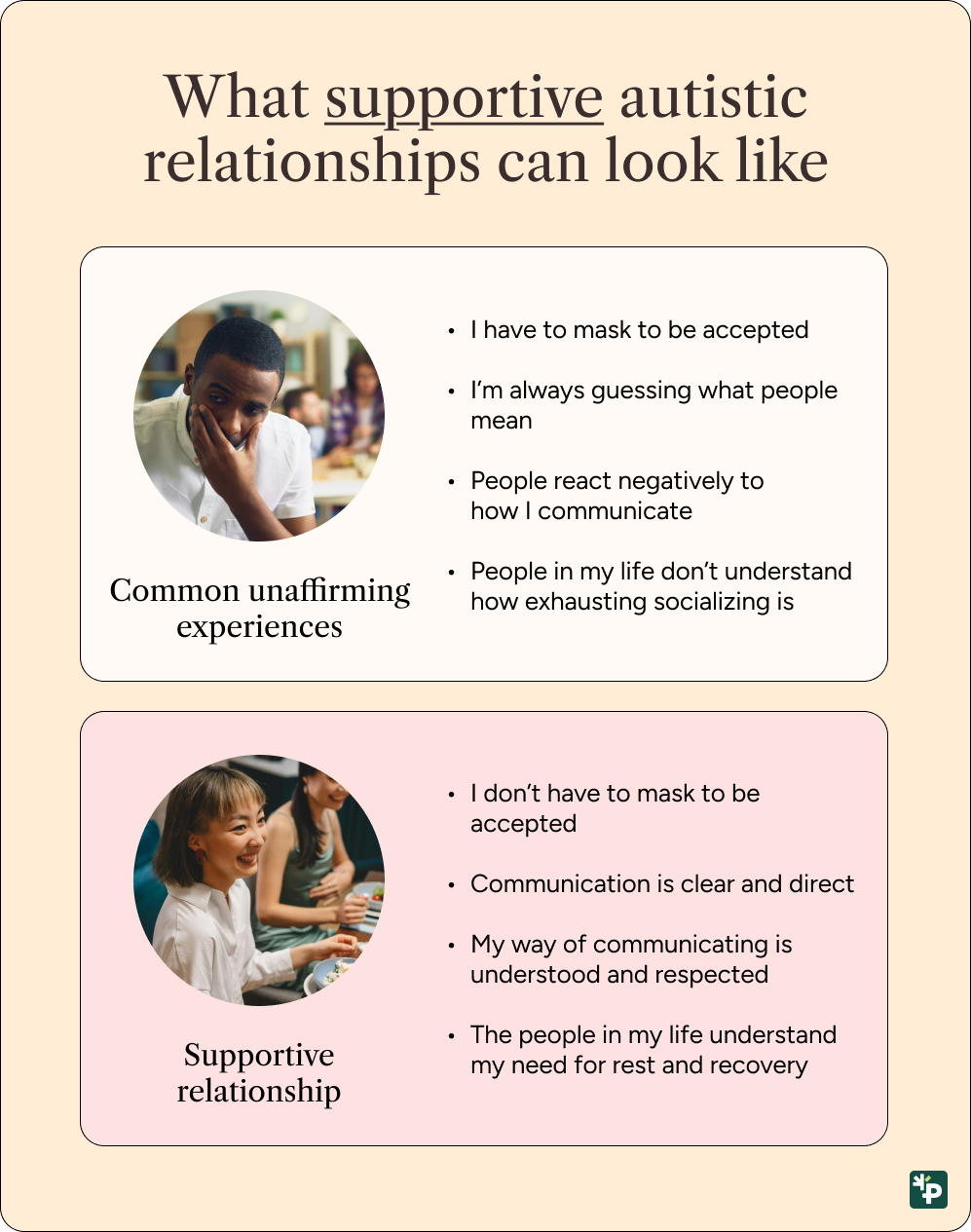
The main difference between a supportive relationship and one that isn’t, says Dr. Whaling, is that they “are often recognizable by the absence of constant strain.” Supportive relationships are where “differences are understood and accommodated over time, if not openly celebrated.”
According to Castagnozzi, some signs of supportive relationships can include:
- Feeling relationally safe and not constantly monitoring yourself
- Respect for your need for space or breaks
- An openness to discussing communication differences
- Directness is understood and not pathologized
- No masking expectations to maintain connection
- Flexibility around engagement and consistency
- Repair conversations are welcomed, not avoided
“Supportive relationships are those where your nervous system can settle,” says Castagnozzi. “[They] don’t eliminate differences, they make space for them.”
When to seek additional support
Some noticeable relationship patterns could indicate a need for professional support. In these cases, neurodiversity-affirming therapists are essential because, says Castagnozzi, certain attachment patterns may show up differently in autistic people. “Traditional attachment frameworks don’t always fully capture autistic relational experiences,” she says.
If you’re noticing any of the following patterns, however, Castagnozzi recommends seeking therapy or additional support:
- Chronic masking that leads to burnout or exhaustion
- Persistent feelings of being misunderstood, unseen, or disconnected in relationships
- Repeated relational patterns (e.g., overgiving, fast attachment, difficulty maintaining boundaries)
- High anxiety in social, friendship, or romantic contexts
- Difficulty navigating conflict, especially if it leads to shutdown or withdrawal
- Frequent sensory or emotional overwhelm that impacts your ability to stay engaged in relationships
“Support isn’t about ‘fixing’ how you relate [to others],” says Castagnozzi. “It’s about better understanding your patterns so you can build relationships that work with your neurotype, rather than against it.”
How Prosper Health can help
Yes, autism does impact on relationships, but cultivating those relationships isn’t about becoming more “normal.”
The more you understand yourself, the more you’ll be able to advocate for your own relationship needs, and ultimately build relationships that align with your nervous systems, communication styles, and capacity.
“The most fulfilling relationships are often the ones where you don’t feel like you have to earn connection through performance but where connection exists alongside authenticity,” says Castagnozzi.
If you are struggling with your personal relationships, Prosper Health is here to help. Prosper Health’s virtual therapy provides mental health support for autistic adults, covered by insurance. Our expert clinicians incorporate evidence-based therapies into our sessions, tailoring all care to the unique needs of autistic adults.
With Prosper’s support, building and maintaining healthy, fulfilling relationships is possible. Fill out the form below or give us a call to start today!
Frequently asked questions (FAQs)
How do you set boundaries with an autistic friend?
Setting boundaries begins with open communication: What are your needs? What are your friend’s needs? Boundaries around time, energy, and sensory needs are essential for sustainability, especially for many autistic people. This may look like shorter get-togethers, switching to texting instead of phone calls, setting the expectation that plans have to be scheduled well in advance, and extra recovery time for your autistic friend after they participate in a social gathering.
How does autism affect friendships?
Autism can affect friendships because there are significant behavioral and communication differences between non-autistic and autistic people. Autistic people tend to deal with concerns like a fear of being misunderstood (in social settings), a hyperawareness of social performance, and an uncertainty about how others perceive them. But that doesn’t mean deep and meaningful friendships aren’t possible: Explicit communication about your needs, flexibility, and finding like-minded individuals are solid stepping stones toward long-lasting friendships.
How can I improve communication in relationships?
You can improve communication in relationships by not relying so heavily on subtext, which is common among non-autistic people. Instead of focusing on tone, facial expressions, innuendo, sarcasm, gestures, or implied meanings, speak clearly and directly. Also, ask autistic people what they need when communicating.
What does masking look like in relationships?
Masking in relationships can look like rehearsing conversations, forcing emotional expressions that don’t necessarily come naturally, forcing eye contact, and suppressing natural movements and reactions like self-stimulatory behavior, or “stimming.” It can also look like pushing yourself to attend social events that don’t interest you to appear easygoing and engaged. In short, masking in relationships doesn’t let other people fully know the real you.
Sources
https://www.prosperhealth.io/blog/sensory-processing-disorder-in-adults
https://www.psychologicalscience.org/publications/observer/embracing-autism-difference.html
https://www.prosperhealth.io/blog/autism-masking
https://www.prosperhealth.io/blog/sensory-overload-in-autistic-adults
https://pmc.ncbi.nlm.nih.gov/articles/PMC9014768/
https://reframingautism.org.au/miltons-double-empathy-problem-a-summary-for-non-academics/
https://www.prosperhealth.io/blog/autism-and-stimming
https://www.sciencedirect.com/science/article/pii/S3050656525000288
https://www.prosperhealth.io/blog/unmasking
https://pmc.ncbi.nlm.nih.gov/articles/PMC8992803/
https://www.prosperhealth.io/blog/friendship-on-the-autism-spectrum
https://www.prosperhealth.io/blog/autistic-burnout
https://www.prosperhealth.io/blog/how-to-set-boundaries-as-an-autistic-adult
https://www.prosperhealth.io/blog/dating-someone-with-autism
https://www.prosperhealth.io/blog/autism-and-intimacy
https://autismspectrumnews.org/identifying-and-understanding-risk-factors-for-sexual-victimization-in-women-with-autism-spectrum-disorder/
https://pmc.ncbi.nlm.nih.gov/articles/PMC10576901/
https://www.prosperhealth.io/blog/autism-in-the-workplace
https://pmc.ncbi.nlm.nih.gov/articles/PMC12731565/
Related Posts

Navigating Autism and College: Challenges and Support for Autistic Students
Transitioning to college is a significant life change for all students, but for autistic folks, this transition often presents additional challenges. College life, with its complex academic demands, new social interactions and often overwhelming environments, can be a difficult adjustment for autistic people.
Autistic students may face barriers not only in academics but also in navigating the social, emotional and environmental aspects of campus life. Understanding these challenges and implementing appropriate support is essential to ensure that students can thrive in higher education settings.

Navigating the Workplace: A Guide for Autistic Adults Seeking Accommodations
In 2017, the CDC released findings where they estimated that 2.21% of adults in the US were autistic. This data is imperfect. First, it’s from 2017. And, secondly, it’s mostly based on childhood diagnoses of autism. But, it gives us a number to start from, showing that adult autism is not absent from most workplaces.
Research also shows that people with autism spectrum disorder are more likely to be underemployed or unemployed than their neurotypical peers. That number may be as high as 85%. This can be due to burnout, inaccessibility, or not having appropriate support and accommodations at work.
Being autistic can make working difficult. Many jobs are incompatible with autism, like working at the customer service desk of a department store. There can be a lot of unpredictability, challenging social interactions, and stress.
Plus, stimming and fidgeting may not be easy to do at work. These coping mechanisms might draw negative attention and are sometimes seen as unprofessional. It is vital for us to be able to engage in these activities, because they can quickly and drastically improve our health and well-being.
But, often, workplaces don’t see the benefits of hiring and working to retain autistic individuals. They don’t know that we’re often more productive than our neurotypical counterparts—or that, many times, a combination of a severe lack of resources and some intolerance lead to us leaving for another position.
Thankfully, employees can take steps to get our needs met by seeking out reasonable accommodations.

Neurotypical vs. Neurodivergent Experiences: Understanding Neurodiversity
Neurodivergence is a term coming into increasingly popular use—but what does it mean? With a growing number of people identifying as neurodivergent, it’s important to understand what neurodivergence is, how neurodiversity adds value to our institutions and communities, and the challenges a neurodivergent person often experiences in a neurotypical world.


