.webp)


Key Takeaways
- Alexithymia is the challenge of naming, recognizing, or expressing emotions.
- While alexithymia is a relatively common trait in autistic individuals, it can occur in many groups, like those with ADHD, trauma, people with depression or anxiety, and other mood-based disorders.
- Individuals can use various tools to identify when they have alexithymia, and can seek therapeutic support for any difficulties they might experience with this neuropsychological phenomenon.
Most people have likely had moments when they struggled to put emotions to words, or couldn't quite put their finger on how they were feeling internally, but when is it more than just a moment?
If feeling detached from your emotions is common for you, you could have alexithymia.
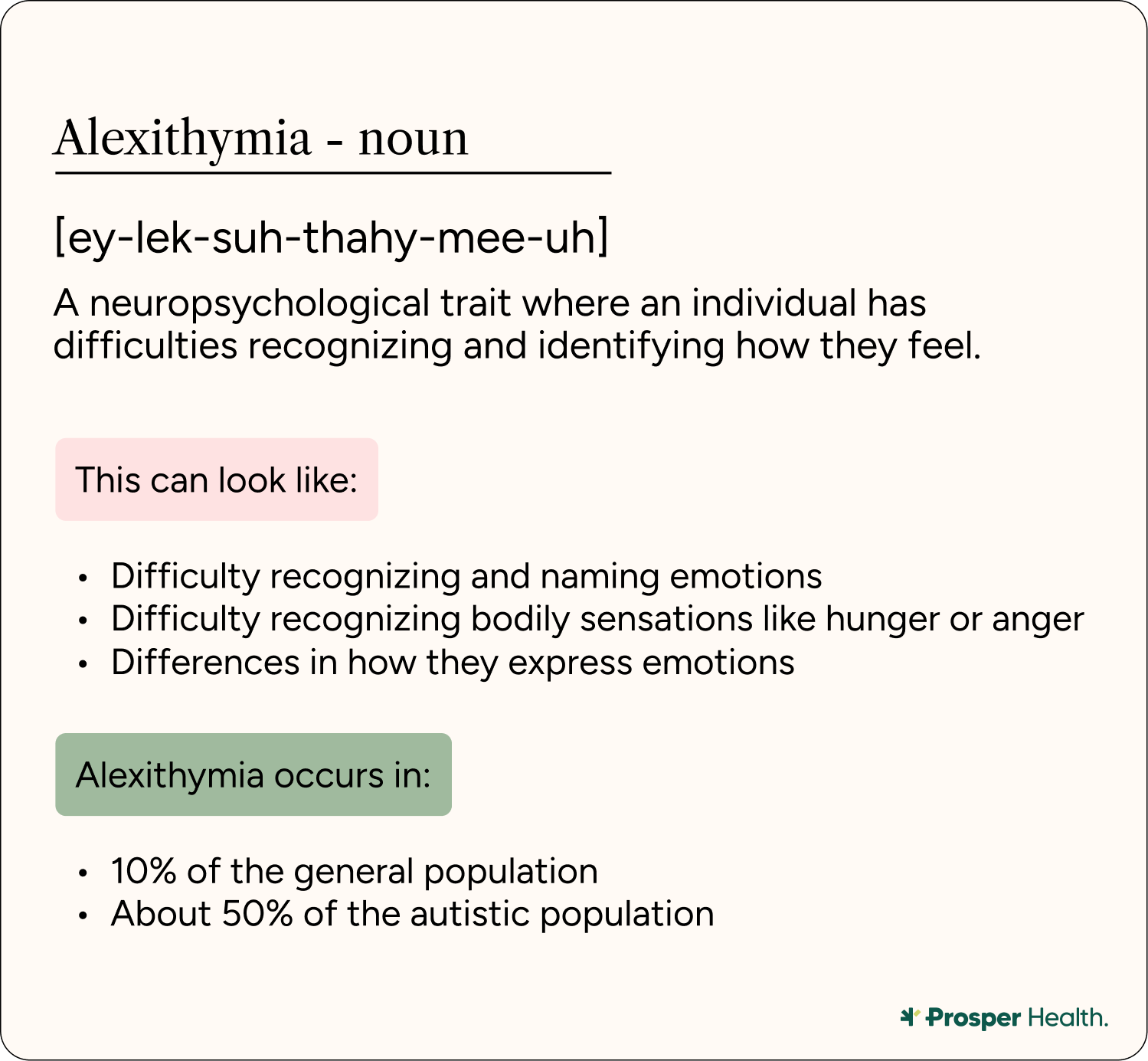
Alexithymia is defined as the challenge of naming, recognizing, and expressing emotions, at some point in one's life. Alexithymia may also manifest as difficulty or differences in identifying emotions vs. bodily sensations, such as thirst, instead construing it as anger or irritability.
I am autistic, and I often struggle with difficulty identifying my emotions and bodily states. For example, it is very difficult for me to identify when I’m hungry. If I wait too long to eat or fail to recognize the signs, I can grow frustrated and foggy, and often need the help of a checklist to identify the issue.
Many autistic individuals struggle with alexithymia. But autistic people aren’t the only ones who tangle with emotional difficulty: individuals with depression can struggle with recognizing their emotions, as can people with anxiety. Those with trauma–both physical and emotional–can also exhibit alexithymia. Alexithymia is also common among those with other neurodivergences, like ADHD.
In this article, we will explain what alexithymia is, its common characteristics, and how to develop strategies to both identify and ameliorate the condition.
What is alexithymia?
Alexithymia is a condition where the individual has difficulties recognizing and describing emotions they experience. Previously, alexithymia was thought to be exclusive to autism, but research has shown that it is actually widespread and can occur for a number of reasons.
We should note that alexithymia is not a disorder, but rather typifies a trait often associated with an overarching diagnosis like autism, anxiety, or depression.
The prevalence of alexithymia is estimated to be about 10% in the general population, and in a recent survey, approximately 50% of autistic individuals meet criteria for clinically significant alexithymia.
Dr. Jacqueline Shinall, Psy.D., psychologist with Prosper Health, elaborates, “[Alexithymia] can include things such as: trouble recognizing and naming their own emotions, challenges identifying and distinguishing physical sensations (e.g., confusing anxiety with stomach illness), challenges describing their emotions, or feeling disconnected from emotions.” It can also extend to difficulties recognizing and understanding the emotions of others, she adds.
But that doesn’t mean that autistic individuals, or anyone else, has low empathy. It simply means that those with alexithymia have trouble identifying emotional states, whether or not they want to connect. Alexithymia can be related to interoception, which is a person’s sense of their body’s signals. An individual with alexithymia can have trouble interpreting physical symptoms such as hunger or thirst.
Additionally, emotional dysregulation can play into alexithymia. In a large survey of the general population, those with a high instance of alexithymia traits reported lesser use of adaptive regulation strategies (like seeking help for emotional distress) and a higher use of maladaptive strategies (like suppressing their emotions).
Types of alexithymia
There are two different kinds of alexithymia: primary (where alexithymia is a trait) and secondary (where it is a state).
Cynthia Shaw, Psy.D, licensed clinical psychologist and owner of Authentically Living Psychological Services, explains.
“Primary alexithymia has developmental origins; meaning, this is somewhat of a biological form of processing. Whereas secondary alexithymia may occur after a traumatic incident or emotional disruption, where a person later struggles to be in touch with their emotions.”
Secondary alexithymia can also be caused by a physical disruption, like a car accident, a concussion, or other traumatic injuries.
What are common characteristics of alexithymia?
Alexithymia has some common symptoms.
- Difficulty identifying emotions in oneself
- Using generic emotional terms rather than specific ones
- Struggling to express emotions in a socially expected way
- Difficulty regulating emotions
- Trouble recognizing emotions in others
It’s worth noting that alexithymia is different for everyone, so some traits may manifest more or less for each individual. I have a strong understanding of my emotional state, but struggle with my physical state, for example.
What are some examples of how alexithymia shows up in daily life?
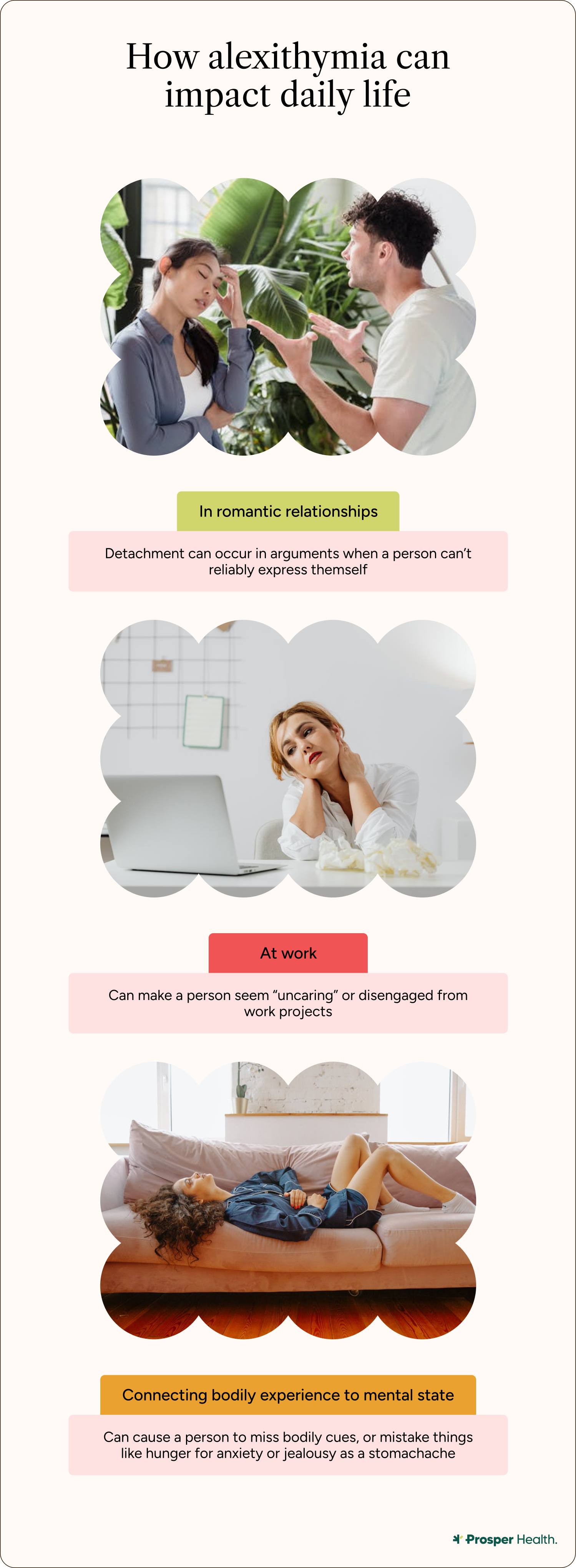
Alexithymia can show up in many ways in day-to-day life. The experience of living with alexithymia may create situations that require adaptability, but it's very possible to implement lifestyle strategies for adjustment. Here are a few typical ones:
Challenges in romantic relationships
- Arguments may arise when a person isn’t able to express emotions clearly
- Detachment in relationships
For example, “when a couple is arguing, but the person with alexithymia is unable to express themselves; their partner might know something is wrong, but the person with alexithymia may say they are fine,” says Dr. Shaw.
People may also seem more distant in relationships, says Dr. Shinall. “They may just not understand what someone else is feeling because they have a hard time recognizing the emotion in themselves. It can also cause difficulty expressing to a partner about why they feel a certain way, which again, can lead to misunderstandings.”
Difficulties at work
- Those with alexithymia may be seen as “uncaring” or “unfriendly”
- Affect may be construed as uncaring around work projects
“Others may think they don’t care or are not friendly because they don’t express or experience emotions the same way,” says Dr. Shinall.
Trouble linking physical manifestations to mental states
- Crossed wires in bodily functions: anxiety may appear as stomach upset or a headache, or jealousy as stomach upset
- Repeatedly seeking medical advice for bodily sensations linked to mental state rather than illness
- Missing body cues such as hunger or thirst
For example, someone with alexithymia may “not be able to identify that their stomach upset is jealousy, for example,” explains Dr. Shaw.
“People can misattribute physical sensations when the root of them is unclear. This can lead to people not picking up on changes in emotions and repeatedly seeking medical advice for, something like stomach aches, for example,” adds Dr. Shinall.
Emotional dysregulation
- Cannot identify root of irritation, only recognizing when they reach a meltdown state
- Feeling like there’s no middle ground to their emotions
“When someone cannot identify HOW they are feeling or why they are experiencing certain bodily sensations, then it is harder for them to manage those emotions,” says Dr. Shinall.
Difficulties in parenting
- Not responding in socially expected way to child’s cues
- Difficulty regulating emotions during overstimulation because of an inability to identify triggers
- Difficulty taking care of one’s own body because of missing cues like the need for rest or quiet
What causes alexithymia?
Alexithymia doesn’t have a single root cause, but rather can be the result of multiple conditions.
“There is a neurological component, which is likely due to differences in brain connectivity for brain regions typically involved in processing emotions. There is not one known cause leading to these differences, but typically associated with other diagnoses and experiences,” says Dr. Shinall.
For example, Dr. Shinall elaborates, it is more common in autistic individuals than the general population, or those with different mental health diagnoses. It can also be seen in those with Post-Traumatic Stress Disorder (PTSD), anxiety disorders, and depression, as well as those who experienced a traumatic brain injury (TBI), those who experienced a stroke, or have Parkinson’s disease.
Additionally, a person’s environment may contribute to alexithymia.
Having a “‘limited education or emotional vocabulary, not having emotional processing mirrored by a parent,” can cause alexithymia as well, Dr. Shaw explains.
What conditions commonly overlap with alexithymia?
Alexithymia most commonly overlaps with autism, with an estimated 50% rate of prevalence. But there are other conditions that commonly co-occur with alexythymia, including:
- PTSD
- Depression
- Anxiety
- ADHD
There are also acquired conditions that overlap with alexithymia, like:
- Traumatic brain injuries (TBI), like concussions
- Stroke
- Parkinson’s disease
Finally, there are environmental impacts as well, like:
- Parental neglect
- Emotional abuse
- Physical abuse
It’s worth noting that only about 10% of the general population is estimated to show traits of alexithymia.
How do I know if I have alexithymia?
While alexithymia is not a DSM-5 diagnosis, a therapist can still help to identify whether or not you suffer from its effects.
“Understanding alexithymia can help someone recognize if they have it. For example, if someone recognizes that they don’t typically know how they are feeling or how to describe it, or that others frequently tell them that they seem upset or angry when they do not realize they feel that way,” says Dr. Shinall.
Noting the disparity between what you think your feelings and expressions are, and what others perceive them as, can be very helpful in taking the first step to getting help with alexithymia. It’s important to know, however, that because alexithymia co-occurs with so many conditions, believing you have it does not necessarily mean you have autism as well, explains Dr. Shinall.
She also says that there are screening tools that, while not diagnostic, can help individuals determine if they have traits of alexithymia. The results of these tools can be helpful in the context of therapy.
Toronto Alexithymia Scale (TAS-20)
The Toronto Alexithymia Scale (TAS-20) is a 20-question self-report questionnaire that can help determine if you are exhibiting signs of alexithymia. The TAS-20 measures three areas:
- difficulty identifying feelings
- difficulty describing feelings
- externally-oriented thinking
The TAS-20 has been studied, and it is regarded as one of the most helpful tools to identify patterns of alexithymia by clinicians. However, the TAS-20 is not a diagnostic test, and because it is self-administered, it requires a certain level of awareness about one’s own emotional state.
Bermond-Vorst Alexithymia Questionnaire (BVAQ)
The Bermond-Vorst Alexithymia Questionnaire (BVAQ) is a 40 question self-report questionnaire developed to measure four areas of alexithymia signs:
- difficulty identifying feelings
- difficulty describing feelings
- externally oriented thinking
- restricted imagination
The BVAQ was developed to be more sensitive than the TAS-20, and it is a newer peer-tested tool. Like the TAS-20, however it is also self-administered, and is not diagnostic.
Observer Alexithymia Scale (OAS)
The Observer Alexithymia Scale differs from the TAS-20 and BVAQ in that it is a tool for relatives and friends to assess whether a person has alexithymia. The 33-item questionnaire measures five different factors in a person’s emotional affect, including whether they are:
leading
- distant
- uninsightful
- somatizing (i.e. focus on proper bodily sensations)
- humorless
- rigid
The OAS is scored on a four-point scale for each factor, leading to a total score describing overall alexithymia. However, the OAS is not always impartial, even if it is a potentially a useful tool in describing alexithymia. Like the other tools, it is not diagnostic.
What are some strategies to build emotional awareness?
Individuals with alexithymia struggle with emotional awareness, but certain tools can help. Strategies focus on recognizing bodily cues, and recognizing internal trigger points to certain emotions. But some tools can also develop a stronger emotional vocabulary, and ways to discuss emotions. Finally, there are visual tools, like an emotion chart, which can help develop an understanding of the brain-body connection.
“Building emotional intelligence often starts with self-curiosity, mindfulness, and introspection. Paying attention to bodily sensations, questioning what those cues may be indicating, and being open to learning about emotions are all ways to begin building awareness,” Dr Shaw says.
Here are some tools to build emotional awareness in those with alexithymia.
Cognitive Behavioral Therapy (CBT)
Cognitive behavioral therapy, which is goal-oriented talk therapy that helps change behavioral patterns, has been shown as effective for those with alexithymia in recognizing their emotions. It can work well for those with alexithymia, with some modifications, says Dr. Shinall.
“Using a modified version of CBT includes focus on recognizing and connecting bodily sensations, developing an emotional vocabulary, behavioral activation, and problem solving rather than a focus on cognitive restructuring,” she says.
Dialectical Behavioral Therapy (DBT)
Those with alexithymia have also benefited from dialectical behavioral therapy, which focuses on emotional state to get in touch with feelings in order to identify, describe, and ultimately regulate.
Like CBT, Dr. Shinall says DBT can be modified well for those with alexithymia.
Somatic therapy
Studies demonstrate that those with alexithymia have difficulties recognizing their bodily signals. Somatic therapy is based on feeling sensations in the body that relate to emotions.
“Over time, someone can start to connect some of these internal and bodily feelings with specific emotions,” says Dr. Shinall.
Studies have shown somatic therapy, which focuses on the physical manifestations and feelings associated with emotions, to be effective in helping to treat alexithymia.
Yoga/meditation
Similarly to somatic therapy, yoga and meditation can bring greater awareness to the body and mental state for someone with alexithymia. Studies have shown that yoga can decrease alexithymia symptoms. Yoga can be practiced in the comfort of your own home or in a studio class with others, which can stretch emotional understanding even further.
Emotion chart
Visual tools may also be helpful for those with alexithymia, serving as a way to capture the nuances of emotions that might otherwise be missed.
“For example, many people with alexithymia can identify a negative/positive feeling, but cannot pinpoint the emotion. Starting broad and helping them identify the emotion using visual cues can be beneficial,” says Dr. Shinall.
Visual tools can also help determine when an individual needs to decrease or increase the level of stimulation to help reregulate their emotions.
“In other words, recognizing sensory overload and what is causing it can help someone become more in-tune with their own emotions,” Dr. Shinall adds.
Charts can be found online for free, or can be developed with a therapist’s help.
Journaling
Finally, journaling about emotions can help those with alexithymia. The following are some leading self-reflection prompts.
- Where in my body am I feeling this?
- What cue is my body indicating? Do I think it’s accurate?
- What three words could I use to describe my emotions right now?
- How do I want to feel in an hour? How can I help myself embody that emotion?
How can I find support for alexithymia?
Many people struggle with identifying their emotions at some point in their lives, but if it’s impacting your daily life, it might be time to seek out support from a professional.
“It is most important that the therapist has experience with neurodivergence, understands how alexithymia presents in individuals, and is able to meet the client where they are at,” Dr. Shinall says.
Finding a therapist who is knowledgeable in somatic therapies can be a plus. Prosper Health has neurodiverse and neuro-affirming therapists who are skilled in working with those with alexithymia–including autistic individuals.
The bottom line
Alexithymia can be a challenge to identify, because emotions are so innate to how we process our sense of self and the world around us.
However, with proper support, real progress can be made to identify emotions and connect our bodies to those experiences. Learning to understand yourself better–and to support your unique mind, is paramount to understanding and living with alexithymia.
Frequently asked questions (FAQs)
What are the symptoms of alexithymia?
Some common symptoms of alexithymia are:
- Difficulty identifying emotions in oneself
- Using generic emotional terms rather than specific ones
- Struggling to express emotions in a socially expected way
- Difficulty regulating emotions
- Trouble recognizing emotions in others
Can you have alexithymia and not be autistic?
Yes, you can have alexithymia and not be autistic. Alexithymia is experienced by up to 10% of the general population, though the greatest overlap (50%) is with autistic individuals.
Can alexithymia be treated?
Yes, alexithymia can be treated. Licensed therapists typically suggest somatic therapy, cognitive behavioral therapy (CBT), or dialectical behavioral therapy (DBT).
Sources
https://pmc.ncbi.nlm.nih.gov/articles/PMC6331035/?referrer_domain=www.google.com
http://linkinghub.elsevier.com/retrieve/pii/S0165178115000761
https://pmc.ncbi.nlm.nih.gov/articles/PMC5098957/
https://pubmed.ncbi.nlm.nih.gov/36566943/
https://psychiatryonline.org/doi/10.1176/appi.neuropsych.14070169
https://pmc.ncbi.nlm.nih.gov/articles/PMC5098957/
https://pmc.ncbi.nlm.nih.gov/articles/PMC4274591/
https://pmc.ncbi.nlm.nih.gov/articles/PMC5645215/
https://www.frontiersin.org/journals/psychiatry/articles/10.3389/fpsyt.2018.00111/full
https://www.sciencedirect.com/science/article/abs/pii/S0022399902004671
https://ijbmc.org/index.php/ijbmc/article/view/873


