.webp)


Key Takeaways
- Sensory Processing Disorder (SPD) is not a formal diagnosis in the DSM-5-TR, but it is a heavily researched condition.
- There are significant overlaps with autism and ADHD, primarily because all three conditions have nervous system regulation components.
- Many adults with SPD develop coping strategies, like masking, often causing their condition to be misdiagnosed or missed entirely.
- Sensory differences can significantly impact daily life at home, work, public spaces, and relationships.
- There is no cure, but SPD is manageable. Support options include occupational therapy, cognitive behavioral therapy, and sensory tools.
Key Takeaways
- Sensory Processing Disorder (SPD) is not a formal diagnosis in the DSM-5-TR, but it is a heavily researched condition.
- There are significant overlaps with autism and ADHD, primarily because all three conditions have nervous system regulation components.
- Many adults with SPD develop coping strategies, like masking, often causing their condition to be misdiagnosed or missed entirely.
- Sensory differences can significantly impact daily life at home, work, public spaces, and relationships.
- There is no cure, but SPD is manageable. Support options include occupational therapy, cognitive behavioral therapy, and sensory tools.
Let’s say you’re taking a walk, enjoying the bright sunshine and fresh air, when suddenly, a loud, smelly garbage truck speeds by. For most neurotypical people, it’s just a brief hiccup in their otherwise peaceful stroll.
But for adults with sensory processing disorder—or the more affirming, sensory processing differences—the truck’s fleeting noise and stench can cause sensory overload, thus destroying whatever pleasure they might’ve been getting from their morning walk.
Sensory processing disorder presents a tricky situation for adults, because while it is a very real condition, it is not a formal diagnosis in the Diagnostic and Statistical Manual of Mental Disorders, 5th Edition (DSM-5-TR). But this grey area doesn’t diminish how difficult and potentially isolating sensory overwhelm can be as an adult.
In this article, we’ll explain what sensory processing disorder is, why it’s not a formal diagnosis, how it can present in adults, how it relates to autism, and what supports exist for those who experience sensory overload.
What is sensory processing disorder?
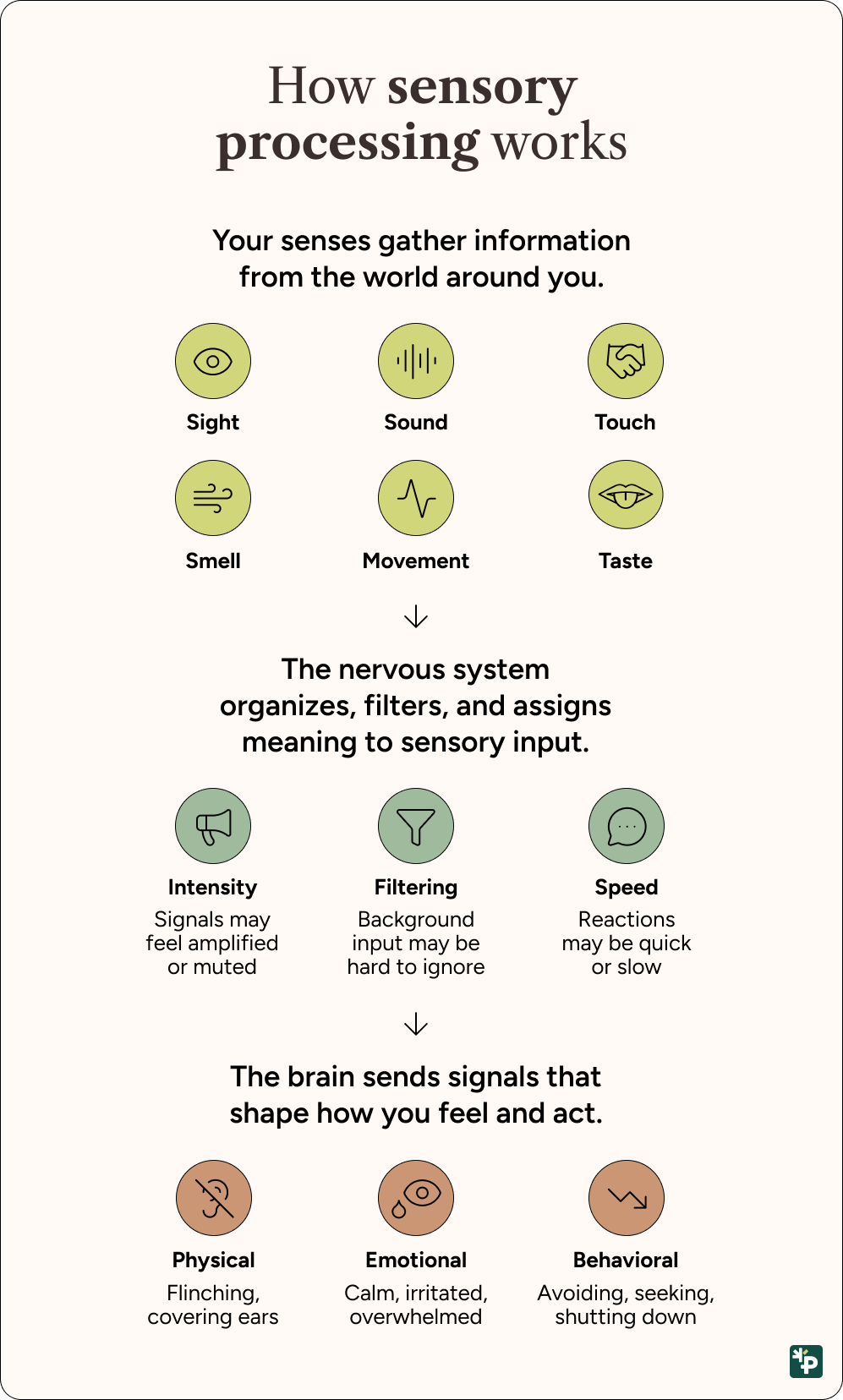
According to the Cleveland Clinic, sensory processing disorder (SPD) is a difference in how your brain understands and responds to information from your senses. Research estimates that about one to three out of every 20 people in the general U.S. population have SPD, with estimates higher for those with neurodevelopmental conditions.
A note on language
“Sensory processing disorder” is a commonly used but imperfect term, having evolved from the now-defunct sensory integration disorder. Nowadays, many neurodivergent people prefer language like “sensory processing differences” instead. However, we will use “sensory processing disorder” and “SPD” in this article for consistency purposes, as researchers and reputable sources like the Cleveland Clinic opt for these terms as well.
Is “sensory processing disorder” an official diagnosis?
One of the key challenges in addressing sensory processing disorder is that it is not a currently recognized medical diagnosis like autism or ADHD. Although clinicians are increasingly recognizing SPD, it remains a heavily debated condition and is not an official DSM diagnosis.
At the same time, SPD “is a widely recognized condition that has been heavily researched,” says Dr. Hannah Jones, a licensed clinical psychologist with Prosper Health. Even though it’s not in the DSM, Dr. Jones confirms that clinicians can address SPD with their patients, noting that occupational therapists (who usually diagnose SPD) use standardized, reliable measures to “differentiate a person’s sensory processing from what is considered ‘typical.’”
For Kristen Delventhal, LCSW, a psychotherapist and sibling to an autistic woman, SPD provides clinically useful information for understanding distress, behavior patterns, and nervous-system regulation. In short, acknowledging SPD helps to provide a more holistic picture.
“As a clinician, I find it is important to validate the client’s lived experience without over-pathologizing it,” she says. “While labels can feel important in some sense, the more important thing is identifying the needs and applying supportive interventions.”
In addition, observes Dr. Jones, SPD is “strongly associated with other forms of neurodivergence.”
But it’s not just that there isn’t an official SPD diagnosis. Another huge wrinkle in getting help for sensory processing differences is that SPD is often overlooked in adults. Both Delventhal and Dr. Jones point out that SPD is still treated as a childhood issue: “There’s a bias in diagnostic criteria that describes most clearly what it looks like in children,” says Dr. Jones.
Both clinicians also note that by the time people reach adulthood, many have already adopted coping strategies to hide their SPD, such as masking, which can cause their condition to either be misdiagnosed or missed entirely.
What does sensory processing disorder look like in adults?
Sensory issues in adults will, of course, vary by individual, and they can present through all five senses: sight, sound, smell, taste, and touch. “Some adults with SPD may not feel hunger, thirst, or pain clearly,” explains Dr. Jones. But, in the case of tactile sensitivity in adults, others may feel things too intensely. Even a minor stomachache or a clothing tag can feel unbearable. This type of chronic sensory overload can lead to fatigue, brain fog, or even meltdowns from built-up stress.
Below, Dr. Jones provides some common examples of what sensory processing disorder looks like in adults:
- Water sensitivity: Discomfort with water pressure, water temperature, and/or sound while showering and/or brushing teeth can lead to challenges with hygiene.
- Fabric sensitivity: Clothing sensitivity in adults is a very real thing. Some may have difficulty wearing certain clothes because of fabric sensitivity or discomfort with compression or looseness.
- Light/sound sensitivity: Fluorescent lighting, background chatter, or typing sounds can make it hard for some people to concentrate in work settings and cause them to mentally drain faster than others.
- Sensitivity to physical affection: Some people may struggle with hugs, kissing, hand-holding, or sexual intimacy, which can potentially lead to relationship misunderstandings.
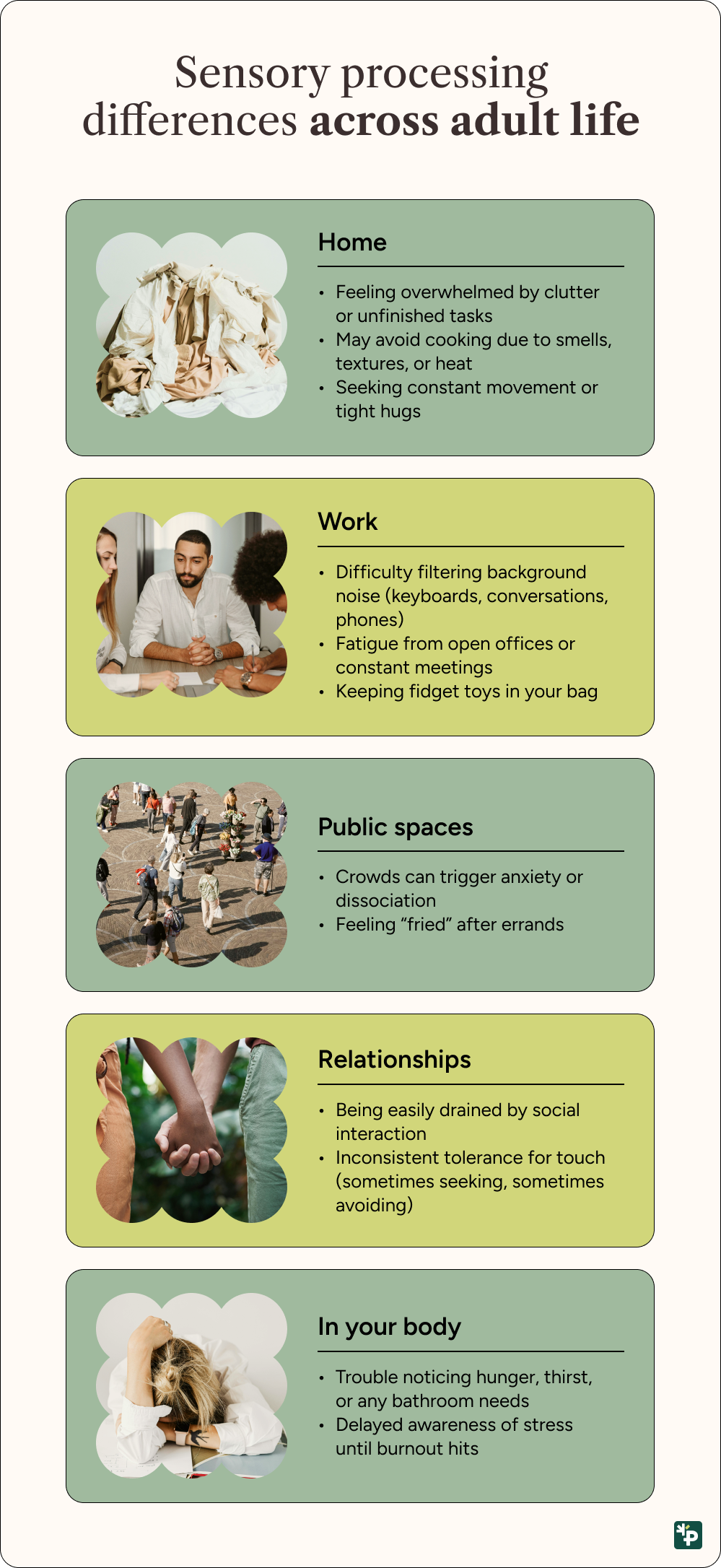
All of these sensitivities can affect several aspects of adult life in different ways. Read on for our breakdown of how to spot signs of SPD with guidance from Delventhal:
At home: daily routines and sensory load
- Feeling overwhelmed by clutter, visual noise, or unfinished tasks
- Difficulty transitioning between activities (work → home → bedtime)
- Irritation with household sounds (appliances, TVs, multiple conversations)
- Avoidance of cooking due to smells, textures, or heat
- Needing rigid routines to feel regulated
At work: productivity, focus, and overwhelm
- Difficulty filtering background noise (phones, keyboards, conversations)
- Fatigue from open offices or constant meetings
- Strong emotional reactions to interruptions
- Either hyperfocus or complete shutdown
- Needing more recovery time after “normal” workdays
In public spaces: noise, crowds, and unpredictability
- Grocery stores can feel physically painful or disorienting
- Crowds triggering anxiety or dissociation
- Strong startle responses
- Feeling “fried” after errands
- Leaving early or avoiding outings altogether
In relationships: communication, touch, and energy
- Being easily drained by social interaction
- Misinterpreted as distant or irritable
- Inconsistent tolerance for touch (sometimes soothing, sometimes overwhelming)
- Needing alone time that others perceive as rejection
- Difficulty explaining sensory needs without guilt
In your body: interoception, pain, and fatigue
- Trouble noticing hunger, thirst, or bathroom needs
- Delayed awareness of stress until autistic burnout hits
- Heightened pain sensitivity—or unusually high pain tolerance
- Chronic fatigue without clear medical cause
- Feeling disconnected from bodily cues
What are common types of SPD?
Even though SPD isn’t an official diagnosis, there are approximately six different types of this condition. To be clear, these are common patterns of sensory processing disorder in adults, not diagnostic boxes, and often people do have overlap between these different patterns.
If anything, these descriptions, with examples provided by both Delventhal and Dr. Jones, may help you recognize your own sensory processing sensitivity.
Sensory over-responsivity (SOR)
People with SOR are overly sensitive to sensory information. They’re likely overwhelmed by bright lights, multiple conversations, and noise. Also, those with SOR may avoid certain food textures and experience clothing sensitivity. This level of sensory aversion can cause people to feel anxious or irritable.
Sensory under-responsivity (SUR)
Those with SUR need more sensory information than usual before it has an impact. This can cause delays in response time compared to neurotypical people.
If you’re experiencing this kind of sensory under-responsivity, you may not notice hunger, pain, or temperature changes until they reach extreme levels. This can include wearing multiple layers in hot weather or shorts and sandals in the cold. Or, you may not realize you stubbed your toe or got a bruise until later on because you didn’t feel the pain.
Sensory craving (SC)
People who exhibit SC need and seek out sensory information for stimulation. To feel regulated, they’ll lean toward intense physical activity and thrill-seeking behaviors like skydiving and rollercoasters. Or they’ll opt for sensory stimulation like constant fidgeting, pacing, or movement, loud music, and strong, intensely flavored food.
However, the stimulation doesn’t always satisfy the sensory craving, and these behaviors can often be confused with ADHD symptoms.
Sensory discrimination differences
This type of SPD means a person has difficulties distinguishing the subtleties of sensory information. They may not be able to understand things they hear, or even just acknowledge when a sound, texture, or other physical sensation feels off.
Another example of sensory discrimination differences is a tendency to grip something too tightly (causing broken objects) or too loosely (causing a tendency to drop things).
Postural differences
A person with postural differences experiences poor body awareness: They may have difficulty sitting upright without support (especially for long periods), and tend to slouch and lean. They also need frequent movement to maintain their focus.
Dyspraxia (motor planning differences)
Dyspraxia causes challenges with performing motor skills, such as tying one's shoes or cooking. People with this condition may appear “clumsy” or uncoordinated because it takes them longer to learn these kinds of skills. Occupational therapy can be beneficial for people with dyspraxia.
How does SPD relate to autism and ADHD?
There are significant overlaps between sensory processing disorder, autism, and ADHD, primarily because, says Delventhal, all three have nervous system regulation components.
SPD and autism
One of the criteria for autism diagnosis is significant differences in sensory processing. "This can present very similarly to the way that processing differences do in SPD,” says Dr. Jones. This is a distinctive overlap between SPD and autism, but sensory processing differences don’t automatically trigger an autism diagnosis (other criteria must be met).
At the same time, Dr. Jones explains that “a person can be autistic and not have significant sensory processing differences.”
SPD and ADHD
While sensory processing challenges are not currently a requirement for diagnosing ADHD (unlike an autism diagnosis), studies have found a higher rate of sensory processing differences in people with ADHD. This data suggests that “evaluating sensory processing in individuals with ADHD might be important for a full picture of their support needs,” says Dr. Jones.
What are support options for adults with SPD?
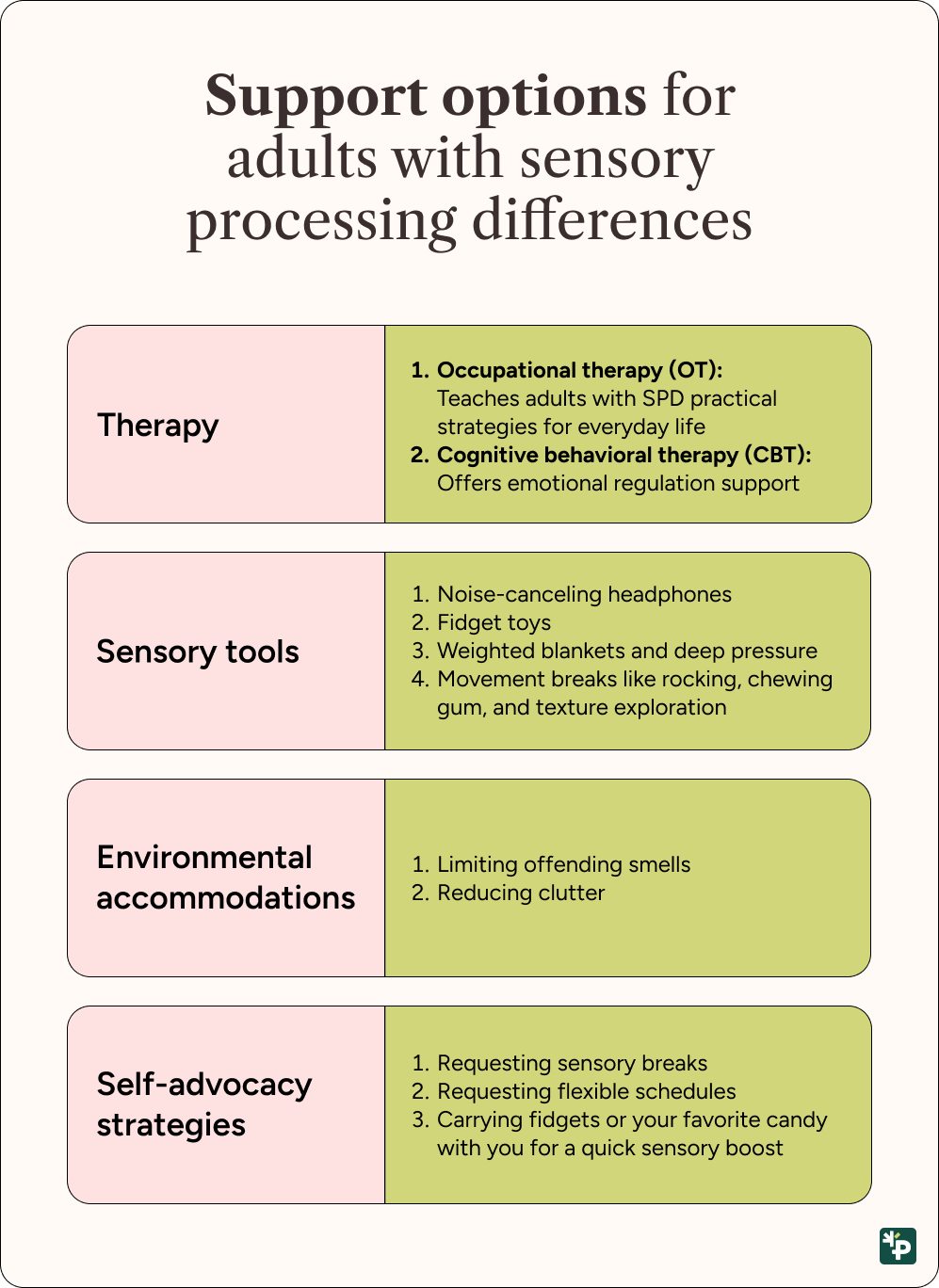
There is no “cure” for SPD, but there are several therapeutic options available to help you manage day-to-day challenges.
Occupational therapy (OT)
Occupational therapy is a form of treatment that helps people perform daily tasks. According to Delventhal, it’s considered “the gold standard” for sensory assessment because it not only helps adults understand their sensory profile, but it also teaches them practical strategies for everyday life.
It’s also beneficial for treating sensory processing disorder in adults because occupational therapists can recommend specific routines, strategies, and tools to “support regulation, reduce overwhelm, and improve daily life,” says Dr. Jones.
Sensory Integration Therapy (SIT), which falls under the OT umbrella, is an option for people with SPD because it focuses on retraining the brain’s response to sensory input, allowing them to adapt comfortably to their surroundings.
This adaptation is achieved through “structured, repetitive exposure in a safe environment,” explains Dr. Jones. While SIT was initially developed to help children, this form of therapy can be adapted for adults by including activities that “promote tolerance, balance, or body awareness, especially when sensory sensitivities impact daily tasks or mobility,” says Dr. Jones. More research on this type of therapy in adults is needed, but it is a promising option.
Cognitive behavioral therapy (CBT)
While OT can provide practical strategies, cognitive-behavioral therapy offers support for emotional regulation. Delventhal highlights how people with SPD might feel shame around their sensory-based challenges, as well as experience catastrophic overwhelm. That’s where CBT comes in, as this type of therapy can help with advocacy, boundary-setting, and emotional validation.
“CBT helps reframe unhelpful or unrealistic thoughts about sensory challenges (e.g., ‘I'm a grown adult; I should be able to eat broccoli’),” says Dr. Jones.
Sensory tools and environmental accommodations
In addition to therapy, there are several sensory tools and environmental accommodations that can help people with SPD deal with sensory overload and the desire for increased sensory input. Both Delventhal and Dr. Jones recommend sensory tools like:
- Noise-canceling headphones
- Fidget tools
- Deep pressure tools, like a weighted blanket
- Dim lighting
- Scheduled sensory breaks
As for environmental accommodations, these can include things like limiting certain smells, reducing clutter, or changing seating to “significantly improve focus, comfort, and energy in everyday spaces,” says Dr. Jones.
Workplace and daily-life strategies
Figuring out ways to regulate your nervous system while at work and at home is key to living with SPD.
“Sticking with predictable routines helps implement transition buffers and reduces decision fatigue,” advises Delventhal. She also recommends designing living spaces in ways that feel regulating, “so we are not creating nervous system overload.” Depending on your needs, that could mean eliminating fluorescent lighting or always having a weighted blanket nearby.
As for workplace strategies, Dr. Jones suggests building in sensory breaks, using flexible schedules, organizing workspaces according to sensory needs, and advocating for accommodations. Doing so helps adults with sensory processing disorder manage their sensory load and sustain their productivity.
The bottom line
Sensory processing disorder may not be an official diagnosis (yet), but it should still be taken seriously. Clinicians are learning more about this condition every day, as there is plenty of research available to provide insight and guidance.
“Sensory processing disorder can have a significant impact on daily life,” acknowledges Dr. Jones, but also notes that it’s a manageable condition with self-compassion, external support, and appropriate resources. She often reminds her clients, "Your nervous system isn’t broken—it just needs different inputs to function well.”
If you have concerns about sensory processing disorder, Prosper Health is here to help.
Our virtual, neurodiversity-affirming therapy services provide mental health support for autistic and neurodivergent adults—plus, they’re covered by insurance, making care more affordable.
With Prosper’s support, understanding SPD—and how to manage this condition—is possible.
Frequently asked questions (FAQs)
What are the types of sensory processing disorder?
There are approximately six different types of SPD, all of which can potentially overlap:
- Sensory over-responsitivity (SOR)
- Sensory under-responsitivity (SUR)
- Sensory craving (SC)
- Sensory discrimination differences
- Postural differences
- Dyspraxia (motor planning differences)
What are the signs of sensory processing disorder in adults?
Signs of sensory processing disorder in adults can vary by individual, but some common examples can include:
- Water sensitivity: discomfort with water pressure, water temperature, and/or sound
- Fabric sensitivity: discomfort with certain fabrics and/or levels of compression or looseness
- Light/sound sensitivity: discomfort with fluorescent lighting, background chatter, or typing sounds
- Sensitivity to physical affection: discomfort with hugs, kissing, hand-holding, or sexual intimacy
How do you treat sensory overload in adults?
Treatments like occupational therapy (OT) – with a focus on sensory integration therapy (SIT) – can help adults with SPD develop practical coping strategies. Cognitive behavioral therapy (CBT) addresses the emotional dysregulation that can develop from sensory processing challenges. In addition, environmental accommodations (like dimmed lighting and decluttered workspaces) and various sensory tools (like noise-canceling headphones) can help adults better manage their SPD.
Is sensory processing disorder autism?
No, sensory processing disorder is not the same as autism, but there are noticeable overlaps between the two conditions. Specifically, one of the criteria for autism diagnosis is significant differences in sensory processing. Therefore, it’s quite common for neurodivergent adults to have SPD, even though not all autistic people have sensory processing issues.
Is sensory processing disorder a diagnosis?
Sensory processing disorder is not currently an officially recognized medical diagnosis. However, clinicians are increasingly recognizing this heavily researched condition, allowing for more tailored treatment.
Sources
https://www.prosperhealth.io/blog/sensory-overload-in-autistic-adults
https://my.clevelandclinic.org/health/diseases/sensory-processing-disorder-spd
https://www.prosperhealth.io/blog/autism-vs-adhd
https://pmc.ncbi.nlm.nih.gov/articles/PMC5733937/
https://www.uclahealth.org/news/article/sensory-processing-disorder-not-yet-recognized-diagnosis
https://www.psychologytoday.com/us/basics/sensory-processing-disorder
https://www.prosperhealth.io/blog/autism-masking
https://www.prosperhealth.io/blog/autism-meltdowns
https://my.clevelandclinic.org/health/diseases/23963-dyspraxia-developmental-coordination-disorder-dcd
https://www.prosperhealth.io/blog/what-is-audhd
https://www.sciencedirect.com/science/article/pii/S0890856725002096
https://my.clevelandclinic.org/health/treatments/occupational-therapy
https://www.healthychildren.org/English/health-issues/conditions/developmental-disabilities/Pages/Sensory-Integration-Therapy.aspx
https://www.apa.org/ptsd-guideline/patients-and-families/cognitive-behavioral
https://www.prosperhealth.io/blog/autistic-burnout
https://www.prosperhealth.io/blog/how-to-deal-with-sensory-overload-in-autistic-adults
https://www.prosperhealth.io/blog/how-to-regulate-your-nervous-system


