.webp)


Key Takeaways
- The window of tolerance is the zone of nervous system arousal where you feel grounded and regulated, and you can think and behave without disruption.
- People often leave their windows of tolerance when they’re overstressed or overstimulated. This can lead to hyperarousal or hypoarousal.
- Hyperarousal can involve anxiety, irritability, or restlessness. Meanwhile, hypoarousal may cause numbness, fatigue, and fogginess.
- Certain groups of people, such as neurodivergent individuals and trauma survivors, may have narrower windows of tolerance, on average.
- With effort and experimentation, people can learn how to return to their windows of tolerance and even expand their window of tolerance over time.
When autistic yoga therapist Elizabeth Walunas is inside her window of tolerance, she feels a sense of quiet in her gut. She can think and act in a goal-oriented way and handle stimulation sustainably. Walunas knows she’s left her window of tolerance when she gets “zingy and jumpy and twisty sensations of anxiety” in her stomach.
The window of tolerance varies from person to person, and everyone reacts differently outside of it. But the truth is, many of us spend a lot of time outside of our windows. This is especially true for neurodivergent adults, which is why cries of “calm down!” and “just relax!” don’t always land for our nervous systems.
By understanding the window of tolerance, we can learn how to better manage stress. In this article, we’ll explore what happens in our minds and bodies when we’re inside or outside our windows of tolerance, how to recognize when we’ve left our zones of tolerance, and what to do in both the short-term and long-term.
What is the window of tolerance?
The window of tolerance is the optimal zone of nervous system arousal where a person can think, feel, and respond with ease and flexibility. Put simply, it’s when you feel grounded, emotionally regulated, and best able to handle the everyday stressors of life. The width of the window varies from person to person. It can even shift over time in the same individual.

It all boils down to your sympathetic and parasympathetic nervous systems. The sympathetic nervous system helps prepare your body to respond to challenges, while the parasympathetic nervous system helps your body recover and return to a calmer state. When your nervous system is able to flexibly respond to changing demands, you're generally within your window of tolerance. There may be some stress, but you’re able to manage it effectively.
That said, it’s possible to veer too far toward one system at the expense of the other. This may cause you to leave your zone of tolerance and enter a state of either hyperarousal or hypoarousal, making it more difficult to deal with stress.
Everyone has a different window of tolerance. Some people have narrower or wider windows than others, making it more or less challenging to cope with stress.
A person’s window of tolerance can also shift over time based on circumstances, mental health, and other factors. “Context matters,” says Dr. Hannah Jones, a licensed clinical psychologist with Prosper Health.
The concept of the “window of tolerance” was introduced by psychiatrist Dan Siegel in his 1999 book about child development, The Developing Mind.
What happens inside the window
Being in the window of tolerance doesn’t necessarily mean you’re in a constant state of calm and peace. Rather, you’re able to tolerate emotions and life challenges “without having a pronounced stress reaction” such as hyperarousal or hypoarousal, Jones explains.
You may feel calm, but even if you don’t, you’re likely to maintain clear thinking, feel regulated and emotionally resilient, and have a neutral to positive mood. You’ll also have the energy and motivation you need to deal with struggles in life.
What happens when you leave the window: hyperarousal and hypoarousal
When stress exceeds your window of tolerance, you may enter a state of hyperarousal or hypoarousal. This happens when your arousal or energy levels become either too high (hyperarousal) or too low (hypoarousal). Notably, someone can have signs of both at the same time.
In any case, it can become difficult to think clearly or respond flexibly. This isn’t a choice or personal failure, but a nervous system survival response. “People can realize they are outside of their window of tolerance by paying attention to changes in their body, emotions, thinking, and behavior,” says Jones.
Recognizing hyperarousal
Hyperarousal, which can trigger a “fight-or-flight” response, often takes place when you feel overwhelmed or unsafe. Sensory overload, social exhaustion, and executive function demands are common triggers, especially if you're neurodivergent.
Signs can be subtle or more obvious. They may include the following:
- Anxiety
- Irritability or rage
- Excessive energy
- Restlessness
- Jitteriness
- Panic attacks
- Racing thoughts
- Difficulty concentrating
- A pounding sensation in the head
- Black-and-white thinking
Hyperarousal can also manifest physically through signs like shallow breathing, muscle tension, or a racing heart rate, says Jones. That’s because there’s too much activity happening in your sympathetic nervous system.
Signs of hyperarousal may overlap with anxiety or mood disorders. However, anxiety and mood disorders are more persistent, prolonged, and disruptive.
Recognizing hypoarousal
Hypoarousal happens when stresses build up over time and “the nervous system is overwhelmed beyond its capacity and shuts down,” says Tyana Tavakol, licensed therapist in CA and FL and virtual private practice owner of Uncovering You. “The nervous system has decided that being activated is not changing the situation, so the only thing that's left is to go internal."
Thus, you may experience changes in parasympathetic activity. Hypoarousal can lead to phenomena such as:
- Low mood
- Fatigue
- Emotional numbness
- Fogginess
- A feeling of being “checked out”
- A sense of disconnection
- Dissociation
- Slower breathing and heart rate
- Difficulty finding words, concentrating, or completing simple tasks
All in all, hypoarousal can feel like a shutdown. While some people may mistake it for laziness or “not caring,” it’s actually your body’s way of conserving energy. Many autistic people experience hypoarousal after they spend a lot of time masking or in an environment that overwhelms their senses. Burnout can also be a trigger.
Hypoarousal can be confused with depression. While they can overlap, depression is more consistent, lasts a longer period of time, and significantly interferes with your quality of life.
Some people experience elements of both hyperarousal and hypoarousal during overwhelming situations, which can resemble a freeze response.
Why some people have a narrower window
Some individuals have narrower windows of tolerance than average. This is especially common (although not universal) among neurodivergent individuals and trauma survivors. A narrow zone of tolerance can also befall just about anyone in certain circumstances—even people who typically have wider windows. Here are some reasons why:
Neurodivergence
Neurodivergent people (such as autistic individuals or those with ADHD) may have narrower windows of tolerance. This is partly because many neurodivergent individuals are more sensitive to sensory stimuli than average, which means there’s less bandwidth available.
What’s more, our society typically doesn’t account for the needs of neurodivergent individuals. Sensory stimuli and social demands often exceed their comfort zones. Many neurodivergent people also expend a lot of their energy trying to mask their true selves. It’s easy to get overwhelmed navigating a neurotypical world.
It’s also common for neurodivergent people to have differences in interoception (sensory awareness). In this case, they may not notice dysregulation until it’s significant.
“These extra pressures add up and make it more and more difficult to stay emotionally regulated and in the window of tolerance,” says Tyana Tavakol, licensed therapist in CA and FL and virtual private practice owner of Uncovering You.
CTA: Does this sound like you? A formal evaluation at Prosper Health can help you find out whether a neurodivergent nervous system is behind your narrow window of tolerance. Get started today.
Trauma
If someone experiences trauma, reminders might trigger their nervous system into extreme states. Not only that, but their brain may start to associate fear with an overwhelming sense of dread, and self-soothing may become difficult, notes Siegel in The Developing Mind. That's because trauma can lead to a persistent feeling of being out of control. All of this can narrow the window of tolerance and lead to even more distress outside of it.
Mental illness
Different mental illnesses such as anxiety, depression, post-traumatic stress disorder, or even personality disorders may narrow a person’s window of tolerance. That’s why it’s a good idea to see a mental health professional if signs of hyperarousal or hypoarousal are consistently interfering with your life and causing a lot of distress.
Situational Factors
Even in the same person, the window of tolerance can be narrower in certain situations. For instance, a person’s window of tolerance can narrow if they’re in a negative state of mind or dealing with burnout. This may also occur if they have no social support or their needs (for food, sleep, water, etc) aren’t being met.
It’s important to note that having a narrower window of tolerance is a nervous system adaptation, not a deficiency.
Why common regulation advice often doesn't work
You may have heard regulation advice like deep breathing, mindfulness, or splashing your face with cold water. To be sure, these strategies do work for many people. But if you don’t find them effective, that doesn’t mean anything is wrong with you.
These tools can be ineffective for several reasons. Standard advice doesn’t account for the fact that every person’s nervous system is unique. For example, certain strategies can feel dysregulating for people with sensory sensitivities. In addition, some people may struggle with tools that rely on noticing internal sensations.
“Many Western medical system-based regulation strategies assume a person has enough capacity to implement strategies in the moment,” says Jones. “For people with narrower windows, those tools can feel inaccessible or even increase frustration.”
If standard regulation strategies work for you, great! If not, don’t feel pressured to conform. What you need is some experimentation to learn what works best for you. Here’s what you can try.
How to come back when you’re outside your window
The proper tools to return to your window of tolerance depend on where you’re coming from. You’ll need strategies to relieve overstimulation either way, but if you’re in a state of hypoarousal, you might want activating strategies, as well.
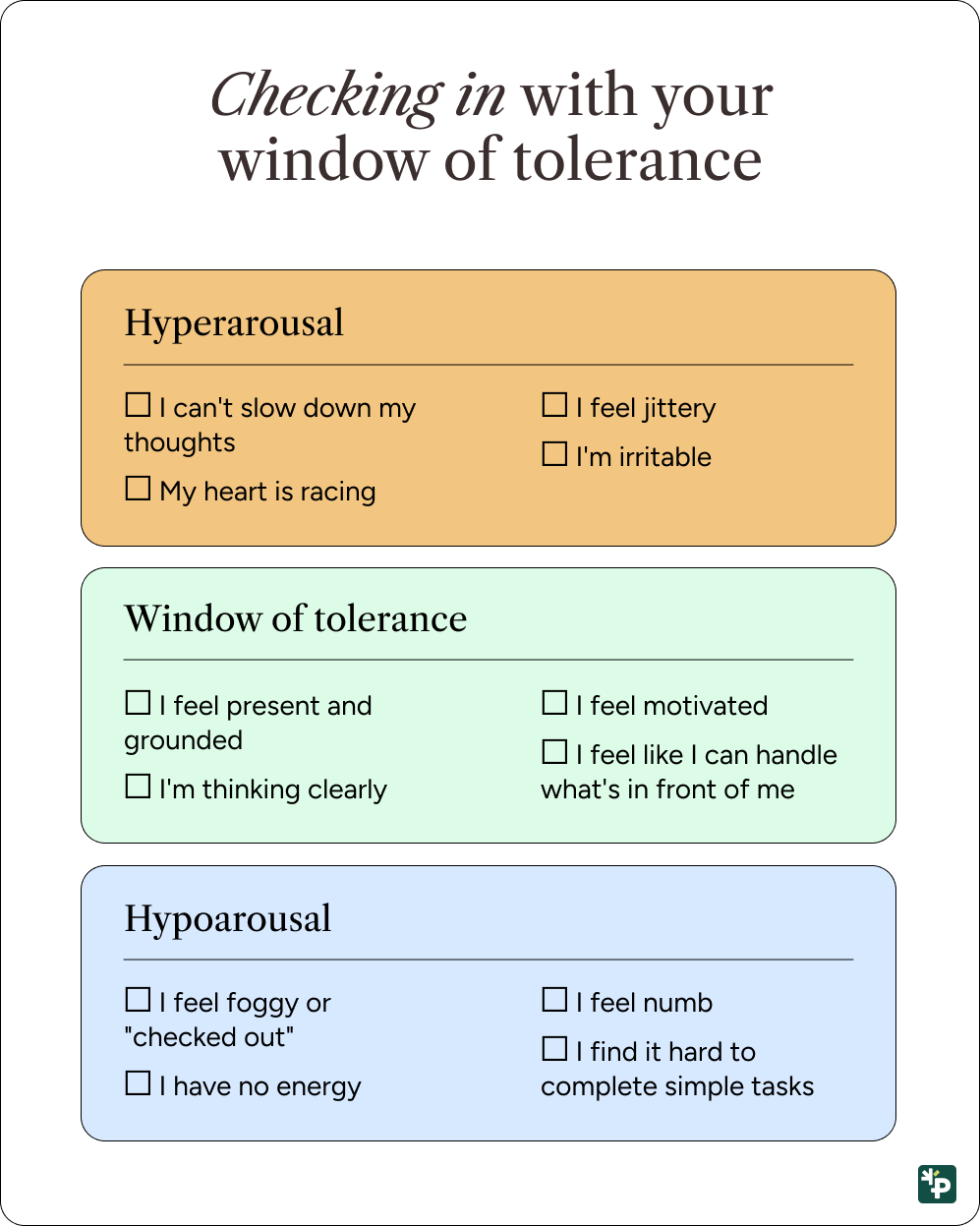
The following are ways you might regulate your nervous system in the moment (instead of expanding your window, which we’ll discuss later). Don’t forget that these are tools to try, not instructions to follow. What works for you may be different from what works for somebody else.
Tools for hyperarousal
When you’re in a state of hyperarousal, “the goal is not a perfect sense of calm, but gently shifting the nervous system toward safety,” says Jones. Here are some strategies that might help:
- Step away from stimulation: Hyperarousal often happens in overwhelming environments or situations. Stepping away, if you can do so, can help you return to your window of tolerance.
- Wear noise-cancelling headphones: Headphones can help drown out noises that you find agitating.
- Dim the lights: Bright lights often contribute to overstimulation, especially for autistic individuals.
- Wear sunglasses: Sunglasses can reduce the amount of sensory input you’re taking in.
- Wear comfortable clothes: If irritating clothing is getting on your nerves, swap it out for clothes that feel more comfortable.
- Use comfort items: You can take advantage of tools that you find comforting, such as weighted blankets, candles, or soothing smells.
- Use grounding strategies: You may benefit from grounding strategies such as tapping, repetitive and soothing movements, or the 5-4-3-2-1 technique.
- Listen to relaxing music: Slower-paced, soothing music may reduce stress, anxiety, blood pressure, and heart rate.
- Bask in nature: Spending time in nature (either green or blue spaces) can boost your mood and relieve stress.
- Use imagery: Visualize something that brings you peace—for example, a beautiful location (real or imagined), a loved one, or a cherished pet.
Tools for hypoarousal
How to cope with hypoarousal depends largely on what caused your hypoarousal to begin with.
Many of the above strategies can also help you decompress if you’ve entered hyperarousal due to being overstimulated. Reducing sensory input can “help the nervous system gain the capacity to start to come back online,” Tavakol says.
If you’ve gotten all the rest you need—or if you’re in hypoarousal because of understimulation—you might want additional strategies to help reactivate your nervous system. These might include the following:
- Put on an energizing song: Music that is relatively fast-paced (but not overstimulating) can be activating.
- Engage in physical activity: Getting up and moving—whether you prefer to take a walk, do a few jumping jacks, dance, or whatever else—may energize you. Even just stretching can be helpful.
- Spend time in the sun: Sunlight can bring you energy. Just be sure to wear your sunscreen!
- Sun lamp: If you don’t have direct access to sunlight, then carefully using a sun lamp may be your next best bet.
- Take advantage of the cold: Among other ways to take advantage of the cold, you could try sucking on ice cubes, eating a cold treat like ice cream, or taking a cool shower.
- Drink water: Drinking water can help you feel more alert and productive.
- Focus on what feels good: If you have trouble finding motivation, focus on what feels good. Special interests can come in handy here.
How to expand your window over time
Expanding your window of tolerance can help you face challenges and life stresses more easily. Keep in mind, though, that it won’t happen overnight, and it won’t happen simply through willpower. It’s a long-term process that happens with persistent effort. Be patient with yourself.
Below are some ways to help expand your window of tolerance over time.
Meet your needs
Make sure all your needs are met. This includes getting good sleep, eating well, and drinking water. Meeting your biological needs gives your body fuel and energy to face daily stresses. Don’t forget your social needs, either! People tend to cope with stress better when they have a support system.
Listen to your body
Paying attention to your internal cues can help you notice stress building up before it takes you out of your window of tolerance. Tavakol suggests setting an alarm every hour to check in with your body and stress levels.
For example, are you hungry or thirsty? Do you need to use the bathroom? Is there anything in your environment making you feel uncomfortable? Taking care of these needs now can help you avoid going into a state of overwhelm later.
Adapt your environment
Make your environment as sensory-friendly as you can. For instance, you might get comfy chairs, set up warm or dim lighting, and close your door if you want peace and quiet, suggests Tavakol. Try to give your environment a sense of safety, comfort, and predictability.
Manage stress
First, identify your stressors and triggers. Then, if you can, it’s a good idea to reduce the number of chronic stressors you’re dealing with, says Jones.
If that isn’t feasible, prepare for these stresses in advance (mentally, physically, and practically). Keep in mind the strategies that help you return to your window of tolerance when you’ve left it.
When you need to, seek out support or resources that can make your stressors more manageable. With exposure and support, your nervous system might adjust over time.
See a therapist
Expanding your window of tolerance can be challenging, so there’s no shame in needing support from a mental health professional. This is especially a good idea if being outside your window of tolerance is causing a lot of distress that interferes with your daily life, as that could be a symptom of depression, anxiety, or other disorders.
Either way, be sure to find a therapist with expertise in your particular situation (for example, if your struggles are associated with trauma, grief, or mental illness).
Keep in mind that some therapists may not understand the intricacies of neurodivergent nervous systems. So if you’re neurodivergent, look specifically for a therapist who’s neurodiversity-affirming. For example, Prosper Health offers virtual diagnosis and neurodiversity-affirming therapy for autistic adults, covered by insurance.
“Neurodiversity-affirming therapy emphasizes understanding your own nervous system, reducing masking, and expanding capacity over time, not forcing tolerance in every setting,” says Jones.
The bottom line
If you feel regulated, grounded, and ready to face the world, you’re in your window of tolerance. However, it’s all too easy to fall outside of it and enter a state of either hyperarousal or hypoarousal, especially if you’re neurodivergent.
Standard regulation advice may work for you—or it may not. Experimentation is key. By paying attention to your own body, you can learn how to return to your window of tolerance and even expand it over time.
If you’re neurodivergent or suspect that you are, Prosper Health offers virtual diagnosis and therapy that can help you regulate your nervous system and expand your window of tolerance. Treatment is neurodiversity-affirming and covered by insurance. You don’t have to go through this alone.
Frequently asked questions (FAQs)
What does it feel like to be outside your window of tolerance?
Personal feelings are different for everyone. However, people experiencing hyperarousal often experience racing thoughts, jitteriness, and anxiety. Meanwhile, hypoarousal might cause numbness, low mood, and fatigue.
Can your window of tolerance change over time?
Yes. The same person can have a different window of tolerance depending on their life experiences and circumstances. For example, you might have a wider window of tolerance when you’re well-fed and you’ve gotten enough sleep than you would if you were tired, hungry, and handling a crisis. It’s also possible to expand your window of tolerance over time.
What's the connection between the window of tolerance and autistic burnout?
Someone may leave their window of tolerance more easily if they’re overwhelmed from autistic burnout. This is one of several reasons many autistic people have relatively narrow windows of tolerance.
Sources
The Developing Mind by Dan Siegel
https://www.prosperhealth.io/blog/why-do-i-get-overstimulated-so-easily
https://pubmed.ncbi.nlm.nih.gov/20093318/
https://www.prosperhealth.io/blog/how-to-regulate-your-nervous-system
https://www.prosperhealth.io/blog/neurodiversity-affirming-therapy
https://pmc.ncbi.nlm.nih.gov/articles/PMC12576875/
The Autistic Burnout Workbook: Your Guide to Your Personal Recovery Plan By Megan Anna Neff


