.webp)


Key Takeaways
- Although signs of autism in adult men often present in different contexts, the core characteristics are the same in autistic men as they are in autistic women.
- Narrow, popular cultural archetypes like Raymond Babbitt (Rain Man) and Sheldon Cooper (The Big Bang Theory) represent only a small fraction of the autism spectrum.
- Many autistic men mask their autistic traits to navigate neurotypical environments. This often leads to burnout and exhaustion.
- Autism in adult men is frequently missed because diagnostic criteria were historically built on research involving young boys with more obvious, externalized traits.
- A formal autism evaluation can provide clarity and reduce shame, helping individuals understand why they have experienced the world differently from others.
Key Takeaways
- Although signs of autism in adult men often present in different contexts, the core characteristics are the same in autistic men as they are in autistic women.
- Narrow, popular cultural archetypes like Raymond Babbitt (Rain Man) and Sheldon Cooper (The Big Bang Theory) represent only a small fraction of the autism spectrum.
- Many autistic men mask their autistic traits to navigate neurotypical environments. This often leads to burnout and exhaustion.
- Autism in adult men is frequently missed because diagnostic criteria were historically built on research involving young boys with more obvious, externalized traits.
- A formal autism evaluation can provide clarity and reduce shame, helping individuals understand why they have experienced the world differently from others.
To the average Heated Rivalry viewer, hockey phenom Shane Hollander has everything: He’s a millionaire, the best player in the league, and — spoiler alert! — by the end of the first season of the hit TV series, he’s in a committed relationship with the love of his life, Ilya Rozanov.
While it’s not explicitly stated on the show (or in the books the series is based on), the Shane character is also canonically autistic. Because guess what? You can be a successful man and be autistic.
If you look at the character a little more closely, maybe you can relate to Shane’s social awkwardness. Or his laser-focused approach to hockey. Or his propensity for detailed, decade-long plans. Or his steady food and beverage preferences (macrobiotic diet! ginger ale!).
Maybe this recognition is happening a little later in life, too.
Thom*, who lives in Chicago, was formally diagnosed with autism at age 47. Although he received an ADHD diagnosis about a decade beforehand, further exploration led him to identify with videos from popular autistic content creators like Kojo Sarfo and Morgan Foley. This content helped him “recognize a lifetime of masking” as well as notice autistic traits like social-communication differences and a preference for the same foods.
Whether it’s recognizing yourself in certain forms of media, a child’s recent diagnosis, a partner who raised the possibility that you might be autistic, a relationship breakdown — or something else — you’re here for a legitimate reason: To understand yourself better.
After reading this article, you will be able to recognize signs of autism in adult men, understand why it so often goes unrecognized, and possibly explore next steps.
What autism actually looks like in adult men
The signs of autism in adult men, as with signs of autism in general, will vary by individual. While the following sections do examine some common presentations of autistic traits in men, it’s okay if you don’t recognize every example — or if you experience different levels of intensity than others.
In addition, Jacqueline Shinall, PsyD, a clinical psychologist at Prosper Health, notes that “one of the biggest misconceptions is that autism looks dramatically different in men than in women.” The core characteristics are the same, she explains, even though they often present in different contexts or are interpreted differently.
As an example, she offers several different possibilities for why an autistic man may appear quiet at work:
- He’s unsure when it’s appropriate to join a conversation
- He’s spending hours researching a hobby in-depth
- He’s overwhelmed by the noisy environment
- He relies heavily on routines to make daily life feel manageable
“These experiences often don't stand out individually, but together they form a lifelong pattern that becomes much more meaningful,” she says.
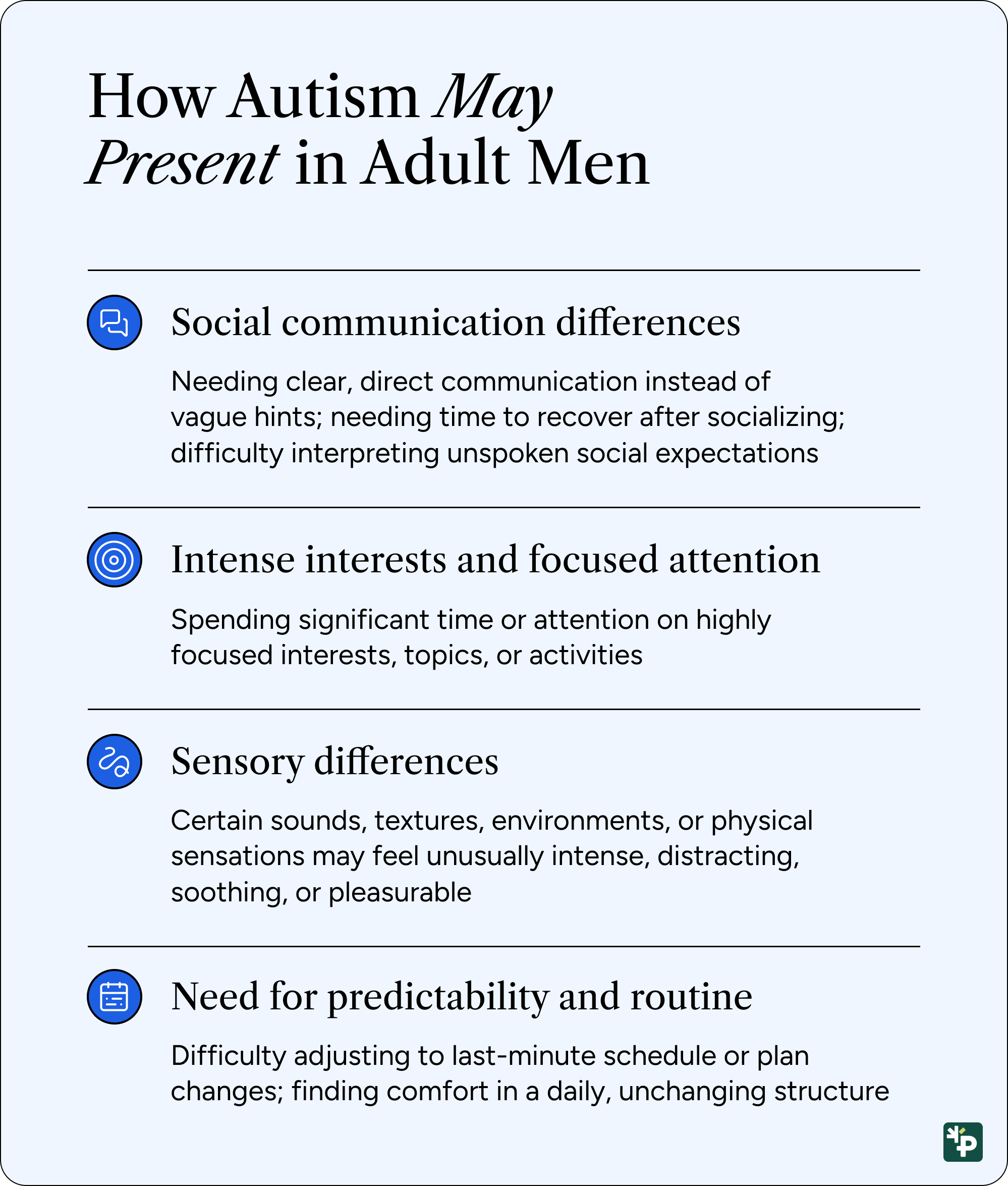
Social communication differences
Although Thom says he “craves socialization,” he acknowledges that he then needs to “spend the whole next day in bed to recover.” Amy Fitzpatrick, M.D., Chief Medical Officer at Bedrock Recovery Center, says that it’s common for autistic men to “spend several hours alone after social events so [they] can recharge and regain [their] ability to interact with others.”
Other examples of social-communication differences also can pop up in different kinds of relationships: Perhaps you’re the coworker who gives honest feedback in meetings, because you prefer clear, direct communication. Or you have one or two close friendships built entirely around a shared hobby rather than a wide social circle.
Intense interests and focused attention
Dr. Shinall confirms that “adult autistic men sometimes channel their intense interests into careers that reward deep specialization: cybersecurity, engineering, music theory, historical research.”
On that note, another moment that helped Thom realize he might be autistic is when he started “pouring [himself] way too much into [his] work.” This ability to hyperfocus was “one thing nobody would complain about [at work],” even though Thom felt “that other aspects of my life were out of control.”
He says that as he got older, he had “fewer spoons and less ability to mask and put up with work politics and nonsense.”
Sensory sensitivities
According to Dr. Shinall, sensory sensitivities can look like always wearing the same brand of noise-canceling headphones, or having a strong, specific reaction to restaurant noise that partners and friends learn to plan around.
Another example from Dr. Fitzpatrick is an autistic adult who may have difficulty attending company-sponsored lunches because the background noise levels might be too overwhelming.
Need for predictability and routine
Thom also shared that he “hates to be surprised” or to feel “out of my element,” which tracks with the common autistic trait of needing predictability and/or routine.
Though Dr. Shinall explains that the “need for predictability” often shows up less as “rigidity” and more as a “very particular, well-defended daily structure.” As in, the same coffee shop, the same route to work, same order of tasks, etc. This preferred daily structure is necessary for some autistic men because “deviating from it costs more energy than people realize.”
The emotional experience
The myth that autistic adults lack empathy is, unfortunately, still prevalent because some autistic people express their emotions differently than others. For example, someone may need extra time to process their emotions before reacting, which can be misinterpreted as indifference. Also, some autistic adults may have alexithymia, which occurs more frequently among autistic people, and can make it harder to name, recognize, or express emotions.
How autistic traits in men differ from the stereotypes
Despite the strides in representation that shows like Heated Rivalry have made recently, the most pervasive cultural archetypes of autism in men continue to be savant characters like Raymond Babbitt from the Academy Award-winning film Rain Man and Dr. Sheldon Cooper from the long-running sitcom The Big Bang Theory.
Raymond and Sheldon, with their savant skills, significant support needs, and, especially in Sheldon’s case, highly scripted social interactions that are often played for laughs, accurately reflect a narrow, specific presentation of autism in adult men.
However, these characters are “one small fraction of those on the autism spectrum,” says Dr. Fitzpatrick. Thom speculates that characters like Sheldon and Raymond shaped how most people picture autism because, due to their overemphasized traits, “it’s easy to see how different they are.”
But real life isn’t TV or the movies. The Sheldon/Raymond stereotype describes only one end of a wide spectrum, so using this archetype as a self-screening tool may cause some men to dismiss the possibility of autism before giving it real consideration.
Dr. Fitzpatrick warns against using media depictions as a screening tool because “the decision for a diagnosis is based on the lifetime development patterns of an individual with autism, not whether or not that person matches a fictional character.”
If you’ve watched Rain Man and/or The Big Bang Theory and figured, “Well, I can’t be autistic because I’m not like that,” that response is totally valid. But since characters like Raymond and Sheldon represent only a small portion of the spectrum, it may be worth revisiting your initial conclusion.
Masking — and why it's one of the main reasons autism goes unrecognized in men
Masking, or the suppression, hiding, or compensation for autistic traits, is a practice adopted by some autistic adults to navigate neurotypical environments. It’s not necessarily a conscious choice so much as a learned survival strategy. And it’s one of the main reasons neurodivergent signs in adult men go unrecognized.
Even though many believe masking is something that primarily affects autistic women, “it is seen frequently in men as well,” says Dr. Shinall. “Many autistic men have spent years consciously studying social interactions, rehearsing conversations, copying what other people do, or hiding behaviors that drew negative attention when they were younger.”
This level of “successful” masking is not evidence against autism; if anything, it’s often exactly what delays diagnosis.
“Boys are also sometimes socialized early to suppress exactly the traits that would otherwise flag autism, like stimming or intense or unique interests, so by adulthood the presentation looks a lot more neurotypical on the surface,” notes Dr. Shinall.
This level of masking “can genuinely ‘fool’ teachers, doctors, and even the men themselves for years,” which is why many men, like Thom, for example, aren't identified until their 30s, 40s, or later.
What may also impede men from recognizing their own autistic traits is the fact that while masking is documented in autistic men — including this 2021 study from The Journal of Autism and Developmental Disorders — their overall camouflaging experience is wholly underrepresented in the research. Especially when compared to female masking.
Studies such as this 2023 report from Frontiers in Psychiatry call for additional research on masking in autistic men.
What masking looks like in autistic men
Masking, as with any other autistic trait, will vary from individual to individual. Dr. Shinall provides some common examples below:
- Memorizing conversation starters and acceptable responses before networking events
- Laughing when everyone else laughs despite not understanding the joke, or carefully monitoring facial expressions and body language throughout a conversation
- Rehearsing small talk before a work event, or replaying a conversation afterward to check for mistakes
- Deliberately practicing "normal" facial expressions or eye contact in the mirror
- Suppressing self-regulatory behaviors, or “stimming,” like tapping or pacing
The cost of masking
While masking may help some autistic people feel more accepted in non-autistic circles, research, such as this 2021 study published in Autism Adulthood, has shown that this practice can have negative long-term mental health effects.
“I’m currently working to reduce my masking,” reveals Thom. Though to non-autistic people, now he “may seem withdrawn or have a flatter affect.” This is because “it can take a tremendous amount of focus and energy to keep up those aspects of my personality,” he says.
Dr. Shinall says this type of masking can present in what she calls a "work personality." Some autistic men may know exactly how to act professionally, but “once they get home they're completely drained and need significant time alone to recover.”
Unmasking can sometimes feel like a double-edged sword for people like Thom. Yes, they’re embracing their true selves, but by doing so, “people can feel like I was duplicitous, putting on an act for them,” he says. But “it was the highest compliment I knew how to give, trying to act like them because I wanted them to like and accept me.”
Why autism is so often missed or misdiagnosed in men
Missed diagnosis of autism in adult men can occur particularly when someone’s presentation does not match stereotyped expectations of autism or when autistic traits are masked, compensated for, or attributed to other conditions.
Below, Dr. Shinall breaks down how and why this can happen in further detail:
Diagnostic criteria
The diagnostic criteria for autism were largely built from research on young boys with more obvious, externalized presentations, and men who didn’t fit that early template were often overlooked. Clinicians now recognize that many autistic adults have developed effective coping strategies, making the underlying differences less apparent during a brief appointment.
The misdiagnosis pattern
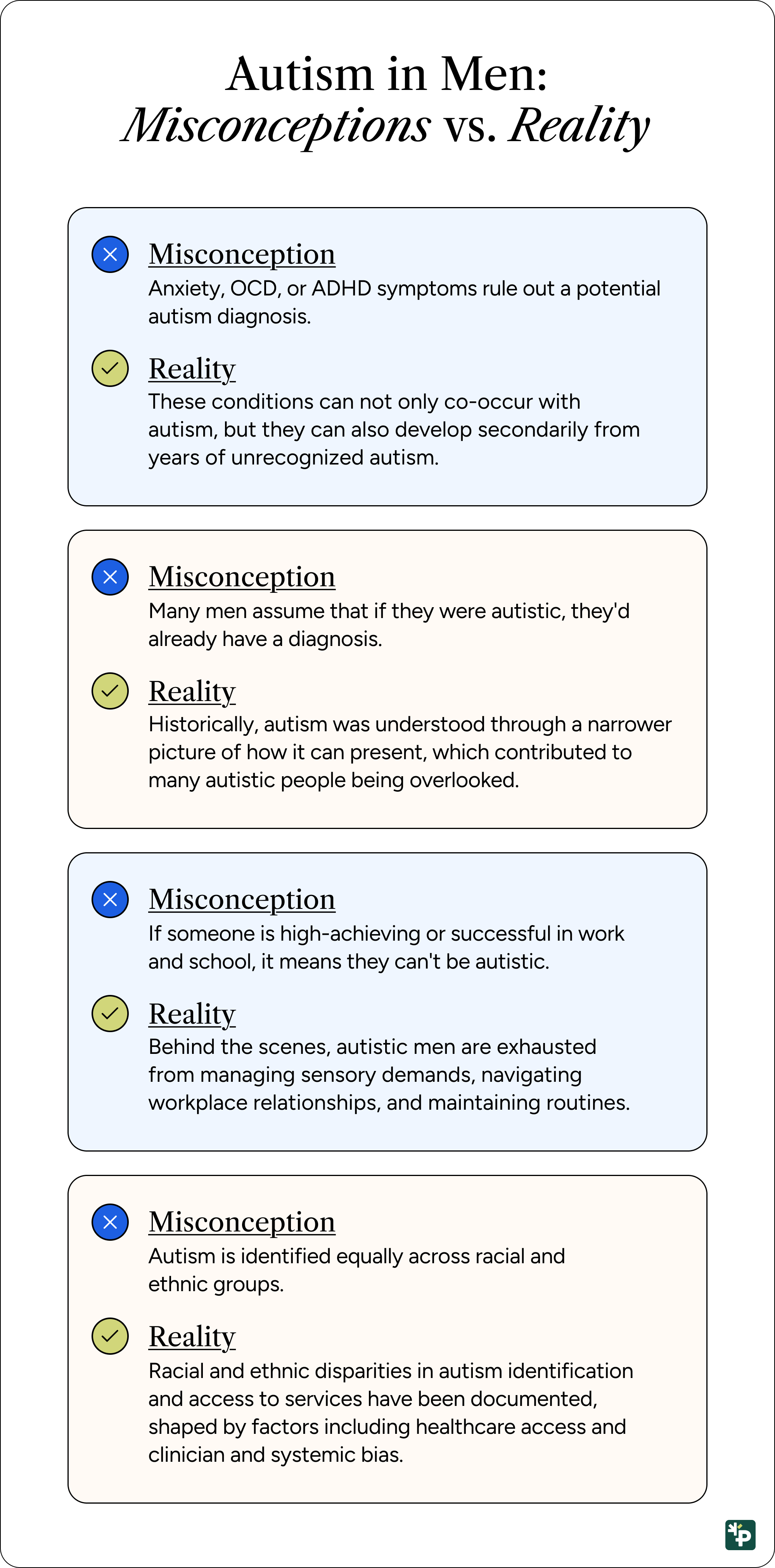
Research, such as this 2024 study published in eClinicalMedicine, has documented the pattern of misdiagnosis in autistic adults. Dr. Shinall says this is common because features like social withdrawal, rigidity, or emotional shutdowns get labeled as anxiety, depression, obsessive-compulsive disorder (OCD), personality disorders, or other diagnoses instead of being traced back to an underlying autism presentation. While those conditions can absolutely co-occur, there are some cases where they're describing the consequences of living for years with unrecognized autism.
The high-achievement barrier:
High-achieving men are often overlooked because success at work or school is mistaken for the absence of disability.
But what others may not see is someone excelling professionally while expending enormous effort managing sensory demands, navigating workplace relationships, and maintaining routines behind the scenes.
In addition to the three main reasons above, men from historically underdiagnosed communities are at a disadvantage when it comes to autism diagnoses. “Cultural expectations, clinician bias, differences in access to specialists, and the ways autistic traits are interpreted can all influence whether someone is recognized and referred for an evaluation,” confirms Dr. Shinall.
Black and Latino boys, she says, are more likely to be diagnosed with “conduct or oppositional disorders for the same behaviors that would prompt an autism evaluation in white boys."
If you recognize yourself: What that means and what to do next
If you recognize any part of yourself in this article, it’s a meaningful starting point, regardless of your age, your lingering doubts, or any prior diagnoses.
You may also be here because something happened to put you in self-reflection mode:
“Many first question themselves in response to significant life changes, for example, when they have children, enter into a new career, start a long-term relationship, or experience burnout,” notes Dr. Fitzpatrick. Perhaps you’re identifying certain patterns in social interaction, sensory processing, or communication. If this is the case, trust your gut, even if that gut is also telling you things like, “I'm too old," "I've managed fine," or "I'd have been diagnosed as a child.”
Because the answers to all three of those internal monologues are as follows:
- No, you’re not
- Perhaps, but you shouldn’t have to just “manage”
- Not necessarily
The next step in this self-actualization journey, for some, may be a formal autism evaluation.
Diagnoses aside, an autism evaluation “helps people understand why they have experienced the world the way they have and distinguishes autism from other conditions that can look similar,” says Dr. Shinall.
It can also give “language and structure to a lifetime of traits that may have felt confusing or isolating without a name.” An evaluation can clarify what's actually autism versus what's anxiety, depression, or ADHD, allowing you to obtain the right kind of support.
A psychologist will conduct a formal autism evaluation, which usually involves:
- A clinical interview
- Standardized tools
- Developmental history
- A comprehensive written report
Prosper Health offers 100% virtual, insurance-covered adult autism evaluations in a neurodiversity-affirming setting. Remember that a diagnosis at any age provides clarity — and clarity always has practical value.
*Identified by first name only to protect the contributor’s privacy
Frequently asked questions (FAQs)
What are the signs of autism in adult men that are most commonly missed?
Signs of autism in adult men tend to be missed because men, like women, engage in masking, or the suppressing of autistic traits. Some spend years studying social interactions, copying what others do, and concealing certain behaviors like stimming. Ultimately, this delays diagnosis because their signs of autism remain hidden for years, possibly decades.
How does autism impact relationships?
Autism can impact relationships in a variety of ways: Masking prevents friends, loved ones, and coworkers from getting to know an autistic person’s true self. Social-communication differences may require autistic adults to set clear boundaries for socializing, which can include direct, straightforward communication and extra recovery time after a get-together.
How is autism in men different from autism in women?
Although there is a considerable amount of overlap in how autism presents in both men and women, there are significant differences as well: Primarily, long-term masking in women is more extensively documented (though masking does exist among autistic men). In addition, some men are more likely to receive an earlier diagnosis due to male-centered diagnostic criteria.
What does an autism evaluation for adults actually involve?
A psychologist conducts an adult autism evaluation through a clinical interview, standardized tools, a developmental history, and a comprehensive written report. A diagnosis can provide autistic adults with enhanced self-awareness, guidance toward work and school accommodations, and an identification of their strengths.
Sources
https://www.prosperhealth.io/blog/adult-autism-signs
https://www.prosperhealth.io/blog/autism-and-relationships
https://www.prosperhealth.io/blog/spoon-theory
https://www.prosperhealth.io/blog/how-to-develop-a-daily-routine-for-autistic-adults
https://www.prosperhealth.io/blog/autism-and-empathy
https://pmc.ncbi.nlm.nih.gov/articles/PMC12667228/
https://reframingautism.org.au/autism-and-emotions-how-and-why-do-autistic-people-process-emotions-differently/
https://www.prosperhealth.io/blog/alexithymia-explained
https://www.prosperhealth.io/blog/sensory-processing-disorder-in-adults
https://www.prosperhealth.io/blog/autism-masking
https://www.prosperhealth.io/blog/autism-in-adult-women
https://link.springer.com/article/10.1007/s10803-021-05221-3
https://www.frontiersin.org/journals/psychiatry/articles/10.3389/fpsyt.2023.1108110/full
https://pmc.ncbi.nlm.nih.gov/articles/PMC8992921/
https://www.prosperhealth.io/blog/autism-and-stimming
https://www.prosperhealth.io/blog/unmasking
https://www.prosperhealth.io/blog/misdiagnosed-autism
https://pmc.ncbi.nlm.nih.gov/articles/PMC11001629/
https://pmc.ncbi.nlm.nih.gov/articles/PMC4180801/
https://www.prosperhealth.io/blog/what-cooccurs-with-autism
https://www.prosperhealth.io/blog/how-to-get-tested-for-autism-as-an-adult
https://www.prosperhealth.io/diagnosis


