.webp)


Key Takeaways
- Originally developed in reference to chronic illness, spoon theory is a metaphor that helps neurodivergent individuals explain "invisible" energy depletion to others.
- Unlike ordinary exhaustion, autistic energy depletion may involve sensory, cognitive, social, emotional, and executive functioning demands that are not always resolved by standard rest or sleep alone.
- Autistic energy is often uneven rather than just low; someone might have energy for one type of task but not another.
- Recovery strategies must be tailored to the specific type of depletion (e.g., sensory, social, executive). Effective approaches often involve reducing demands, increasing predictability, and supporting sensory regulation, rather than just "pushing through" discomfort.
- By using spoon theory to recognize early signs of depletion and to implement accommodations — such as written instructions, quiet workspaces, or flexible scheduling — individuals can reduce their "survival mode" and build a life with more access to joy.
Key Takeaways
- Originally developed in reference to chronic illness, spoon theory is a metaphor that helps neurodivergent individuals explain "invisible" energy depletion to others.
- Unlike ordinary exhaustion, autistic energy depletion may involve sensory, cognitive, social, emotional, and executive functioning demands that are not always resolved by standard rest or sleep alone.
- Autistic energy is often uneven rather than just low; someone might have energy for one type of task but not another.
- Recovery strategies must be tailored to the specific type of depletion (e.g., sensory, social, executive). Effective approaches often involve reducing demands, increasing predictability, and supporting sensory regulation, rather than just "pushing through" discomfort.
- By using spoon theory to recognize early signs of depletion and to implement accommodations — such as written instructions, quiet workspaces, or flexible scheduling — individuals can reduce their "survival mode" and build a life with more access to joy.
Have you ever felt like your energy levels aren’t matching what others perceive? You may look “fine” on the outside, but on the inside, your nervous system is working overtime, quickly eating up your physical and mental energy. For some neurodivergent people, this kind of energy depletion can cumulatively worsen until they’re completely tapped out.
“When my energy starts to run out, my first sign is that it gets harder and harder to smile,” explains Drew*, who was diagnosed with autism and ADHD at 40 years old and self-identifies as AuDHD. “It doesn’t mean I’m not having fun, or not happy, it’s just my body’s way of saying that I’m losing control of my ability to mask.”
As his energy drains, Drew usually experiences “drastically reduced verbal communication,” speaking only when spoken to, and responding with a handful of words. Eventually, he says, these depleted energy levels result in his “crying uncontrollably and hiding in a quiet room or space, eventually falling asleep from sheer exhaustion.”
If you can relate to Drew’s experience, spoon theory might be a helpful concept for you. Spoon theory is a metaphor many autistic and neurodivergent people use to explain how sensory, social, masking, and executive function demands lead to energy depletion. It can also help non-autistic people better understand why autistic fatigue differs from general exhaustion.
What is spoon theory?
Spoon theory was originally developed in 2003 by writer and lupus patient Christine Miserandino. In a blog post, Miserandino used spoons to explain the concept of finite daily energy units from the perspective of someone living with chronic illness. Say you started your day with 12 spoons. Every physical activity task (showering, eating, commuting to work, etc.) costs at least one spoon or more. Conserving spoons (e.g., sacrificing certain tasks) became essential to make it to the end of the day.
Although Miserandino, a chronic illness advocate, centered spoon theory on physical efforts, this metaphor was later adapted by neurodivergent self-advocates like Cynthia Kim. In 2014, Kim published a version of spoon theory that, in addition to physical activity demands, described the invisible cognitive, sensory, social, and emotional demands that some autistic people experience.
While not a clinical framework or a diagnostic tool, spoon theory is a communication and self-understanding tool that many neurodivergent (and chronically ill) people find helpful, especially when explaining their invisible energy depletion to others.
“I absolutely adore the spoon theory as a way to communicate energy levels,” says Drew. “It helps provide an easily accessible metaphor for people who don’t have much experience with invisible energy depletion.”
Why daily life can cost more spoons for autistic people
Everybody experiences exhaustion, but autistic energy depletion can differ from ordinary tiredness because rest, sleep, food, or a lighter schedule may not fully address the underlying sensory, cognitive, social, or executive demands contributing to it.
Autistic energy depletion, on the other hand, affects the whole nervous system, explains Dr. Kelly Whaling, Research Lead and Licensed Clinical Psychologist at Prosper Health. It’s not only the body that experiences the effects of energy depletion but also sensory, cognitive, social, and executive functioning demands.
Language like a “depletion of spoons” or energy accounting to describe this limited energy for daily tasks can be useful, says Dr. Whaling, “because it makes invisible effort easier to name.”
“A person may feel physically exhausted,” she continues, “and they may also lose access to speech, have lower sensory tolerance, struggle to make decisions, feel emotionally overwhelmed, or find that everyday tasks suddenly require much more effort.”
Below, Dr. Whaling highlights how these “invisible efforts” can drain an autistic person’s energy:
- Sensory demands: The autistic nervous system may process input more intensely or with less automatic filtering. So things like bright lights, layered noises, strong smells, uncomfortable clothing, movement, heat, and crowded spaces can all require active effort just to tolerate them. Also, keep in mind that these sensory demands vary by person. A setting that feels neutral to one person may be exhausting to another.
- Cognitive demands: Some autistic people may need extra effort to interpret vague instructions, switch tasks, predict expectations, make decisions, or manage uncertainty.
- Masking demands: Masking, or the hiding of autistic traits to appear neurotypical, can deplete energy because it requires autistic people to suppress repetitive, stimulatory, or regulating behaviors, force eye contact, monitor facial expressions, and appear calm while overloaded.
- Social demands: While socializing may often feel lower effort for non-autistic people, it’s not always the case for some autistic people. Conversation often requires several tasks at once: A person may be simultaneously processing words, tone, facial expression, timing, background noise, body language, and social rules. Even enjoyable social contact can be high-cost and require energy budgeting and recovery.
- Executive functioning demands: Anything that includes starting a task, stopping a task, shifting task priorities, planning, organizing, and even recovering from interruption can drain an autistic person’s energy. These demands increase when the environment is fast, unclear, noisy, or unpredictable.
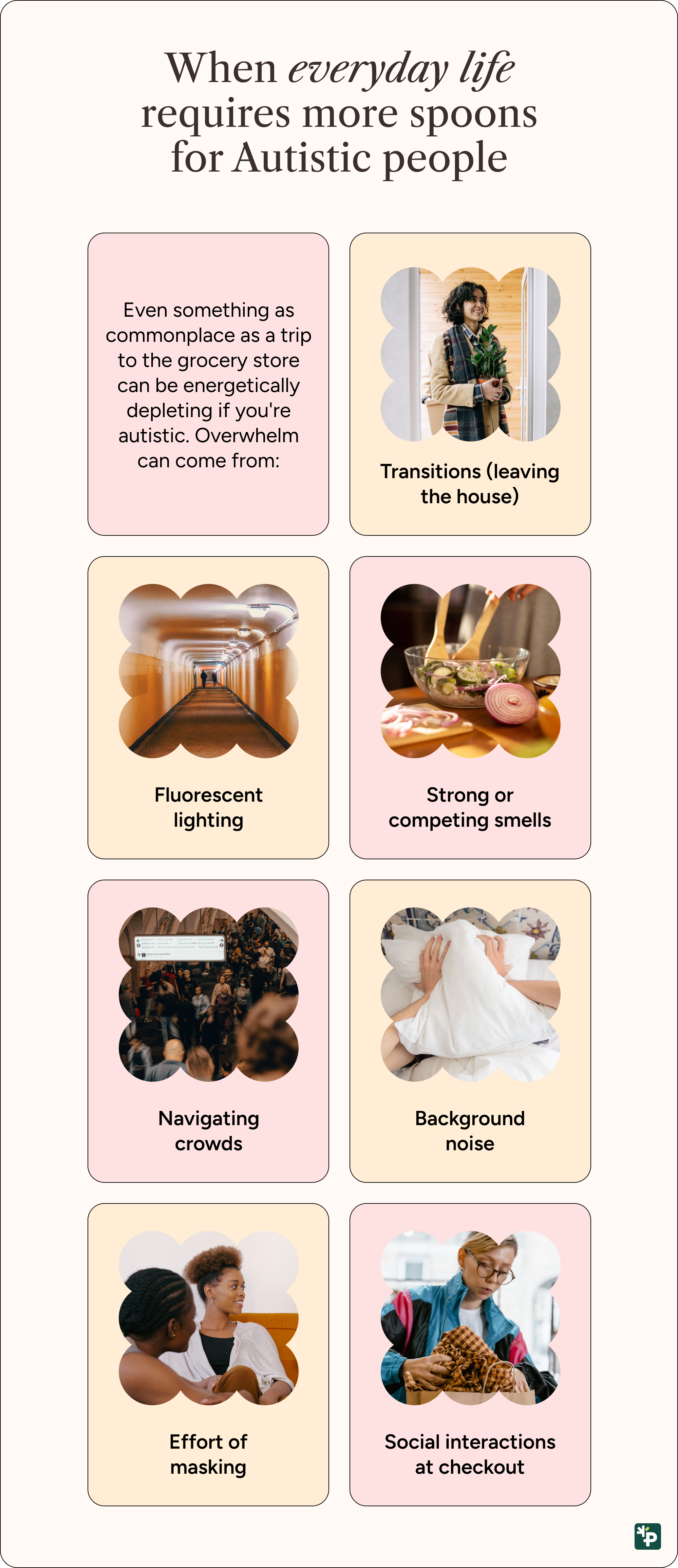
Now, consider how many environments are designed around neurotypical expectations: schools, workplaces, clinics, stores, and social settings. Pair these environments — which are usually characterized by bright lights, background noise, and unpredictable changes — with someone who is neurodivergent, and nervous system strain becomes a lot more likely.
While these everyday environments may require more effort for some autistic people to navigate, this is not due to personal weakness or lack of resilience.
Different types of spoons autistic adults may spend
Another difference between autistic energy depletion and ordinary tiredness is that autistic energy is often uneven instead of just low. Meaning, someone may have the energy for one type of task, but not another.
As an example, an autistic person may have plenty of physical energy to exercise on one day, but they may also find high-focus tasks like writing emails, organizing spreadsheets, or reading challenging that same day.
Remember that the types of spoons autistic adults may spend will vary not only by day, but by individual.
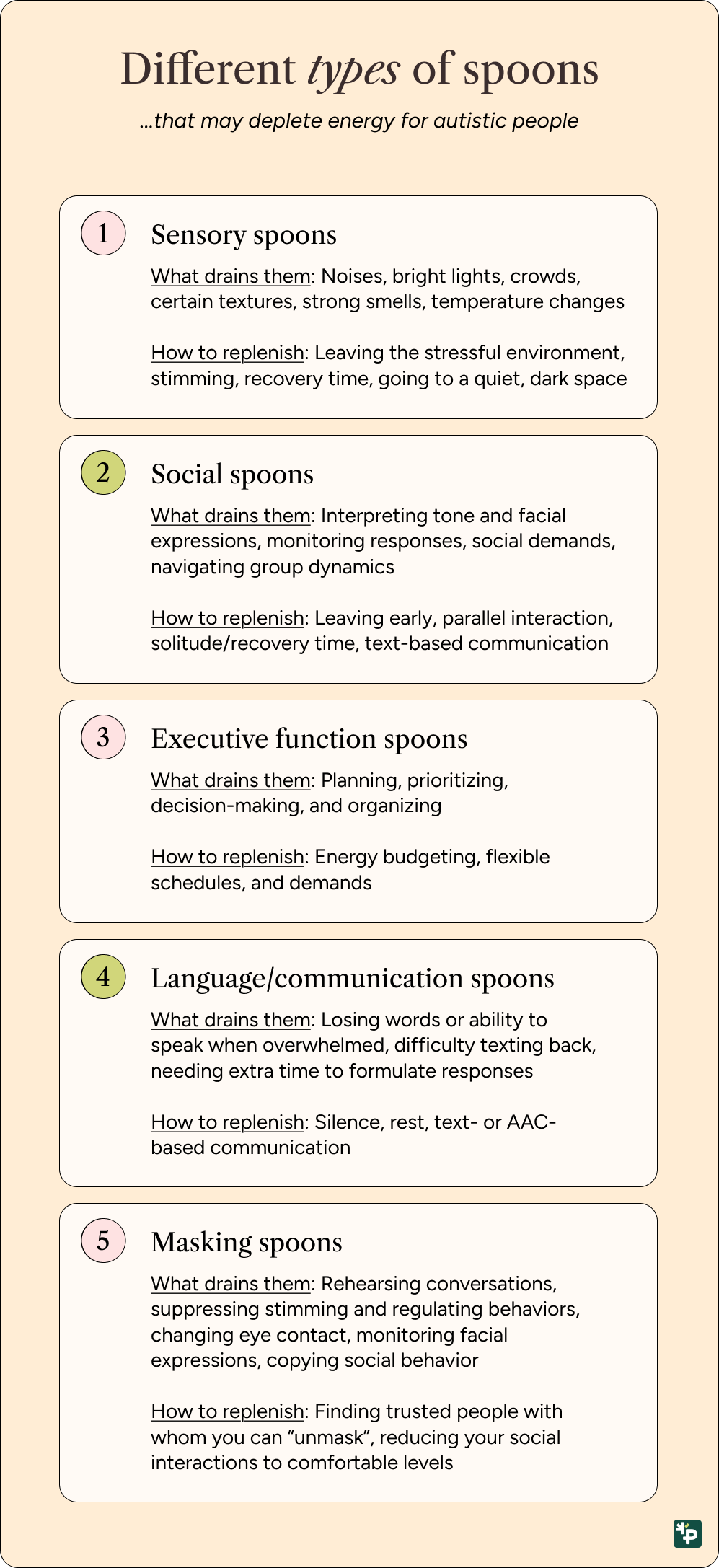
One way to understand neurodivergent spoon theory is to break it down not only by physical activity spoons, but also sensory, social, masking, executive functioning, and language and communication spoons.
Sensory spoons
Noises, bright lights, crowds, certain textures, strong smells, overlapping conversations, and temperature changes may not only cause sensory overload for some autistic people but can also drain their energy over time. This can occur even if someone appears calm on the outside.
Situations where people may use their sensory spoons:
- Grocery stores
- Open offices
- Public transportation
- Restaurants/bars
- School
- Workplace
Social spoons
Socializing can take quite a bit of effort for some autistic people because conversations may require several tasks at once: interpreting tone and facial expressions, monitoring responses, maintaining eye contact, and navigating the group dynamics. Recovery time after any social interaction may also be necessary. Autism-related social depletion is not introversion; needing to cut the evening short doesn’t mean that someone dislikes people — they’re likely just monitoring their social spoons.
Situations where people may use their social spoons:
- Parties
- Friend meetups
- Family gatherings
- Workplace hangouts
- Dating
Masking spoons
Masking can use up several autism spoons because it involves more than just hiding autistic traits. It’s a concerted effort to perform neurotypical expectations to avoid potential judgment, conflict, or misunderstanding.
Examples of masking spoons:
- Rehearsing conversations
- Suppressing repetitive behaviors like “stimming”
- Forcing eye contact
- Monitoring facial expressions
- Copying social behavior
Executive function spoons
The energy involved in tasks like planning, prioritizing, decision-making, and organizing can be draining for some autistic people. This also includes task initiation (like starting dinner) and task-switching (grabbing the laundry while dinner is cooking).
Additional examples of executive function spoons:
- Responding to emails
- Scheduling appointments
- Housecleaning
- Putting groceries away
- Doing homework
- Completing a work project
Language and communication spoons
As Drew mentioned, communication can be challenging when some autistic people experience energy depletion. This is exacerbated during times of stress, overwhelm, sensory overload, or autistic burnout.
Examples of language and communication spoons:
- Losing words when overwhelmed
- Difficulty texting back
- Needing extra time to formulate responses
- Becoming temporarily non-speaking or speaking less
What happens when you run out of spoons
Running out of “spoons” doesn’t happen all at once. Instead, autistic depletion often develops cumulatively.
This is because “the nervous system is carrying repeated layers of sensory, cognitive, social, emotional, and executive functioning demands across time,” explains Dr. Whaling. Most of the stressors that autistic people deal with are “ongoing demands that require continuous adaptation.”
All in a single day, an autistic person may be tolerating fluorescent lights, filtering background noise, switching between tasks, masking distress, interpreting unclear expectations, navigating social interaction, and suppressing sensory discomfort.
While each demand may seem manageable, together, “they place a sustained load on the nervous system,” says Dr. Whaling. Unfortunately, because this gradual energy depletion is usually invisible, the autistic person managing this unsustainable load may look outwardly “fine.” This may also cause some autistic people to “push through” their discomfort as a way of meeting neurotypical expectations.
According to Dr. Whaling, pushing through discomfort can look like:
- Ignoring sensory pain
- Suppressing repetitive behaviors
- Forcing eye contact
- Continuing social interaction despite overload
- Working past the point of exhaustion
But even though you may be “functioning” and completing your tasks, your nervous system is paying the long-term price. “The nervous system may be moving further into a state of stress activation and depletion,” says Dr. Whaling. Eventually, your nervous system could lose its capacity to regulate. This may cause any of the following:
- Shutdowns
- Meltdowns
- Irritability
- Increased sensory sensitivity
- Emotional overwhelm
- Difficulty communicating
- Task paralysis
“The visible crash may happen later, after the nervous system has already been operating beyond sustainable capacity for hours, days, weeks, or longer,” notes Dr. Whaling. Over time, the nervous system may become increasingly depleted and less able to regulate incoming demands. This is why typical forms of rest (a good night’s sleep, a quiet evening, etc.) aren’t always enough to replenish your spoons or regulate your nervous system.
Boom-and-bust cycles
The “boom-and-bust cycle” describes a period of high productivity and engagement (sometimes outwardly viewed as “good days”) followed by crashes, exhaustion, or burnout. It’s a pattern commonly observed among neurodivergent people.
Often, these cycles occur when “autistic people operate above sustainable capacity for extended periods to meet work, school, family, or social expectations,” explains Dr. Whaling.
So, during the "boom" phase, a person may appear highly productive, highly organized, socially engaged, or intensely focused. But in many cases, says Dr. Whaling, “this functioning is being maintained through significant effort, masking, nervous system activation, and energy expenditure.”
Eventually, this overextended energy output catches up with the person. This can present as exhaustion, shutdown, increased sensory distress, withdrawal, reduced functioning, difficulty initiating tasks, or the need for prolonged recovery time.
In addition, Dr. Whaling notes, “the ‘bust’ phase is often misunderstood as laziness, inconsistency, or lack of motivation.” These crashes are in no way failures of willpower or motivation, but instead “the physiological consequence of operating beyond sustainable limits for too long.”
How autistic adults can replenish their spoons
Spoon replenishment for autistic adults is a highly individualized strategy and will vary by person. It will usually look quite different than generic wellness or productivity advice (“get a full eight hours of sleep!” “invest in a planner!”), because certain “neurotypical” self-care activities may still be draining for some autistic people. However, general healthy habits like eating nourishing food, hydrating regularly, moving your body, and getting additional sleep are always a good rule of thumb when trying to replenish your spoons.
“The best strategy depends on the person, the type of depletion, and whether the main demand was sensory, social, cognitive, emotional, or executive functioning-related,” advises Dr. Whaling.
While some people recover best through solitude, Dr. Whaling also points out that others prefer to recover through “low-pressure connection, such as sitting near a trusted person without needing to talk and just physically being in the same room.”
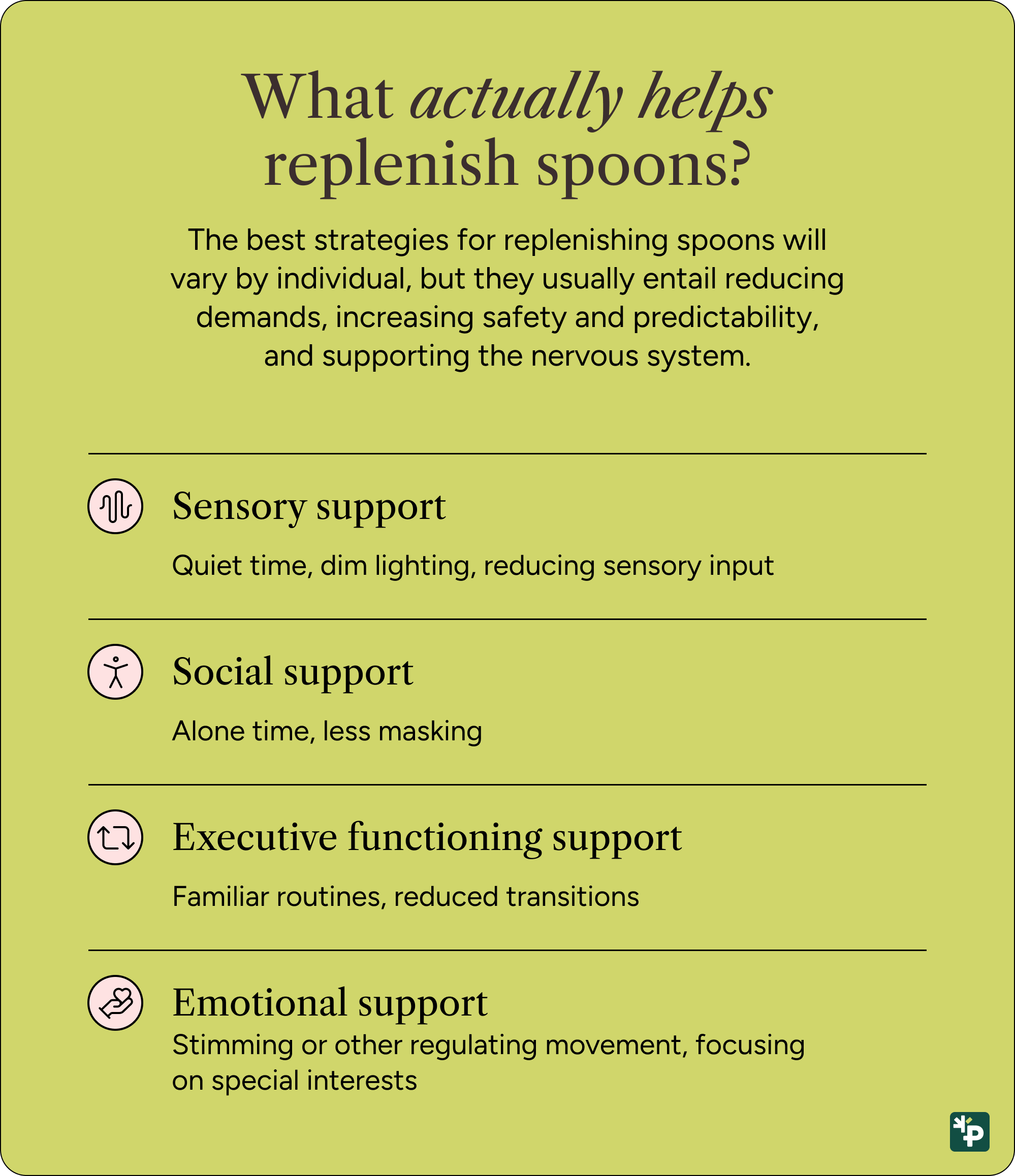
These recovery strategies, she says, usually require reducing demand, increasing predictability, and supporting sensory regulation. They can include:
Sensory support
- Quiet time
- Dim lighting
- Comfortable clothing
- Noise-canceling headphones
- Sensory engagement like pressure, rocking, or using weighted items (blankets, etc.)
Social support
- Alone time
- Less masking/spending time with safe people
Executive functioning support
- Familiar routines
- Reduced transitions
- Clear written plans
Emotional support
- Engaging in repetitive behaviors, such as stimming
- Focusing on your special interests
Using spoon theory in daily life
When using pacing systems (aka a lifestyle management strategy) in daily life, “Spoonies,” or people who subscribe to spoon theory, need to ask themselves how much nervous system load an activity creates.
“Two activities may look similar to other people while placing very different demands on the nervous system,” explains Dr. Whaling. One autistic person might find a two-hour work meeting less draining than a 30-minute grocery store trip “because the grocery store includes fluorescent lights, unpredictable movement, background noise, decision-making, social navigation, and sensory overload.”
Another good example is when one autistic person might find texting more exhausting than speaking “because written communication requires more planning and self-monitoring.” But another autistic person may prefer the asynchronous lack of demands with text-based communication.
Since your needs — and your spoons! — are likely to vary by day, below are some tips from Dr. Whaling that focus on a practical, low-pressure application rather than a rigid self-management approach.
Recognizing high-cost activities
Spoon theory can help autistic people identify which activities cost the most energy, and this starts with noticing patterns in their own functioning. Which environments, tasks, or interactions are consistently draining your energy? Which situations need extended recovery time? Journaling or reflecting on these questions can help you figure out your own energy profile.
While “high-cost activities” differ for everyone, keep in mind that certain situations can be extra draining for some people because they require preparation beforehand and recovery afterward.
Some of these activities may include the following:
- Meetings
- Phone calls
- Commuting
- Medical appointments
- Family gatherings
- Group events
- Noisy restaurants
- Travel
- Unclear tasks
- Multitasking
Recognizing early signs of depletion
Spoon theory can also help people with their energy budgeting, or consciously choosing where their limited nervous system resources will go.
Recognizing your own energy-depleting signals can make a huge difference in planning fulfilling activities. For example, you may only have enough spoons to either attend your friend’s birthday dinner or deep-clean your apartment. Both activities may not be possible depending on how much energy you have left that day.
Early signs of depletion may include:
- Stronger reactions to sensory input, such as lights or sounds
- Reduced speech
- Slower processing
- Irritability
- Tearfulness
- Indecision
- More mistakes
- Trouble starting tasks or feeling stuck
- Needing to withdraw
- Unable to tolerate one more demand
Communicating limits to other people
Spoon theory can also help explain invisible exhaustion to partners, friends, family members, coworkers, or healthcare providers. Using specific scripts that emphasize your limited energy while politely setting boundaries lets others understand your needs.
Here are some examples courtesy of Dr. Whaling:
- "I want to be present, but I am running low on capacity. I need to leave early."
- "I can do one more task today. Which one should I prioritize?"
- "I am not ignoring you. I am overloaded and need quiet before I can respond."
- "I need written instructions so I can process this accurately."
- "I can attend, but I will need breaks and may not be able to socialize the whole time."
- "I am at my limit today. I need to reschedule rather than push through and crash."
- "I can do this, but I need more time and fewer interruptions."
When support may help
Chronic autistic depletion — which can ultimately lead to shutdowns and/or burnout – can make daily life more challenging to navigate without support.
So when seeking potential help, Dr. Whaling recommends options that reduce demands, increase predictability, and protect recovery time.
These options may include:
- Autism-affirming therapy
- Occupational therapy
- Workplace or school accommodations
- Practical help with daily tasks
“Accommodations can be especially important because chronic depletion is often caused by an ongoing mismatch between the person and the environment,” notes Dr. Whaling. This can include written instructions, flexible scheduling, remote or hybrid work, reduced meetings, quiet workspaces, sensory breaks, predictable routines, clear priorities, fewer last-minute changes, and permission to communicate by email or text when speaking is harder.
This also applies to practical support: Help with meals, cleaning, transportation, scheduling, paperwork, childcare, or errands can reduce the total nervous system load.
Keep in mind that these supports do not always need to be permanent or at the same intensity. When someone is chronically depleted, says Dr. Whaling, the first goal is often stabilization: reducing demands enough for the nervous system to recover. But over time, as the person recovers and restructures their environment, some supports may be adjusted, reduced, or used only during higher-stress periods.
The bottom line
While spoon theory can be a practical tool for autistic people — and for helping non-autistic people understand chronic energy depletion — that’s all it is. It’s a framework. A strategy. Spoon theory may work for some people. But that doesn’t mean it’s the right fit for everyone.
And it’s okay if it’s not.
“The goal of spoon theory is to help an autistic person build a life with more support, more access to joy, and fewer demands that require constant survival mode,” says Dr. Whaling.
If you’re interested in learning more about how spoon theory can help you navigate autistic energy depletion, support is available through Prosper Health. We provide neurodiversity-affirming therapy for autistic adults, as well as fully virtual autism assessments.
Contact us today to get started.
*Last name withheld to maintain the contributor’s privacy
Frequently asked questions (FAQs)
What are the benefits of using the spoon theory?
Spoon theory can help autistic people identify which activities cost the most energy, as well as activities and situations that require extended recovery time. A person’s number of “spoons” allows for more productive energy budgeting. This pacing system can also provide a visual aid for non-autistic people who may not initially understand the sensory, social, emotional, and executive functioning demands that autistic people face daily.
Is spoon theory the same as energy accounting?
Not exactly, but they are connected. Determining how many “spoons” one has on any given day can help an autistic person with their energy accounting or budgeting. For example, once someone knows how many spoons — or energy units — they have for the day, they can figure out if they’ll be able to meet up with friends after work, or if they need to go home for some quiet time.
Is running out of spoons the same as autistic burnout?
No. While “running out of spoons” can feel extremely depleting after a particular day — and can potentially lead to autistic burnout over time — burnout results from long-term chronic exhaustion and nervous system dysregulation. Using spoon theory to manage one’s energy and prevent “running out of spoons,” however, may help stave off autistic burnout.
Why do I have more spoons on some days than others?
Some autistic people may have more spoons on some days than others because their baseline energy can vary depending on the day. Since every day is different, and activities and demands can differ by day, a person’s number of spoons won’t always remain consistent.
Deep dive resources
- Using the Spoon Theory to Manage Your Energy
- Spoon Tracker Worksheet
- A Guide to Energy Accounting
- My Energy Account Worksheet
- Introduction to Energy Accounting
Sources
https://www.prosperhealth.io/blog/what-is-audhd
https://lymphoma-action.org.uk/sites/default/files/media/documents/2020-05/Spoon%20theory%20by%20Christine%20Miserandino.pdf
https://musingsofanaspie.com/2014/10/15/conserving-spoons/
https://www.prosperhealth.io/blog/autism-masking
https://neurodivergentinsights.com/the-neurodivergent-spoon-drawer-spoon-theory-for-adhders-and-autists/?srsltid=AfmBOooSE-JheDfBQru7BO_IjVU0FeWXxGTeaZtZZ_HBFAcHtngbDkSP
https://www.prosperhealth.io/blog/sensory-overload-in-autistic-adults
https://www.prosperhealth.io/blog/autism-and-stimming
https://www.prosperhealth.io/blog/autistic-burnout
https://www.prosperhealth.io/blog/how-to-regulate-your-nervous-system
https://www.prosperhealth.io/blog/autism-meltdowns
https://www.prosperhealth.io/blog/dorsal-vagal-shutdown
https://neurodivergentinsights.com/how-to-use-pacing-systems/?srsltid=AfmBOoqPuYI0spALkt5p-KvBL1a_V2hmqbIDaO14PMEN-TAij5_Nu7QC


