.webp)


Key Takeaways
- Autistic parents are just as capable of caring for and loving their kids as non-autistic parents. Some people think autistic parents lack empathy or can’t raise children, but those ideas aren’t supported by evidence.
- Autistic parents may offer unique strengths, like a strong sense of justice, a deep understanding of special interests, and the ability to model self-regulation for their children.
- Support is non-negotiable: Attention to sensory processing, executive functioning, and emotional regulation needs allows autistic parents not only to thrive, but also to prevent burnout.
- Neurodiversity-affirming care is essential for autistic parents. Professional therapy and/or social opportunities within the autistic community, especially those that discourage non-autistic standards, can be hugely beneficial.
Key Takeaways
- Autistic parents are just as capable of caring for and loving their kids as non-autistic parents. Some people think autistic parents lack empathy or can’t raise children, but those ideas aren’t supported by evidence.
- Autistic parents may offer unique strengths, like a strong sense of justice, a deep understanding of special interests, and the ability to model self-regulation for their children.
- Support is non-negotiable: Attention to sensory processing, executive functioning, and emotional regulation needs allows autistic parents not only to thrive, but also to prevent burnout.
- Neurodiversity-affirming care is essential for autistic parents. Professional therapy and/or social opportunities within the autistic community, especially those that discourage non-autistic standards, can be hugely beneficial.
Parenting is never easy. But some autistic adults may face additional doubts about their parenting capabilities due to ongoing stigma and myths about autism. Specifically, that autistic adults are incapable of being good parents.
But this is a false belief! Not only are autistic parents capable and caring, but they also bring unique strengths to parenting that non-autistic people might not recognize. At the same time, autistic parents have real support needs that need to be acknowledged and accommodated.
This article will help readers understand what it takes to be an autistic parent, offer support options, provide strategies for common challenges, and debunk prevalent myths.
Autistic adults are capable, loving parents
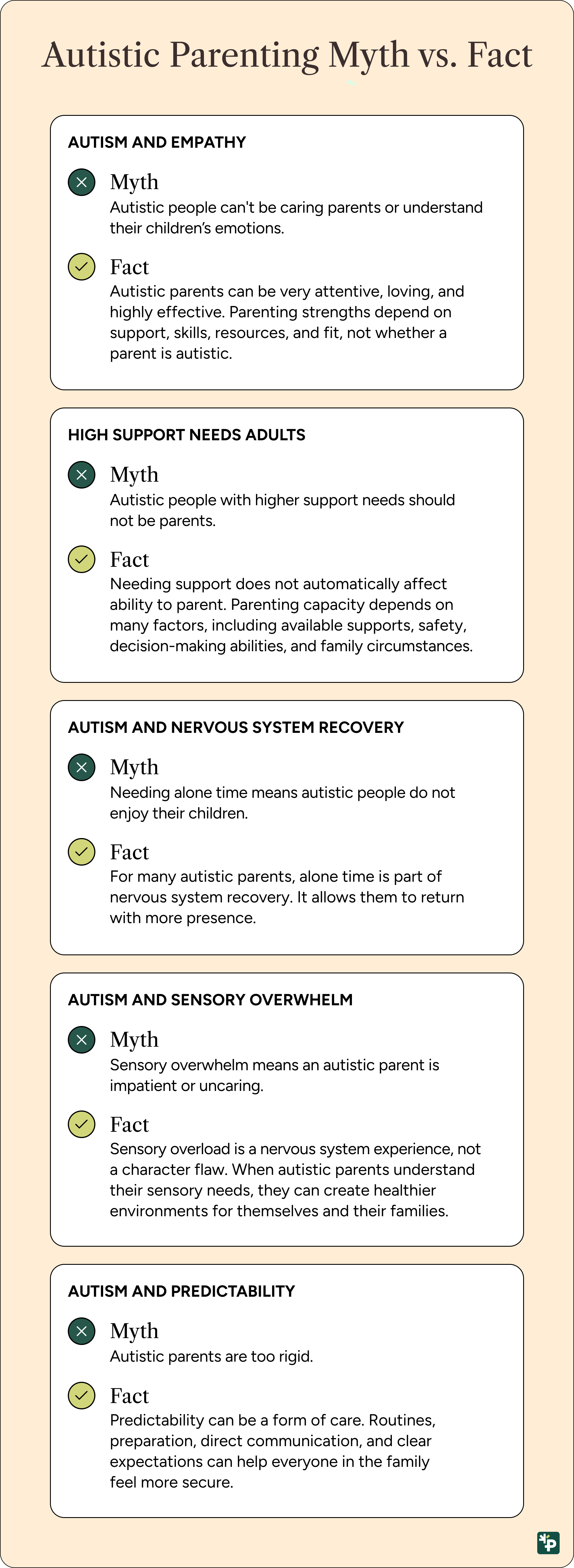
Two of the most common myths about autistic parenting are that autistic people lack empathy and capability/competency.
These myths have been perpetuated by a combination of medical misrepresentation and ableism. “Some of the stigma associated with autism comes from early and ongoing mischaracterization of it by a lack of empathy or emotion,” says Dr. Hannah Jones, a licensed clinical psychologist with Prosper Health.
She continues, “medical models of health that consider ‘normative’ behavior to be desirable and ‘abnormal’ behavior [to be] problematic pathologize what are actually just natural variations in the way people express love, care, and experience connection.”
Dr. Jones also notes that ableism influences cultural conversations around autism, cementing the idea that autistic adults are incapable of any deep relationships, “let alone the type of intimacy and long-term commitment inherent in a healthy parent-child relationship.”
Autistic mom and psychotherapist Julie Bjelland, LMFT, knows first-hand what it’s like to internalize those myths. She says she regularly questioned, “whether I was parenting ‘the right way,’ especially before I fully understood my own neurodivergence.” She spent a lot of time and energy comparing herself to allistic (non-autistic) expectations of how a mother is “supposed” to appear.
Before understanding autism through a neurodiversity-affirming lens, Bjelland says she interpreted her differences in social energy, sensory tolerance, and capacity for nonstop social activities as “personal shortcomings” instead of clear signs of her nervous system’s needs.
Empathy Myth
The misconception that autistic people don’t have empathy partly reflects differences in how empathy is recognized and expressed. The double empathy problem suggests that misunderstandings between autistic and non-autistic people often occur because of each person interpreting communication and emotional cues differently.
Autistic people may express care in ways that are not always recognized by others, and alexithymia (challenges with naming, recognizing, or expressing emotions) or interoceptive differences (awareness of internal body signals) can sometimes make emotions harder to identify or communicate. These differences reflect varied ways of experiencing and showing empathy.
Differences in emotional interpretation, however, do not translate to callousness: “Autistic parents do not lack empathy or love,” says Bjelland. “We may need more recovery time, more sensory regulation, clearer communication, and different rhythms of connection.” In addition, she says that autistic people may show care by problem-solving, researching, remembering details, protecting someone’s needs, offering honesty, creating a calmer environment, or deeply respecting someone’s autonomy. “Those are all forms of care.”
Clarissa Harwell, LCSW, is an autistic parent and therapist whose children and husband are neurodivergent as well. While she self-identifies as a highly sensitive person who can access empathy “quite easily,” she says that her autistic husband has been accused of lacking empathy because he “does not express [it] in expected ways.”
Harwell debunks the empathy myth through her work providing therapy to autistic clients, educating them about different ways of being, communicating, and feeling.
“Many people experience relief that there's no perfect or correct way to feel or express empathy,” she says.
Capability/Competency myth
Since many autistic people require support systems to manage day-to-day tasks, these needs can be misconstrued — by both autistic and non-autistic people — as an inability to be a competent parent. Again, this is false.
Harwell admits that there were many moments during which she had “a much lower capacity than usual to be the parent I want to be, and that has led to feelings of guilt.”
This “lower [nervous system] capacity” can often be chalked up to “intense sensory overwhelm,” she explains:
“I was under-resourced (stressed, hungry, tired, too much sensory input for too long, not enough down time/time alone) and it led to irritability, feeling very ‘touched out,’ needing to be in a dark room with no sound, etc.”
These periods of overwhelm also led to Harwell “feeling deficient and wondering why other parents seemed able to handle the mess, the noise, the intense needs of children.”
It wasn’t until Harwell learned she was autistic that she finally understood that her capacity was indeed limited, and, most importantly, that there wasn’t anything wrong with her.
“The idea that autistic people are not equipped to parent well is also rooted in misunderstanding,” observes Bjelland, who also says her hardest moments as an autistic parent were related to her nervous system capacity. “Autistic people may need supports, accommodations, and nervous system care, but needing support does not make someone an inadequate parent.” She reiterates that while all parents need support, “autistic parents deserve support that fits their neurotype.”
The real strengths autistic parents bring
While some autistic parents may need support, accommodations, and nervous system care, they also bring certain strengths that aren’t always found among non-autistic adults. This level of attunement to autism can be especially beneficial for autistic children in terms of role-modeling.
“I love being an autistic parent to autistic children,” says Harwell, acknowledging that despite their differences, they “have a shared understanding of our autistic traits.” Harwell is grateful her children “never have to defend their needs” to her, while highlighting her own need for predictability that allows her to “foresee many of my children's needs and support them in creating days that are comfortably predictable.”
Although there are some common attributes autistic parents bring to the table — which Dr. Jones provides below — remember that every autistic parent is unique.
Common attributes of autistic parents
These traits won’t apply to every autistic parent, and even strengths can create challenges in some situations. But for some parents, they can be meaningful assets in parenting.
A strong sense of justice: This autistic trait can help someone parent fairly, while also feeling deep empathy when their child is mistreated.
Heightened attunement to a child's emotional experience: This can be especially beneficial if children of autistic parents experience peer exclusion or bullying.
A profound sense of commitment and family connection: This can help autistic parents bond more deeply with their child.
Honesty: A clear, direct, and honest communication style can help set clear expectations and balance child autonomy with safety.
Engaging in self-regulatory behaviors: If an autistic parent uses calming and coping tools (examples include “stimming,” setting boundaries, or using fidget toys or noise-canceling headphones), this models to children that it is okay for them to do the same. In fact, engaging in these self-regulatory behaviors can even provide bonding opportunities between parent and child(ren).
Strong commitment to routines and stability: This common autistic trait can provide necessary structure and consistency for children.
An ability to immerse deeply in interests: Understanding special interests (and even having one or two of your own!) can lead to shared experiences, opportunities for enrichment, and enthusiasm about a child's interests.
Previously learned skills for navigating a neurotypical world: This can include helping children adjust their environment to a more sensory-friendly one and teaching them self-advocacy.
“With any of these strengths, autistic parents can help their child self-regulate, express themselves clearly, and feel heard and validated,” says Dr. Jones.
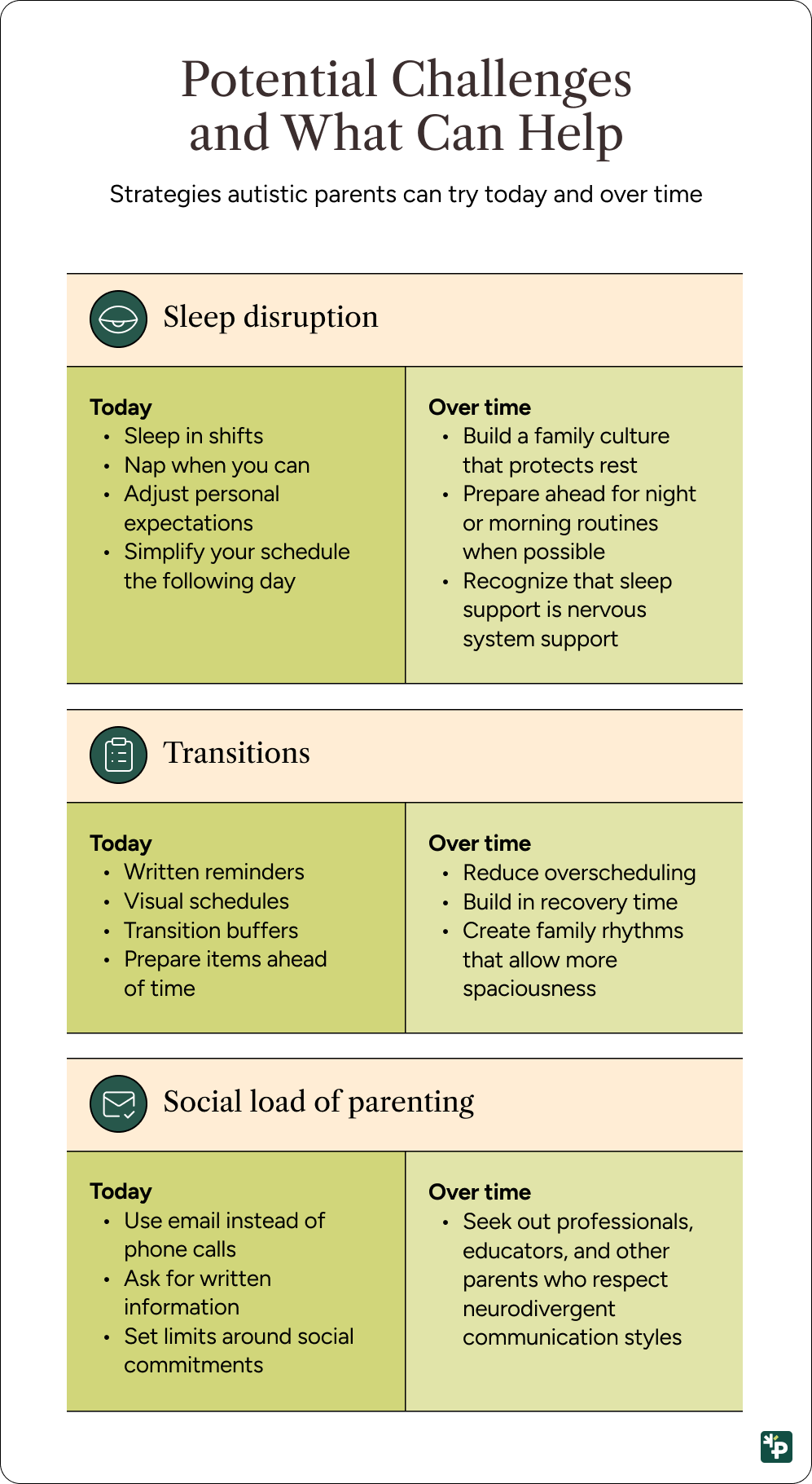
Real challenges, and what actually helps
Just as strengths vary by individual, so do the difficulties for autistic parents. But a few common challenges stand out: For example, both Harwell and Bjelland, as autistic parents, didn’t hesitate to voice their thoughts about sensory overload — as well as their advice — when asked about some of their more prominent challenges.
Below, Harwell, Bjelland, and Dr. Jones offer several concrete strategies for dealing with some of autistic parents’ most prevalent challenges:
Sensory overload
Sensory overload occurs when the brain is overwhelmed by sensory information. Combine that with parenting, which, observes Bjelland, “often comes with noise, touch, clutter, interruptions, and constant demands,” and it could be a recipe for disaster without the right strategies.
For Harwell, the parenting aspect that is “frequently the most difficult” is the fact that everyone in her four-person autistic family has a different sensory profile. Whereas Harwell loves hugging her kids, one of her children “cannot tolerate much touch at all.” So one essential strategy she recommends is a thorough understanding of not only your own sensory profile, but also your children’s to ensure that everyone in your household is comfortable, whether they’re sensory-seekers or sensory-avoiders.
Bjelland also recommends the following strategies to help reduce sensory overload:
- Noise-reducing earbuds/headphones
- Quiet breaks, dim lighting, soft clothing, lowering background noise
- Permitting yourself to step away when everyone is safe
- Building predictable routines
- Teaching the family that regulation needs are normal
Executive functioning demands
Executive functioning, or the set of cognitive skills that enable us to effectively manage everyday life like staying focused, organizing schedules, and planning and starting tasks, is another common challenge for autistic parents. Meal planning, keeping track of appointments, and maintaining household routines are essential for families, but these tasks can become overwhelming for some autistic parents.
Recommended strategies for helping autistic parents stay on top of their executive functioning demands, as well as relieve the pressure, include:
- Visual planners
- Reminder apps
- Structured daily schedules
- External support from a partner, co-parent, family member, or a trusted friend
Emotional regulation under parenting stress
Another common challenge for autistic parents is when they experience their own emotional overload while simultaneously dealing with their child’s emotions. “Autistic parents may feel their child’s pain very deeply,” says Bjelland. Ironically, this challenge also helps to debunk the myth that autistic parents don’t feel empathy.
Developing emotional resilience through practical strategies is key for managing these challenges. Bjelland offers her recommendations below:
- Grounding techniques: Deep, slow breathing and lowering sensory input
- Neurodiversity-affirming support: This can include therapy or coaching with someone who understands autism, nervous system education, and self-compassion practices.
Social expectations
Parents are usually the default liaison between school and the parents of their children’s friends. This can pose challenges for autistic parents who don’t necessarily have the social or mental bandwidth to be their children’s school/friendship point person at all times.
Moms, especially, carry this invisible load, which usually includes pressure to be constantly (and unfairly) warm and available.
There are, however, many practical strategies to help you avoid social-expectation overwhelm. Dr. Jones lists them below:
- Create a list of social-activity priorities: What’s more important? Your child's soccer league or the PTA? Then, prioritize those activities and allow yourself to decline others.
- Communicate with other parents/community about your social bandwidth: Clarify that lower engagement is not necessarily a sign that you are uninterested in connecting, but that you are conserving your energy so you can show up when it really counts.
- Enlist the help of a partner, friend, family, etc. to show up on your behalf
- Multimethod communication: For example, one parent might not attend a parent-teacher conference in person after a long day at work, but might appreciate being able to attend virtually, record the meeting, and review it afterward along with a written summary via email or videoconferencing AI note-takers.
- Therapeutic support: A trained professional can help you understand and navigate social expectations, as well as set personalized goals that align with your needs and values.
Finding support that's actually built for you
Whether you’re seeking professional or community-based support (or both!), autistic parents need a neurodiversity-affirming approach. This is primarily because general parenting advice may inadvertently increase overwhelm:
“[A neurotypical approach] assumes a level of sensory, social, and executive functioning capacity that may not match an autistic parent’s lived reality,” explains Bjelland. “The right support should help autistic parents identify the load they are carrying and create accommodations that reduce it.”
Even if you were diagnosed with autism after becoming a parent, you still deserve support. “Ask for help with the concrete parts of parenting that drain you most, such as routines, sensory overload, school communication, transitions, and executive functioning,” advises Dr. Jones. “And build a support plan that includes respite and backup people.” She also recommends exploring both occupational therapy (if sensory issues are a factor) and clinical therapy with a provider who understands autism in adults. Support groups for autistic parents and autistic adults can also be a huge benefit.
More on these options below.
Professional support
For those looking for neurodiversity-affirming therapy, Prosper Health is a great place to start. Our autism-informed therapists offer 100% virtual, insurance-covered sessions, allowing autistic parents to benefit from spaces where they don’t have to translate or defend their nervous system needs.
Dr. Jones also advises reading Parenting While Autistic: Raising Kids When You’re Neurodivergent by autism expert Wendela Whitcomb Marsh, which, she says, “provides guidance and validation on parenting while autistic, including strategies for managing sensory issues.” Another book she recommends is Parenting When You’re Autistic, by Pooky Nightsmith: “[This resource] offers guidance from a mental health professional for neurodivergent parents on raising children in a neurotypical world.”
Community support
Support from the autistic community can be just as helpful for autistic parents as professional therapy or coaching because it’s an opportunity to interact with like-minded individuals. Harwell extols the benefits of engaging with autistic people who share the same special interests, saying it’s an excellent way to “meet our own needs and support our long-term well-being.” Whether it's through video games, hiking, anime, a deep passion for insects, sword-fighting classes, working on cars, riding horses, reading, or even coffee, discovering your people can do wonders for your mental health.
Dr. Jones recommends finding a support group for autistic parents — or just autistic adults — through organizations like the Autism Society and the Association for Autism and Neurodiversity (AANE).
The bottom line
It doesn’t matter if you’re autistic or non-autistic: Raising children is the toughest job out there, and every parent needs help. But the best way for autistic parents to flourish is through support that affirms their neurodiversity, individuality, sensory needs, and capacity for rest and recovery.
“Needing support does not make you less equipped, or less worthy as a parent,” assures Bjelland. “You deserve parenting supports that honor your nervous system rather than shame it.”
Because while autistic parenting styles may look different, they are no less thoughtful or loving.
“Your child does not need a perfect parent,” says Dr. Jones. “They need a parent who is supported, self-aware, and able to stay regulated enough to connect and repair after hard moments.”
Frequently asked questions (FAQs)
Do autistic parents have autistic children?
Yes, autistic parents can have autistic children. While this is not always the case, autism does run in families. And autistic parents might have an advantage over non-autistic parents: They can serve as a role model to their autistic kids by helping them navigate a neurotypical world with the various skills and strategies they’ve developed over the years.
What if my parenting style looks different from other parents?
If your parenting style works for you and your children, that’s all that matters. Parenting is not about measuring your style by non-autistic performance standards, or looking like every other parent. The goal is to create a family environment where love, safety, honesty, and nervous system needs are respected.
How do I advocate for myself as an autistic parent with teachers, doctors, or other parents?
Autistic parents, moms especially, are no stranger to the invisible social-expectation load. In addition to managing school schedules, medical appointments, and playdates, this invisible load also includes the pressure to be constantly warm and available. Strategies for navigating these expectations include prioritizing social activities for you and your children, communicating openly with parents/community about your social bandwidth, and enlisting a partner, loved one, or friend to help with these seemingly endless demands.
How do I manage a meltdown or shutdown when I'm responsible for my children?
If you’re prone to meltdowns or shutdowns, planning ahead can help you meet both your needs and your children’s. Learn your early signs, identify ways to reduce sensory input and demands, and have a plan for keeping your children safe while you recover. When possible, identify a trusted person who can step in when you need additional support.
Sources
https://pmc.ncbi.nlm.nih.gov/articles/PMC8992913/
https://pmc.ncbi.nlm.nih.gov/articles/PMC8992804
https://academic.oup.com/bjsw/article-abstract/53/1/276/6651130?redirectedFrom=fulltext
https://www.prosperhealth.io/blog/autism-and-empathy
https://kar.kent.ac.uk/102365/7/D.%20Milton%20-%20The_double_empathy_problem_ten_years_on%20-%20PPDF.pdf
https://www.prosperhealth.io/blog/interoception-in-autism
https://www.prosperhealth.io/blog/alexithymia-explained
https://www.prosperhealth.io/blog/sensory-overload-in-autistic-adults
https://www.prosperhealth.io/blog/can-autism-be-cured
https://www.prosperhealth.io/blog/adult-autism-signs
https://www.prosperhealth.io/blog/autism-and-stimming
https://www.prosperhealth.io/blog/how-to-set-boundaries-as-an-autistic-adult
https://www.autism.org.uk/advice-and-guidance/about-autism/preference-for-order-predictability-or-routine
https://www.prosperhealth.io/blog/how-to-develop-a-daily-routine-for-autistic-adults
https://www.prosperhealth.io/blog/special-interests-and-autism
https://www.prosperhealth.io/blog/creating-a-sensory-friendly-home
https://www.prosperhealth.io/blog/executive-functioning-in-autism
https://www.prosperhealth.io/blog/emotional-resilience-in-autism
https://www.prosperhealth.io/blog/autistic-burnout
https://autismsociety.org/
https://aane.org/services-programs/group-services/support-groups-community-connection/
Related Posts

Exploring Autism and Intimacy: Navigating Emotional and Physical Connections
Emotional and physical intimacy present unique challenges and opportunities for autistic adults. Autistic people experience romantic relationships differently, navigating complexities related to communication, sensory sensitivities and emotional expression. These issues are compounded if an autistic person’s partner doesn’t fully understand what autism spectrum disorder is or how to support their autistic partner.
However, by fostering an environment of empathy and patience, autistic individuals and their partners can build fulfilling, intimate connections that honor their unique needs and experiences.

Autism and Empathy: What the Research (and Autistic People) Actually Say
We often make assumptions about others’ internal states based on their external behaviors. For example, if it seems like you’re shivering, one might guess that you’re cold. The assumption might be correct much of the time, but these assumptions are not always accurate. It’s also possible that you could be shivering but not cold, or cold but not shivering.
Likewise, if you’re autistic, you may find your behaviors misunderstood because you communicate differently from what some people expect. People might misperceive your feelings and intentions. This is common for autistic people, and that’s part of why there are harmful misconceptions about autism and empathy — specifically, that autistic people have none.
The question “Do people with autism have empathy?” prevails in blog posts and articles. The reality is that autistic people do have empathy, and in fact, many have heightened empathy. This is true even if its expression presents differently, says Anna Kroncke, PhD, a licensed psychologist with Prosper Health.
The autism lack of empathy myth causes a lot of confusion, especially for neurodivergent people who aren’t diagnosed in childhood. You may hear for years that you’re “cold” or “insensitive,” even when you have the best of intentions, and have no idea why. Or, the fact you have empathy may lead you to doubt the possibility you’re autistic to begin with.
In this article, we'll discuss what research shows about autism spectrum disorder, empathy, how to recognize it in your own life, and how having empathy doesn't rule out the possibility of being autistic.

Navigating Love: A Guide to Dating Someone with Autism
Relationships are complex and often rewarding, offering connection, intimacy, and growth. This can be doubly true when you’re dating someone with autism.
If you’re neurotypical, you might notice that an autistic partner needs more alone time or is especially sensitive to sensory stimuli. To be clear, these traits aren’t exclusive to autistic individuals, nor are they universal among them. However, there are a couple of common examples of how autistic people often differ from neurotypical partners.
When present, these patterns reflect differences in how autistic people process information, communicate, and experience the world. It might take time to understand these differences, but unique cognitive profiles can add new and exciting dynamics to a relationship.
Communication and processing differences are core aspects of autism, so “navigating them is inevitably going to be a central part of the relationship,” says Dr. Kelly Whaling, Research Lead and Licensed Clinical Psychologist at Prosper Health.
A healthy relationship is rooted in honest communication, mutual understanding, and accommodation. That said, it’s common for people to misread autistic individuals’ behaviors through the lens of neurotypical norms.
So, in this article, we’ll discuss what to know about autism and romance, how factors like masking and social overwhelm impact relationships, and the perks of dating someone autistic. We'll also discuss what healthy support and mutual adaptation can look like, and the difference between processing differences and incompatibility.


