.webp)


Key Takeaways
- The fear of being perceived is an overarching anxiety that other people are watching, judging, or evaluating you.
- For some autistic, ADHD, and AuDHD adults, this fear is a protective reaction to a lifetime of being corrected, judged, or excluded for their neurodivergent traits.
- The fear of being perceived is not exclusive to neurodivergent people. But autistic, ADHD, and AuDHD adults may experience this fear more intensely.
- Masking strongly contributes to this fear: The constant effort to hide one’s true self to avoid failure can lead to exhaustion and low self-esteem.
- A fear of being perceived is not a personal failing, and it shouldn’t be a source of shame. A formal autism or ADHD diagnosis and/or neurodiversity-affirming therapy can help.
Key Takeaways
- The fear of being perceived is an overarching anxiety that other people are watching, judging, or evaluating you.
- For some autistic, ADHD, and AuDHD adults, this fear is a protective reaction to a lifetime of being corrected, judged, or excluded for their neurodivergent traits.
- The fear of being perceived is not exclusive to neurodivergent people. But autistic, ADHD, and AuDHD adults may experience this fear more intensely.
- Masking strongly contributes to this fear: The constant effort to hide one’s true self to avoid failure can lead to exhaustion and low self-esteem.
- A fear of being perceived is not a personal failing, and it shouldn’t be a source of shame. A formal autism or ADHD diagnosis and/or neurodiversity-affirming therapy can help.
Let’s say you’re about to go to lunch with a colleague, but you just need to make a few last tweaks on a task.
Your colleague is happy to wait for you and remains quiet while you finish up, but it doesn’t matter. You still feel like you’re being watched. Suddenly, your anxiety skyrockets, and completing your work task now feels impossible with your coworker standing idly by.
Many call this the fear of being perceived — and it’s become a viral shorthand for a much broader feeling — but for autistic and ADHD adults, there’s usually something more concrete that’s happening behind the scenes.
Autistic content creator Morgan Foley even made a video illustrating the fear of being perceived, in which she not only demonstrates how this feeling can present in several scenarios (work, socializing, chores, etc.), but also the thoughts going through her head in that moment.
After reading this article, you will be able to recognize this type of fear as a specific, explainable pattern connected to neurodivergence, understand why it hits differently depending on your neurotype, and identify at least one concrete step toward feeling safer while still being yourself.
Most importantly, this article will help you to answer the question, “Why do I hate being perceived?”
What is the fear of being perceived?
The fear of being perceived is the underlying dread that you are being watched, noticed, judged, or evaluated by others. According to a 2020 study published in the Journal of Autism and Developmental Disorders, it is a feeling that is not exclusive to neurodivergent people.
Some sources may refer to the fear of being perceived as “scopophobia,” which is a clinical term for the fear of being watched. But this feeling is much more than shyness. It’s an anticipatory sensation that can cause both physical and mental discomfort. Also, since this phrase circulates widely online, it can mean different things to different people.
But for autistic and ADHD adults, the fear of being perceived can mean something quite specific. Meaning, this fear can be directly tied to masking (the suppression of autistic and ADHD traits) and a lifetime of having natural behavior corrected.
Why autistic, ADHD, and AuDHD adults experience this so intensely
Even though anyone can have moments where they have a fear of being perceived, some autistic, ADHD, and AuDHD adults experience this sensation more intensely than others — and it’s worth exploring further.
It’s also essential to remember that autism, and neurodivergence more broadly, is a spectrum and presents differently in different individuals. This can mean that even autistic adults might experience fear of being perceived differently.
What causes the fear of being perceived in neurodivergent people?
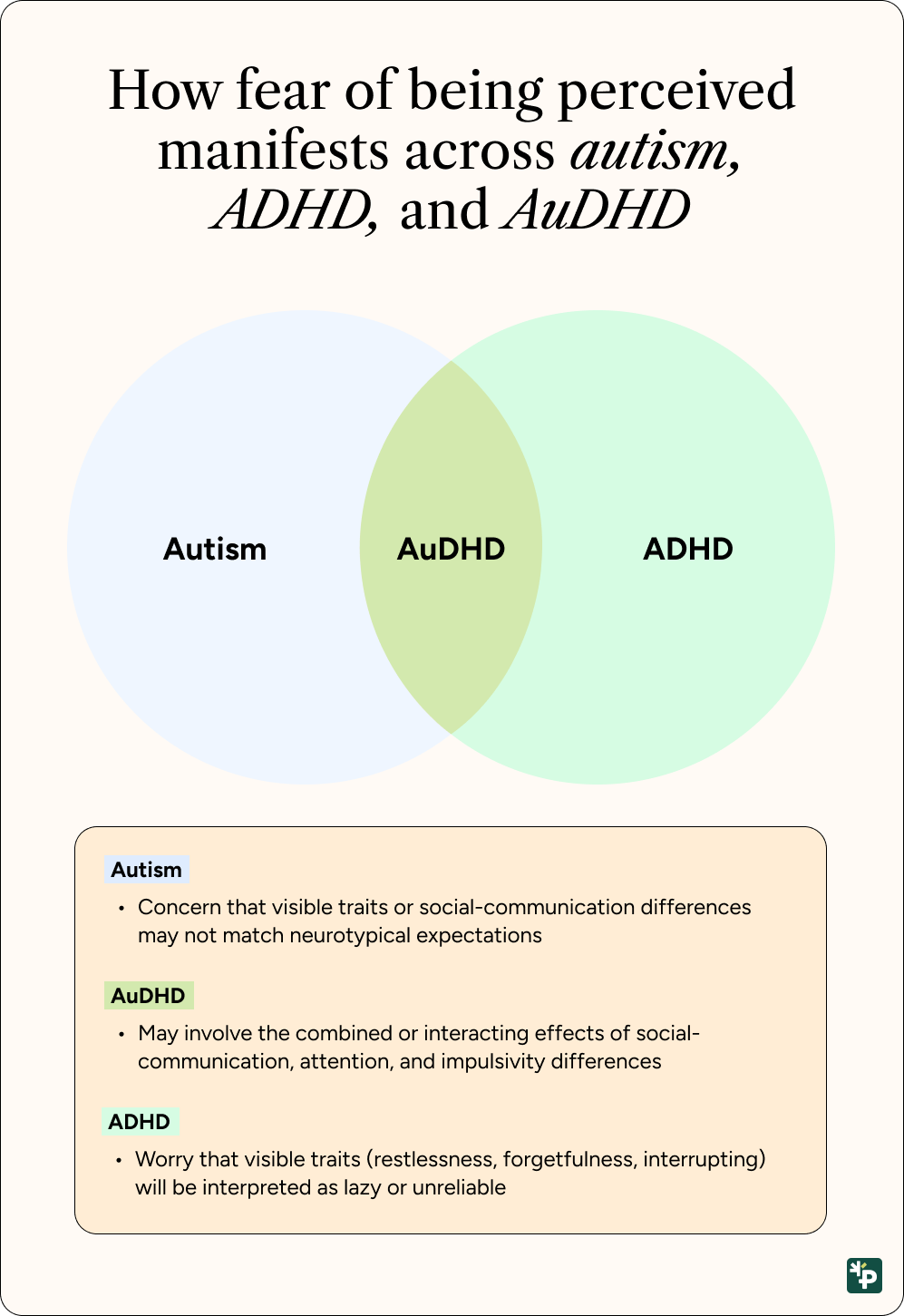
For autistic people, the fear of being perceived often stems from two main factors: social-communication differences and social expectations that are set in early childhood.
Social cues and insights are often skills that “do not come naturally to autistic individuals,” explains Anna Kroncke, PhD., a licensed psychologist with Prosper Health. Therefore, if understanding “others' actions, words, and expectations” is not natural, and these challenges begin in early childhood, “it can lead to fear and discomfort, and as someone ages, these challenges compound.”
People who have attention-deficit hyperactivity disorder (ADHD) don’t necessarily experience the same social differences as autistic people: Instead, they experience challenges with inattention, impulsivity, and hyperactivity — all of which can impact social interactions. Dr. Kroncke says that people with ADHD “can be very good at taking perspective and having insight into others when they are paying attention.”
Adults who are AuDHD (have autism and ADHD diagnoses), however, can experience a fear of being perceived due to both social-communication differences as well as challenges with inattention and impulsivity.
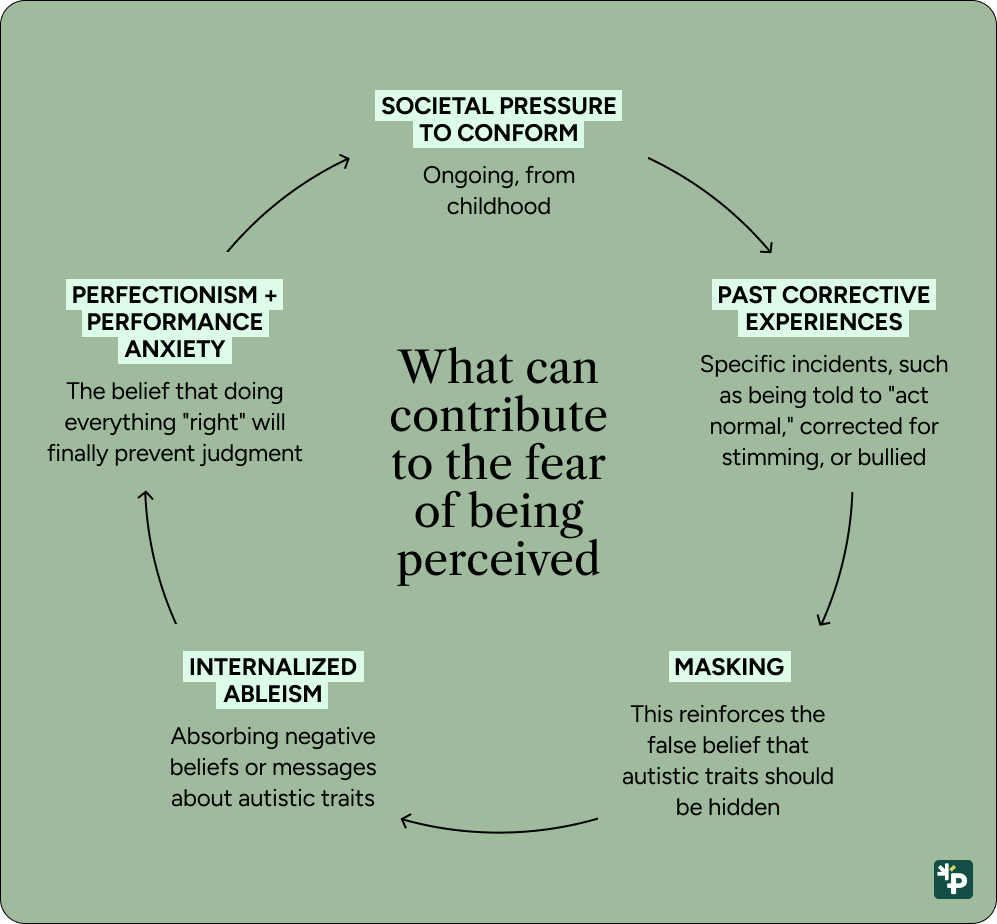
Below, Dr. Kroncke explains why the following examples directly impact the fear of being perceived in neurodivergent people:
Societal pressure to conform
In the case of autism, society teaches us from an early age that certain behaviors are expected. These expectations are then reinforced in school and workplace environments that are built around neurotypical presentations. On top of these rules, children are expected to understand when the social expectations vary or even change.
So an autistic person, who may take information literally and directly, and who has a strong set of morals and ideas around what to do and not do, may be confused by certain norms like not tattling on another child, or a teacher referring to everyone in a classroom as their “friends” when they don’t have a relationship with every child.
Children with ADHD could miss certain cues from peers or teachers as they struggle to pay attention, and impulsivity may lead them to yell out in class or cut someone off when speaking. These behaviors are usually reprimanded and could earn a child “defiant” or “poorly behaved” labels. As a result, they may become anxious and start to fear being perceived.
Masking
Masking for autistic people can look like watching, mimicking, or mirroring the behaviors of others. While neurotypical individuals become more comfortable in their identity, autistic individuals can experience increased rejection and failure, as well as instances when others seem to misinterpret their words or actions.
This can have a snowball effect, causing autistic people to start masking in early adolescence and continuing throughout adulthood because it feels easier and more comfortable for navigating a neurotypical world. A fear of failure can be a natural conclusion for some autistic people, especially if they feel they could never meet others’ social expectations early on.
Masking for someone with ADHD could look like pretending to pay attention — and not asking for clarification or information to be repeated. Or, they may not allow themselves to engage in self-regulatory behaviors like “stimming,” which could help them focus. They also may hide frustration and anxiety so they’re not seen as immature or different.
Internalized ableism
Internalized ableism is the — often unconscious — idea that there is a right way to act, and it can affect how some autistic people socialize as well as interact with co-workers.
It’s the belief that if you need to do things for your own comfort, like not making eye contact, turning your camera off during a virtual meeting, or wearing noise-canceling headphones, then you are in the wrong. In other words, it’s the idea that being different is shameful.
Autistic people can experience internalized ableism when significantly exposed to ableist expectations and little validation or affirmation. Even if a person with ADHD can read social cues and engage with their peers, they are likely receiving negative feedback about their attention and/or ability to complete schoolwork. Just as it does with autism, anxiety may develop and then increase with each failure.
Past corrective experiences
The experiences of autistic individuals, as well as those with ADHD and those who are AuDHD, are relatively similar in these scenarios. This is because people with ADHD and autistic individuals may experience more challenges in traditional classroom environments.
For people with ADHD, these challenges may relate to attention and working memory differences, as well as difficulties with work completion. For autistic people, challenges may be more closely related to social expectations and differences. Autistic people may be told to “make eye contact” or “stop stimming,” or they may be bullied or excluded altogether because of their visible differences.
This type of constant correction can be incredibly damaging to self-esteem and self-worth for neurodivergent people.
An ADHDer may not have social differences in the same way (unless they have both diagnoses). Still, they may have significant emotional impulsivity and, in earlier years, may exhibit behavioral impulsivity.
Perfectionism and performance anxiety
For both autistic people and those with ADHD, it can be hard to do something if you don’t feel you can do it just the “right” way. So much so that it might feel paralyzing to try a new task or something you see as challenging if you have this perfectionist mindset.
How it manifests differently by neurotype
Although the fear of being perceived can vary by individual in how it presents, there are some common ways for these feelings to present depending on your neurotype:
For autistic adults: The fear of being perceived in autism may manifest through worry that their own body language or social cues aren’t matching neurotypical expectations. This hyperawareness may also contribute to nervous system dysregulation, anxiety, and challenges with staying present. Sensory overload can also potentially compound the fear of being perceived in loud or crowded environments, because both processing sensory input and feeling observed happen simultaneously.
“Many people, in times of stress, are likely to have a heightened experience of sensory processing because of the layered anxiety that is present,” says Dr. Kroncke.
For ADHD adults: Adults with ADHD may worry that their visible traits (restlessness, forgetfulness, interrupting) will be interpreted as lazy, disorganized, or unreliable. As discussed above, this is often linked to a lifetime of being corrected for their impulsive or inattentive behavior.
For AuDHD adults: The fear of being perceived can be more challenging (and exhausting) for autistic adults who also have ADHD, says Dr. Kroncke, because not only do they have social-interaction differences, but they’re also dealing with attention and impulsivity challenges.
The masking-and-late-diagnosis connection
If you’re someone who has received a later-in-life autism and/or ADHD diagnosis, while spending years being told that you’re “too sensitive,” “too much,” or “paranoid,” know this: There is a completely valid explanation for your fear of being perceived.
A 2023 study published in Autism Research explores the direct correlation between late diagnoses and masking, suggesting that effective masking is what prevents certain people (women, especially) from being flagged for autism evaluation. This can lead to, according to this 2024 study in Autism in Adulthood, lower self-esteem and increased instances of depression, anxiety, burnout, and exhaustion in autistic people.
“The more you camouflage, [the more] you take on the sense that nothing you do is correct, or good enough,” explains Dr. Kroncke. “The more someone needs to hide who they are to be accepted, the worse it will feel inside.”
Fortunately, there has been a “massive” increase in masking research, confirms Dr. Kroncke, which has, in turn, allowed for improved understanding of autism, even for individuals who have hidden their autistic traits. For many adults, an autism diagnosis may be the first time a fear of being perceived is explained as a valid response to social expectations and pressures rather than dismissed as a personal failing.
Reframing the fear
Whether it was implicitly or explicitly, there are plenty of autistic adults and people with ADHD who have spent years being told that their fear of being perceived was “too sensitive” or “all in their head.” This negative messaging may have led to feelings of shame or a need for people-pleasing. (YouTuber Mikaela Joy expands on these feelings in this video titled “The Autistic Fear of Being Perceived.”)
The first thing to know is that a fear of being perceived is a predictable response to a very real, possibly lifelong pattern of being corrected, scrutinized, or excluded. Having this particular fear is not a personal flaw.
For those who are late-identifying autistic and/or ADHD, this may be the first time where the fear of being perceived is explained, rather than dismissed or minimized — and that can be monumental for your self-actualization journey. Most importantly, having language for this particular feeling can potentially change your perspective on the fear of being perceived, regardless of a formal diagnosis.
Coping strategies
Reframing a fear of being perceived, especially after spending years believing there was something wrong with you, doesn’t just happen automatically. Several strategies can help, which Dr. Kroncke breaks down below:
Self-compassion: Acknowledge your feelings of judgment with compassion and validation instead of pushing them away. In addition, you may want to work on identifying neurodivergent strengths and giving credibility to intelligence, logical thinking, kindness, morals, and values of compassion and service.
Safer unmasking: Instead of unmasking everywhere at once, small steps are key: Choose one trusted person or place where you can be your authentic self. For example, Dr. Kroncke says she had a client “bring her fidgets to work for the first time at age 39, and people loved it; she felt like she was hiding just a little bit less.”
Boundary-setting: This can include stepping back from people or situations that consistently feel unsafe or judgmental.
Building or finding community: Finding community helps you know that you are not alone in your fear of being perceived. You deserve to surround yourself with people who value you and accept your differences, whether it’s with in-real-life peers or virtual neurodivergent-affirming spaces.
Self-advocacy: Working on the above-mentioned skills can help you build confidence, which will then put you in a more comfortable position to advocate for yourself. This improved sense of self may encourage you to communicate your needs and boundaries more directly at work, or in social and academic settings, instead of masking to avoid awkward conversations.
Finding support
If you’re someone whose inner monologues include phrases like “I hate being perceived,” then it may be time to seek support.
Legitimate paths to support come in several forms, including neurodivergent-led peer communities like the Autistic Self Advocacy Network (ASAN) and the Autistic Women & Nonbinary Network (AWN) — as well as formal evaluations and professional therapy.
How Prosper Health can help
Prosper Health offers both formal autism evaluations and neurodiversity-affirming therapy for adults that are 100% virtual and covered by most insurance plans.
An evaluation can provide clarity for adults who have wondered if autism and/or ADHD explains their very specific fear of being perceived. This fear is absolutely real and worth taking seriously, even if you choose not to pursue a formal diagnosis.
Prosper’s therapy services also provide safe spaces to practice unmasking and other helpful coping strategies.
Seeking an autism assessment and/or therapy does not mean there is something about you that needs to be “fixed.”
The bottom line
No one wants to feel like they’re being judged by someone else, which is why the fear of being perceived is a completely human reaction, regardless of your neurotype. But if you’re someone who identifies as autistic, AuDHD, or having ADHD, you deserve to understand why those fears may feel more extreme — and how to manage them.
Acknowledging that neurodivergence may play an integral role in your fears of being perceived can not only help to reduce shame, but also empower you on the path to self-discovery.
Frequently asked questions (FAQs)
Why am I afraid of being perceived?
Having a fear of being perceived is a natural reaction for any human being, because many people don’t like the idea of being watched, noticed, judged, or evaluated by other people. Some neurodivergent people, such as those with autism, ADHD, or both (AuDHD), may experience a more intense fear of being perceived because their social-communication differences (autism) and/or challenges with inattention and impulsivity (ADHD) can impact their social interactions.
Is the fear of being perceived a sign of autism?
No, the fear of being perceived is not a sign of autism, because this feeling can present in both autistic and non-autistic people. For autistic people, however, a fear of being perceived can manifest from two common factors: social-communication differences and social expectations in neurotypical environments.
Can you unlearn the fear of being perceived?
A good first step is reframing this particular fear from a personal flaw to a predictable response to long-term patterns of being corrected by others. There are numerous coping strategies available, like self-compassion, boundary-setting, safe unmasking, and professional therapy, but none of these strategies are necessarily about “unlearning” the fear of being perceived. They’re more about understanding that you don’t need to “fix” this feeling — you just need to find ways to cope with it while validating why it exists in the first place.
Is fear of being perceived the same as scopophobia?
It can be: “Scopophobia” is a clinical term for the fear of being watched. Since the fear of being perceived is a) not a clinical term and b) an umbrella phrase that circulates widely online, it can mean different things to different people. But whatever label you use isn’t as important as understanding that this feeling is a natural reaction to years of being corrected, and that it shouldn’t be a source of shame.
Sources
https://www.tiktok.com/@morgaanfoley/video/7376325444465052974
https://link.springer.com/article/10.1007/s10803-020-04657-3
https://neurosparkhealth.com/masking/fear-of-being-perceived
https://www.medicalnewstoday.com/articles/scopophobia#what-it-is
https://www.prosperhealth.io/blog/what-is-audhd
https://www.prosperhealth.io/blog/types-of-neurodiversity
https://pmc.ncbi.nlm.nih.gov/articles/PMC7261276/
https://www.prosperhealth.io/blog/autism-vs-adhd
https://www.prosperhealth.io/blog/autism-and-stimming
https://www.simplypsychology.org/internalized-ableism-in-autism.html
https://www.prosperhealth.io/blog/autism-and-anxiety
https://focusadhd.com/psychology/adhd-and-judgment-overcoming-the-fear-of-being-misunderstood/
https://neurodivergentcounselling.ca/blog/how-it-feels-to-be-perceived-the-autistic-experience-of-being-seen?srsltid=AfmBOoqUFu8jff5s6VLkCTkFYXU9AFxGdaqYhL6_LApS7MEveVU5FQou
https://pubmed.ncbi.nlm.nih.gov/38031639/
https://pmc.ncbi.nlm.nih.gov/articles/PMC11317797/
https://www.youtube.com/watch?v=ciFUEgiQd-I
https://www.prosperhealth.io/blog/unmasking
https://autisticadvocacy.org/
https://awnnetwork.org/


