.webp)

.png)
Key Takeaways
- Neurodiversity is the idea that there are many different brain types, that are all natural variations in how human brains work.
- The neurodivergent umbrella includes diagnoses like autism, ADHD, dyslexia, dyscalculia, and dyspraxia. These are not deficits but rather different ways the brain processes information.
- Due to historical bias in diagnostic frameworks, conditions like autism and ADHD are frequently overlooked in adults, especially women, people of color, and the LGBTQ+ community.
- Co-occurrence of neurotypes (e.g., autism and ADHD) is common, as many conditions share overlapping genetic and neurological pathways.
- Being neurodivergent does not mean someone is less capable. Moving away from a "deficit-based" mindset allows people to be better self-advocates.
Key Takeaways
- Neurodiversity is the idea that there are many different brain types, that are all natural variations in how human brains work.
- The neurodivergent umbrella includes diagnoses like autism, ADHD, dyslexia, dyscalculia, and dyspraxia. These are not deficits but rather different ways the brain processes information.
- Due to historical bias in diagnostic frameworks, conditions like autism and ADHD are frequently overlooked in adults, especially women, people of color, and the LGBTQ+ community.
- Co-occurrence of neurotypes (e.g., autism and ADHD) is common, as many conditions share overlapping genetic and neurological pathways.
- Being neurodivergent does not mean someone is less capable. Moving away from a "deficit-based" mindset allows people to be better self-advocates.
Exploring neurodiversity as an adult can be equally exciting and intimidating.
Perhaps you’re noticing that, through the neurodiversity lens, certain once-confusing moments in your life are suddenly making sense. Or you’re still healing from lifelong frustrations, feeling misunderstood, and lack the language to articulate your unique experiences.
If this sounds like you at all, then you’re in the right place. This article will not only guide you through some of the most common types of neurodiversity but also help you understand how each neurotype actually shows up in adult life — and what your options are if you want to investigate further.
What does neurodiversity actually mean?
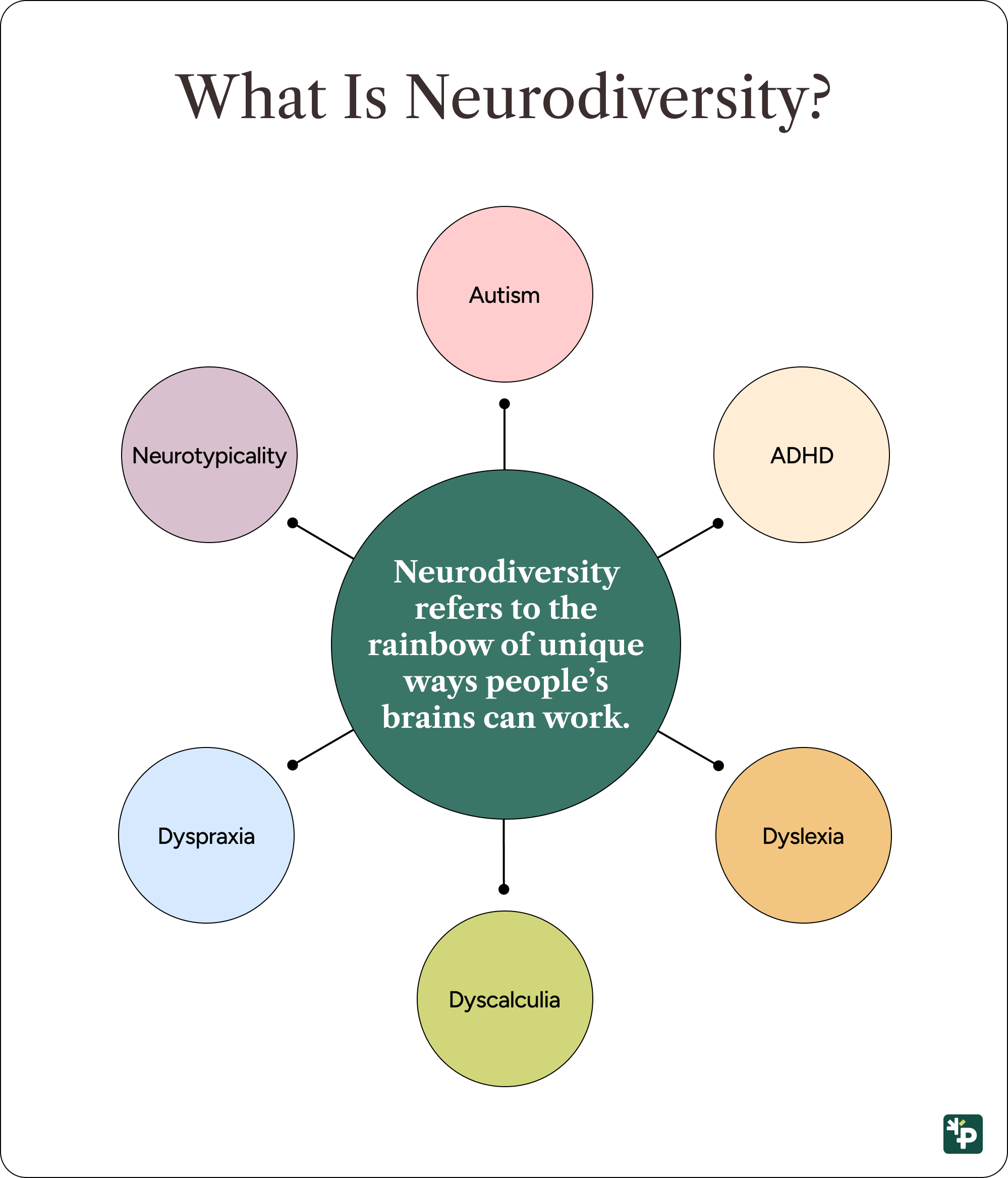
According to the American Psychological Association, the word “neurodiversity” refers to the diversity of all people. However, neurodiversity is often used to contextualize the different ways people experience and interact with the world, or how their brains work, specifically through neurodevelopmental conditions such as autism, ADHD, and dyslexia.
As such, neurodiversity itself is a framework, not a diagnosis. It’s the idea that, per a Harvard Medical School article, differences are not deficits — and that there is no single correct way of thinking, learning, and behaving.
“Neurodiversity is the idea that there are many different brain types,” says Dr. Hannah Jones, a licensed clinical psychologist with Prosper Health, “and they are all natural variations in how human brains work.” She adds that all brain types have “unique strengths and value.”
Within the neurodiversity framework, people are categorized under two umbrella terms: “neurotypical” or “neurodivergent.”
“Neurotypical” refers to people whose patterns of thinking, learning, communication, and development generally align with what is considered typical within their culture and society. They do not meet criteria for a neurodevelopmental condition such as autism or ADHD.
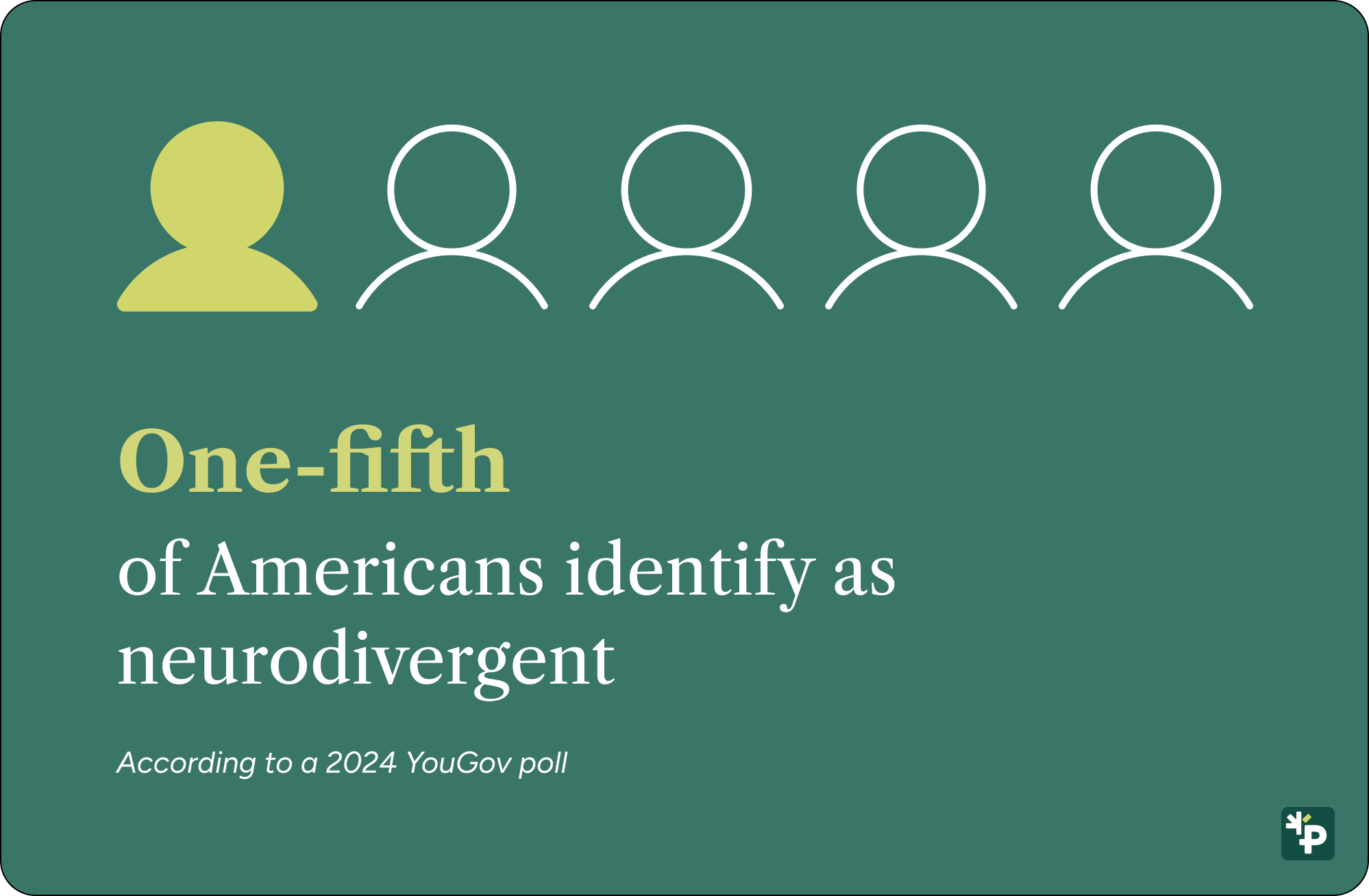
“Neurodivergent” refers to people whose brains work differently from what is considered typical. This can include someone with a neurodevelopmental condition like autism or ADHD, or learning disabilities like dyslexia or dyscalculia. The increased recognition of neurodiversity has resulted in about one-fifth of Americans identifying as neurodivergent, according to a YouGov poll.
Types of Neurodiversity: An Overview
The list of neurotypes that fall under the neurodivergent umbrella is constantly changing, primarily because there aren’t any official medical definitions for the term “neurodivergent.” But for this article’s purposes, we’ll cover approximately five neurodevelopmental conditions that are commonly considered neurodivergent: Autism, ADHD, dyslexia, dyscalculia, and dyspraxia.
A gentle reminder that this table — and the featured neurotypes — provide a general overview of neurodiversity. Not only do individual presentations vary significantly, but types of neurodiversity are not mutually exclusive; some individuals may experience multiple neurotypes.
Autism
Autism, or autism spectrum disorder (ASD), is a neurodevelopmental condition that affects social communication, as well as how people behave and process sensory information. It is considered a developmental disability, but not a mental disorder or mental illness.
“For many autistic people, autism is primarily about experiencing the world differently than non-autistic people,” observes Dr. Jones. “It can involve noticing patterns others miss, needing predictability, navigating sensory overwhelm, and constantly translating between your own way of thinking and the expectations of others.”
Common signs of autism in adults can include the following:
- Social interaction and communication differences
- Sensory and processing differences
- Self-soothing/self-regulation activities like self-stimulatory behavior or “stimming”
- Special interests
- Masking, or suppressing autistic traits to appear neurotypical, and its energy-depleting effects
- Emotional regulation and cognitive differences
Regardless of these common traits, autism is a unique experience for every individual.
Owing to an overall better understanding of autism, there has been an increase in recognition of autism diagnoses among adults in recent years. But a late diagnosis is especially apparent in women, girls, members of the LGBTQ+ community, and people of color, mainly because of the initially restrictive diagnostic framework.
“Many diagnostic frameworks, autism included, were developed around the experiences of White (European American) children assigned male at birth,” explains Dr. Jones. “So people whose autism looks different are more likely to be missed.”
She goes on to say that people with historically marginalized identities (women/assigned female at birth, people of color, LGBTQ+) “often spend years adapting and masking as an act of safety, which contributes to many misunderstandings before autism is ever considered.”
ADHD
Attention-deficit hyperactivity disorder, or ADHD, is a developmental condition classified in one of three presentations: Inattentive, Hyperactive-Impulsive, and Combined.
There are 18 diagnostic criteria for ADHD (nine for inattentive and nine for hyperactive/impulsive), and when five or more are met for either category, it results in a diagnosis of either:
- Inattentive presentation ADHD
- Hyperactive-Impulsive presentation ADHD
- Combined type ADHD
Combined presentation is the most common type of ADHD, where people present with all three of the condition’s characteristics: inattention, hyperactivity, and impulsivity.
- Inattention: Difficulty paying attention, staying organized, and staying on top of tasks
- Hyperactivity: Needing to move around often, feeling restless or fidgety, and highly verbal
- Impulsivity: Interrupting, having trouble waiting one’s turn, intruding on others
While traits will vary by individual, the ADHD neurotype may include experiences such as time blindness, restlessness, or periods of intense focus on highly engaging activities.
People with ADHD tend to:
- Crave novelty and stimulation
- Struggle with routines
- Have attention-regulation challenges
- Quickly lose interest in previous hyperfixations
As with autism, ADHD is frequently missed in adults, especially women, according to a 2023 study published in the Journal of Attention Disorders.
“Women are especially likely to be overlooked because their ADHD may appear as overwhelm, anxiety, perfectionism, or chronic exhaustion,” says Dr. Jones. “Often, ADHD in women presents more as predominantly inattentive, which can be easily masked.”
In addition, Dr. Jones notes that women with more hyperactive symptoms may learn strategies over time for camouflaging. The long-term result of this behavior is that hyperactivity is experienced more internally (e.g., racing, rapidly changing thoughts, rapid and tangential speech, channeling energy into completing tasks, etc.). Such internal characteristics may not be easily observable to others.
Although ADHD is not on the autism spectrum, it does have significant overlaps with autism, and it is considered one of the types of neurodivergence.
Dyslexia and dyscalculia
Dyslexia and dyscalculia are similar learning disabilities that affect how your brain processes certain types of information: written language (dyslexia) or math- and number-related skills (dyscalculia).
All this means is that the brain processes certain kinds of coded information differently. What these neurodivergent examples do not mean is that the person’s brain is less capable. If you’re reading this article, and you suspect you may have either dyslexia or dyscalculia (or have since been diagnosed with either condition), know that your previous experiences are valid — even if you’ve spent years thinking you lacked intelligence and/or basic reading/math skills.
Dyslexia
According to the Yale Center for Dyslexia and Creativity, dyslexia affects about 20% of the U.S. population. Since it is commonly due to a difficulty in phonological processing (the appreciation of spoken language’s individual sounds), dyslexia affects a person’s ability to read quickly and automatically, and to retrieve spoken words easily.
Although it causes challenges in learning to read, dyslexia has no bearing on a person’s intelligence or creativity.
Dyscalculia
Dyscalculia, according to the Learning Disabilities Association of America, is a numbers-centric learning disability that affects about 4-7% of students in the United States. Because dyscalculia impacts a person’s ability to complete numerical tasks, including calculations and problem-solving, this neurotype can impact:
- Copying and memorizing phone numbers, logins, and dates
- Everyday calculations like shopping budgets, counting change, restaurant gratuities, or following recipes
- Managing finances
- Keeping track of time
Both dyslexia and dyscalculia are also frequently unrecognized in adults, mainly because, explains Dr. Jones, “adults often develop workarounds that hide their difficulties. By the time they reach adulthood, people may know they struggle with reading or math, but have ways of supporting themselves that may make it difficult to notice differences.”
Another issue, says Dr. Jones, is the lack of available data for adult evaluations:
“Diagnosing specific learning disorders in children relies on an understanding of developmental factors across contexts and a comparison of academic and intellectual functioning.”
In the case of adults, she continues, they may not have as many data points to work with (for example, they may no longer have academic records). “They also do not always have a reference person who knew them well when they were young and [who can] offer additional developmental data.”
Dyspraxia
Dyspraxia, or developmental coordination disorder, is another example of what is considered neurodivergent. According to the Learning Disabilities Association of America, dyspraxia, which affects motor planning and coordination, can cause movement and coordination challenges (both gross motor and fine motor skills), as well as impact language, speech, and learning.
This particular neurotype is likely the least familiar to most readers because, unfortunately, according to Dyspraxia DCD America, there is no available diagnostic tool for adults over age 21. As a result, obtaining a formal diagnosis for adults is extremely challenging.
“Many adults with dyspraxia are labeled clumsy, disorganized, or uncoordinated rather than being recognized as having a neurodevelopmental difference,” observes Dr. Jones. “Because awareness of dyspraxia remains relatively low in general (unless it is very pronounced), it often flies under the radar.”
Adults with dyspraxia may experience any of the following signs:
- Poor balance
- Low muscle tone
- Poor posture/slumping in chair
- Falling out of a chair
- Awkward body movements (walking, running, throwing)
- Accident proneness (bumping into people or objects)
- Difficulty driving a car, may choose not to drive
- Difficulty in work and school activities:
- Copying information from a screen or a board
- Writing with a pen/pencil
- Typing on a keyboard
Other neurotypes to know about
The neurodivergent umbrella is broad and evolving, so there is no “set” number of neurotypes that fall under this category.
All diagnoses and conditions fall on the neurodiversity spectrum, says Dr. Jones, because neurodiversity is simply the concept that there are many different brain types.
But neurodivergence, more specifically, “refers to brain types that differ in some significant way from people who have been labeled ‘neurotypical,’ and all of these diagnoses can fall under the neurodivergent umbrella.”
Below are a few other types of neurodiversity also worth exploring:
Dysgraphia
Dysgraphia, according to the International Dyslexia Association, is a learning disability that impairs handwriting. People with this condition may find speaking much easier than writing, and may exhibit issues with spelling, letter formation, and legibility, letter size and spacing, grammar, and the rate or speed of their writing.
Tourette syndrome
Per the Tourette Association of America, Tourette syndrome is a neurodevelopmental disorder characterized by sudden, involuntary movements and/or sounds called tics.
Movement, or motor, tics can include shoulder shrugging, neck stretching, arm jerking, or head bobbing/jerking. Sound, or vocal/phonic tics, can include throat clearing, grunting, shouting, or sniffing.
Sensory processing differences
Sensory processing differences, or differences in how your brain understands and responds to information from your senses, affect about one to three out of every 20 people in the general U.S. population. Examples include sensitivity to water, fabrics, lights, sound, and physical affection.
There is no formal diagnosis for sensory processing differences, but this condition has been heavily researched, and it commonly co-occurs with autism.
Co-occurrence of neurotypes: Why one diagnosis rarely tells the whole story
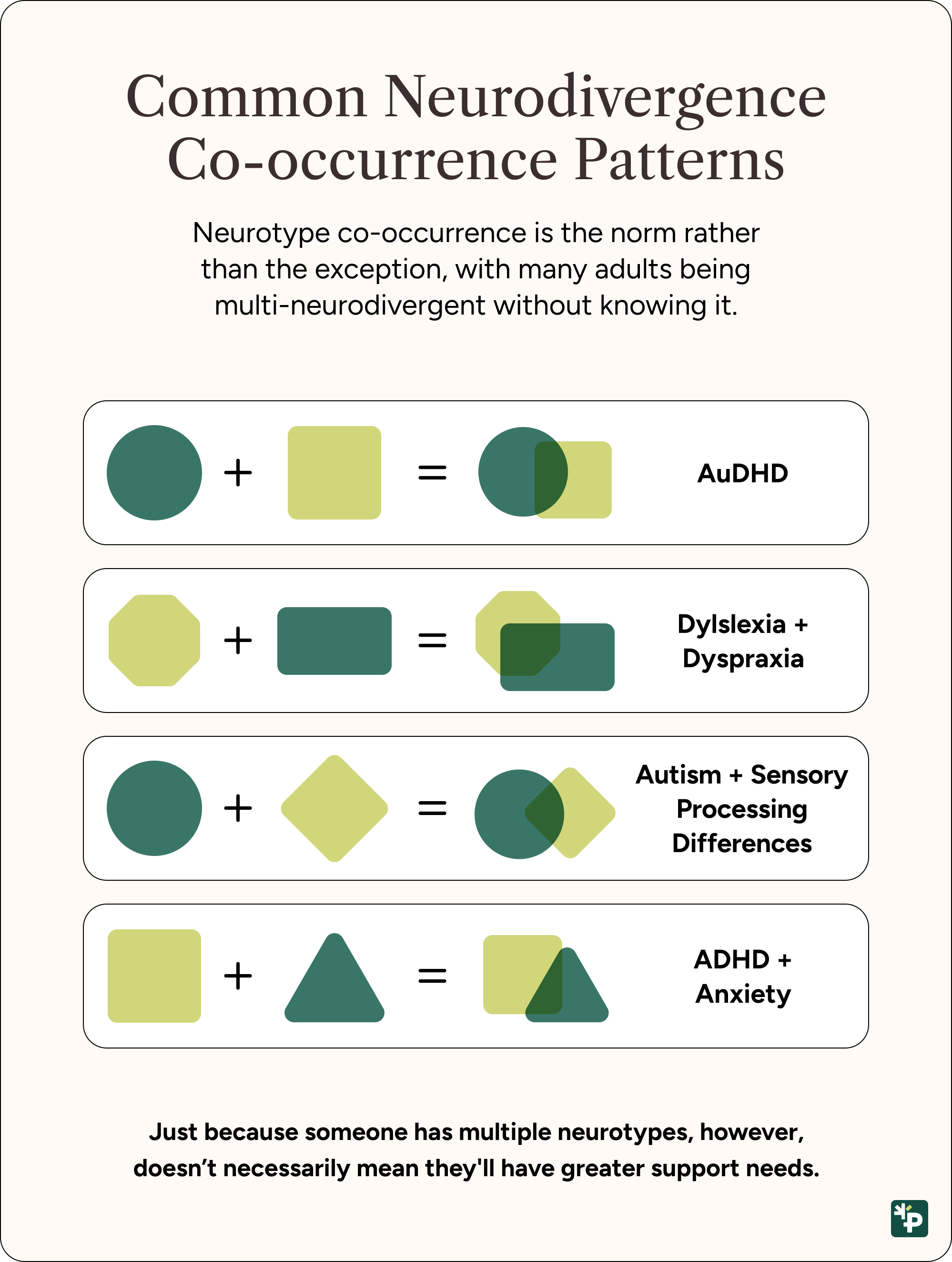
If you’re currently exploring different neurodivergent types, one of the most important things to remember is that co-occurrence is often the rule, not the exception.
Autism and ADHD, colloquially known as AuDHD, for example, co-occur frequently because they share overlapping genetic, neurological, and developmental pathways, explains Dr. Jones. “Rather than being entirely separate conditions, they often reflect different expressions of related underlying brain differences,” she says. However, she cautions that this is an evolving concept still being heavily researched.
Dyslexia often appears alongside dyspraxia, dyscalculia, and dysgraphia because, Dr. Jones says, skills like reading, writing, motor coordination, and mathematics rely on interconnected brain systems. “When one area develops differently, it's common to see differences in related areas as well.”
While not separate neurotypes, anxiety and depression also frequently develop alongside neurodivergence. This is because many neurodivergent people “spend years navigating environments that were not designed with their needs in mind,” says Dr. Jones. Chronic misunderstanding, exclusion, masking, and unmet support needs can increase vulnerability to anxiety and depression over time, she notes.
For those who are only now re-examining their experiences, know this: It’s okay if you never thought about this before, because people tend to normalize their own experiences.
“If you've lived your entire life struggling with reading, attention, sensory input, or coordination, you may assume that's simply how everyone experiences the world,” says Dr. Jones. “It is often not until people receive specialized education, or they or someone close to them notices significant differences in comparison to most others, that the possibility of co-occurring neurotypes enters a person's awareness.”
So if you’re someone who already has one diagnosis and you suspect you may have another, that’s completely understandable. Having more than one neurotype doesn’t complicate your experience — even though it may feel like that at first — and a formal evaluation can help guide you toward that clarity.
What support is available for neurodivergent adults?
In addition to formal evaluations and diagnoses, you may want to explore options like neurodiversity-affirming therapy, workplace and education accommodations, and opportunities for neurodivergent self-advocacy and community.
Although support for neurodivergent adults doesn’t require a formal diagnosis, an evaluation can provide greater self-understanding. Plus, an official diagnosis can make it easier to obtain accommodations.
If you’re interested in pursuing support, Prosper Health can help. We provide virtual, insurance-covered autism evaluations, as well as neurodiversity-affirming therapy services.
The bottom line
If you’ve been diagnosed with any of the conditions discussed in this article, congrats — you’re neurodivergent! This doesn’t mean you have a deficit or that you’re any less capable of thriving in life; your brain just approaches human experience a little bit differently from the majority.
The more we talk about the various types of neurodiversity, and further educate ourselves on this topic, the better equipped neurodivergent people will be to not only advocate for themselves, but also highlight that all brain types have unique strengths and value.
Frequently asked questions (FAQs)
Can you be neurodivergent but not autistic or ADHD?
Yes, you can be neurodivergent but not autistic or ADHD, because “neurodivergent” refers to people whose brains work differently from what is considered typical. Several other neurodevelopmental conditions fall under the still-evolving neurodivergent umbrella, including the learning disabilities dyslexia and dyscalculia, as well as dyspraxia, which affects motor skills and coordination. If you're considering accommodations at work or school, a formal diagnosis may still be necessary in some settings.
Can you be neurodivergent without a formal diagnosis?
Yes, you can be neurodivergent without a formal diagnosis. “Neurodivergent” is an umbrella term — read: not a clinical diagnosis — used to describe anyone who processes information, learns, or behaves differently from what society considers typical. Formal diagnoses, however, can confirm certain neurodevelopmental conditions like autism, ADHD, or dyspraxia, or learning disabilities like dyslexia and dyscalculia.
How do I know if I should get evaluated?
Getting evaluated for a neurodevelopmental condition or learning disability is a personal decision. But if you identify with any of the conditions explored in this article, you may want to consider a clinical evaluation. Although a formal diagnosis isn’t required for neurodivergent support, a professional evaluation can provide clarity and open doors to community and accommodations.
What does masking mean?
Masking, or suppressing autistic traits to appear more outwardly neurotypical, is a common practice among neurodivergent people. Masking can include — but is not limited to — suppressing self-regulating behaviors like “stimming,” forcing eye contact, or pretending not to be bothered by sensory overload. This practice is not only energy-depleting, but it also prevents neurodivergent people from living as their authentic selves.
Sources
https://www.apa.org/education-career/training/supercharge-neurodiversity
https://www.health.harvard.edu/blog/what-is-neurodiversity-202111232645
https://www.prosperhealth.io/blog/neurotypical-vs-neurodivergent-experiences
https://my.clevelandclinic.org/health/articles/neurotypical
https://yougov.com/en-us/articles/50950-neurodiversity-neurodivergence-in-united-states-19-percent-americans-identify-neurodivergent-poll
https://www.prosperhealth.io/blog/what-is-autism-spectrum-disorder
https://www.prosperhealth.io/blog/why-many-adults-receive-a-late-autism-diagnosis-and-what-to-do-next
https://www.prosperhealth.io/blog/adult-autism-signs
https://www.prosperhealth.io/blog/autism-and-stimming
https://www.prosperhealth.io/blog/autism-masking
https://www.nimh.nih.gov/health/topics/attention-deficit-hyperactivity-disorder-adhd
https://journals.sagepub.com/doi/10.1177/10870547231161533
https://www.prosperhealth.io/blog/autism-vs-adhd
https://dyslexia.yale.edu/dyslexia/dyslexia-faq/
https://ldaamerica.org/what-is-dyscalculia/
https://ldaamerica.org/disabilities/dyspraxia/
https://www.dyspraxiadcdamerica.org/dyspraxia-dcd-adults/
https://dyslexiaida.org/understanding-dysgraphia/
https://my.clevelandclinic.org/health/diseases/23294-dysgraphia
https://tourette.org/about-tourette/overview/what-is-tourette/
https://www.prosperhealth.io/blog/sensory-processing-disorder-in-adults
https://www.prosperhealth.io/blog/what-is-audhd


