.webp)


Key Takeaways
- Autism and BPD are different diagnoses, but they can share some overlap, like social differences and rigid thinking styles.
- Autism is a neurodevelopmental condition, and BPD is a personality disorder. They’re also tied to different core traits, like sensory differences in autism and fear of abandonment in BPD, though autistic people can experience that fear too.
- Autism and BPD can co-occur, and masking can be one of the biggest reasons the two get confused or misdiagnosed in the first place.
- Therapy, especially CBT and DBT, might be able to help both autistic people and people with BPD build coping skills and improve their quality of life.
Key Takeaways
- Autism and BPD are different diagnoses, but they can share some overlap, like social differences and rigid thinking styles.
- Autism is a neurodevelopmental condition, and BPD is a personality disorder. They’re also tied to different core traits, like sensory differences in autism and fear of abandonment in BPD, though autistic people can experience that fear too.
- Autism and BPD can co-occur, and masking can be one of the biggest reasons the two get confused or misdiagnosed in the first place.
- Therapy, especially CBT and DBT, might be able to help both autistic people and people with BPD build coping skills and improve their quality of life.
Maybe you’ve been told you're “too sensitive.” Or “too rigid.” Or that you overreact to things other people brush off. Somewhere along the way, you might have even been handed a label, borderline personality disorder (BPD), and it explained some of what you were going through, but not all of it.
Autism and borderline personality disorder (BPD) can look similar from the outside. Both can involve intense emotions, relationship difficulties, and reactions that may seem confusing to other people. But they have different underlying causes, and telling them apart matters. If autism is mistaken for BPD, you may end up getting support that doesn’t address what’s actually going on.
According to the CDC, autism is a neurodevelopmental condition present from early childhood. BPD is a personality disorder that tends to develop later, usually in adolescence through early adulthood, according to a clinical review of BPD. The two conditions have different origins, but some of their day-to-day symptoms can look similar. Understanding those differences can help you find support that actually fits your experience.
This article covers what autism and BPD have in common, why the two can get confused, whether you can have both at once, and what support looks like.
What are autism and BPD?
According to the CDC, Autism spectrum disorder is a neurodevelopmental condition present from early childhood. BPD is a personality disorder that tends to develop later, usually in adolescence through early adulthood, per research presented in a clinical review of BPD.
The two conditions have different origins, but some of their day-to-day symptoms can look similar. Understanding those differences can help you find support that actually fits your experience.
Borderline personality disorder is a mental illness that severely impacts a person's ability to regulate their emotions, according to the National Institute of Mental Health. If you have BPD, you might:
- Experience heightened emotions like intense anger or fast mood swings
- Act impulsively
- Feel a deep fear of abandonment
- Shift between idealizing and devaluing people
- Struggle with a changing or unstable sense of who you are
- Feel disconnected from yourself entirely at times
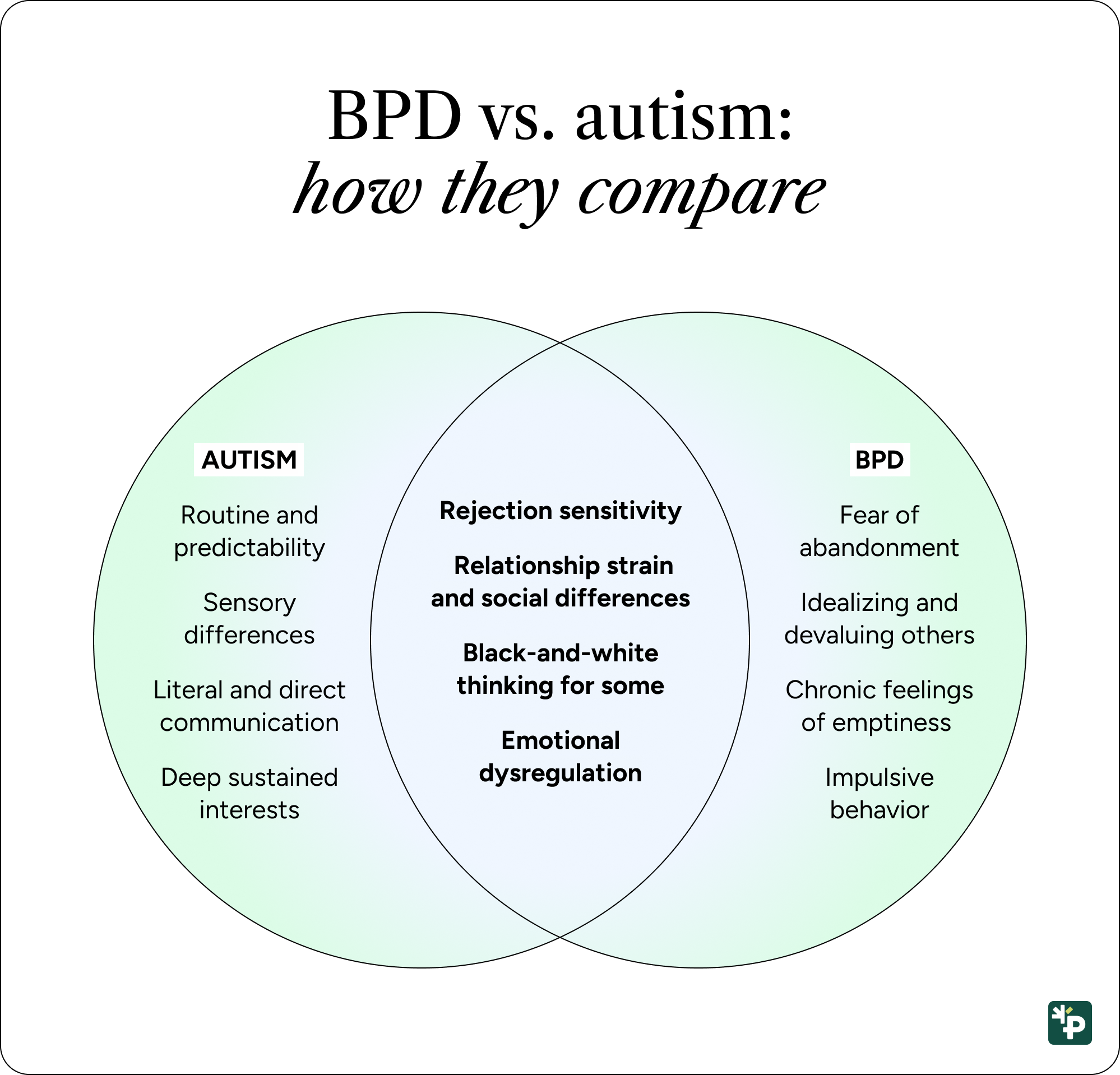
Social experiences
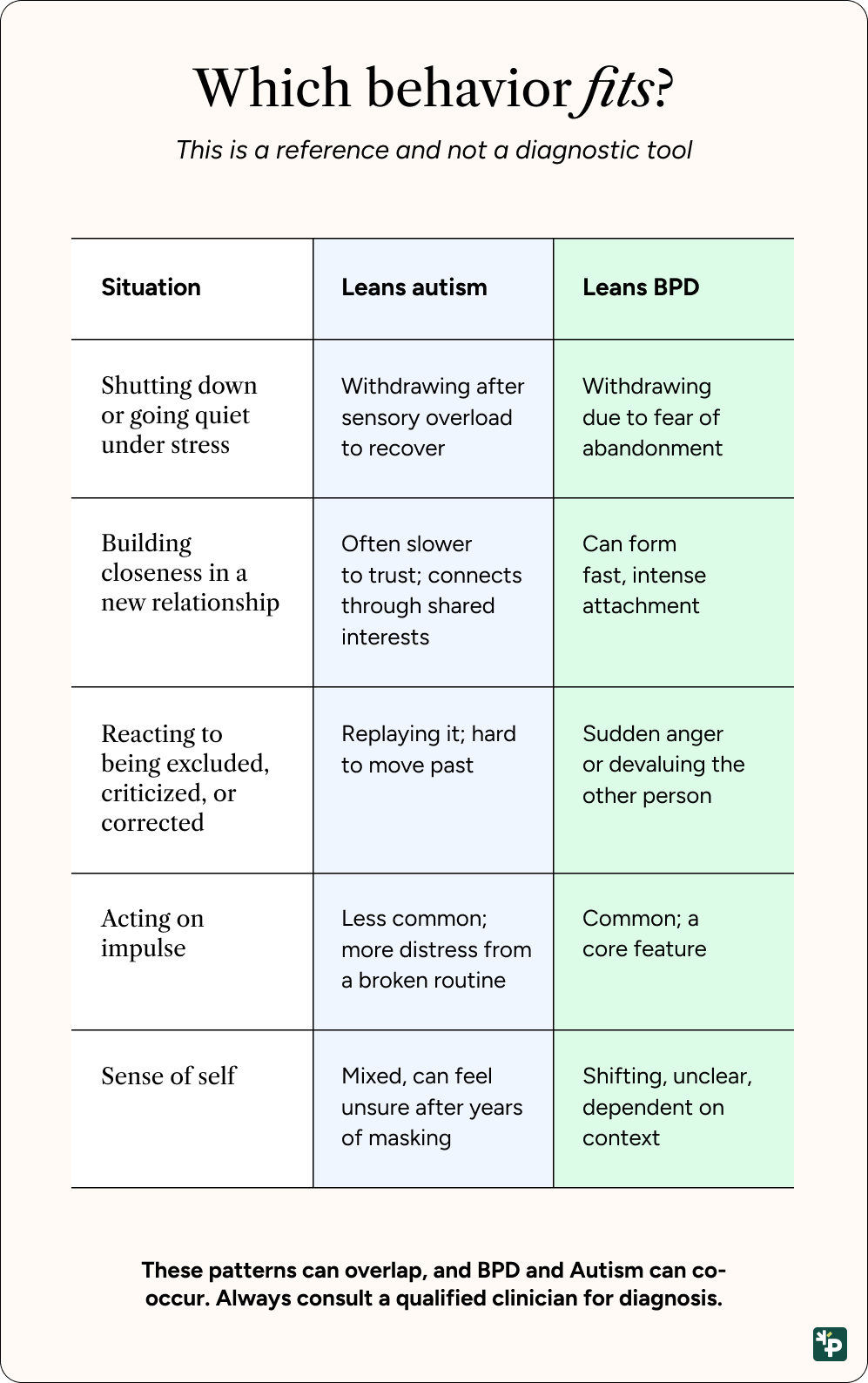
You might build social relationships at a different pace than people around you. If you’re autistic, you may take more time to build trust and a deep connection with someone new.
If you have BPD, the opposite pattern can be common. You may grow close to people quickly and intensely.
Autistic people can also seem to dive in fast, since sharing openly about your interests with someone new can look like quick attachment from the outside, even when it isn’t.
Preference for familiar styles of thinking
Both Autism and BPD can mean getting rooted in certain ways of seeing things. With BPD, this often shows up as black-and-white thinking. Something either feels completely wonderful or completely terrible, with little room in between.
Autism tends to show up more as difficulty adjusting to change or new ideas, though some autistic people experience that same all-or-nothing thinking too. Either way, unfamiliar perspectives can be difficult to sit with.
Rejection sensitivity
Rejection sensitivity, sometimes called rejection sensitive dysphoria, can show up in both groups.
According to the Cleveland Clinic, it involves overwhelming emotional pain in response to real or perceived rejection or criticism. Although RSD is not a formal diagnosis or a recognized condition in the DSM-5, the term is sometimes used to describe this type of intense response to rejection. If this is you, you might be tuned into signs that someone could be pulling away.
Rejection, even minor or perceived, can hit a lot harder than it seems to for non-autistic or BPD people.
Mental health outcomes
Both conditions can have a significant impact on mental health and quality of life. People with BPD and autistic people also face higher risks of self-harm and suicidal thoughts and behavior than the general population.
As stated by NewYork-Presbyterian's Borderline Personality Disorder Resource Center, up to 70% of people with BPD attempt suicide at some point in their lives. Research published in Current Developmental Disorders Reports puts that figure at around 24% for autistic people.
If you or someone you know is thinking about hurting themself, call, text, or chat 988 for immediate support.
The good news: therapy, especially neurodiversity-affirming approaches like CBT and DBT, can make a real difference for both.
Why Autism and BPD Get Confused: The Role of Masking
Masking is the practice of hiding autistic traits and mimicking neurotypical behavior to fit in, something a lot of autistic people learn to do — often without fully realizing it. And masking can take a significant toll.
According to a study published in the Journal of Autism and Developmental Disorders, camouflaging autistic traits is linked to exhaustion, anxiety, and threats to a person's sense of self.
These come alongside emotional patterns that can look a lot like BPD from the outside, such as intense reactions, relationship strain, and a sense of instability, even though what's actually driving it is completely different.
Masking can be a big part of why many adults might get misdiagnosed with BPD first, especially women and AFAB people. A study published in Autism in Adulthood found that women face significantly longer delays in getting an autism diagnosis than men, and are more likely to receive other diagnoses first, patterns the researchers linked to higher rates of camouflaging.
If this sounds familiar, you’re not alone. It’s also not a reflection of anything being wrong with how you presented. It’s a reflection of how well masking can work and how much it costs — to build and perhaps, to eventually take off.
How Do Autism and BPD Differ?
Despite the overlap, autism and BPD are very different conditions. The biggest difference is how they’re classified (autism is a neurodevelopmental disorder, while BPD is a personality disorder). But they diverge in a few other key ways too.
Classification
As the DSM-5 explains, autism is a neurodevelopmental condition involving persistent differences in social communication and interaction, along with restricted or repetitive patterns of behavior, interests, or activities. These characteristics begin in early development and can affect communication, learning, and behavior throughout life.
BPD, on the other hand, is a personality disorder, and the clinical review of BPD notes that personality disorders like BPD typically emerge later, in adolescence or early adulthood, rather than being present from birth.
Impulsivity vs. sameness
Impulsivity can be common with BPD. If you’re autistic, you might act impulsively sometimes too, maybe speaking before you’ve thought something through fully, but you’re more likely to prefer familiarity and routine. You may also avoid impulsive choices that could throw off your plans.
Emotional regulation
Emotional dysregulation is a core diagnostic feature of BPD. It’s not a defining trait of autism, though plenty of autistic people can struggle with it too.
For autistic people, dysregulation can be influenced by factors such as sensory overload, social exhaustion, or unmet needs, rather than the condition itself.
Nature of social differences
Both groups can experience social differences, but they tend to look different.
If you're autistic, you might not find neurotypical social norms intuitive, and you may communicate in a more literal, direct way. With BPD, social differences tend to center more on instability, relationships, and emotions that swing rather than settle.
This is a general reference, not a diagnostic tool. Only a qualified clinician can make an actual diagnosis.
Mental health outcomes
Both autistic individuals and people with BPD are more likely to report poorer mental health outcomes and life satisfaction. Both groups are also more likely to self-harm, experience suicidal thoughts, attempt suicide or die by suicide. It’s estimated that up to 70% of individuals with BPD have attempted suicide, and as many as 24.3% of autistic people have attempted suicide.
Interventions like psychotherapy can be very effective at helping individuals with BPD and autistic people achieve better mental health outcomes. Neurodiversity-affirming therapy and psychotherapeutic approaches like cognitive behavioral therapy (CBT) and dialectical behavior therapy (DBT) can be particularly impactful in improving overall well-being.
If you or someone you know is thinking about hurting themself, call, text or chat the Suicide and Crisis Hotline: 988 for immediate support.
Can you have autism and BPD at the same time?
Yes, research in a 2021 systematic review and meta-analysis published in the journal Autism Research shows that Autism and BPD can co-occur, and if that's your experience, you're not imagining it or overcomplicating things. Having both means navigating a neurodevelopmental difference and a personality disorder at once, and it might be more common than most people realize, especially given how often autism can get missed or misdiagnosed as BPD in the first place.
If this is you, you don't necessarily need to sort out which label explains which piece of your experience before you can get support. Some people find real value in understanding both diagnoses clearly, since it can change what kind of therapy actually fits. Others find it more useful to focus on treating the symptoms in front of them, whatever the framework, and that's a completely valid way to move forward too.
You don't need the "right" label to feel resolved about your own life.
How are autism and BPD diagnosed?
Both diagnoses hinge on a clinical interview with a psychologist or psychiatrist, but the process looks different for each because the diagnostic criteria are so different.
How is autism diagnosed?
An autism assessment usually centers on a comprehensive clinical interview, developmental history, and evaluation of behavior and communication. According to the DSM-5 criteria summarized by the CDC, you'll need to show persistent differences in social communication and interaction across more than one context, plus at least two of the following: repetitive movements or behaviors, a strong preference for sameness and routine, intense or restricted interests, and sensory hyper- or hypo-sensitivity.
These traits also need to have been present since early childhood and to genuinely interfere with daily life, in a way that isn't better explained by something else.
A clinician might also use questionnaires or talk to people who knew you well growing up, since that can help paint a fuller picture of your traits over time.
How is BPD diagnosed?
A clinical review of BPD in StatPearls outlines several symptoms clinicians look for when making a diagnosis. To meet the criteria, a person must have at least five of the following:
- A strong fear of abandonment, along with frantic efforts to avoid it, whether the abandonment is real or perceived
- Relationships that feel intense and unstable, sometimes swinging between idealizing someone and suddenly seeing them in a very negative light
- An unstable or changing sense of identity
- Impulsive behavior that could be harmful
- Repeated suicidal behavior, threats, or self-harm
- Intense mood swings or emotions that change quickly
- Ongoing feelings of emptiness
- Anger that feels intense or difficult to control
- Brief periods of paranoia or feeling disconnected from reality, especially during times of stress
Clinicians will often also ask about your family's mental and physical health history, and may request a physical exam to help rule out other explanations.
If ADHD is part of your picture too, that can complicate this differential further. A large population-based study of over two million people found that ADHD and BPD co-occur at meaningfully higher rates than chance, since traits like impulsivity and emotional dysregulation show up in ADHD as well as autism and BPD.
What support is available for autism and BPD?
Because autism and BPD are typically lifelong diagnoses, support tends to focus less on eliminating traits and more on building skills and a stronger sense of wellbeing, though the actual goals look different for each.
Support for autism generally isn't about changing who you are. Support for BPD often does aim to reduce specific traits, like relationship instability or difficulty controlling anger, that are actively getting in the way of the life you want.
Therapy
Therapy is generally the main form of support for both. The goal, either way, is building skills to manage what's hard, interrupting patterns that are causing harm, and strengthening your ability to advocate for yourself.
Cognitive behavioral therapy (CBT): CBT helps you identify and interrupt unhelpful thought and behavior patterns. Research published in the Journal of Rational-Emotive and Cognitive-Behavior Therapy describes emerging evidence for CBT's effectiveness with autistic adults, particularly for anxiety, OCD, and depression, often addressing beliefs that feed anxiety or low self-esteem.
For people with BPD, it often means addressing the beliefs driving unstable relationships or a shaky sense of self.
Dialectical behavior therapy (DBT): According to Cleveland Clinic, DBT was developed by psychologist Marsha Linehan specifically for BPD, though it's since proven effective far beyond it, including for suicidal thoughts and behavior, substance use, eating disorders, and PTSD.
DBT leans more into accepting and regulating emotion than CBT does, and it incorporates mindfulness and skills for building healthier relationships.
A long-term relationship with a therapist you really connect with tends to matter more than any specific technique, so it's worth taking time to find a provider you trust.
Medication
Medication isn't the main treatment for either autism or BPD, but it can still play a role. If you have BPD, you might be prescribed something for specific symptoms or a co-occurring condition like depression or anxiety, antidepressants, anti-anxiety medication, mood stabilizers, or antipsychotics.
If you're autistic, medication is more likely to target anxiety or depression that shows up alongside autism, rather than autism itself.
Finding support for autism, BPD, or both
Whether you're untangling a possible misdiagnosis, exploring a dual diagnosis, or just trying to understand yourself better, you don't have to figure this out alone.
If a current diagnosis doesn't feel like it captures the full picture, that's worth saying out loud to a provider, plainly. You can try, “this diagnosis doesn't feel like it explains everything I'm experiencing," or "has autism ever been considered here?" during an appointment.
Support can come from a few places. A clinician experienced in both autism and BPD can help you sort out what's truly going on. Connecting with the autistic or neurodivergent community can help too, especially if you've spent years feeling like an outlier.
Prosper Health offers both telehealth autism evaluations for adults, covered by insurance, and neurodiversity-affirming therapy for autistic adults, including those navigating a co-occurring BPD diagnosis. However you get there, you deserve support that actually fits.
Frequently asked questions
Can you have BPD and autism at the same time?
Yes. Autism and BPD are separate diagnoses, but they can co-occur, and it's more common than a lot of people expect, especially since autism so often gets missed or misdiagnosed as BPD in the first place.
What does "autistic borderline" mean?
It's a term some people use to describe having both autism and BPD, more as an identity or community label than a strict clinical one. If it fits you, it can be a useful way to talk about your experience without picking one label over the other.
What does "borderline autism" mean, and is that the same as having both?
Not quite. "Borderline autism" is an informal term, not a clinical or diagnostic one, that some people use for autistic traits that don't fully meet the criteria for an autism diagnosis, sometimes also called subclinical traits or the broad autism phenotype. That's different from having autism and BPD together, so it's worth not mixing the two up.
Why do autism and BPD get mistaken for each other?
Mostly because of surface-level overlap: emotional intensity, relationship difficulty, and rigid thinking show up in both. Masking plays a big role too. Years of suppressing autistic traits can produce emotional exhaustion and identity confusion that looks a lot like BPD from the outside.
Does ADHD make it harder to tell autism and BPD apart?
It can. A population-based study of over two million people found ADHD and BPD co-occur at notably higher rates than chance, and traits like impulsivity and emotional dysregulation overlap with both autism and BPD too, which is part of why a thorough evaluation matters, especially if you're AuDHD (autistic and ADHD) or think you might be.
How many people with BPD have autism?
Estimates vary depending on the study. Research summarized in the American Journal of Psychotherapy puts the co-occurrence at around 4% of people diagnosed with autism also meeting criteria for BPD, though other studies have found higher rates.
That range reflects real differences in how these studies define and screen for autism, not just chance. Either way, the overlap is common enough that a good clinician should consider both when something doesn't add up.
Sources
1. Centers for Disease Control and Prevention. "About Autism Spectrum Disorder." cdc.gov/autism/about
2. National Institute of Mental Health. "Borderline Personality Disorder." nimh.nih.gov/health/topics/borderline-personality-disorder
3. NewYork-Presbyterian. "Understanding BPD." Borderline Personality Disorder Resource Center. nyp.org/bpdresourcecenter
4. "Updated Systematic Review of Suicide in Autism: 2018–2024." Current Developmental Disorders Reports. link.springer.com/article/10.1007/s40474-024-00308-9
5. Hull, L., et al. "'Putting on My Best Normal': Social Camouflaging in Adults with Autism Spectrum Conditions." Journal of Autism and Developmental Disorders. pmc.ncbi.nlm.nih.gov/articles/PMC5509825
6. "Taking Off the Mask: Investigating Autism Diagnosis and Camouflaging in Adult Women." Autism in Adulthood. liebertpub.com/doi/full/10.1089/aut.2024.0150
7. Cleveland Clinic. "Rejection Sensitive Dysphoria (RSD)." my.clevelandclinic.org/health/diseases/24099-rejection-sensitive-dysphoria-rsd
8. Cleveland Clinic. "Dialectical Behavior Therapy (DBT)." my.clevelandclinic.org/health/treatments/22838-dialectical-behavior-therapy-dbt
9. Spain, D., et al. "Improving Cognitive Behaviour Therapy for Autistic Individuals: A Delphi Survey with Practitioners." Journal of Rational-Emotive and Cognitive-Behavior Therapy. pmc.ncbi.nlm.nih.gov/articles/PMC8991669
10. "Good Psychiatric Management of Borderline Personality Disorder and Co-Occurring Autism Spectrum Disorder." American Journal of Psychotherapy. psychiatryonline.org/doi/10.1176/appi.psychotherapy.20230049
11. "Do Borderline Personality Disorder and Attention-Deficit/Hyperactivity Disorder Co-Aggregate in Families? A Population-Based Study of 2 Million Swedes." ncbi.nlm.nih.gov/pmc/articles/PMC7815504
12. “Borderline Personality Disorder.“ StatPearls. https://www.ncbi.nlm.nih.gov/books/NBK430883/
Related Posts

ADHD vs. Autism: Understanding the Differences and Overlaps
There is not a day that goes by that I don’t ask the question, “Is it ADHD or autism?”
As the parent of an AuDHD child—AuDHD being a colloquial term used to describe the dual diagnosis of both autism and ADHD—I still have difficulty differentiating between the two diagnoses. Is her stimming an autism or an ADHD trait? Which of her Individualized Education Plan (IEP) accommodations at school are tailored to her autism, and which ones are tailored to her ADHD? How is her ADHD medication affecting her autism traits?
My experience is with my 9-year-old daughter, but this dilemma is equally accurate for many adults. If you’re neurodivergent in any capacity, you’ve likely had moments where you’re comparing your characteristics, trying to determine if they could be a sign of autism, ADHD, or both.
AuDHD is becoming increasingly common among neurodivergent people, and those with both diagnoses deserve a clear understanding of autism and ADHD, and what it means when they co-occur.
That said, the two conditions are not the same! Many people will only get diagnosed with one condition or the other, so it's essential to understand how they differ.

Alexithymia and Autism
Everyone will, at some point in their lives, find themselves at a loss for words when describing how they’re feeling. When it occurs on occasion, it’s human nature. However, if the challenge to name or express emotions is a prevailing theme in someone’s life, it may be a sign of alexithymia. While primary alexithymia is relatively uncommon, the odds of having alexithymia traits are much higher in autistic people.

OCD and Autism: Understanding the Differences, Overlaps, and Support Options
Having autism and obsessive-compulsive disorder (OCD) can be confusing for people with both conditions, especially because there are so many similarities between OCD and autism. It can also be a puzzle for people trying to figure out if they have autism or OCD.
However, overlapping traits, such as repetitive behaviors, can sometimes lead to an overall misunderstanding of the support people with these co-occurring conditions may need. This is mainly because although the characteristics of both autism and OCD are alike, the underlying reasons behind those behaviors are rather different.
As with autism, people with an OCD diagnosis are considered neurodivergent because they respond to the world differently than neurotypical individuals.
No matter where you are in your journey toward understanding OCD and autism (whether you’re considering an evaluation or have recently received a diagnosis), this article unpacks the differences between these conditions, as well as where they overlap. In addition, we’ll discuss understanding what it means to have both autism and OCD, as well as the supports available to you.


