.webp)


Key Takeaways
- Autistic inertia occurs when an autistic person exhibits difficulty starting, stopping, or switching tasks.
- This type of inertia is usually due to executive functioning challenges (starting tasks), monotropism (stopping tasks), and demands on cognitive flexibility (switching tasks).
- Since it is not an official diagnostic category, autistic inertia is frequently misread as laziness or lack of motivation, sometimes leading to anxiety, depression, and OCD misdiagnoses.
- Standard strategies like timers and baby steps don’t always work because they can add to an autistic person’s stress. What people with autistic inertia need is support and understanding over a strident “let’s fix this problem” approach.
Key Takeaways
- Autistic inertia occurs when an autistic person exhibits difficulty starting, stopping, or switching tasks.
- This type of inertia is usually due to executive functioning challenges (starting tasks), monotropism (stopping tasks), and demands on cognitive flexibility (switching tasks).
- Since it is not an official diagnostic category, autistic inertia is frequently misread as laziness or lack of motivation, sometimes leading to anxiety, depression, and OCD misdiagnoses.
- Standard strategies like timers and baby steps don’t always work because they can add to an autistic person’s stress. What people with autistic inertia need is support and understanding over a strident “let’s fix this problem” approach.
Consider the experiences below. Do any of them sound familiar to you?
- You know it’s time to get up for the day, but you’re unable to move
- You keep going on that work task even though you really need to use the bathroom
- You’re having a lot of trouble transitioning from a preferred activity to a necessary one (in my autistic daughter’s case, this usually means putting down the tablet to start her bedtime routine)
These examples only scratch the surface of a very real concept called autistic inertia. We know the definition of regular inertia is that an object will remain at rest or in motion unless acted upon by an outside force. Similarly, Autistic inertia describes how an autistic person will commonly keep going in the same state they’re in, and it takes a greater energetic effort to change states, activity, or mindset.
Chances are, the people around you, including yourself, have misunderstood autistic inertia, possibly dismissing this behavior as laziness or procrastination. But nothing could be further from the truth. Starting tasks, stopping tasks, and switching tasks are all classified under the umbrella of autistic inertia and deserve deeper examination.
After reading this article, you’ll have a better understanding of what autistic inertia is, why it occurs, and how to recognize your own patterns. You’ll also learn recommended support strategies for yourself or a neurodivergent loved one who has this experience.
What is autistic inertia?
Autistic inertia is the challenge some autistic people face when stopping, starting, or switching tasks. According to a 2021 study published in Frontiers in Psychology, autistic inertia has roots in Isaac Newton’s First Law of Motion (a body will remain at rest or continue in perpetual motion unless acted upon by an external force). But that primarily applies to starting and stopping tasks.
Autistic inertia also includes difficulty in switching tasks, which can be due to cognitive flexibility demands and sensory reorientation differences.
Although the term autistic inertia is discussed in clinical and research contexts, it is not a formal diagnostic category. It did, however, originate in autistic community discourse, grounding the concept in lived experience.
As with other neurodivergent differences, inertia is not an autism and motivation problem or a willpower problem. In most cases, the intention to start, stop, or switch a task is present. But regardless of genuine desire, the person may find it extremely difficult to shift states.
The three directions of autistic inertia
Although there are three directions of autistic inertia (starting, stopping, and switching), public conversation usually focuses most on the difficulty of starting a task. This does neurodivergent people a disservice because many autistic individuals experience stopping and switching inertia as well.
“Stopping and switching are less visible to other people,” explains Dr. Rachel Loftin, Chief Clinical Officer at Prosper Health.
If someone cannot start a task, it’s pretty obvious to others: An unwritten email, dishes left in the sink, a missed appointment, etc.
“To the ordinary observer, stopping and switching inertia can look like productivity, focus, stubbornness, avoidance, or ‘being absorbed,’” says Dr. Loftin. That can translate to someone viewing an autistic person who works for six hours without stopping as “dedicated,” without taking into consideration that, internally, they’re unable to disengage, eat, rest, or transition.
“Clinically, we need to understand inertia as difficulty changing state, not only difficulty beginning,” notes Dr. Loftin.

Start inertia: Stuck at rest
Start inertia is the most “visible” version of autistic inertia, where you may be completely motivated to begin your tasks, but your brain and body feel unable to respond.
According to Dr. Loftin, some daily life examples can include:
- Wanting to get out of bed but feeling unable to move
- Sitting near the shower for an hour but can’t bring yourself to turn on the water
- Knowing exactly what email to send but not opening the laptop
- Feeling hungry but unable to start making food
- Avoiding a task not because it is unimportant, but because the first movement toward it feels “locked”
Why it happens: Starting any task requires executive functioning, says Dr. Loftin. This means identifying the task, sequencing steps, shifting attention, initiating motor action, and tolerating uncertainty. “For many autistic people, task initiation is especially hard when the task is vague, multi-step, socially loaded, or sensory-demanding.”
Sensory anticipation is also a potential obstacle for some autistic people: “The brain may be bracing for the sound of the shower,” continues Dr. Loftin, “the texture of clothing, the brightness of a grocery store, or the unpredictability of a phone call before the task even begins.”
Stop inertia: Stuck in motion
Stop inertia is usually less visible to outside observers, but it is no less relevant, especially for autistic people. As with Start inertia, you may want to stop your task, but are unable to do so.
Per Dr. Loftin, some daily life examples can include:
- Continuing to research long after you meant to stop
- Staying in a work task despite needing the bathroom
- Scrolling even when it is no longer enjoyable
- Having trouble smoothly ending a conversation
- Staying up too late because stopping the current activity feels more disruptive than exhaustion
Why it happens: A significant reason why Stop inertia occurs is monotropism: an attention-based autism theory that describes a person’s tendency to concentrate deeply on a small number of interests at a time. Through this lens, says Dr. Loftin, “attention may become deeply invested in one task, interest, or stream of information.”
Once engaged, the activity may feel regulating, coherent, and immersive for the autistic person. Abruptly stopping this kind of enjoyable or regulating task can require substantial effort because “the person is leaving an established attentional pattern and transitioning into something less predictable.” In other words, they’re leaving their comfort zone.
Switch inertia: Stuck between states
Switch inertia compounds both Start inertia and Stop inertia: Not only does an autistic person need to figure out how to end a task, but they almost immediately need to begin a new one.
Per Dr. Loftin, some daily life examples can include:
- Moving from work mode to dinner mode
- Leaving the house after getting ready
- Transitioning from a preferred activity to a necessary one (like knitting to brushing your teeth)
- Switching from one browser tab/task to another
- Going from a quiet room into a social setting
- Returning to work after an interruption (like an in-office birthday celebration)
Why it happens: Switching tasks often involves cognitive flexibility demands and sensory reorientation, explains Dr. Loftin: “The person has to disengage from one task, hold the next task in mind, tolerate the gap between states, and adjust to new sensory demands.”
Such abrupt switches in sensory orientation can include adjusting to different lighting, sounds, posture, social expectations, clothing, motor patterns, or decision demands.
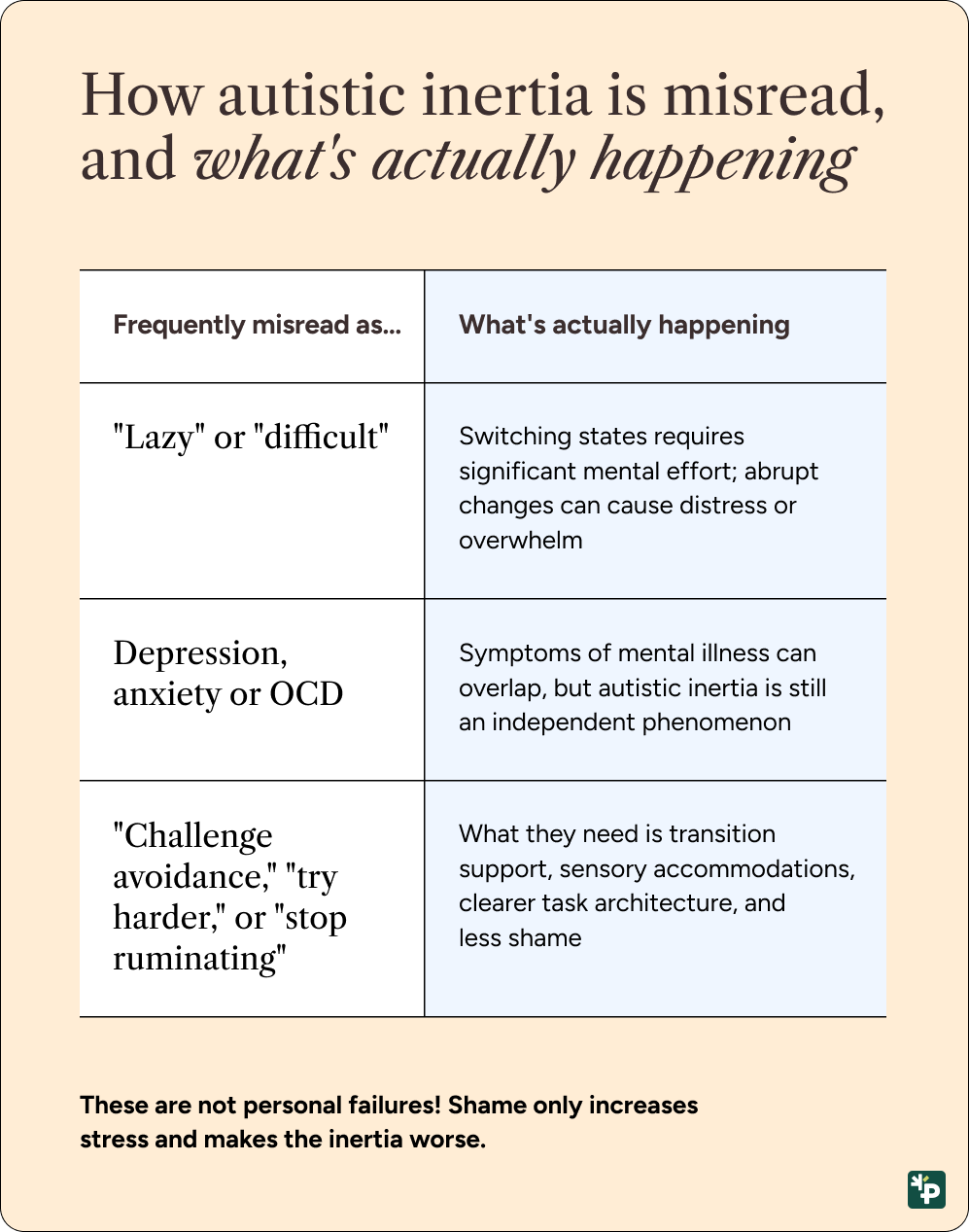
How autistic inertia is misread, and what's actually happening
Autistic inertia is frequently misread as laziness, lack of motivation, or avoidance because not everyone (including both autistic and non-autistic people) is familiar with the concept — yet.
So if you’re someone who has been led to believe they’re “lazy” or “difficult,” know that a) you’re not and b) there are reasonable explanations as to why this has happened to you.
“Autistic inertia is often mistaken for depression, anxiety, or OCD because the outside behaviors can overlap: withdrawal, avoidance, delay, rigidity, repetitive behavior, or difficulty disengaging,” explains Dr. Loftin. Unfortunately, she says, this is even more common among late-diagnosed adults and can cause long-term frustration because these people spent much of their lives “explaining their experiences through non-autistic frameworks.”
Additional potential long-term harm can occur from being misdiagnosed because, says Dr. Loftin, the treatment can target the wrong mechanism: “Someone may be told to ‘challenge avoidance,’ ‘try harder,’ or ‘stop ruminating,’ when what they need is transition support, sensory accommodations, clearer task architecture, and less shame.”
The shame spiral can indeed exacerbate an autistic person’s experience with task inertia. According to this ReachLink article, shame grows out of the gap between knowing what you need to do and the inability to execute the task. Shame only increases stress and worsens the inertia because you’re interpreting your challenges as personal failures (which they are not).
If you’ve received diagnoses for depression, anxiety, or OCD, and you don’t feel your current treatments are aligned with your behaviors, autistic inertia may be a more accurate explanation. Since depression and anxiety commonly co-occur with autism, further exploration may be warranted.
Autistic inertia across life stages
Autistic inertia can manifest quite differently throughout one’s life, though it is more easily managed in childhood due to an adult-based support structure and fewer responsibilities.
In childhood, however, autistic inertia can show up during school morning routines, bedtimes, stopping play, or moving between classroom activities, says Dr. Loftin, who notes that childhood inertia is “often interpreted as defiance.” (As the parent of an autistic child, I can attest to these examples as well; morning and bedtime routines are the biggest challenges in our family.)
But by the time people reach adulthood, there are fewer external supports available, and usually a higher transition load including work, bills, relationships, caregiving, meals, healthcare, and household tasks.
Adults who have difficulties managing these responsibilities will often have their inertia-based behavior “interpreted as irresponsibility, avoidance, or poor discipline,” says Dr. Loftin.
In addition, life transitions can intensify autistic inertia because they “increase executive demands while reducing predictability,” observes Dr. Loftin. They also often remove familiar routines, sensory anchors, and external scaffolding.
These life transitions can include:
- College
- Moving out
- Starting a new job
- Unemployment
- Divorce
- Parenthood
- Grief
- Illness
- Perimenopause/menopause
- Burnout
- Receiving a late autism diagnosis
Adults who receive a late autism diagnosis will likely experience a multitude of emotions, especially once they start to recognize that inertia explains many of their life patterns. Remember that every one of those feelings is valid.
“Many late-diagnosed adults grieve missed deadlines, lost jobs, strained relationships, or years of self-blame,” Dr. Loftin acknowledges. “My advice is to hold two truths: ‘This had real impact,’ and ‘I was navigating an unsupported nervous system without the right map.’ From there, the work becomes repair, accommodation, and self-trust — and not punishment.”
Autistic inertia vs. ADHD task paralysis, depression, and burnout
If you feel you’ve been misdiagnosed, your frustration is completely valid. But keep in mind that there is a lot of overlap between autism and ADHD, as well as depression and burnout. Not to mention autism and ADHD often co-occur, commonly known as AuDHD.
Remember that learning more about yourself isn’t about replacing one label with another. Instead, you deserve the most accurate explanation for your patterns and behaviors.
Differentiating between autistic inertia, ADHD task paralysis, depression, and burnout can be confusing because, as Dr. Loftin confirms, not only do they overlap, but “many people experience more than one.” Plus, they all can appear as if someone isn’t performing their necessary tasks — which can lead to the “lazy” and “unmotivated” labels.
The key difference, says Dr. Loftin, “is why the person is stuck.”
Even though all four of these patterns frequently co-occur, accurate identification still matters because the most beneficial treatments will ultimately differ from one another.
What actually helps (and why standard advice often doesn't)
While well-meaning, standard advice tends to be the wrong approach for people experiencing autistic inertia, primarily because there isn’t a strong understanding of the root cause.
“Timers, tiny steps, and motivational self-talk fail when they assume the main problem is planning or willingness,” says Dr. Loftin. For many autistic people, the barrier isn’t not knowing what to do, “it is crossing the activation or transition threshold.” Therefore, she explains, a timer can possibly make things worse if it creates urgency, sensory stress, or abrupt interruption.
Encouraging someone to “just break it down” won’t help if each micro-step still requires a state change.
Instead, support for autistic inertia should focus on reducing the cost of the state change, not increasing motivation. “Inertia usually improves with scaffolding, predictability, sensory respect, and collaborative problem-solving,” says Dr. Loftin. And above all: reducing shame.
As with any strategy, remember that there is no one-size-fits-all approach, and it may take some experimentation to figure out what exactly works best for you.
Below, Dr. Loftin offers recommended “ramps” for starting, stopping, and switching tasks.
Start ramps:
- Reduce direction ambiguity
- Create a concrete first movement (“Open the document” may be more effective than “Write the article”)
- Use body doubling (start the task alongside another person, either in-person or virtually)
- Prepare a comfortable environment for yourself in advance
- Lower sensory barriers
Stop ramps:
- Create a predictable, structured routine for stopping a task (“Save, write the next step, close laptop, stand up” works better than “stop now”)
- Use gentle external cues
- Build in closure rituals
- Avoid abrupt interruptions when possible
Switch ramps:
- Use transition buffers
- Use visual previews
- Use sensory bridges
- Implement consistent routines
“The goal is not to force flexibility,” says Dr. Loftin, “it is to make the next state easier to enter.”
When to seek support
Seeking support for autistic inertia is always beneficial at any time, because the more you understand yourself, the more confidence you’ll have in your self-worth, no matter how you identify.
Signs it’s time for more support
As with any physical or mental health concern, you’ll want to look into support when inertia interferes with your quality of life. If it’s affecting your eating, hygiene, sleep, work, relationships, safety, or mental health (this includes anxiety, depression, burnout, or even constant feelings of shame), then it’s worth finding help.
Talking to others about autistic inertia
Dr. Loftin advises communicating that autistic inertia “is not a motivation problem, but a transition problem.” Emphasize that some autistic people “may want to do the thing and understand why it matters, but still be unable to shift states on command.”
Not everyone will understand this concept immediately, so sharing resources like this article can help educate friends and loved ones about why you may get so stuck with certain tasks.
Also, friends and loved ones may want to consider implementing a supportive phrase like:
“What would make the next step easier?” (as opposed to the judgmental-sounding, “Why haven’t you done it yet?”)
What kind of support actually helps
Since studies like this 2023 report from the International Journal of Qualitative Studies on Health and Well-Being suggest that many autistic adults haven’t always had positive therapy experiences, it’s understandable that some are wary of seeking out support.
Helpful support is “autism-informed and practical,” advises Dr. Loftin, as opposed to options that have a decidedly neurotypical slant. This can range from neurodiversity-affirming therapy (including support for co-occurring anxiety, depression, ADHD, or burnout when present) to occupational therapy and executive-function coaching.
An adult autism assessment is also an option if you haven’t yet received an official diagnosis. Not only can a formal evaluation provide a foundation for understanding and support, it may also clear the path toward workplace/school accommodations.
If you’re interested in pursuing an autism assessment, Prosper Health can help. We provide virtual, insurance-covered evaluations, as well as autism-centered therapy options.
The bottom line
Yes, living with autistic inertia can present daily-life challenges, especially if you don’t have an understanding support system. At the same time, the traits that cause those “stuck” feelings have potential benefits as well.
“The same attentional patterns that contribute to inertia can also support depth, persistence, expertise, and sustained engagement,” says Dr. Loftin. So while help is available, remember that it’s not about forcing yourself to overcome autistic inertia.
An improved understanding of who you are and how your brain works can remove unnecessary barriers, build supports that make transitions easier when they matter, and most importantly, improve your quality of life.
Frequently asked questions (FAQs)
What is an example of autistic inertia?
Autistic inertia examples vary between three directions: starting tasks, stopping tasks, and switching tasks. An example of Start inertia is knowing it’s time to get up (and being ready to leave the bed), but you can’t seem to move your body. Stop inertia is when you need to use the bathroom or eat, but you’re hyperfocused on finishing that big project. Switch inertia occurs when you need to transition from a preferred activity (like watching TV) to a necessary one (like cooking dinner).
Is autistic inertia an official diagnosis?
No, autistic inertia is not an official diagnosis. It is, however, a concept grounded in lived experience, originating in autistic community discussions. Autistic inertia is also a term increasingly used in clinical and research contexts.
Is autistic inertia the same as procrastination?
No, autistic inertia is not the same as procrastination, even though outside observers may view an autistic person’s difficulty in starting, stopping, or switching tasks as deliberate avoidance. Autistic inertia is an involuntary neurological issue directly affiliated with autism. In contrast, procrastination generally reflects a different set of cognitive and emotional processes, even though they can appear similar from the outside.
How do I explain autistic inertia to someone who thinks I'm just making excuses?
Keep the focus on clinically accurate terms: Say that autistic inertia is not a motivation problem, but a transition problem. You want to execute the task in question, and you understand its importance, but it’s still challenging to shift states.
Sources
https://www.merriam-webster.com/dictionary/inertia
https://pmc.ncbi.nlm.nih.gov/articles/PMC8314008/
https://www.nature.com/articles/s44271-025-00386-4_reference.pdf
https://reframingautism.org.au/autistic-inertia-stranded-in-the-moment/
https://www.prosperhealth.io/blog/executive-functioning-in-autism
https://www.prosperhealth.io/blog/sensory-processing-disorder-in-adults
https://www.autism.org.uk/learn/knowledge-hub/professional-practice/what-is-monotropism
https://www.reachlink.com/advice/autism-spectrum-disorder/autistic-inertia/
https://www.prosperhealth.io/blog/misdiagnosed-autism
https://www.prosperhealth.io/blog/what-cooccurs-with-autism
https://www.prosperhealth.io/blog/autistic-burnout
https://www.prosperhealth.io/blog/autism-vs-adhd
https://www.prosperhealth.io/blog/what-is-audhd
https://pmc.ncbi.nlm.nih.gov/articles/PMC8314008
https://add.org/adhd-paralysis/
https://www.health.harvard.edu/mind-and-mood/what-causes-depression
https://www.autismparentingmagazine.com/autistic-inertia/
https://pmc.ncbi.nlm.nih.gov/articles/PMC8595127/
https://pmc.ncbi.nlm.nih.gov/articles/PMC11000678/


