.webp)


Key Takeaways
- The genetic nature of autism is complex. Autism runs in families, but there is no single gene that causes it, nor is it guaranteed that the gene will be passed down.
- The neurotype can present differently within the same family due to varied gene combinations and spontaneous mutations.
- Development is shaped by gene-environment interaction. Autism is not solely caused by genetics or environmental factors; it's a combination.
- The recent rise in diagnoses is due to broader criteria and increased awareness, not sudden genetic shifts.
- Genetics influence autism, but they do not fully determine a person’s identity or support needs—access to affirming support, inclusion, and acceptance are what truly determine a person's ability to flourish.
Key Takeaways
- The genetic nature of autism is complex. Autism runs in families, but there is no single gene that causes it, nor is it guaranteed that the gene will be passed down.
- The neurotype can present differently within the same family due to varied gene combinations and spontaneous mutations.
- Development is shaped by gene-environment interaction. Autism is not solely caused by genetics or environmental factors; it's a combination.
- The recent rise in diagnoses is due to broader criteria and increased awareness, not sudden genetic shifts.
- Genetics influence autism, but they do not fully determine a person’s identity or support needs—access to affirming support, inclusion, and acceptance are what truly determine a person's ability to flourish.
Autism diagnoses have increased by about 300% over the past 20 years, along with a rise in more widespread understanding about this neurological condition. While the phrase “knowledge is power” comes to mind, the more we understand autism, the more questions about its origins and causes inevitably arise.
When I received my daughter’s autism diagnosis, part of me was relieved. My suspicions had been confirmed, and we could now obtain much-needed accommodations. At the same time, countless questions were spilling out of my brain as quickly as I could form them.
- “Did I do something unhealthy in my pregnancy?” (Answer: No)
- “Is there a connection between my neurodivergent brother and my husband’s autistic nephew? (Answer: Probably)
- “How did our genetics play a role in my daughter’s diagnosis?” (Answer: It’s complicated; more importantly, no one is to blame, and no one gene is responsible)
- “Is there an autism cure?” (Answer: No, because autism is not a disease and doesn’t need to be “fixed”)
The truth is, there remains a lot of confusion around the causes of autism—specifically on the subject of genetics—even though we know so much more about this condition now than we did only a decade or two ago.
Still, everyone deserves to understand why they are the way they are, without fear, guilt, or shame. Our goal with this article is to help you understand the relationship between autism and genetics, as well as to clarify common misconceptions about genetic inheritance, the process by which DNA is passed down from parents to children.
But above all, we’re here to remind you that humans, whether neurotypical or neurodivergent, are so much more than their genetic makeup.
Is autism genetic?
The word “genetic” is defined as “of, relating to, caused by, or controlled by genes.” So, yes, autism is genetic, but the full answer, the “how” and the “why,” is more complicated.
Autism spectrum disorder (ASD) is a neurodevelopmental difference defined primarily by certain traits and behaviors, such as how autistic people communicate or process sensory information. This condition exists on a spectrum because characteristics vary by individual.
Autism is only rarely linked to a single genetic variant with a large effect. In reality, an estimated 200-1,000 genes can impact autism susceptibility. Adding to the confusion of the “Is autism genetic?” question, we also need to consider something called heritability. This is a measure of how well differences in people’s genes account for differences in their traits.
For example, explains Dr. Rachel Loftin, Chief Clinical Officer at Prosper Health, “twin and family studies estimate heritability around 60–80%, meaning genetic factors explain much of the variation in autism across a population.” Keep in mind that these are population-based statistics, not a key indicator of autistic parents passing autism down to their children.
What does it mean when researchers say autism is genetic?
Common misunderstandings about the term “genetic” can lead to confusion about autism’s origins. Some people interpret a “genetic” explanation to mean that your genes control everything about you, or that a single gene explains why you’re autistic.
Then there's genetic influence and genetic destiny. Genetic influence means that the genes you inherit can play a role in shaping your behavior. When these influences interact with your environment, upbringing, and life experiences, they can affect the initiation and persistence of certain behaviors. Genetic destiny (or determinism) is different, suggesting that our genetic makeup invariably determines our traits and diseases.
When researchers say “autism is genetic,” however, they are talking about something far more complex than a three-word explanation.
“Genetic differences play a substantial role in the development of autistic neurotypes,” says Dr. Loftin, noting that autism is typically polygenic, or involves many genes. However, she cautions that when we describe autism as genetic, we don’t mean:
- It comes from a single gene in most cases
- It is inherited from a parent in a simple or predictable way
- It represents a fixed destiny or pathology
“Autism reflects naturally occurring differences in neurodevelopment,” says Dr. Loftin, and genetics help explain why these differences cluster in families and populations.
There is no single “autism gene”
As previously stated, autism is usually polygenic rather than resulting from a single, standalone gene. A polygenic trait is a characteristic, such as height or skin color, influenced by two or more genes. Since multiple genes are involved, polygenic traits don’t follow the traditional inheritance patterns of passing traits from parents to children.
This focus on polygenic traits is key to understanding autism. While it’s natural to look for a simple explanation—like the discovery of a single “autism gene”—there is still no strong evidence for genes that uniquely determine autism.
Rather than focusing on the idea of an “autism gene,” Dr. Loftin points to certain rare genetic variants that, she says, can have a very strong influence on whether an autistic phenotype develops. A phenotype is the set of an individual’s observable traits resulting from genetic and environmental interaction.
She explains that these variants are highly penetrant and strongly associated with autism, meaning they significantly increase the likelihood of autism when present.
Dr. Loftin emphasizes that even these variants do not guarantee a specific outcome or represent a single “autism gene,” though they are among the clearest genetic pathways linked to autism.
Inherited genes vs. spontaneous (de novo) mutations
While de novo (new) genetic variants are common, only a small subset are strongly associated with autism and can play a significant role in its development.
When we commonly use the word “genetic,” we’re probably talking about “inherited genes.” To say that genes are “inherited” means that traits or variants encoded in DNA are passed from a parent to offspring during reproduction.
But when it comes to genetics and autism, there aren’t only inherited genes to consider. There are also spontaneous, or de novo, mutations that can appear for the first time in a family member. These genetic changes can arise either in a parent’s sperm or egg cells or during early development after fertilization.
These spontaneous mutations can sometimes explain why autism appears even when it doesn’t “run in the family.”
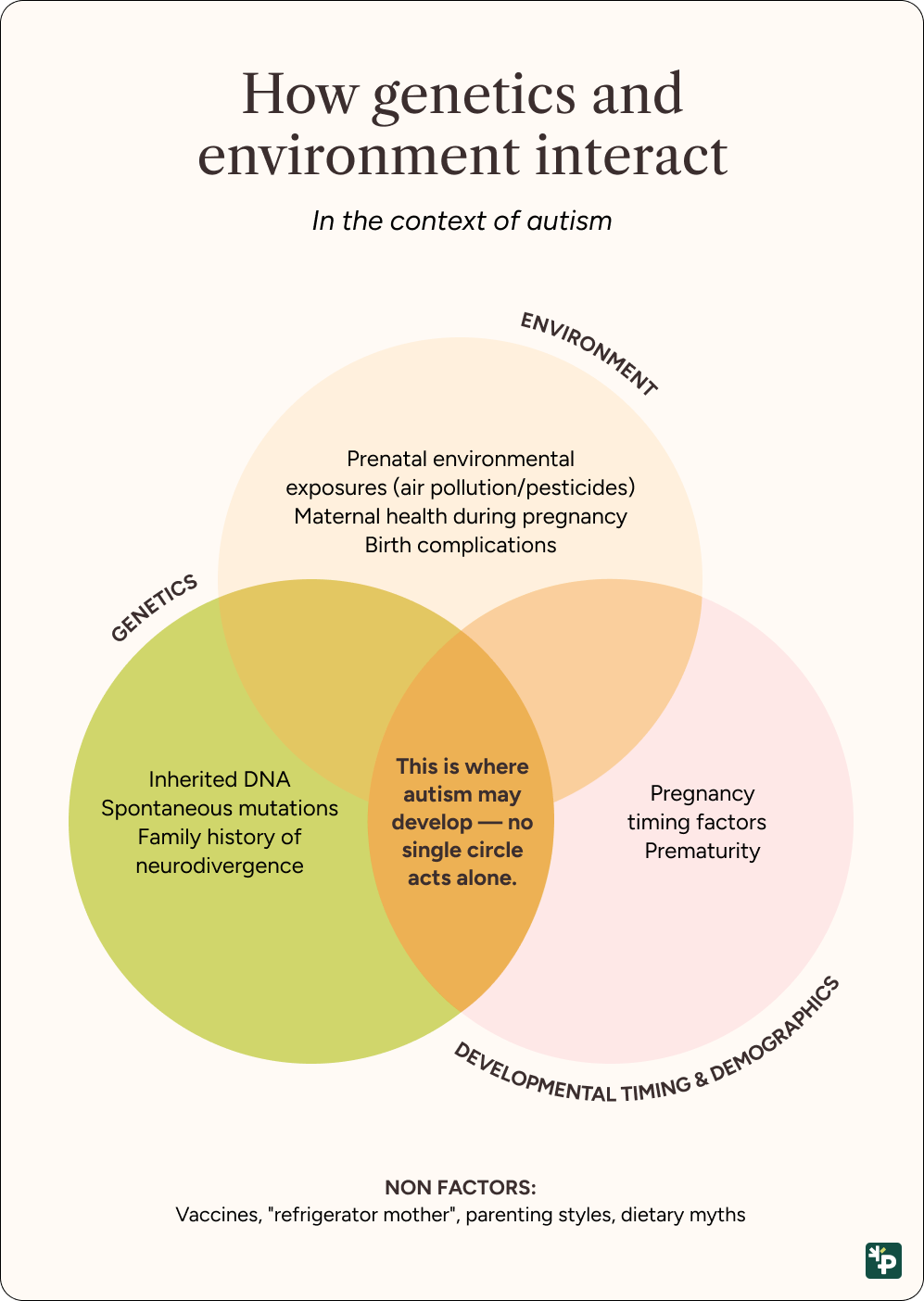
How genetics and environment interact
In addition to genetics, certain environmental factors can increase the likelihood of autism. From a research perspective, “environment” means biological and prenatal factors, not parenting styles (debunked as an autism cause in the 1970s) or vaccines.
Research suggests the following factors may be associated with an increased likelihood of autism, especially when combined with genetic factors:
- Air pollution and/or pesticide exposure during pregnancy
- Medical conditions and illnesses during pregnancy, such as fever, infection, diabetes, obesity, an immune system condition, or pre-eclampsia
- Birth complications (being born very early or very small, or not getting enough oxygen during delivery)
- Parental age and birth spacing between siblings
It bears repeating that autism is best understood as the result of complex interactions between genetic and environmental factors, rather than any single cause.
If autism is genetic, why are diagnoses increasing?
Although there’s been a rise in autism diagnosis rates in the U.S. over the past several decades, it’s not because there have been sudden biological changes causing an increase in the condition.
“Genetic shifts in a population do not occur fast enough to explain the rapid increase in diagnoses over the past few decades,” says Dr. Loftin.
Instead, the increase in diagnosis rates can be chalked up to an overall better understanding of what autism is, as well as improved tracking and reporting, thanks to:
- Broader diagnostic criteria
- Improved screening and earlier identification
- Increased awareness among clinicians, educators, and families
- Recognition of autism in groups historically underdiagnosed (e.g., women, non-speaking individuals without intellectual disability, adults, racialized communities)
Why autism can look different within the same family
Autism is highly heritable, with the likelihood of siblings receiving an ASD diagnosis steadily increasing with each child.
“Autism reflects a range of neurodevelopmental profiles,” observes Dr. Loftin. “Shared genetics may increase the likelihood of autistic traits, but each person’s brain develops uniquely.”
Just because there are shared genetics within a family, however, that doesn’t automatically guarantee similar autism presentations. Dr. Loftin also notes that many of the reasons we’ve covered in this article can explain why autism can look different between family members:
- Siblings share about 50% of their genetic variation
- Autism is usually polygenic, with different combinations of variants
- De novo (new) genetic variants
- Development is shaped by gene-environment interaction
Other factors that can shape autism presentation include “personality, co-occurring conditions, language access, and support environments,” says Dr. Loftin.
What genetics can explain and what it can’t
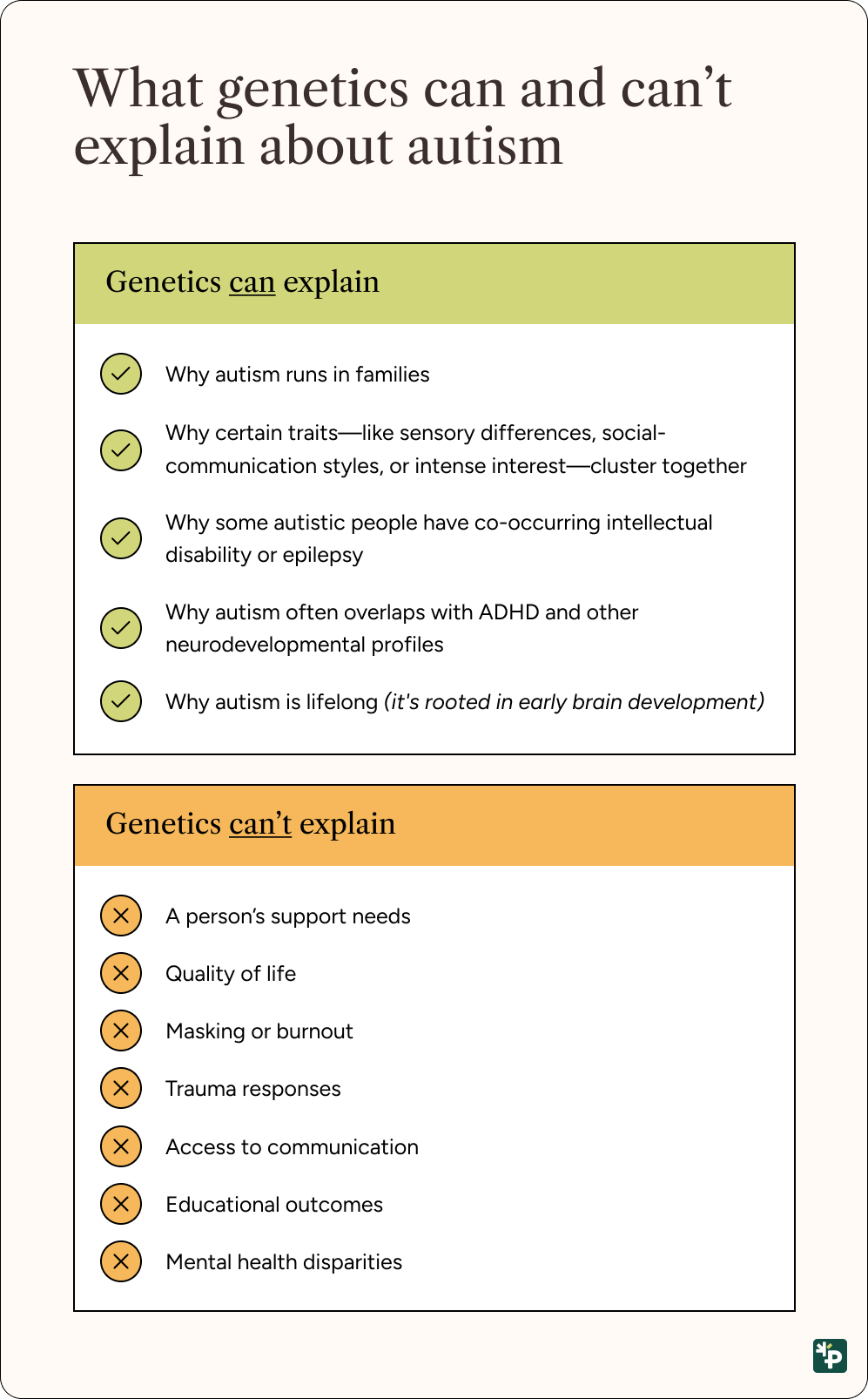
Genetics can help us understand some aspects of autism, but since they’re not the only causal factor, we’re not going to find every answer in our genes. A good way to think about the connection between genetics and autism is by breaking it down into what genes can and can’t explain.
Genetics can explain
- Why autism runs in families
- Why certain traits, like sensory sensitivity, particular social-communication styles, or monotropism (hyperfocus on special interests), cluster together
- Why some autistic people have co-occurring intellectual disability or epilepsy
- Why autism often overlaps genetically with ADHD and other neurodevelopmental profiles
- Why autism is lifelong (neurodevelopmental differences are rooted in early brain development)
Genetics, says Dr. Loftin, can also help us understand brain development differences, synaptic development, and neural connectivity patterns.
Most importantly, genetics provides a scientific foundation for autism acceptance, as well as further autism research. “Genetics support the idea that autism is a naturally occurring neurotype, not caused by parenting or vaccines (which have been conclusively debunked),” says Dr. Loftin.
Genetics can’t explain
- A person’s support needs
- Quality of life
- Masking or burnout
- Trauma responses
- Access to communication
- Educational outcomes
- Mental health disparities
Genetics may help you to understand why you’re autistic, but what’s equally important is knowing that your genes do not determine your identity, your strengths, your place in your community, and whether or not you flourish in life.
Keep in mind that your genes don’t predict a fruitful and well-rounded life. That’s entirely dependent on environmental and social factors like access to affirming support, early accommodations, inclusion, stigma reduction, and socioeconomic factors.
Why this question comes up often for autistic adults
Many autistic adults frequently ask the “Is autism genetic?” question because, explains Dr. Loftin, it connects to several other issues that arise when accepting their neurodivergent identity.
“The genetics question often reflects a desire for validation and relief from blame as well as scientific curiosity,” she says.
Initially, autism was blamed on psychological causes, with now-discredited theories like “refrigerator mothers” (aka emotionally cold and distant parents) and poor attachment skills feeding many misconceptions about autism.
So exploring the genetic side of autism can now be part of a self-discovery journey that includes:
- Understanding family patterns
- Reframing internalized stigma
- Letting go of blame
- Making sense of lifelong differences
- Parenting decisions
- Identity formation
At the same time, it’s important to reiterate that autism is a multifaceted condition that isn’t just about your genes. While the rise of genetics research “helped shift the narrative away from parental blame, it also raises new anxieties about determinism or eugenics,” says Dr. Loftin.
Eugenics is the problematic—and scientifically inaccurate—theory that humans can be improved through selective breeding.
Genetic research on autism, while useful, “does not justify eugenics,” emphasizes Dr. Loftin. “Historically, genetics has been misused in harmful ways. Ethical research must center autistic voices and autonomy.”
Does genetics matter for diagnosis or support?
Generally speaking, no, genetics aren’t relevant for autism diagnosis or support. Although additional knowledge may be relevant in specific medical circumstances.
An autism diagnosis, for most people, is made from behavioral and developmental criteria, not genetic criteria, says Dr. Loftin. To be clear, there is no single genetic test for autism, and none of that is required for an autism diagnosis. However, Dr. Loftin says that genetic testing may be recommended in cases like intellectual disability, epilepsy, or congenital differences.
While genetics can matter in certain medical situations, keep in mind that genes do not determine identity or any required autism accommodations. Having answers about your genetic history may feel like you’ve solved a personal mystery, but your genetics have no bearing on any needs-based support.
“Genetics rarely determines what support someone needs,” reiterates Dr. Loftin. Those types of decisions, she says, shouldn’t be based on your genes, but on the following:
- Functional needs
- Sensory profile
- Communication style
- Mental health
- Environment
The bottom line
Learning about genetics and its connection to autism can be a substantial step toward a fuller understanding of the condition. However, genetics are only one component of what makes you “you.” Yes, autism is genetic, but it’s also complex, and most importantly, human.
“Genetic” also doesn’t mean “inevitable or limiting,” says Dr. Loftin. “Development is dynamic and shaped by context.” On that note, she reiterates that neurodiversity and genetics aren’t opposites. “You can affirm autism as a natural neurotype while acknowledging biological underpinnings.”
Gaining further knowledge about your genetic makeup may help you paint a fuller picture of yourself, but self-understanding and neurodiversity-affirming support are far more beneficial in the long term. Social variables, like inclusion, access, acceptance, and accommodations matter more than your genotype, advises Dr. Loftin.
Wherever you are on your autism education journey, whether it’s reflection, learning more about your condition, or seeking support, Prosper Health can help. Our virtual, neurodiversity-affirming therapy services provide mental health support for autistic and neurodivergent adults—plus, they’re covered by insurance, making care more affordable.
Frequently asked questions (FAQs)
Why is autism on the rise?
Autism itself isn’t on the rise. Autism diagnoses, however, are steadily increasing because of several factors: broader diagnostic criteria, improved screening and earlier identification, increased awareness among clinicians, educators, and families, and improved recognition of autism in historically underdiagnosed groups.
Can genetic testing diagnose autism?
No, genetic testing can’t diagnose autism. Most autism diagnoses are made from behavioral and developmental criteria, not genetic criteria. In addition, no single genetic test exists for autism.
Is autism hereditary or genetic?
Yes, autism is both genetic and hereditary. But that doesn’t mean the condition is automatically passed from parent to child. Describing autism as “genetic” means acknowledging its complicated nature. Autism is typically “polygenic,” or involving many genes. It is not caused by a single gene or necessarily inherited from a parent.
Does autism run in families?
Yes, autism runs in families. If a child is diagnosed with autism, the chances of the younger siblings also developing the condition steadily increases. But autism can still present differently within families: Even though shared genetics may increase the likelihood of autistic traits, each person’s brain develops uniquely.
Sources
https://publichealth.jhu.edu/2025/is-there-an-autism-epidemic
https://www.prosperhealth.io/blog/can-autism-be-cured
https://www.prosperhealth.io/blog/what-is-autism-spectrum-disorder
https://medlineplus.gov/genetics/understanding/inheritance/heritability/
https://medschool.ucla.edu/news-article/is-autism-genetic
https://pubmed.ncbi.nlm.nih.gov/26709141/
https://www.cdc.gov/genomics-and-health/about/index.html
https://www.sciencedirect.com/topics/psychology/genetic-influence
https://www.genome.gov/genetics-glossary/Polygenic-Trait
https://www.genome.gov/genetics-glossary/Mendelian-Inheritance
https://pmc.ncbi.nlm.nih.gov/articles/PMC7212289/
https://www.genome.gov/genetics-glossary/Phenotype
https://www.genome.gov/genetics-glossary/Inherited
https://www.cancer.gov/publications/dictionaries/genetics-dictionary/def/de-novo-mutation
https://www.cshl.edu/labdish/where-does-autism-come-from-when-it-doesnt-run-in-the-family/
https://www.prosperhealth.io/blog/is-there-a-rise-in-autism
https://www.prosperhealth.io/blog/adult-autism-facts-and-statistics
https://www.bbc.com/future/article/20250509-why-autism-diagnoses-are-on-the-rise
https://www.scientificamerican.com/article/autism-has-no-single-cause-research-shows/
https://www.jci.org/articles/view/201157
https://sparkforautism.org/discover_article/environment-autism/
https://pmc.ncbi.nlm.nih.gov/articles/PMC7821228/
https://www.sciencedirect.com/topics/neuroscience/gene-segregation
https://www.thetransmitter.org/spectrum/female-protective-effect-explained/
https://embryo.asu.edu/pages/early-infantile-autism-and-refrigerator-mother-theory-1943-1970
https://www.prosperhealth.io/blog/autism-misconceptions
https://www.caloprograms.com/understanding-asd-and-attachment-issues/
https://www.genome.gov/about-genomics/fact-sheets/Eugenics-and-Scientific-Racism


