


Key Takeaways
- A special interest is a deep, often long-term passion for a specific topic that you might identify with and find emotionally regulating. Hyperfixation is a very intense but shorter-term focus on a particular interest that you think about almost constantly or engage with as much as you can.
- The term “special interest” relates to the DSM-5's description of restricted or fixated interests in autism. Special interests are one possible feature of autism, but are not required for an autism diagnosis. Meanwhile, “hyperfixation” is a term that describes a phenomenon that many people with ADHD (and other neurodivergent individuals) experience.
- Anyone can have special interests, hyperfixations, or both, regardless of neurotype.
- It’s especially common for AuDHDers (autistic people with ADHD) to have both special interests and hyperfixations.
- Having hyperfixations or special interests isn’t a problem in itself, but neurodivergent-affirming therapy can help if you find it difficult to juggle your hyperfixations with daily responsibilities.
Recently, a friend dragged me to see a movie that, honestly, I wasn’t too eager to see. Two weeks later, we went out to eat. “It’s been hard to focus. That movie’s been on my mind all day, every day, from when I wake up in the morning to when I go to bed,” I said. “I even think about it when I get up in the middle of the night to use the bathroom.”
My friend, who’s autistic herself, responded, “You have a new special interest!”
Did I? I wasn’t so sure. A hyperfixation vs special interest can be tricky to tell apart. What captivated me about the movie was a theme common to another piece of media that has been one of my primary special interests since 2013 — specifically, the strength of trauma victims trying to resist or escape their abusers. However, I’ve also had hyperfixations like this fade after weeks to months, so I wasn’t sure yet which one this latest movie would become.
Differentiating hyperfixations vs special interests is a common question for people who are, or believe they might be, neurodivergent. This is especially true for people who’ve had special interests dismissed as “just a hyperfixation” or “just a phase.”
It’s understandable if you feel confused. “There isn't a well established way to meaningfully separate them clinically,” says Dr. Hannah Jones, a licensed clinical psychologist with Prosper Health. That’s because the word “special interest” is based on clinical criteria, while “hyperfixation” is not.
What we can do is read how our experiences might reflect how the terms special interest and hyperfixation are typically used in the neurodivergent community. And to be clear, you don't have to have a diagnosis or settled self-identity for either term to apply to you.
In this article, we'll discuss the differences between hyperfixations and special interests, why you might experience one or both, and what this might mean for you.
What's actually different between a hyperfixation and a special interest?
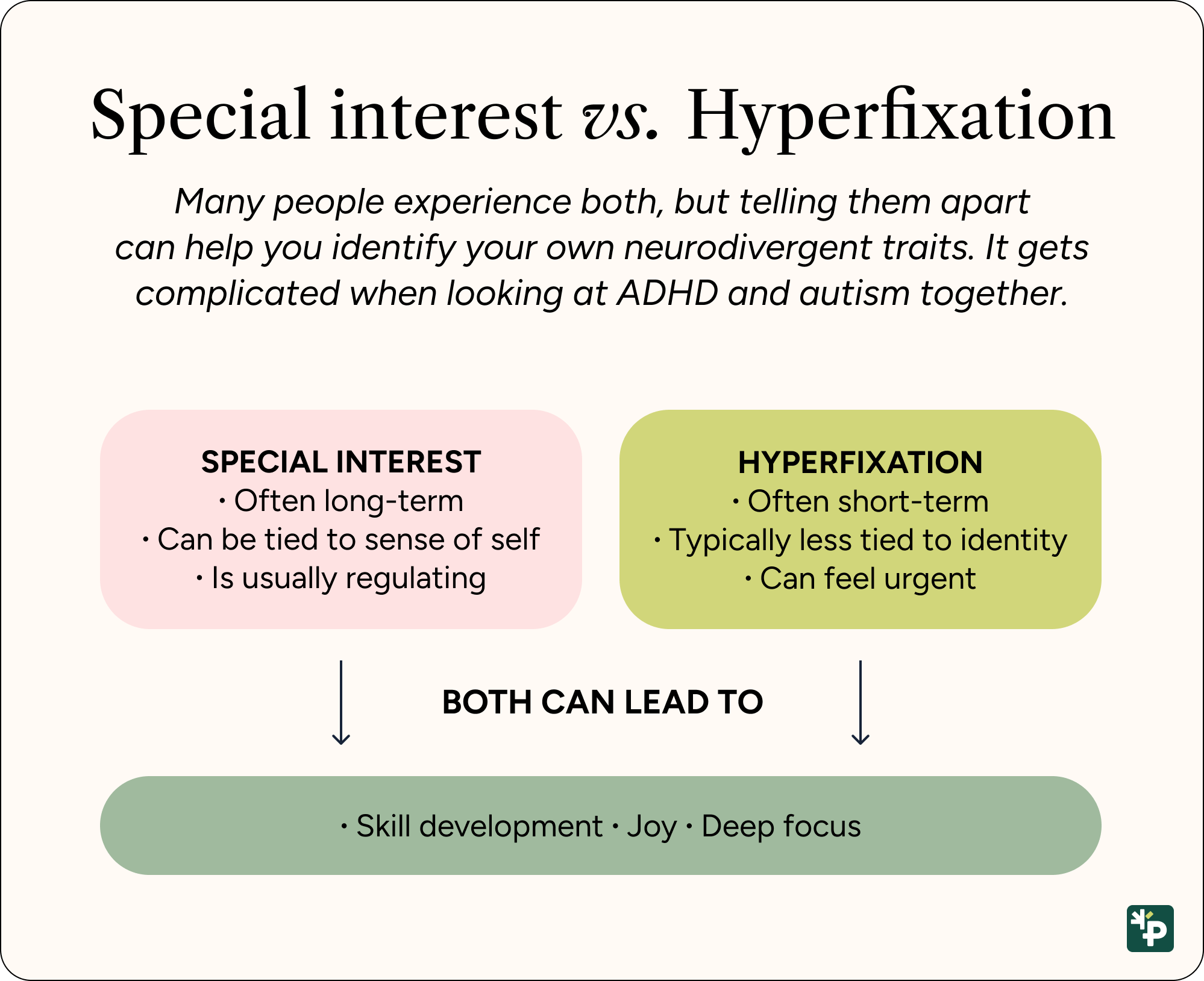
A special interest is a very deep, often long-term focus on a particular subject that may bring you comfort and tie to your sense of identity. Meanwhile, hyperfixation is an intense but typically shorter-term engagement with a specific activity or topic that makes it hard to focus on anything else. Here are some differences between the two:
Clinical basis
The term “special interests” refers to one sign of autism described in the DSM-5, specifically “highly restricted, fixated interests that are abnormal in intensity or focus.” Many advocates actually push back against this pathologizing language since special interests are often not a problem but a source of stability, comfort, and identity.
In contrast, the word “hyperfixation” doesn’t describe any clinically recognized criterion of ADHD. A hyperfixation isn’t an “ADHD special interest” in that respect. Rather, hyperfixation is a term the community uses to refer to a phenomenon that many people with ADHD experience, says a 2026 study in the Irish Journal of Psychological Medicine.
Duration
A hyperfixation typically lasts from hours to months, says Chelsea Hudson, CEO & Licensed Therapist at Cityscape Counseling. Meanwhile, it’s not uncommon for special interests to last years or even a lifetime.
However, duration isn’t the most reliable way to set the two apart. Just because an interest hasn’t lasted your entire life doesn’t mean it’s not a special interest. A special interest also doesn’t have to be the only topic you’re deeply interested in, notes a 2018 study in Autism Research.
Sense of identity
“A person might deeply identify with their special interest [and] understand the world through the frame of their interest,” says Jones.
Having had a special interest in a specific book and its adaptations since I was a teenager, I’ve long felt like the main character was a “part of my soul.” I couldn’t explain this feeling, and in fact, I thought I was being overdramatic. This changed when I was diagnosed with autism and learned more about special interests.
Hyperfixations typically don’t link to identity to quite this degree.
Internal experience
From the outside, a person engaging in a special interest can seem similar to a person engaging in a hyperfixation. But the internal experience can be quite different.
Engaging with special interests often feels calming and joyful, notes a 2024 article in Autism in Adulthood. My longest-standing special interest is cats. I’m subscribed to hundreds of cat pages online so I can enjoy countless images and videos of cats each day. When I’m upset, I find so much relief from my cats lying on me and purring. If I’m outside the house, I often look at images of my cats or even imagine them cuddling me.
Hyperfixations vary in the emotions they bring. “A hyperfixation can be experienced as exciting, stimulating, and energizing, or it can feel stress-inducing and anxiety-provoking when a person has difficulty disengaging from it,” says Jones.
Sometimes I hyperfixate on pieces of media I really enjoy and relate to. On the other hand, I’ve also hyperfixated on tragic historical events which are distressing, not comforting.
Urgency
A hyperfixation can feel urgent and involve “an inability to stop or put something down even when sleep or relationships are being negatively impacted,” says Hudson. For example, when I hyperfixate on tragic historical events, sometimes I get settled in bed but then get urges to grab my phone and search for more information about the topic instead of going to sleep.
Some people hyperfixate on a single task for hours (which is also known as “hyperfocus”). In this case, it can be extremely difficult to pull attention away. You might forget to eat, use the bathroom, or otherwise take care of your needs and responsibilities.
On the other hand, with special interests, “people are usually able to take a pause without becoming distressed if they know they can return,” Hudson notes.
It can be hard to pinpoint hyperfixations and special interests if you've spent a lot of time masking or minimizing your interests. We'll circle back to this later.
The distinction between special interests and hyperfixations becomes a bit more complicated when we consider ADHD and autism together.
Why the “autism-means-special-interest” and “ADHD-means-hyperfixation” split isn't the whole story
Many people believe that special interests are exclusive to autistic people and hyperfixations are exclusive to those with ADHD. The reality is that autistic people can experience hyperfixations and people with ADHD can have special interests. Personally, I don’t have ADHD, but I experience both special interests and hyperfixations.
It’s really not a matter of autism vs. ADHD. “Monotropism, or a tendency toward deep and intense engagement with interests, can be found in both ADHD and autism, and this trait underlies both patterns of hyperfixation and special interests,” says Jones.
There’s also the overlap between autism and ADHD. A 2021 review in Research in Autism Spectrum Disorders estimated that about 40% of autistic people also have ADHD (AuDHDers).
If you have both special interests and hyperfixations, they may be about different topics or even the same ones. For example, one of my special interests has a new television adaptation coming out soon. The autistic hyperfixation is already building up. I scour the web in hopes of new information as soon as I wake up every morning, and then many more times throughout the day.
When the series comes out, I’ll watch all eight hours in one sitting, then I’ll hyperfixate on it for weeks until it settles back down into a special interest. I can predict this in much the same way I can predict I’ll see leaves in the fall and snow in the winter.
That said, even with a clear understanding of the overlap, many people doubt their experiences due to other people’s reactions.
When someone tells you it's "just" a hyperfixation
Unfortunately, we live in a world where many people simply don’t understand special interests. You may have heard hurtful comments like, "it's just a phase," "you're being obsessive," or "that's not a real interest, it's just a hobby."
Many people have a specific idea of what special interests look like. When your experience doesn't match up — say, by shifting over time, being more intense, developing more recently, or including more than one special interest — people may wave it off as being less legitimate.
If your experiences are repeatedly dismissed and invalidated, you may downplay your own interests. Over time, this can make it hard to trust your own experiences. You might wonder if you really have special interests at all and whether you're even autistic.
This is an understandable concern, but not every autistic person has special interests. Of those who do, they can look different for everyone. Your experience doesn't have to match a specific template to qualify as a special interest.
The role of masking
Sometimes, the world is cruel about special interests. This leads many autistic people to mask their special interests by hiding or minimizing them, mentioning them less, or engaging with them more privately.
A personal example: I was bullied as a child for being “obsessed” with cats. I continued to write stories about cats and cuddle my cats at home, but I stopped talking about them as much publicly. I even asked my mom to stop buying me cat-themed clothing, knowing it would be met with ridicule.
In high school, I was overjoyed to discuss a special interest during a relevant presentation — a 1970s movie during a presentation on how 1970s media reflected the culture of the time. My teacher interrupted me to tell me to “shut up and move on” and to stop hyperfixating on a movie that “isn’t even that good.”
Experiences like these, which are all too common, can lead autistic people to mask their special interests to the point they're invisible from the outside. “When someone learns to suppress visible signs of their interests, people in their lives might not be aware of how invested they are in the passion or hyperfixation,” says Jones.
In cases of chronic masking, this suppression can become so ingrained that it leads to a diminished sense of self, leaving you struggling to recognize what your own genuine interests actually are. Ultimately, this makes your interests less apparent not only to others — including clinicians during an evaluation — but also to yourself. This can remove a valuable coping tool, as special interests often aid in emotional regulation. It also plays a role in underdiagnosis or misdiagnosis, as special interests are a criterion of autism.
Does it matter which one it is?
Both special interests and hyperfixations are valid ways of engaging deeply with the world. The point of telling them apart isn’t to validate your neurodivergence or sort yourself into the “correct” category. Rather, the purpose is to learn more about your experience, and set apart what’s helpful from what’s less so.
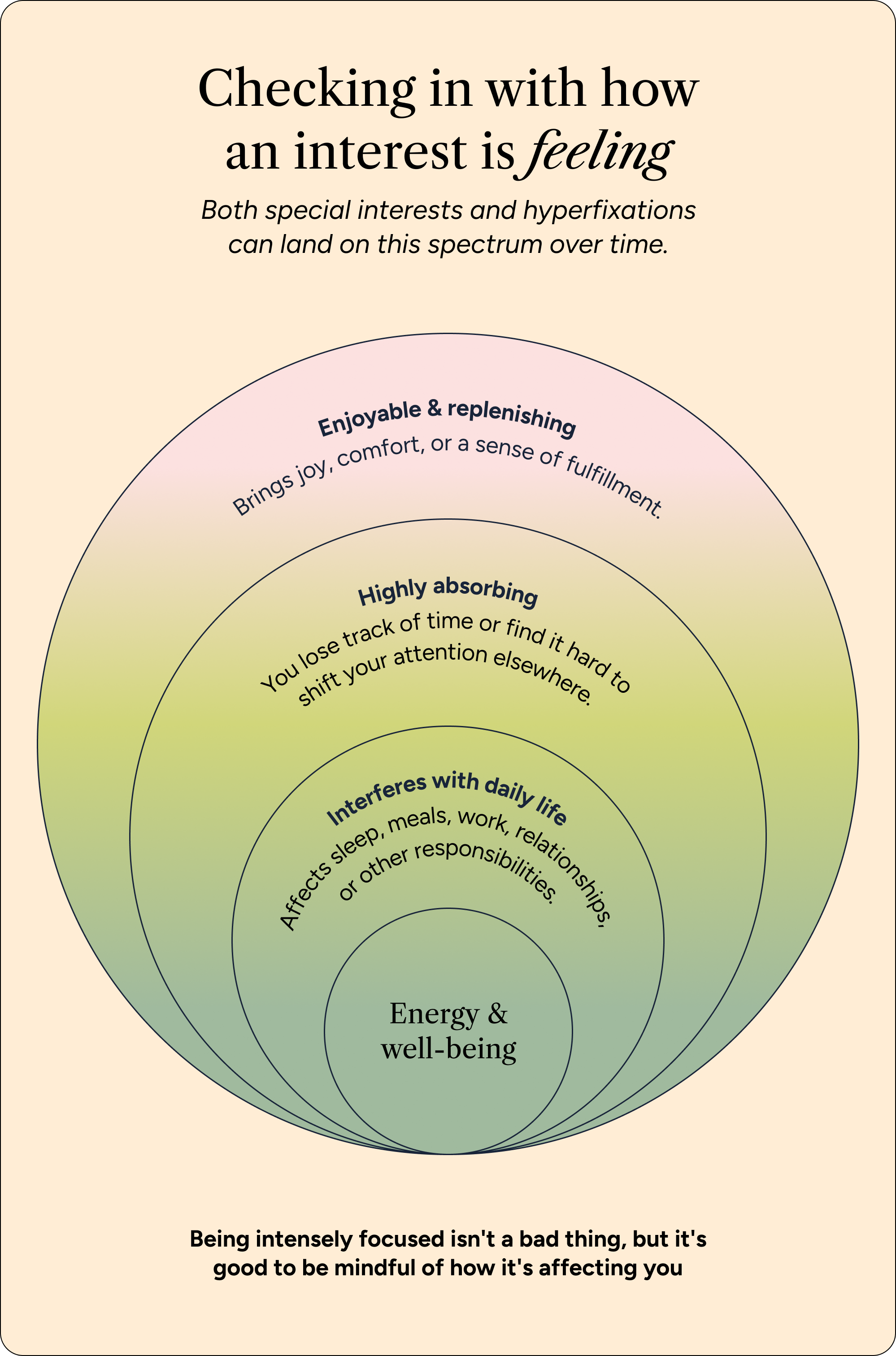
Does your interest bring you joy and emotional regulation like cats do for me? If your interest brings no harm to yourself or others, it’s worth protecting and making space for your interest, even if other people see it as unusual or intense. You could even turn it into a career! Some people with special interests in mental health become psychologists, for example.
On the other hand, if your interest feels urgent or exhausting, or it’s consistently getting in the way of your needs (e.g. sleep, food, work, or relationships), you might want to look further into that pattern. You may benefit from support, as we’ll describe later.
Finding support and further understanding
Knowing the difference between hyperfixations and special interests doesn’t mean you have to do anything further with the information. It’s completely valid if you simply feel better having language to describe your experience. But if you do feel the need for more support and understanding, you have several options:
- Evaluation: A formal evaluation for autism or ADHD can help you understand yourself better.
- Therapy: A neurodivergent-affirming therapist can help you thrive without treating your neurodivergence as something to “fix.” Virtual telehealth provider Prosper Health offers online therapy services for autistic adults, as well as evaluation for adults who think they might be autistic.
- Communities: Peer or online communities may offer you a chance to discuss these experiences with other neurodivergent individuals.
The bottom line
The term “special interest” is based on clinical criteria for autism, whereas “hyperfixation” is not, so we don’t have an established way of setting them apart clinically.
That said, special interests are longstanding, deep passions that you may strongly identify with. The neurodivergent community uses the term “hyperfixation” to describe very intense (but shorter-term) interests that you may think about constantly or engage in as much as possible.
Special interests and hyperfixations can overlap. There’s nothing wrong with having either, or even both. However, neurodivergent-affirming therapy — such as that offered at Prosper Health — can help if you ever find it challenging to balance special interests or hyperfixations with daily life.
Frequently asked questions (FAQs)
Can autistic people have hyperfixations instead of special interests?
Yes, many autistic people have hyperfixations. While many autistic people do get special interests, some do not. Therefore, it’s possible for autistic people to have hyperfixations and not special interests.
Can a special interest start in adulthood, or do they only begin in childhood?
Yes, a special interest can begin at any point in your life. A special interest that develops in your 30s is no less valid than one that begins when you’re a child.
Is hyperfixation the same as hyperfocus?
No, hyperfixation isn’t the same as hyperfocus.
Since they’re not clinical terms, some sources do use the terms interchangeably, with hyperfixation meaning hyperfocus.
However, a 2026 study in the Irish Journal of Psychological Medicine distinguishes the two. It defines hyperfocus as being completely absorbed in a task to the point you're unaware of anything else and might neglect needs such as eating or sleeping. It defines hyperfixation as an episode of days to weeks in which you think about a specific interest constantly or spend as much time engaging with it as possible.
Sources
https://onlinelibrary.wiley.com/doi/abs/10.1002/aur.1931
https://journals.sagepub.com/doi/full/10.1089/aut.2023.0157
https://www.sciencedirect.com/science/article/pii/S1750946721000349


