.webp)


Key Takeaways
- Echolalia is the unsolicited repetition of another person’s words, phrases, or other vocalizations.
- Echolalia in adults can look like repeating another person's words immediately after they speak, using them in similar situations in the future, or even repeating phrases from movies or TV shows.
- Echolalia is common in young children. In adults, it's generally associated with autism, in which case it’s used as a functional tool for language processing, communication, emotional regulation, and sensory or cognitive support.
- Unless it’s causing distress, echolalia is typically not cause for concern. In fact, neurodivergent individuals can use echolalia to their advantage.
Key Takeaways
- Echolalia is the unsolicited repetition of another person’s words, phrases, or other vocalizations.
- Echolalia in adults can look like repeating another person's words immediately after they speak, using them in similar situations in the future, or even repeating phrases from movies or TV shows.
- Echolalia is common in young children. In adults, it's generally associated with autism, in which case it’s used as a functional tool for language processing, communication, emotional regulation, and sensory or cognitive support.
- Unless it’s causing distress, echolalia is typically not cause for concern. In fact, neurodivergent individuals can use echolalia to their advantage.
Jonathan, a 37-year-old autistic adult, has experienced echolalia for as long as he can remember. “Sometimes, it’s a sudden flash and I’ll blurt out a random quote or say something in a funny voice,” he says of his own experience.
Echolalia in adults is the act of repeating another person’s words, phrases, or vocalizations, either immediately or later on. It “is most commonly associated with autism, where it often serves as a meaningful way to process language or regulate,” explains Dr. Hannah Jones, a licensed clinical psychologist with Prosper Health.
With that said, echolalia in adults is expressed in many ways. In this article, we’ll explore what echolalia looks like, why it happens, and when it may be cause for concern. We’ll also discuss how it relates to autism and other forms of neurodiversity.
What is echolalia?
Echolalia is the repetition of another person's speech, most often words or phrases, but can include other vocalizations, as well. It’s the norm in early childhood when kids are learning to communicate. Although it typically diminishes by the age of three, echolalia in adults is particularly common among autistic adults. Repetitive verbal behaviors can also occur in ADHD and other conditions.
Historically, psychologists often described echolalia as involuntary, but the reality is more nuanced. Echolalia may be automatic, intentional, or somewhere in between. In any case, it serves a purpose.
What are the different types of echolalia?
Echolalia looks different for everyone, but here are a few common types of echolalia in adults:
- Immediate echolalia: The repetition of words right after they’re said.
- Delayed echolalia: Repeating words after some time has passed.
- Unmitigated echolalia: The repetition of words exactly how they were initially said.
- Mitigated echolalia: A person repeats speech in an altered form—with a different pitch or tone, for example.
- Ambient echolalia: Repeating words or noises from the environment, like a television, radio, or ceiling fan.
Internal echolalia isn’t a formally recognized clinical subtype. However, people in neurodivergent communities use the term informally to refer to the silent repetition of sounds, phrases, or patterns in your head.
What does echolalia look like in adults?
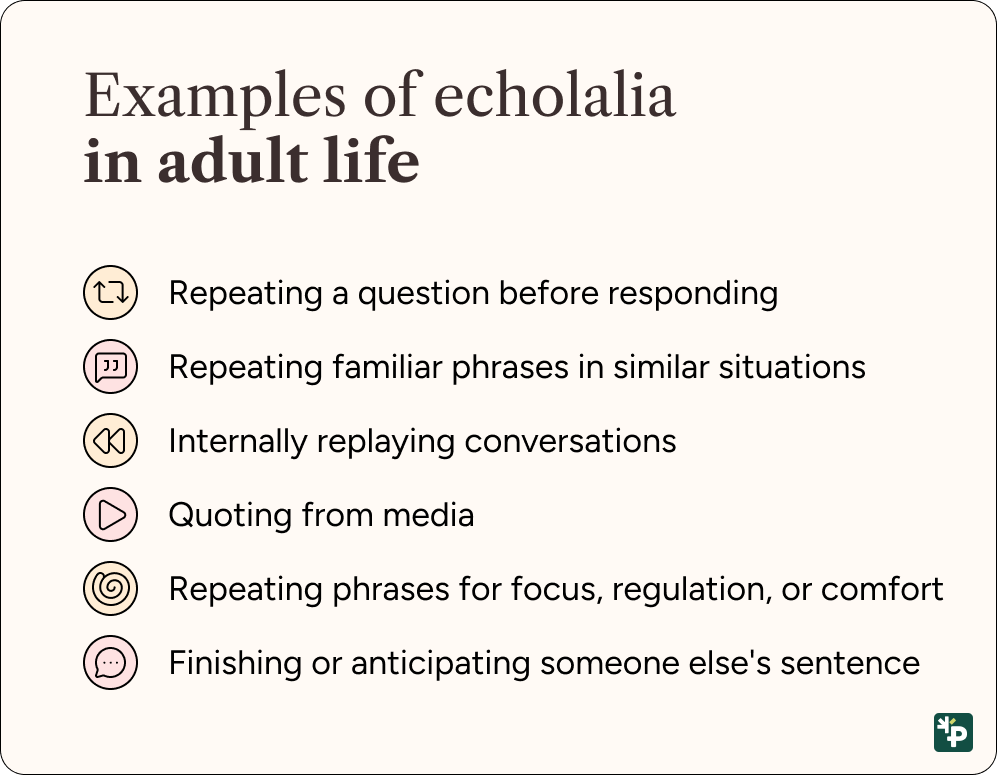
Echolalia shows up in a variety of ways. Here are some echolalia examples in adults:
- Repeating a question before answering: You may repeat “do you want to eat?” when someone asks if you want to eat, and then say whether or not you’re hungry.
- Using phrases from media in conversation: You might quote from a movie or TV show you love without thinking.
- Using familiar scripts in social situations: After hearing certain words from others, you may repeat them in similar social situations.
- Repeating phrases for comfort or focus: After someone says “it’ll be okay,” you might repeat that to yourself.
- Repeating phrases to start speaking (initiation support): If someone says they love dogs, you might repeat their words and then tell them about your own dogs.
- Finishing someone else’s sentence: If someone starts to recite a quote, you may finish it.
- Replaying conversations internally: Repeating other people’s words in your head is sometimes considered a form of internal echolalia.
Why echolalia happens
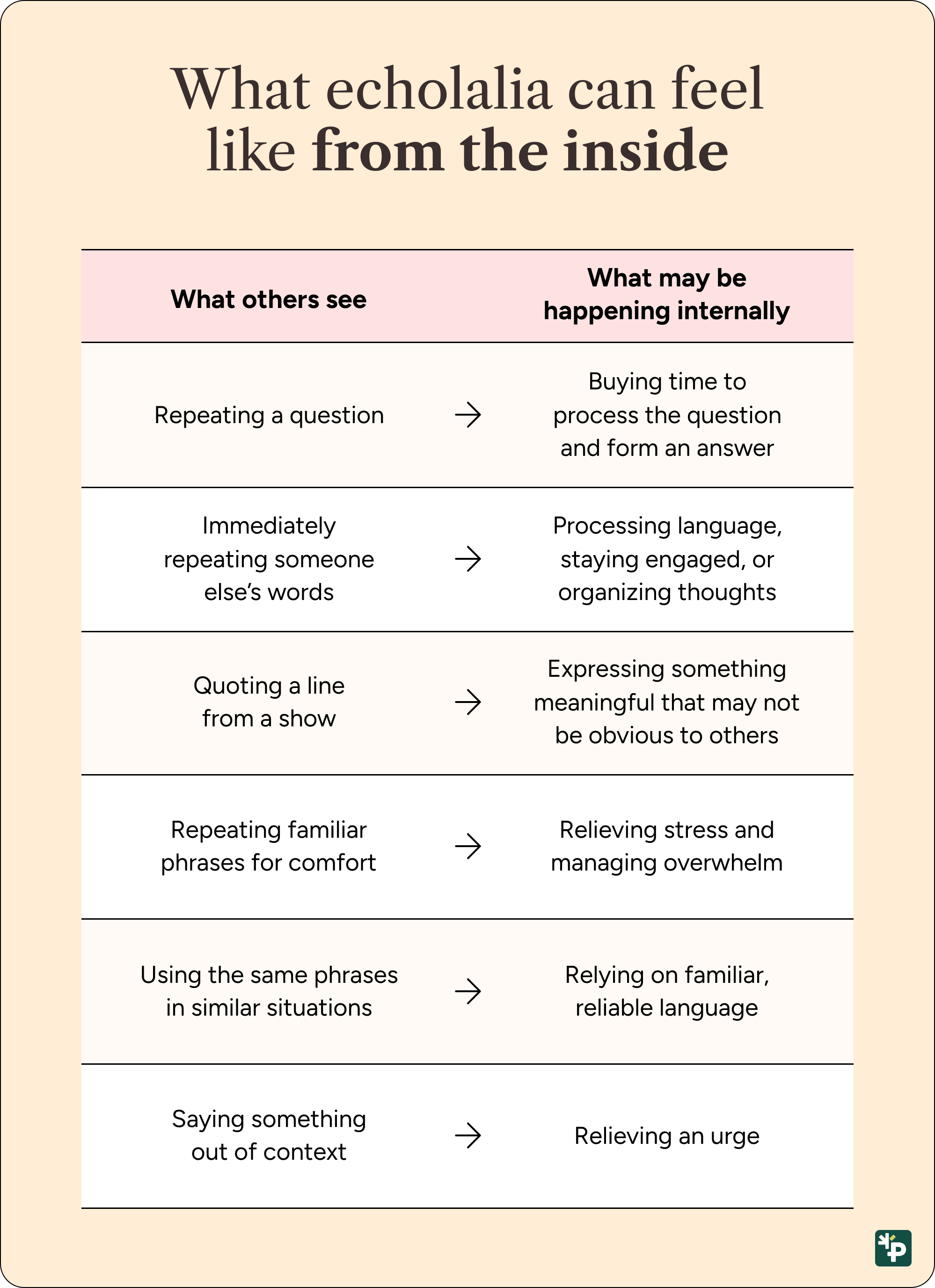
Echolalia in adults, particularly for neurodivergent individuals, serves several functions. These include processing language, communication, emotional regulation, sensory and cognitive support, and relieving an impulse.
Language processing
For some people, echolalia can serve a similar purpose as saying “umm” or “give me a second.” Repeating words can buy a person time to process what was said and form a proper response.
Sometimes, people use internal echolalia to try to make meaning of or understand the words of others, or commit those words to memory.
Communication
There are multiple ways echolalia can assist with communication. It can help a person express a sentiment when words are hard to find. “Sometimes when I talk, I don't have the words or frame of reference to relate, except with song lyrics,” says Jonathan.
Some neurodivergent people also question their choice of words, since their own words are sometimes misinterpreted. In this case, repeating other people’s phrases can feel like a way to rely on safe, “tried and true” speech.
Emotional regulation
Repeating phrases over and over—particularly familiar ones—is a coping mechanism for some people. According to Jones, some people find that repeating words can relieve stress, and ground their nervous system in calmness and predictability. This is true for both external and internal echolalia.
Sensory and cognitive support
For some people, repeating words can be a way of staying on track or focused on a specific topic. “Repeating familiar language can help with organizing thoughts when things feel overwhelming,” says Jones.
Relieving an impulse
Jonathan notes that in some cases, echolalia can be a compulsion that seems to come out of nowhere. “It's like a build up inside, like pressure through your entire body,” he says, “and you just need to let it out.”
He compares it to sneezing, which you often do without thinking. While you can prevent it in some cases, doing so is uncomfortable.
The urge can feel particularly strong for people with Tourette’s syndrome, to the point that echolalia may become automatic or involuntary.
How echolalia connects to autism, ADHD, and more
Echolalia is one communication pattern that can occur in autistic adults. It may even be considered when a person is evaluated for a late autism diagnosis. However, not everyone who experiences echolalia is autistic, and not every autistic person experiences echolalia.
When echolalia occurs in autistic people, “it’s often a meaningful way of processing, communicating, or regulating,” says Jones.
Among adults with ADHD, it may serve the same purpose. However, Jones notes that it can also manifest as a form of impulsive verbal repetition or verbal play, often linked to attention and stimulation. Echolalia is also a common vocal tic in tic disorders like Tourette’s syndrome.
In addition, echolalia may develop among adults with schizophrenia, dementia, post-epileptic states, and other conditions.
In any case, echolalia isn't a matter of repetition for its own sake, but a reflection of how the brain organizes and processes language.
Echolalia vs. similar behaviors
Echolalia in adults can get mixed up with vocal tics and palilalia. That's because these types of repetitive speech can all look similar on the surface. Echolalia—especially internal echolalia—can also be confused with obsessive-compulsive disorder (OCD) compulsions. Here are some of the differences and overlaps between these behaviors.
Vocal tics
Echolalia is sometimes considered a type of vocal tic. However, when it happens in the context of tic disorders such as Tourette’s syndrome, it may be driven primarily by an internal urge or premonitory sensation.
In fact, it might feel automatic. “Tics at times may almost feel impossible to stop from coming out,” says Tyana Tavakol, licensed therapist in CA and FL and virtual private practice owner of Uncovering You.
Outside of that context, and especially among autistic people, echolalia often serves a wider function.
Palilalia
Palilalia is when you suddenly repeat your own phrases, words, or syllables two or more times in a row. The words may get quieter or faster with each repetition.
Echolalia and palilalia are different because the latter involves repeating your own words, not those of others. Palilalia is also more likely to be involuntary or hard to control, and some people find it painful to suppress.
OCD
Like echolalia, OCD compulsions may involve repeating words over and over in your head or out loud. The difference is that OCD compulsions are often an attempt to reduce anxiety and uncertainty, says Cristina Billingsley, LMFT, CCTP, of Sierra Center for Wellness. They may also be an attempt to prevent or mitigate harm.
OCD compulsions often feel urgent. You may even fear that something bad might happen if you don’t do them. For example, you might mentally replay a conversation, looking for signs a friend hates you, or recite a prayer a certain number of times to make sure God doesn’t punish you.
Any relief from compulsions is temporary until OCD obsessions inevitably resurface. Fortunately, OCD is treatable with therapy.
Meanwhile, echolalia isn’t typically driven by intrusive fears or attempts to prevent harm. Emotionally, it may feel reassuring, grounding, or neutral. For some people, it can help regulate the nervous system and promote cognitive processing.
Another distinction to note is that of echolalia vs echopraxia. The words sound similar, but echopraxia refers to repeating other people’s actions, not their words.
Is echolalia something to be concerned about?
Echolalia typically isn’t cause for concern. As we noted before, it’s generally a functional way to process, communicate, or regulate.
With that said, you may want to see your doctor if you suddenly begin using echolalia for the first time during adulthood, after an injury, or alongside confusion or other neurological changes.
You may also want to look at your echolalia more closely if it's causing distress, interfering with communication, or not meeting your needs. In that case, it may be related to a disorder such as Tourette’s syndrome, or it may be another phenomenon altogether (such as an OCD compulsion).
Why many adults mask echolalia
If you are one of many adults who experiences echolalia, you may have felt pressure to mask or suppress your vocalizations. This is often due to social pressure and workplace or school expectations.
Andrea says she masks her echolalia because she doesn’t want to be misinterpreted. “It sounds like I'm mocking someone if I repeat what they said exactly how they said it," she notes.
Another woman, Meg, describes a time when somebody said a coworker’s name in a funny way. When Meg repeated it, conflict broke out in her workplace. “Since then, I’ve just been trying to not repeat funny things out loud,” she says.
With the above in mind, masking is common and understandable. In some cases, you may not really have a choice.
Unfortunately, it can take a lot of energy to resist echolalia, and you might feel disconnected from conversations if you’re often monitoring your own reactions. For some people, masking shifts external echolalia into internal echolalia. Instead of repeating words out loud, you may start repeating phrases in your head. At this point, you may not realize you’re doing it.
Support and communication strategies
Echolalia is not only functional, but you can actively use it to your advantage. The goal isn’t to eliminate echolalia, but to make it work for you. ”When supported, echolalia can enhance communication rather than limit it,” says Jones.
Developing scripts can help you navigate common situations more smoothly. In times when language feels hard to access, it can be useful to have some familiar phrases to fall back on. This can offer structure and predictability, making social situations less nerve-wracking.
Jones suggests offering brief clarification after using echolalia, for example, by saying “give me a second to think” to show that you’re processing information.
Is unmasking always a good idea?
Unmasking is generally associated with better mental health outcomes. Ideally, we should all be able to do so, but it’s not always safe in a neurotypical society. It’s completely valid if you wish to mask for safety reasons.
Not everyone reacts to echolalia with understanding. If this is a concern for you, Tavakol suggests explaining echolalia beforehand. A dismissive or disrespectful response means it may be useful to consider how much energy you'll invest in that relationship going forward.
Of course, that’s not always possible, especially in professional situations. If you feel the need to mask for safety purposes, Tavakol emphasizes that this doesn't mean anything is wrong with you. The biggest problem is a society “that isn't designed to know about or even be open to neurodivergent communication styles,” she says.
Tavakol notes that developing healthy relationships with others in the neurodivergent community may offer a safe environment to unmask, feel accepted as you are, and build a sense of self-acceptance.
The bottom line
Echolalia in adults is common among autistic people and those with other forms of neurodivergence, such as ADHD. In most cases, it’s nothing to worry about. For many people, echolalia serves adaptive or supportive functions in relation to language processing, communication, or emotional regulation.
With that said, the world isn’t built for neurodivergent individuals, so some people want to learn how to make echolalia work well in neurotypical environments. If that’s true for you, Prosper Health can help. Our neurodiversity-affirming clinicians help autistic people thrive in all sorts of situations.
Frequently asked questions
What does echolalia in adults look like? Echolalia can present in a variety of ways. You might immediately repeat the words another person spoke to you or someone else—whether they made a statement or asked a question. You may repeat the speech of someone on the television or radio, or you might repeat phrases from movies in general conversation. These are just a few examples. Echolalia is different for everyone.
Can you have echolalia without autism as an adult? Yes. Echolalia in adults is often associated with autism, but adults without autism can experience echolalia as well. This is more common among adults with ADHD, language processing differences, or neurological or psychological conditions.
Is echolalia a form of stimming? Yes, echolalia can function as a form of vocal stimming. This is because echolalia is often used to regulate mood and improve focus.
Sources
https://www.ncbi.nlm.nih.gov/books/NBK565908/
https://pmc.ncbi.nlm.nih.gov/articles/PMC9703477/
https://www.ncbi.nlm.nih.gov/medgen/581078
https://www.prosperhealth.io/blog/autism-and-communication-differences-in-adults
https://www.prosperhealth.io/blog/unmasking
https://pmc.ncbi.nlm.nih.gov/articles/PMC11317797/
https://riuma.uma.es/rest/api/core/bitstreams/8ab23550-2759-4ba0-a0d3-a4bb4852066c/content


