.webp)


Key Takeaways
- Black-and-white thinking, also referred to as "all-or-nothing thinking" is a cognitive pattern where people approach certain scenarios in absolutes, usually without nuance.
- Black-and-white thinking can develop through learned experiences, as well as from the way your brain processes information.
- Although it’s referred to as a “cognitive distortion” in clinical literature, black-and-white thinking is not a character flaw.
- Appropriate support depends on the underlying cause: People with OCD or trauma may benefit from therapy that directly addresses their stress responses. Autistic people tend to benefit from neurodiversity-affirming therapy that recognizes their preferred thinking style.
- The goal is not to “fix” or eliminate this cognitive pattern, but to build flexibility.
Key Takeaways
- Black-and-white thinking, also referred to as "all-or-nothing thinking" is a cognitive pattern where people approach certain scenarios in absolutes, usually without nuance.
- Black-and-white thinking can develop through learned experiences, as well as from the way your brain processes information.
- Although it’s referred to as a “cognitive distortion” in clinical literature, black-and-white thinking is not a character flaw.
- Appropriate support depends on the underlying cause: People with OCD or trauma may benefit from therapy that directly addresses their stress responses. Autistic people tend to benefit from neurodiversity-affirming therapy that recognizes their preferred thinking style.
- The goal is not to “fix” or eliminate this cognitive pattern, but to build flexibility.
“If I can’t do this project perfectly, I shouldn’t have this job, should I?”
“OMG, my friend canceled our coffee meetup. I knew she never really liked me.”
“My partner forgot I wanted to see The Odyssey this weekend. I think our relationship is in trouble.”
If any of these internal monologues sound familiar, it’s not because someone gained access to your innermost emotions: It’s because these thought patterns are more common than you may think, and they’re known as black-and-white thinking.
Before we delve into these patterns more deeply, know this: It’s okay if you’re unsure whether your black-and-white thinking is a problem, a trait, or both, even if you’ve been told that you tend to “overreact” or that you “can’t see nuance.” Examining this kind of dichotomous thinking doesn’t mean it’s a flaw to be fixed or even a symptom of a specific disorder.
These patterns are just one part of who you are, and you deserve to understand what exactly black-and-white thinking is, what’s driving these patterns, and if you should pursue support.
What is black-and-white thinking?
Black-and-white thinking is a distinctive cognitive pattern where you approach certain scenarios in absolutes, usually without nuance or middle ground. Whether it’s a person or a specific situation, you see things as either entirely good or entirely bad. Terms like dichotomous thinking, all-or-nothing thinking, and binary thinking are also used interchangeably to describe the same underlying patterns.
Although black-and-white thinking is referred to as a “cognitive distortion” in clinical literature, this heavily negative framing doesn’t fit everyone equally: A 2022 Harvard Health Publishing article refers to cognitive distortions as “internal mental filters or biases that increase our misery, fuel our anxiety, and make us feel bad about ourselves.” While this does describe one aspect of all-or-nothing thinking, it doesn’t paint the whole picture.
"For many autistic people, black-and-white thinking isn't simply a cognitive distortion,” explains Jacqueline Shinall, PsyD, a clinical psychologist at Prosper Health. “It's often an understandable attempt to bring predictability to a world that has frequently felt inconsistent, confusing, or difficult to decode."
What does black-and-white thinking look like?
Black-and-white thinking varies from person to person and situation to situation, but generally speaking, it’s a tendency to define something by a single characteristic or moment. Instead of considering both positive and negative aspects, you may come to an inaccurate conclusion without knowing all of the facts.
Dr. Shinall provides several black-and-white thinking examples below:
In relationships
Someone who engages in black-and-white thinking may find it challenging to simultaneously hold both positive and negative aspects of a relationship.
- "If my friend canceled plans, they must not care about me"
- "If we had one argument, the relationship is ruined."
- "If my partner forgot something important, they don't value me."
- "If someone disagrees with me, they must not like me anymore."
In how you see yourself
Rather than seeing strengths and challenges existing together, dichotomous thinking patterns can cause a single difficult moment to define someone’s entire self-image. As in, “If I do X, that means Y.”
- "If I made a mistake, I'm a failure,"
- "If I forgot something, I'm irresponsible."
- "If I need help, I'm incompetent."
- "If I had an awkward conversation, I'm bad at socializing."
At work
All-or-nothing thinking can make normal learning experiences or minor setbacks feel much more significant than they really are.
- "If my supervisor gave me constructive feedback, they think I'm bad at my job."
- “If I don't know the answer immediately, I shouldn't have this job."
- "If a meeting didn't go perfectly, it was a disaster."
- "If I need to ask for clarification, it means I'm not capable."
In daily decisions
People who experience black-and-white thinking may find their everyday choices become polarized, as if there is only one “right” decision, and all the other options are “wrong.” They also may believe they need complete certainty before making a decision, even when multiple options would likely work just fine.
- Spending a long time choosing a restaurant
- Avoiding making purchases unless they're certain it's the best option
- Feeling that changing plans means the day is ruined
Why this happens: Efficiency, not failure
So where did these dichotomous thinking patterns even come from? While Dr. Shinall confirms that there isn’t a single cause of black-and-white thinking, it can develop through learned experiences, as well as from the way your brain processes information. Remember that these patterns are not character flaws or logical failures; they’re just part of who you are!
How it gets learned
For some people, black-and-white thinking develops through experiences where “situations felt unpredictable, unsafe, or highly consequential, making simple rules feel protective and easier to rely on,” explains Dr. Shinall. In the case of some autistic individuals, those experiences may include “repeated social misunderstandings, inconsistent expectations, or years of trying to decode social rules that never seemed fully explained.”
How your brain processes it in the moment
During any stressful moment, “the brain is often trying to reduce uncertainty or to simplify complex information,” says Dr. Shinall. She further explains that our brains are constantly looking for patterns and trying to make quick sense of the world.
But when we're stressed, anxious, overwhelmed, or our nervous system is highly activated, “our ability to tolerate ambiguity decreases.” In those situations, even though there are multiple possibilities to consider, the brain may still gravitate toward clear, certain conclusions because certainty feels safer than uncertainty.
Who experiences black-and-white thinking?
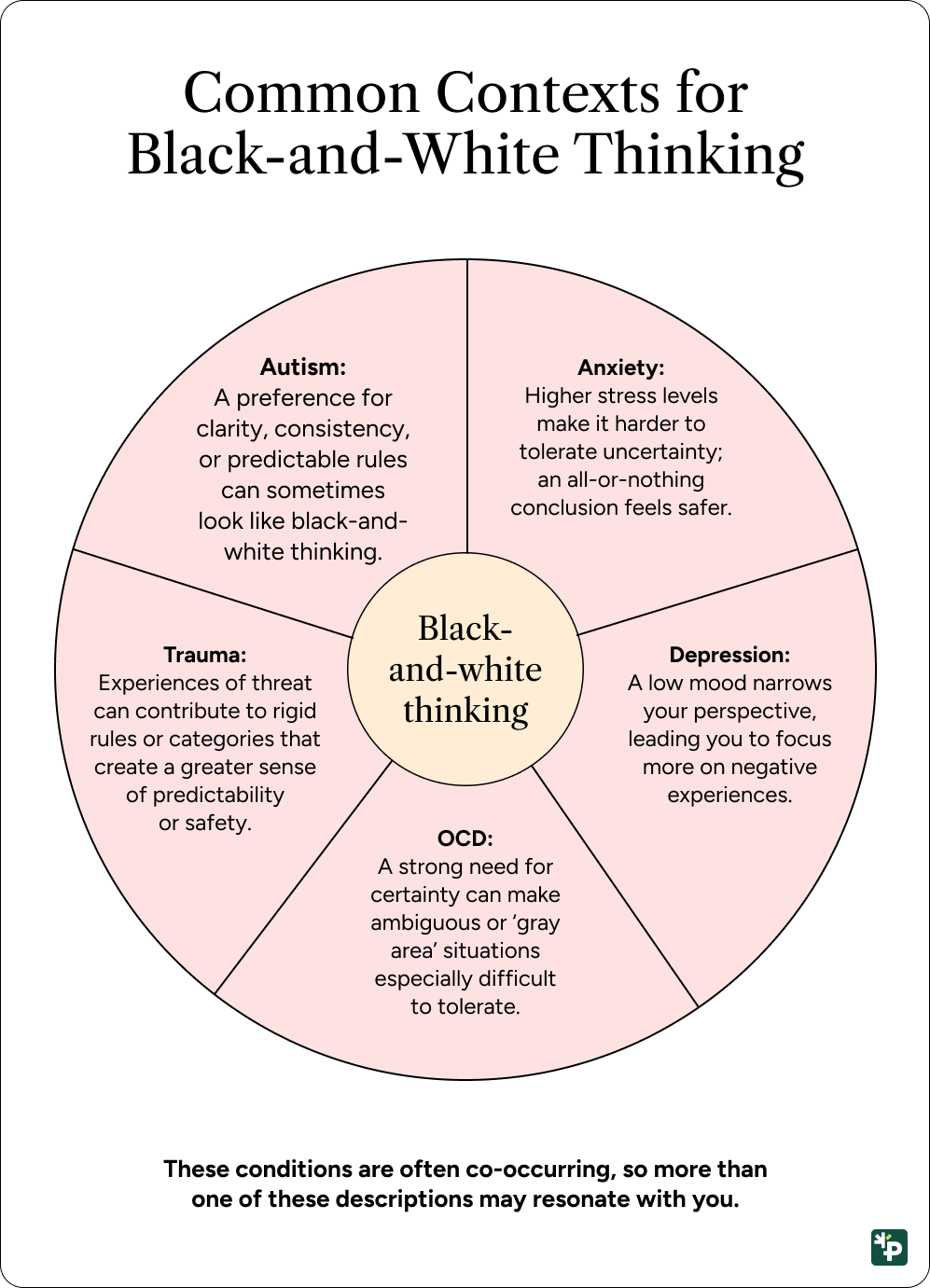
Anyone can experience black-and-white thinking, though Dr. Shinall notes that the underlying reasons often differ from person to person. Different diagnoses (such as anxiety, obsessive-compulsive disorder, depression, and/or trauma) may have their binary thinking driven by fear, threat, or mood.
For people who are diagnosed with autism, the underlying reasons may overlap with an intolerance of change or uncertainty, learned experiences, masking, preferences for consistency, and clearer roles.
“Understanding why the thinking occurs is important because that is what guides the most effective support,” says Dr. Shinall.
Bear in mind, however, that many of the aforementioned conditions often co-occur with autism, so there may be multiple reasons behind your black-and-white thinking.
Common contexts
Dr. Shinall offers additional insights into the connection between black-and-white thinking and certain mental health conditions below:
Anxiety: Anxiety makes our brains prioritize safety and predictability. When someone is anxious, it is much harder to tolerate uncertainty, causing the brain to default to clear, all-or-nothing conclusions to reduce ambiguity.
Depression: Depression can narrow the way people interpret themselves and the world around them. Someone may focus almost exclusively on negative experiences and draw broad conclusions such as "Nothing ever goes right" or "If I struggled today, I'm never going to get better."
Obsessive-compulsive disorder: OCD is closely tied to a need for certainty and a fear of making mistakes. Black-and-white thinking often shows up in beliefs like, "If I'm not 100% certain, it isn't safe," or "If I don't do this perfectly, something bad could happen."
Trauma: Trauma can cause the brain to create rigid rules designed to prevent future harm. Over time, these rules may affect your day-to-day life, such as the belief that all conflict is dangerous or that one negative experience predicts future outcomes.
Autism and neurodivergent cognition
Black-and-white thinking is a common cognitive pattern among autistic people, and may be related to factors such as pattern-based processing, systematizing tendencies, masking, and social unpredictability.
Pattern-based processing: Many autistic people naturally process information by identifying patterns, organizing information into systems, and looking for consistency, explains Dr. Shinall. These processing styles can be viewed as cognitive strengths that can support learning, problem-solving, attention to detail, and developing expertise. The challenge, however, is that social interactions don't always follow consistent rules, “so applying the same rule-based approach to people and relationships can sometimes lead to fixed conclusions,” she says.
Systematizing tendencies: Another common trait among autistic people is the inclination to systematize, “meaning they naturally look for underlying rules that explain how things work,” says Dr. Shinall. While this can be effective in structured environments, it’s not necessarily the case in social situations, which often involve nuance, context, and exceptions.
Social unpredictability: Repeated experiences of social unpredictability can also reinforce black-and-white thinking. Dr. Shinall notes that many autistic adults describe growing up feeling like everyone else seemed to understand "unwritten rules" that were never explicitly explained to them. So after multiple confusing or painful social experiences, “creating clearer, more consistent rules to reduce uncertainty” seems like a natural progression.
Masking: Masking, or the suppressing of autistic traits, can further strengthen these patterns. “When someone spends years consciously analyzing conversations, memorizing social rules, and monitoring their own behavior to fit in, they often become increasingly reliant on those rules,” says Dr. Shinall. But maintaining such rules may make it more challenging to identify the correct approach that different contexts, relationships, and people often require.
If you’re a late-identified autistic adult reading this and are recognizing these connections for the first time, know that this is perfectly okay. “The issue isn’t that autistic people think too systematically,” assures Dr. Shinall. “It's that the social world is often far less systematic than the brain would prefer.”
Is black-and-white thinking always a problem?
Although black-and-white thinking is often framed as a cognitive distortion, it does reflect a cognitive style that, in many situations, can be considered a strength.
“For many autistic people, clear rules and systematic thinking support attention to detail, consistency, ethical decision-making, and problem-solving,” explains Dr. Shinall.
Challenges can arise when black-and-white thinking is applied to situations that naturally involve ambiguity, like relationships or interpreting other people's intentions. That doesn’t mean the goal here is to try to “fix” or even eliminate these cognitive patterns. Instead, the focus should be on building flexibility and recognizing when a situation has multiple valid interpretations.
“Ultimately, the question isn't whether someone thinks in black and white,” says Dr. Shinall, but whether that way of thinking is helping them navigate the situation or creating unnecessary distress.”
What helps (and why one-size-fits-all advice often doesn't)
As with most strategies, the right approach to black-and-white thinking depends on what’s actually driving it. So, in most cases, generic, one-size-fits-all advice probably won’t work.
“Effective support begins with understanding why the thinking pattern exists, not just what it looks like,” emphasizes Dr. Shinall. Even though black-and-white thinking can look similar on the surface, it’s important to identify the root cause, because one person may be responding to anxiety, another to OCD, another to trauma, and an autistic person may simply be relying on a cognitive style that prioritizes consistency and pattern recognition.
“Treating all of these as though they have the same cause often misses the mark,” says Dr. Shinall.
.png)
Building flexibility and self-understanding
Addressing black-and-white thinking is an exercise in patience and flexibility, and, as we’ve already addressed, not a one-size-fits-all approach. But for those who need more concrete advice, these four suggestions should help you get started.
1. Notice the pattern before trying to change it
Observation without judgment is the first and most important step. If you’re noticing that anytime you make a mistake at work, you immediately believe you should be fired, take a beat and sit with that thought. The one thing you don’t want to do is immediately correct that thought, as that approach often backfires. This is why it may help to first notice and understand what prompted the thought.
2. Use language that creates room for complexity
The goal here is to replace an absolute statement with one that better reflects the available evidence. “Small language changes can make a big difference because they create room for nuance without dismissing the person's experience,” says Dr. Shinall.
Here are some examples, courtesy of Dr. Shinall:
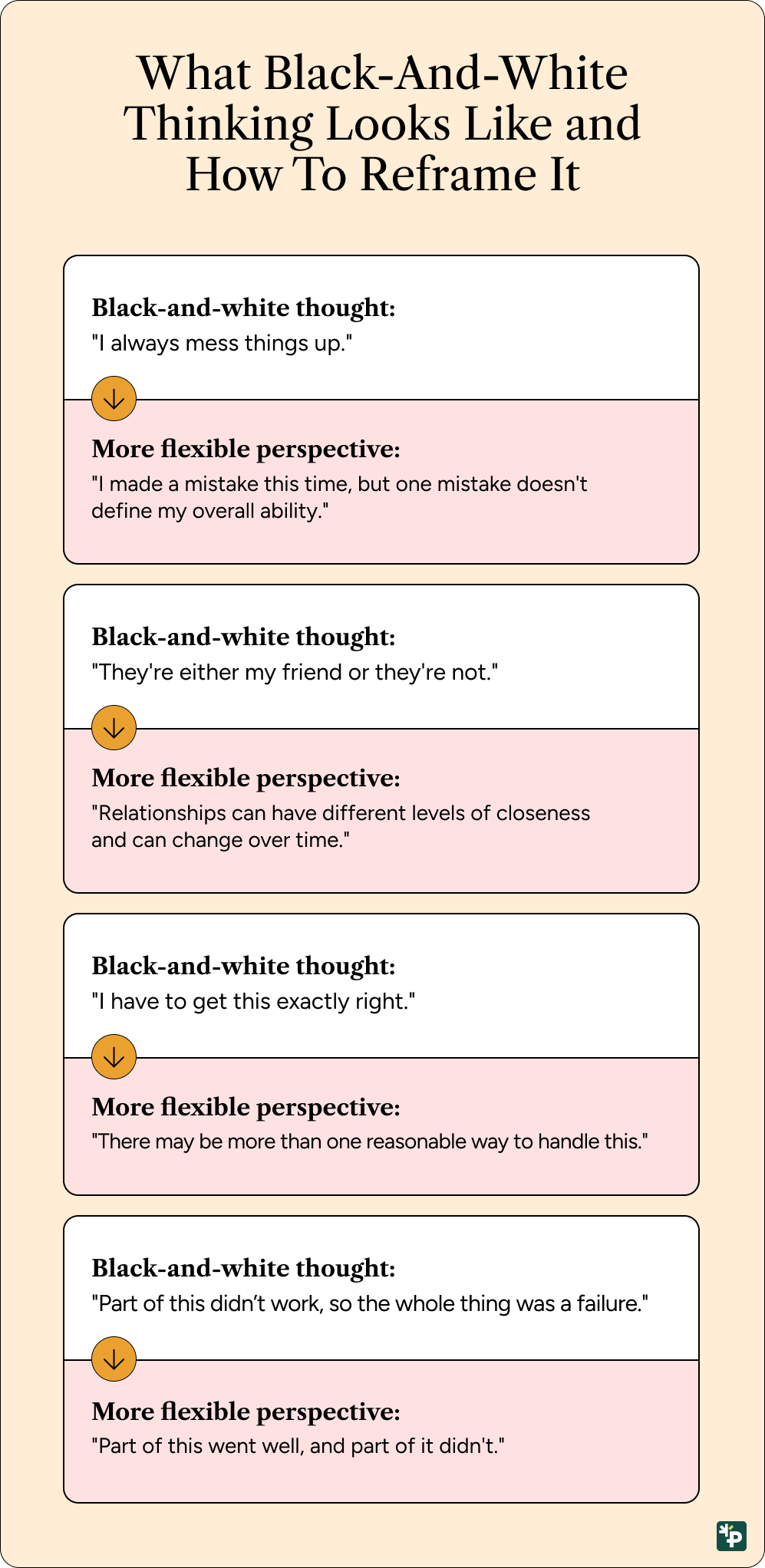
- Instead of "I always mess things up," try "I made a mistake this time, but one mistake doesn't define my overall ability."
- Instead of "They're either my friend or they're not," try "Relationships can be complicated, and one interaction doesn't define the entire relationship."
- Instead of "I have to get this exactly right," try "There may be more than one reasonable way to handle this."
- Instead of "I failed," try "Part of this went well, and part of it didn't."
3. Work with your nervous system, not just your thoughts
When someone’s nervous system is highly activated, the brain naturally shifts towards simpler, more certain ways of thinking (such as black-and-white thinking).
Dr. Shinall recommends regulating the body before addressing your thought patterns: Taking a break, reducing sensory input, going for a walk, practicing deep breathing, or engaging in another preferred calming activity. This will help get your brain to a place where flexibility is possible.
4. When to work with a therapist
Although most people experience black-and-white thinking occasionally, Dr. Shinall suggests working with a therapist if these thought patterns are causing significant distress, interfering with relationships, affecting work or school, or restricting your daily life.
Some therapeutic options to consider include:
Cognitive Behavioral Therapy (CBT): CBT can help people identify rigid thinking patterns and develop more flexible, evidence-based ways of interpreting situations.
Exposure and Response Prevention (ERP): ERP is considered “the gold-standard treatment” for OCD because it helps people build tolerance for uncertainty.
Trauma-informed therapies: These approaches can help address the underlying experiences that shaped trauma-driven black-and-white beliefs.
Neurodiversity-affirming therapy: Autistic and neurodivergent individuals may wish to consider Prosper Health’s neurodiversity-affirming therapy approach because it focuses less on eliminating systematic thinking and more on building flexibility in situations that naturally involve ambiguity. This is also achieved while respecting the strengths of black-and-white thinking.
The bottom line
Black-and-white thinking happens to everyone, so instead of looking at it as a flaw (which it isn’t), think of it as a trait that warrants further exploration.
Whether your binary thinking is a stress response or a preferred thinking style (or both!), understanding its root cause(s) can not only help you understand yourself better, but also guide you toward the support you may need.
Frequently asked questions (FAQs)
What does it mean if you have black-and-white thinking?
Black-and-white thinking is a cognitive pattern in which a person approaches certain scenarios in absolute terms, usually without nuance or middle ground. People who experience black-and-white thinking may feel that a single error at work means they’re not good at their job, or that a canceled meetup means their friend no longer likes them.
Is black-and-white thinking a sign of autism?
Black-and-white thinking is not necessarily a sign of autism, but it is a common cognitive pattern among autistic people. It can offer autistic people predictability and comfort, and may relate to factors like pattern-based processing, systematizing tendencies, masking, and social unpredictability.
How is black-and-white thinking different in autism versus anxiety?
Black-and-white thinking can arise for different reasons in both autistic and non-autistic people. Traits of anxiety may increase the need for prioritizing certainty, while traits of autism may make the need for providing predictable and clearer rules or patterns as a way of processing information. These factors can overlap from person to person.
Will therapy help with black-and-white thinking?
Therapy can help with black-and-white thinking, although you’ll want to research approaches that address the root cause of your cognitive pattern. When dichotomous thinking is connected to OCD-related certainty seeking or compulsive patterns, ERP may be an appropriate treatment approach. Autistic people may also benefit from neurodiversity-affirming therapy. Therapy that considers the individual's cognitive style, sensory needs, communication preferences, and co-occurring symptoms and concerns can help reduce distress and improve flexibility when black-and-white thinking is causing problems in daily life.
Sources
https://www.reachlink.com/advice/general/black-and-white-thinking/
https://www.rula.com/blog/black-and-white-thinking/
https://pmc.ncbi.nlm.nih.gov/articles/PMC4314927/
https://www.health.harvard.edu/blog/how-to-recognize-and-tame-your-cognitive-distortions-202205042738
https://www.prosperhealth.io/blog/autism-and-relationships
https://www.prosperhealth.io/blog/what-cooccurs-with-autism
https://www.prosperhealth.io/blog/autism-and-anxiety
https://www.prosperhealth.io/blog/ocd-vs-autism
https://www.prosperhealth.io/blog/autism-and-traumahttps://www.simplypsychology.org/black-and-white-thinking-in-autism.html
https://www.prosperhealth.io/blog/autism-masking
https://www.apa.org/ptsd-guideline/patients-and-families/cognitive-behavioral
https://iocdf.org/about-ocd/treatment/erp/


