.webp)


Key Takeaways
- Selective mutism is an anxiety-related condition in which people are unable to speak in some situations, despite having no speaking limitations in others.
- While selective mutism is most commonly seen in children, it can occur in adults as well.
- Selective mutism typically co-occurs with social anxiety disorder, and it has some overlap with autism. However, it is distinct from both.
- Many people develop coping strategies to help alleviate the impact of selective mutism on everyday life, including college, work, and relationships.
- Selective mutism is treatable with behavioral and cognitive-behavioral therapy (CBT).
Key Takeaways
- Selective mutism is an anxiety-related condition in which people are unable to speak in some situations, despite having no speaking limitations in others.
- While selective mutism is most commonly seen in children, it can occur in adults as well.
- Selective mutism typically co-occurs with social anxiety disorder, and it has some overlap with autism. However, it is distinct from both.
- Many people develop coping strategies to help alleviate the impact of selective mutism on everyday life, including college, work, and relationships.
- Selective mutism is treatable with behavioral and cognitive-behavioral therapy (CBT).
Imagine a young woman sitting in the cafeteria at work. In between bites of her sandwich and sips of her coffee, she has a spirited, eager conversation with her closest friend. All of this light, peaceful energy ends when a colleague sits next to her and asks how her weekend went.
Suddenly, she’s paralyzed, and as much as she tries, she can’t get any words out. The words are just blocked. As an adult with selective mutism, this is a familiar yet distressing experience.
Many people associate selective mutism with childhood, but it can both persist and start in adulthood, confirms Rachel Loftin, chief clinical officer at Prosper Health. Being unable to speak can feel frustrating, confusing, and alienating. This is especially true in a world where many people don’t understand selective mutism.
In this article, we’ll explain selective mutism in adults, what may contribute to it, and how it differs from (and overlaps with) social anxiety and autism. We will also explore coping strategies, treatment, and support options.
What is selective mutism in adults?
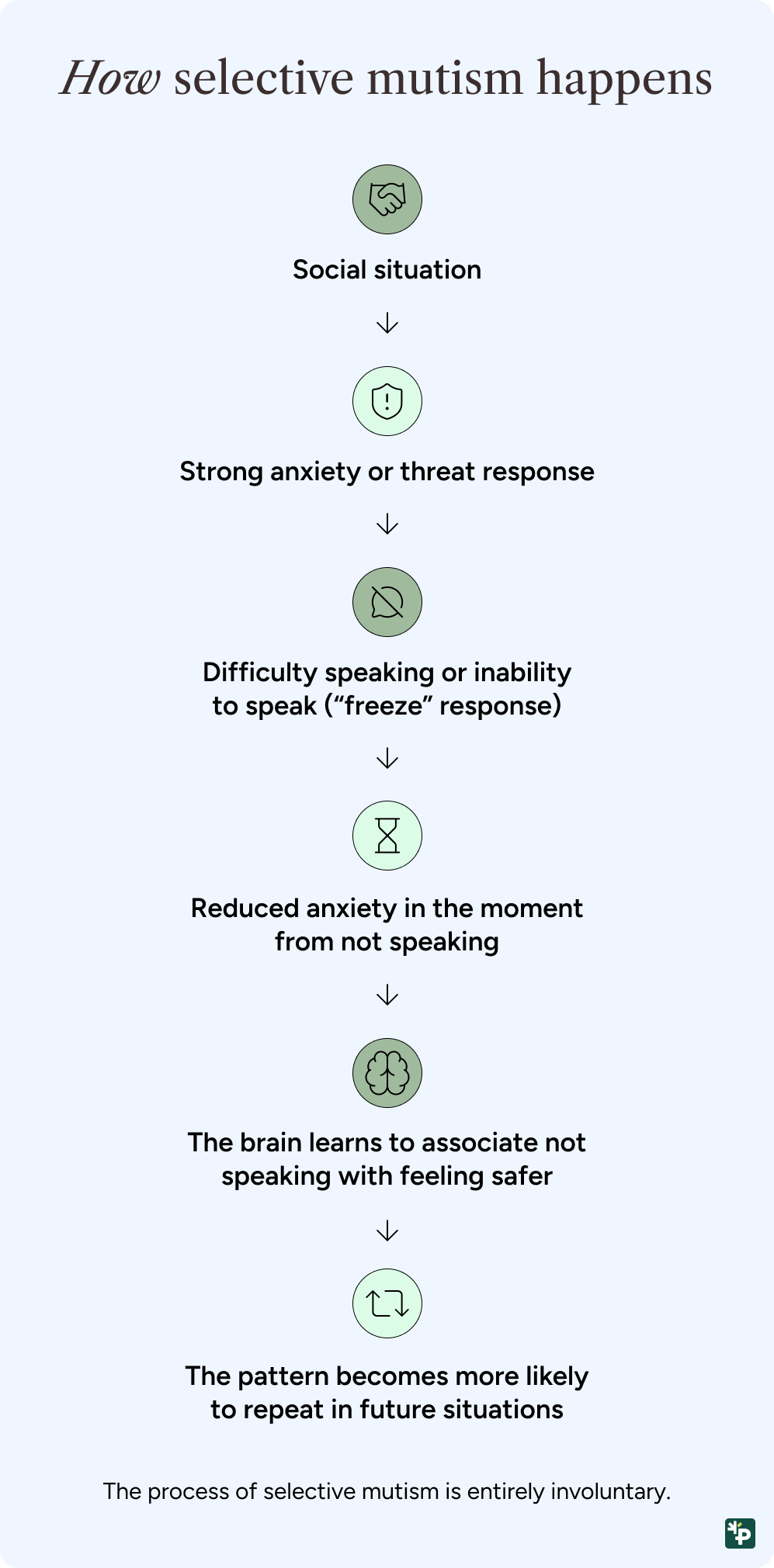
Selective mutism (SM) is an anxiety disorder that prevents people from speaking in some situations—for instance, in specific settings or around certain people—even though they speak comfortably in other contexts. This is not because they simply refuse to talk. Rather, it is experienced as a blocked ability to speak.
SM is an involuntary nervous system response, not a choice. It can feel as if “the throat locks up and the vocal cords physically tighten,” says Kaila Hattis, MA, LMFT, founder of Pacific Coast Therapy. Telling someone with SM to “just say something” is like telling a person with a broken ankle to run, she notes.
The exact prevalence of selective mutism is unknown, and generally considered to be rare, but a 2026 review hypothesizes that this may be because adults can more easily avoid situations that trigger mutism. Unfortunately, there is relatively little research on selective mutism in adults compared to SM in children.
With that said, selective mutism is heavily associated with social anxiety disorder, and has a complex relationship with autism, as we will explore below.
How selective mutism can show up in adulthood
Here are some potential selective mutism symptoms:
- Feeling unable to talk
- Feeling paralyzed by anxiety
- Feeling frozen or unable to move
- Difficulty making eye contact
- Being able to get out only a few words
- Only being able to speak quietly or with slow, short, or hesitant responses
- Using gestures, expressions, or simple noises (like “uh-huh”) instead of words
- Asking a trusted individual to relay information
These symptoms show up only in certain situations that vary from person to person. “An adult with this condition can be articulate at home and go stone silent in a staff meeting 12 hours later,” says Hattis.
Other possible triggers include medical appointments, group events, speaking with authority figures, meeting new people, and going on dates. Some people even experience SM around close family members at home.
The emotional effect of selective mutism
Selective mutism can have a significant emotional impact. A 2026 review noted that some people with SM worry that they may never live “normally” when it comes to college, work, relationships, and other aspects of life. It described one young adult being rejected from college because she couldn’t speak during her interview.
Some people with the condition are afraid to go on dates or pursue new friendships. Even in their established relationships, they might face misunderstandings due to not speaking in certain situations. Other people may mistake them as standoffish, rude, or uninterested. Household members may also express hurt feelings if a person can speak with one member and not others.
These experiences can contribute to feelings such as shame, loneliness, guilt, or social isolation.
Some people with SM develop depression.
Fortunately, there are ways to manage SM and live the fulfilling life you deserve.
What causes selective mutism in adults?
While researchers haven’t identified specific selective mutism causes, several risk factors may contribute, says Loftin. Here are a few:
- Social anxiety: Many people with SM have social anxiety disorder. In fact, some psychologists say that SM is itself an extreme form of social anxiety.
- Behavioral inhibition: Behavioral inhibition is a temperament that makes someone hesitant to interact with the world. People with an inhibited temperament are constantly on the lookout for potential threats, and they withdraw from unfamiliar situations or people. A 2016 study found that infants with behavioral inhibition were much more likely to develop SM later in life.
- Multilingual stress: It can be difficult and anxiety-provoking to interact with others in a language you’re not entirely comfortable using. A 2018 study found that bilingual children who are anxious and less adapted to the dominant culture are more likely to become silent in preschool. Blum notes that there may occasionally be a connection between multilingualism and SM among adults, as well, though research is more limited.
- Neurodevelopmental differences: Research suggests higher rates of co-occurrence between SM and neurodevelopmental conditions such as autism and ADHD. In the case of autism, this may be (at least partially) due to shared genetic pathways. High rates of social anxiety may also play a role.
While it may be relevant in certain individual cases, experts generally don’t consider trauma a typical cause of SM, notes Loftin. When people experience mutism after trauma (trauma-induced mutism), they are more likely silent in all situations—not only in some situations, as is the case in SM.
Can selective mutism develop in adulthood?
Adults can certainly suffer from SM, but the condition almost always begins in childhood. Some case studies have described patients diagnosed with SM in adulthood. Exact prevalence is unknown, but it's considered rare.Oftentimes, it is likely to be because a person went undiagnosed as a child, rather than developing for the first time in adulthood.
“With certain expectations that come into someone's life later on, maybe there are more challenges in terms of how they socially engage and communicate,” says Jenna Blum, Lead Clinical Psychologist at the Selective Mutism Anxiety and Related Disorders Treatment Center.
Blum notes that, in this case, symptoms of SM may appear more overtly in adulthood. This might lead to a late diagnosis if SM went undetected in childhood.
Loftin adds that if a person develops mutism in adulthood, it might not be due to classic SM. It may have another cause, like psychosis, neurologic illness, or severe depression.
However, developing SM in adulthood may be possible in rare situations. You should discuss the possibility with a psychologist if you think it might be the case for you.
Is selective mutism the same as social anxiety?
No, it’s not. But there is a lot of overlap. While data on adults are limited, one study suggests that around 69% of those with SM have social anxiety disorder (SAD). That doesn’t mean the two conditions are the same, though.
By definition, SM occurs only in specific contexts, while SAD may be more pervasive across social situations. In addition, a consistent inability to speak in certain situations is the core symptom of SM. SAD may or may not include trouble speaking. When it does, though, it’s typically due to nervousness and fear, not physical inability (unless, of course, the person also has SM).
The difference between selective mutism and autism
Some studies of clinical populations suggest that more than half of children with SM meet the criteria for autism. Keep in mind, though, that these studies may not be representative of the general population.
In any case, SM by itself doesn’t necessarily mean a person is autistic. A diagnosis of autism requires communication differences that persist across multiple contexts, as well as restricted, repetitive behaviors, interests, or activities. Autistic people also tend to have differences in sensory processing and sensory regulation.
For these reasons, autistic people can sometimes find themselves unable to speak—but that’s not always the same as SM.
Why do autistic people and people with selective mutism go silent?
Autistic people can go silent during “shutdowns.” On the surface, it can look the same as SM. The difference is that SM is generally triggered by social contexts and expectations, whereas shutdowns are more complex. They are typically because of a combination of anxiety, sensory overload, or other autistic stress responses, says Loftin.
Take the example of young adults doing a group project in college. A student with SM may find it impossible to speak in groups, period. Meanwhile, an autistic student without any anxiety disorders may speak fine in groups generally. But they may experience a shutdown if (for example) the room is noisy, and their group members are speaking over each other and arguing.
On the other hand, some autistic people are unable to speak in general. This is distinct from SM since people with SM speak in some situations and not others.
That said, selective mutism can co-occur with autism. If you’re wondering if it applies to you, that’s a possibility you should explore with a psychologist.

Coping strategies you can try now
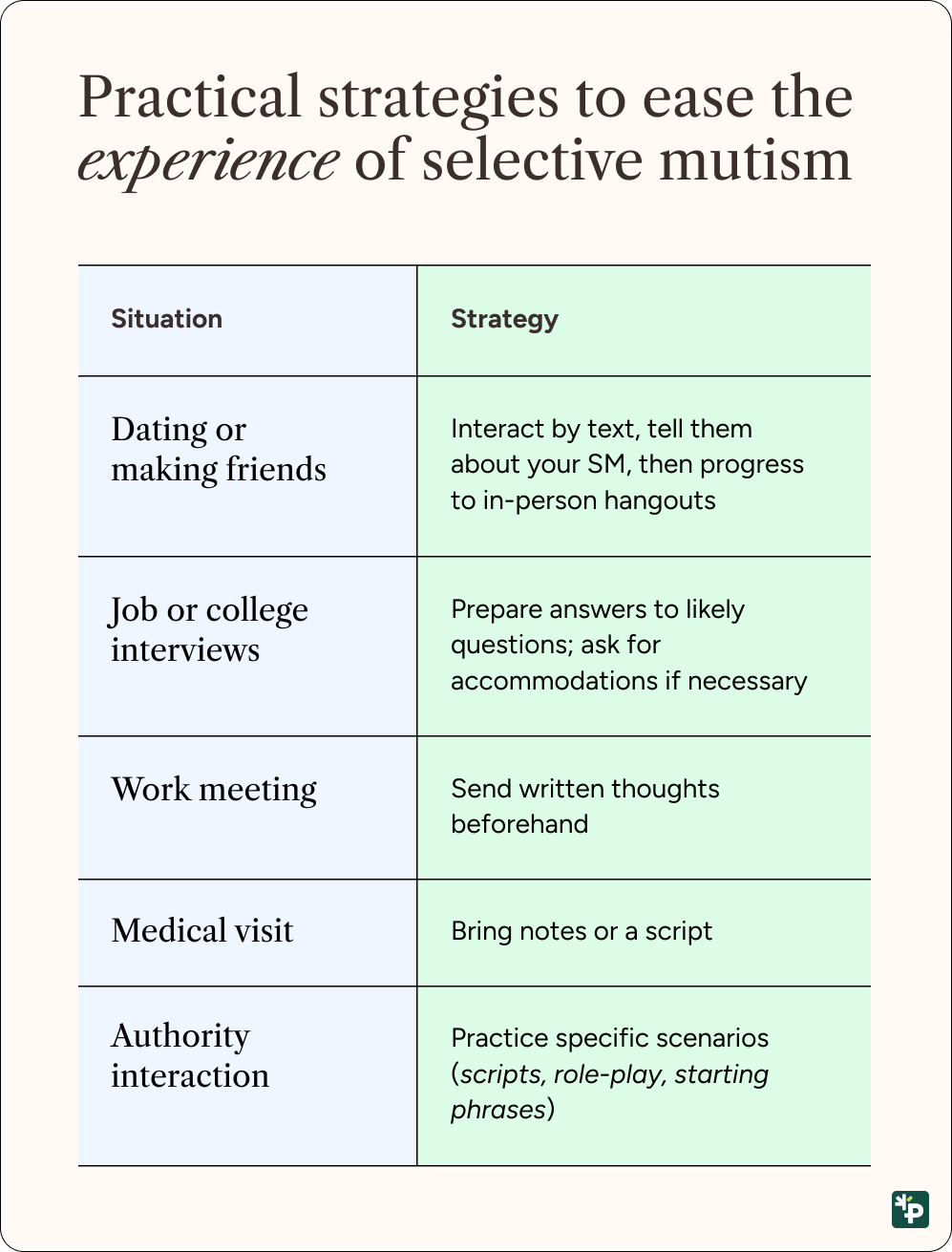
Being unable to speak can be frustrating, but it might feel a little less nerve-racking if you know what to do. This is why Blum suggests creating an action plan for situations in which you’re likely to become silent. This can involve developing social scripts to plan what you might want to say and how you can respond to any questions you might be asked.
If you’re still unable to speak, that’s nothing to be ashamed of. Rest assured, says Loftin: “Speech is not the only valid form of communication.” In these situations, the goal shouldn’t be to make yourself talk, but to enable yourself to communicate if you want to do so.
Here are some ways you can communicate when speaking is difficult, according to Loftin:
- Using Augmentative and Alternative Communication (AAC), such as typing, texting, notes, or gestures
- Carrying a card that explains selective mutism
- Using communication cards with statements like “I can understand you, but I can’t speak right now”
- Asking someone you trust to relay your needs
Dating and Making New Friends
It may be easiest to start communication via texting or messaging apps. You can tell your potential date or friend upfront that sometimes you have trouble speaking when you’re anxious or overwhelmed, but that you can communicate in other ways.
If they’re the right people for you, then they will often understand. “Many people are more receptive than expected when they understand what’s happening,” says Loftin.
You may start with text conversations and voice notes and progress to video calls and short, in-person meetups. If it’s more comfortable for you, Loftin recommends choosing quiet environments, engaging in shared activities, and interacting side-by-side instead of face-to-face. An example is taking a quiet stroll together.
Doing Interviews
If you’re planning an interview for a job or college, and you think there’s a high chance you might become mute, there are ways to cope with that, as well. Blum notes that if you’re working with a practitioner, they might be able to write a letter requesting accommodations. “The more transparency and the more understanding, the better the outcome,” she says.
In her own practice, she’s seen clients receive interview questions in advance. They then scripted their responses, so they could either read off the script during their interview, or even record their answers on their phone and play it for the interviewer.
Below are some other ways you can manage selective mutism in everyday life.
Note that regularly relying on strategies to avoid speaking (e.g. always depending on a friend to relay your needs) might maintain SM in the long run.
There’s no shame in using these techniques when you need to do so! But if you want to reduce the impact of SM on your life, you may want to use them as a temporary stepping stone, with the goal of reaching verbal communication over time.
Treatment and support options for selective mutism in adults
If you ever find yourself unable to speak, or experience any other symptoms that interfere with your life, it may be time to see a psychologist. After you do so, you’ll be evaluated for your symptoms and their impact on your life.
This helps determine whether you have selective mutism or if your symptoms are more likely due to another condition. You should also be evaluated for comorbidities.
If it turns out you do have SM, treatment will likely include the following:
Cognitive-Behavioral Therapy
Cognitive behavioural therapy (CBT) is the main treatment for SM. The cognitive aspect of CBT challenges any unhelpful thoughts you have about yourself, the world, and other people. It also helps you adopt healthier thought patterns.
The behavioral aspect of CBT is particularly important for SM. It involves a step-by-step approach known as exposure therapy.
In exposure therapy, you gradually face situations that bring you anxiety, tackling the least difficult situations first. With repeated exposure, you become more comfortable with these situations, and then you’re able to face the ones that bring you more discomfort. The idea is that you learn to handle stressful situations better the more you get used to them.
Examples of CBT
Here are some examples of how exposure therapy might work:
- Desensitization: This involves gradually reducing your discomfort over time. For instance, if you want to desensitize yourself to your voice, you may take voice or video recordings, listen to them, and then share them. Once you get used to that, you may progress to real-time conversations over the phone or video call.
- Stimulus fading: You start by communicating with someone you’re fully comfortable with, such a parent or partner. Then, a new person you don’t know as well will join the conversation. When you manage to say something, your original conversation partner will leave. Afterward, you can try to continue talking to the other person.
- Shaping: You gradually work your way up to the types of communication you want. For instance, you may start by texting someone, then gradually progress to making eye contact and then saying a few words. After you do that, you may progress to longer sentences and then eventually engage in a mutual conversation.
You and your therapist will work together to create a treatment plan that works for you. It may vary depending on your personal triggers and whether you have any co-occurring conditions.
If you’re autistic, for example, you may benefit from more attention to your sensory load and support for social and emotional cognition. “In autistic adults, supports may also include AAC, workplace/school accommodations, sensory accommodations, and reducing masking demands,” says Loftin. Communication barriers should also be addressed.
Blum adds that managing other factors that contribute to SM—for example, social anxiety—is crucial for recovery.
Medication
There’s less evidence to support medication as a treatment for SM, so it shouldn’t be used to treat SM all on its own, says the United Kingdom National Health Service.
However, some clinicians do prescribe medication as a supplement to CBT. This may be especially helpful if a client has depression or other health issues that would otherwise make recovery more difficult.
The bottom line
Selective mutism is an anxiety disorder that makes it difficult or impossible to speak in some situations but not others. It’s often associated with childhood, but adults can have it, too. Selective mutism in adults can have a major impact on education, career, social life, and more.
The good news is that it can be effectively treated—and you get a preview of that when you look at situations when you can speak. They show you “your capacity,” says Blum. “The goal is to have a provider and people you work with to get you to become that kind of person in all aspects of your life.”
While it’s not the same, selective mutism has some overlap with autism. If you’re autistic, or believe you might be, then Prosper Health is here to help. Prosper Health offers virtual, neurodiversity-affirming diagnosis and mental health services for autistic adults, including those with comorbidities like SM.
Frequently Asked Questions
Is selective mutism the same as being shy? No. Shyness is a tendency to feel uncomfortable or timid in social situations, but it may not have a significant impact on everyday life. Selective mutism is an anxiety disorder that makes speaking impossible or difficult in certain situations.
Can selective mutism go away? Selective mutism typically doesn’t go away on its own. However, it is treatable with therapy.
How do you treat selective mutism in adults? Selective mutism in adults is treated with Cognitive-Behavioral Therapy (CBT). CBT will challenge your harmful thought patterns and help you become accustomed to situations that you find distressing.
Sources
https://www.prosperhealth.io/blog/autism-and-anxiety
https://link.springer.com/article/10.1007/s00787-025-02951-y
https://my.clevelandclinic.org/health/diseases/selective-mutism
https://ckearney.faculty.unlv.edu/information-about-selective-mutism/
https://dictionary.apa.org/behavioral-inhibition
https://pubmed.ncbi.nlm.nih.gov/26970743/
https://www.sciencedirect.com/science/article/abs/pii/S0021992417300539?via%3Dihub
https://pmc.ncbi.nlm.nih.gov/articles/PMC12789166/
https://neuropsychiatricinvestigation.org/public/pdfs/393/122-124.pdf
https://www.selectivemutism.org/members/jenna-blum/
https://pmc.ncbi.nlm.nih.gov/articles/PMC7067754/
https://www.prosperhealth.io/blog/sensory-overload-in-autistic-adults
https://pubmed.ncbi.nlm.nih.gov/41718813/
https://www.nhs.uk/mental-health/conditions/selective-mutism/


