.webp)


Key Takeaways
- The Reading the Mind in the Eyes Test (RMET) is a 36-question assessment that measures how well someone matches subtle visual cues (photos of a person’s eyes) to emotion-related words.
- Like other online quizzes (AQ, RAADS-R), the RMET cannot provide a formal autism diagnosis. A diagnosis requires a comprehensive clinical assessment.
- The RMET does not measure broader traits like empathy, emotional depth, or real-world social perception.
- The test’s limitations include vocabulary bias, cultural assumptions, and a multiple-choice structure that rewards test-taking strategies.
- This test can be a low-stakes first step for curiosity or a tool for illustrating social perception in an educational/research setting.
Key Takeaways
- The Reading the Mind in the Eyes Test (RMET) is a 36-question assessment that measures how well someone matches subtle visual cues (photos of a person’s eyes) to emotion-related words.
- Like other online quizzes (AQ, RAADS-R), the RMET cannot provide a formal autism diagnosis. A diagnosis requires a comprehensive clinical assessment.
- The RMET does not measure broader traits like empathy, emotional depth, or real-world social perception.
- The test’s limitations include vocabulary bias, cultural assumptions, and a multiple-choice structure that rewards test-taking strategies.
- This test can be a low-stakes first step for curiosity or a tool for illustrating social perception in an educational/research setting.
Have you ever considered how well you can visually read other people's emotions? Researchers have developed tools that attempt to study how people interpret emotional cues, though these tools are limited and don’t fully capture real-world social understanding. One of these tools is called the Reading the Mind in the Eyes Test, also known as the RMET or the Eyes Test.
If you’re someone who’s either autistic or questioning whether you might be autistic, then it’s likely you’ve come across (or have already taken!) autism quizzes like the RMET online. (Some of the more common ones include the Autism Spectrum Quotient (AQ) test and the RAADS-R test.) While none of these quizzes can provide a formal autism diagnosis, they can help individuals gather information about the signs of autism in adults and reflect on which traits feel relatable.
The RMET is intended to measure one’s social perception, specifically, the ability to recognize and understand another person’s mental state. Some autistic people approach social and emotional cues differently from non-autistic people, particularly in tasks that rely heavily on interpreting facial expressions. However, it’s important to keep in mind that the Reading the Mind in the Eyes Test doesn’t measure empathy, nor does it define one’s capacity for empathy.
Even though the RMET, like the AQ and the RAADS-R, cannot offer an official autism diagnosis, it still may be worth considering if you’re trying to understand yourself better.
In this article, we will cover what exactly the Reading the Mind in the Eyes Test is, how it works, why it’s sometimes associated with autism, and its key limitations and criticisms. Our goal is to help you make informed choices throughout your autism exploration journey.
What is the Reading the Mind in the Eyes Test?
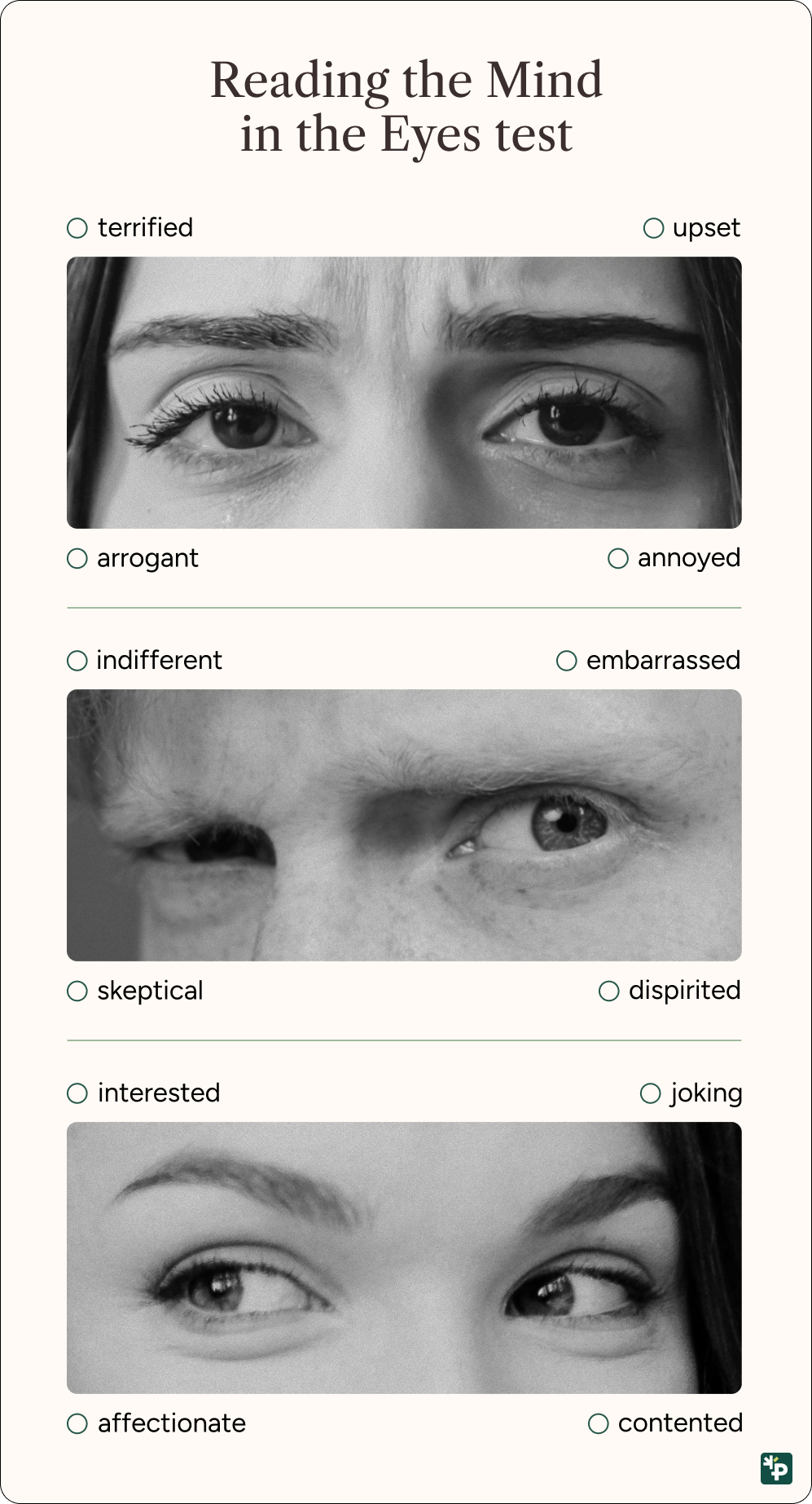
The Reading the Mind in the Eyes Test is a 36-question assessment, now taken online, that purportedly measures how well you recognize another person’s state of mind.
This test, developed by clinical psychologist Simon Baron Cohen (who also created the AQ test) in 1997, consists of 36 cropped, black and white images of human eyes. In each instance, four word choices are provided (Example: “terrified,” “upset,” “arrogant,” “annoyed”). The test-taker selects the correct mood descriptor just by judging the eyes.
Baron Cohen is measuring the theory of mind through this test, which is the idea that we can determine someone’s beliefs, desires, and knowledge through our own reasoning. The key to this theory is the understanding that other people have thoughts, beliefs, emotions, etc. that may be different from our own.
This understanding is an important social skill, because it helps us to show empathy and navigate relationships. For example, if someone notices a friend suddenly becoming quiet and withdrawn, they may infer that the friend is upset, overwhelmed, or wants space, even if the friend hasn’t said so directly.
What’s important to remember is that the theory of mind does not promote the idea that we can read minds. Nor does it suggest that autistic people don’t have empathy. We can use an intuitive understanding of how people think to try reading emotions through the eyes, but that doesn’t mean our intuition will always be accurate.
Why do people take it?
Since the RMET isn’t a diagnostic test and may not even accurately measure your social perception, why bother taking it in the first place?
Some people may wish to take the Reading the Mind in the Eyes Test because they’re curious: “Most people find the test because they are trying to understand themselves,” says Dr. Rachel Loftin, Chief Clinical Officer at Prosper Health. “They may have heard it is connected to autism, through psychology content online or social media. There is a strong pull toward quick, self-guided insight, and this test feels simple and authoritative on the surface.”
If anything, observes Dr. Loftin, taking the RMET can be a low-stakes first step in understanding certain differences in how one relates to others—especially if you’re not ready for a formal autism evaluation. In other words, if you’re in the early stages of exploring how well you interpret social cues and facial expressions, it can be a potentially informative exercise, just don’t take it too seriously.
What it’s like to take the test (and why it can feel confusing)
Even though the RMET itself is pretty straightforward, determining your answer can be confusing (it certainly was when I took the test). You’re given 36 images of cropped eyes, with four descriptor options provided for each, but there are several reasons why you may get frustrated:
- You may feel like you’re guessing the correct answer
- In some cases, multiple answers can seem like the correct one
- Certain words may be unfamiliar to some people
The ambiguity of the answer choices is particularly confounding, as in item #4, where the choices are: “joking,” “amused,” “insisting,” and “relaxed.” What exactly does “insisting” even mean? And what is the difference between “joking” and “amused”?
Item #4 also encapsulates the issue of how multiple answers can feel “correct”: Both “joking” and “amused” are similar enough that each one can come off as “correct.” Another example is Item #7, where the options are “apologetic,” “friendly,” “uneasy,” or “dispirited.” Three out of those four choices have sad overtones, suggesting that any one of them could be the “correct” answer.
What the Eyes Test actually measures (and what it doesn’t)
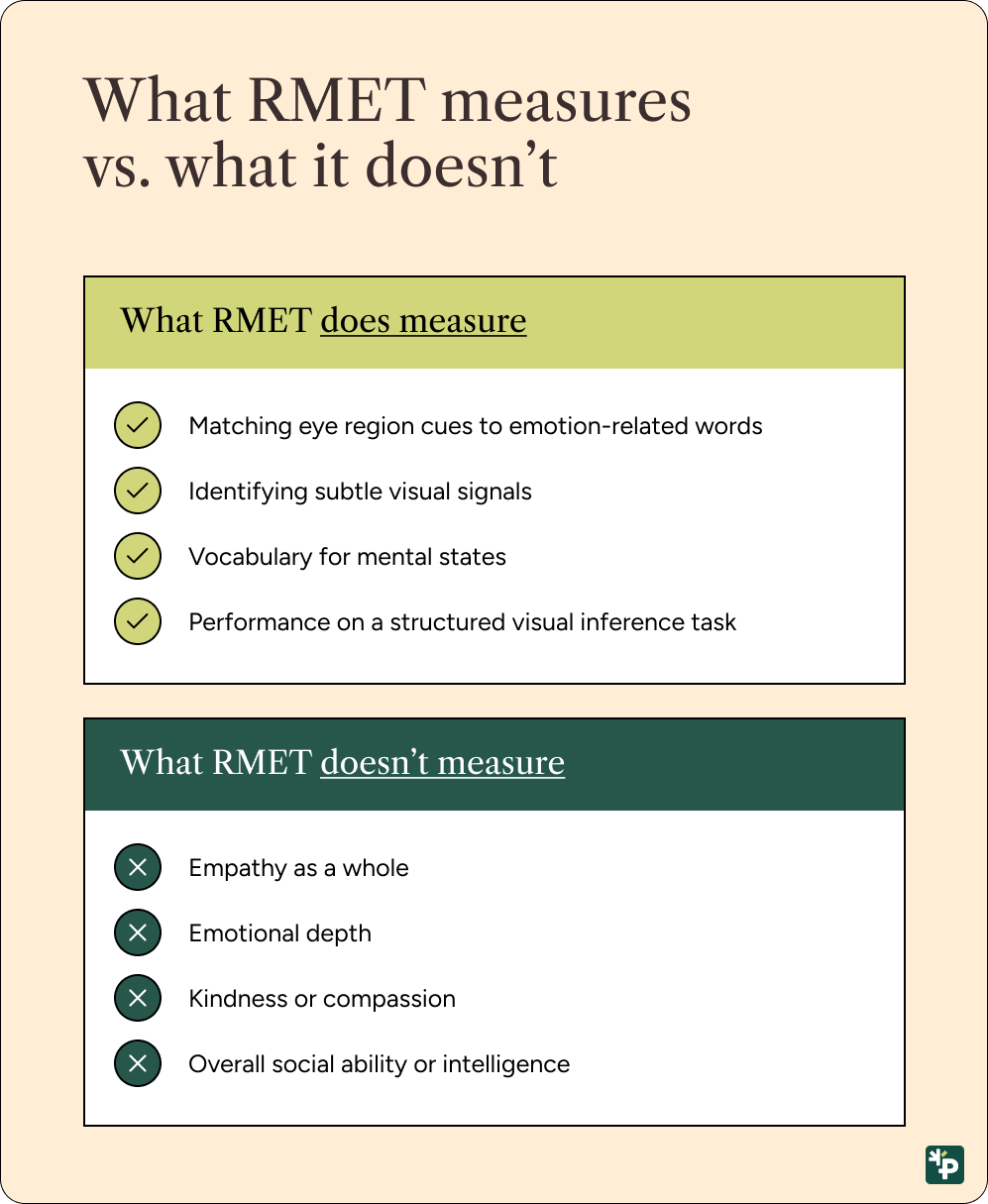
The Reading the Mind in the Eyes Test measures how well someone matches subtle visual cues to emotion-related words. Since this test focuses on a very specific skill—interpreting subtle facial cues from the eye region—Dr. Loftin says that this narrow focus can be useful in a research context.
In addition, she says, the Eyes Test may be beneficial because it “can sometimes spark reflection. People may notice how they approach interpreting emotions or how confident they feel making those judgments.”
While she notes there is a “broader trend” of people trying to quantify empathy, emotional depth, or social ability, it’s critical to remember that the RMET does not measure any of those traits. Nor is it an “empathy quiz” or an emotion detection tool.
For example, the “correct” answer to Item #24 is “pensive.” But just because someone is familiar with the word and can identify it in this context doesn’t mean they can actually understand someone’s feelings in a real-life scenario.
“[Real-world] social understanding is contextual, relational, and dynamic,” says Dr. Loftin. “This test is static and decontextualized.” In other words, empathy and social perception can’t be—and shouldn’t be—reduced to 36 sets of eyes on a screen.
Why the Eyes Test is linked to autism
Some behavioral studies have shown that autistic people may interpret emotional or social cues differently in tasks focused on facial expressions alone. In addition, research shows that autistic people, on average, score lower on the RMET than neurotypical people.
Dr. Loftin acknowledges that “there is a historical link to autism research,” while reiterating that the RMET is not a diagnostic tool. “It was used in early studies to explore differences in social cognition,” she continues, “but diagnosis relies on comprehensive clinical assessment.”
Other reasons why the Eyes Test is unfairly linked to autism include the now-outdated historical framing of autism as “mindblindness.” Mindblindness was once used to describe deficits in the theory of the mind, and to label autistic people as lacking empathy. The “mindblindness” framework is now heavily criticized for oversimplifying autistic social experiences and wrongly equating different communication styles with a lack of empathy.
But autism and empathy aren’t mutually exclusive; it’s just that autistic people’s social and emotional differences have been misinterpreted for decades as deficits. These differences manifest in the RMET too: While neurotypical people tend to arrive at their answers through intuition, some autistic people take an analytical approach, looking for patterns or rules, or using a process of elimination.
That analytical approach isn’t “wrong.” It’s just different.
Research findings on RMET performance are mixed, and differences are often small, context-dependent, and influenced by factors like language ability, anxiety, cultural familiarity, and test-taking strategy.
A neurodivergent-affirming perspective
While continued research is vital for understanding autism, the Reading the Mind in the Eyes Test is, if at all, merely one potential portal into someone’s social perception.
Singular tests like the RMET, which have a very narrow focus, can clash with some autistic people because there is such a wide variability within the autism spectrum. It may be difficult for certain autistic people to arrive at the “correct” answers because they often read context differently than neurotypical people and rely less on facial micro-cues.
Also adding to these challenges is the double empathy problem, where emotional misunderstanding occurs between both autistic people (who are quite capable of empathy, but just demonstrate it differently) and neurotypical people (who also have empathy, but are having trouble understanding how autistic people express theirs).
An autism diagnosis—or even identification—comes from multiple factors: “Autism evaluations look at developmental history, lived experience, patterns across contexts, and clinician observation,” says Dr. Loftin. “A single task [like the RMET] cannot capture that complexity.”
Limitations and criticisms of the Eyes Test
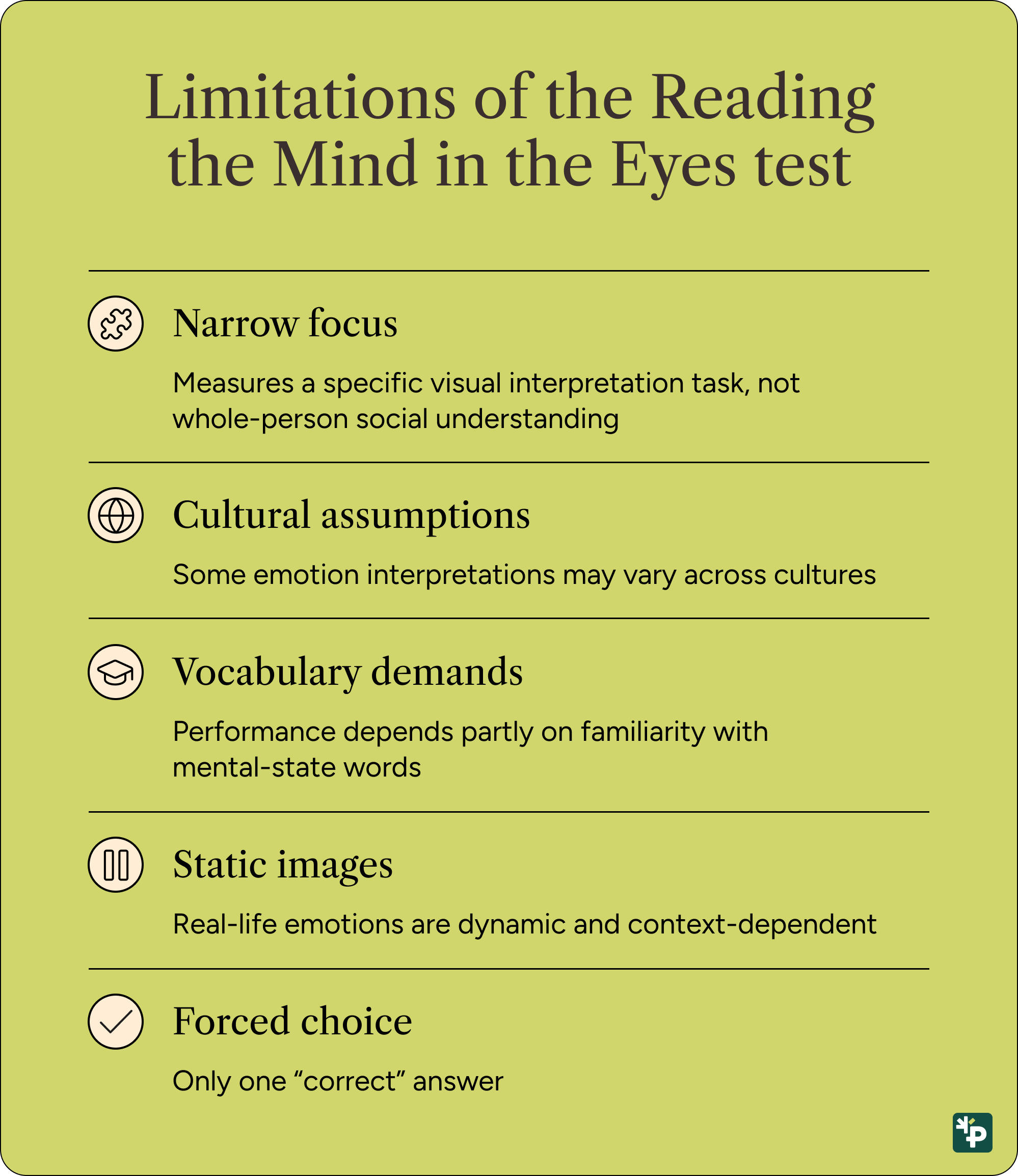
Even though the Reading the Mind in the Eyes Test intends to measure someone’s social perception, it only studies one specific skill: reading facial expressions. This, ultimately, is its biggest limitation.
“[The Reading the Eyes in the Mind Test] measures a very narrow slice of social perception and then gets treated as something much broader,’ observes Dr. Loftin.
Other elements of the Eyes Test that limit its reliability are, according to Dr. Loftin:
- Vocabulary demands: “Success” on the RMET depends heavily on one's vocabulary knowledge and familiarity with specific emotion words.
- Cultural assumptions: The test, which primarily features white, Western faces, limits how broadly its results can be applied across different populations. It also reflects a largely Western framing of what it means to “read” someone. Meaning, the test assumes there is one correct interpretation of a facial expression. This, however, is not how human communication works.
- Multiple-choice structure: The multiple-choice format may reward vocabulary knowledge and test-taking strategy as much as spontaneous interpretation.
- Unfair burdens on the test-taker: The RMET doesn’t account for the fact that social understanding is reciprocal. Misunderstanding is often mutual across both neurodivergent and neurotypical people (e.g., the double empathy problem). The onus is entirely on the person being evaluated.
“In short,” says Dr. Loftin. “[The Eyes Test] is not a good proxy for how someone actually understands other people in real life.”
Should you take the Eyes Test?
If you’re trying to figure out whether or not you might be autistic, then, no, the Eyes Test is not recommended. “It is too limited and too easy to misinterpret,” cautions Dr. Loftin. Instead, you’ll want to find someone qualified to diagnose autism in adults.
But for those interested in psychology, or those who just want to see how these kinds of tests work, taking the RMET test can’t hurt. “It can also be useful in an educational setting to illustrate how researchers operationalize social perception,” notes Dr. Loftin, “but this use should be framed carefully.” A good rule of thumb for approaching the Eyes Test is to ask yourself if you’re merely curious about the test—or if you’re trying to self-diagnose autism. If the answer is the latter, then you’ll want to seek out other options, because the Eyes Test is a research screener, not a diagnosis tool.
How scoring works
The total possible score in the Reading the Mind in the Eyes Test is 36. Your score is based on three factors, but research studies sometimes report group-level average differences between autistic and non-autistic participants. In addition, there is substantial overlap between groups, and individual scores are not clinically meaningful.
The three factors are as follows:
- The time it takes you to complete the test: Neurotypical people take, on average, 2 to 3 minutes; autistic people take, on average, 3 minutes or more.
- The number of correct items: Neurotypical people score, on average, between 23 and 30; autistic people score, on average, 22 or less.
- Your test-taking process: Neurotypical people use, on average, an intuitive process, while some autistic people use, on average, a systematic approach (guessing, process of elimination, or knowledge of facial expressions).
Regardless of the RMET’s structure, keep in mind that there can be overlaps between the “typical” neurodivergent and neurotypical scores. And above all, there is no “score” that can tell you whether or not you are autistic, because this is not a diagnostic test.
What your score actually means
A healthy way to look at your score on the Reading the Mind in the Eyes Test is as a single data point, not as a conclusion about your social perception or whether or not you might be autistic.
Many autistic people build deep, emotionally attuned relationships in everyday life, even if they approach facial-expression tasks differently from non-autistic people.
“The most important thing to understand is that this test measures performance on a very specific task,” reassures Dr. Loftin, “not your capacity for empathy or your ability to connect with others.”
Therefore, a lower score shouldn’t be interpreted as a “deficit in understanding people,” she continues. “It is just one narrow data point, and often not a very meaningful one outside of research contexts.”
What to do if the test raised questions
But let’s say you’ve taken the RMET, and instead of understanding yourself better, you now have more questions: “Could I be autistic?” “Do I have weak social skills?” “Am I not empathetic?”
If you’re even more confused after taking the Eyes Test, Dr. Loftin advises, as a first step, not taking more online tests. “The right move is to zoom out,” she says.
Next, she recommends reflecting on lifelong patterns—not just isolated traits from a narrowly focused test. You know yourself better than any online test, so trust your instincts. To learn more about autism, start with high-quality, evidence-based resources, and consider speaking with a clinician who specializes in adult autism.
“A thoughtful diagnostic process is far more informative than any single score,” says Dr. Loftin.
How Prosper Health can help
Taking an online quiz like the Reading the Mind in the Eyes test may offer some perspective about a particular social skill, but its limited scope can leave you with more questions than answers. This is because the test tries to simplify social perception, which is an incredibly complex beast.
“People vary widely in how they perceive and interpret faces,” notes Dr. Loftin. “Some differences show up at the level of perception, what you notice and attend to, and others at the level of interpretation, how you assign meaning. The Reading the Mind in the Eyes test collapses both into a single score, which is part of the problem.”
If you’re still looking for neurodiversity-affirming guidance after taking the RMET, Prosper Health is here to help. We offer evidence-based resources through our website, as well as virtual autism assessments and therapy for adults. Plus, our services are covered by insurance, making care more affordable.
Frequently asked questions (FAQs)
What is a good score on Reading the Mind in the Eyes Test?
Since the RMET measures a particular skill, there is no such thing as a “good” or “bad” score. A perfect score is 36, and neurotypical adults tend to score between 23 and 30 on average. Autistic adults, on average, tend to score 22 or lower. The most important thing to remember is that a low score doesn't determine an autism diagnosis, and a high score doesn’t necessarily rule one out.
What does Reading the Mind in the Eyes Test measure?
This test measures how a person interprets subtle facial cues from the eye region to determine how well they match these visual cues to emotion-related words. The Reading the Mind in the Eyes Test does not, however, measure empathy, emotional depth, or social ability.
Does the Eyes Test diagnose autism?
No, the Eyes Test does not diagnose autism. An autism diagnosis requires a formal evaluation (conducted by a qualified professional) that examines developmental history, lived experience, patterns across contexts, and clinician observation.
Why do some answers feel equally correct?
One reason the RMET can feel confusing and frustrating is that some word options are quite similar (“joking” vs. “amused”). If someone doesn’t know or understand the subtle differences between certain descriptors—which is not a failing—they run the risk of being penalized.
Sources
https://www.prosperhealth.io/test
https://www.prosperhealth.io/test/the-autism-spectrum-quotient-test
https://www.prosperhealth.io/test/the-raads-r
https://www.prosperhealth.io/blog/adult-autism-signs
https://embrace-autism.com/reading-the-mind-in-the-eyes-test/
https://www.autism.org.uk/advice-and-guidance/about-autism/autism-and-communication
https://pmc.ncbi.nlm.nih.gov/articles/PMC7540806/
https://sll.stanford.edu/tom.html
https://helpfulprofessor.com/theory-of-mind-examples/
https://www.simplypsychology.org/theory-of-mind.html
https://www.thetransmitter.org/spectrum/its-past-time-to-stop-using-the-reading-the-mind-in-the-eyes-test/
https://sachscenter.com/reading-mind-eyes-test/
https://pmc.ncbi.nlm.nih.gov/articles/PMC4976760/
https://pmc.ncbi.nlm.nih.gov/articles/PMC5506186/
https://www.parents.com/what-is-mind-blindness-7509876
https://pmc.ncbi.nlm.nih.gov/articles/PMC3420794/
https://pmc.ncbi.nlm.nih.gov/articles/PMC4975602/
https://www.prosperhealth.io/blog/who-can-diagnose-autism-in-adults
https://www.prosperhealth.io/blog/autism-and-empathy


