


Key Takeaways
- Justice sensitivity describes individual differences in how people perceive unfairness and how strongly they respond to it emotionally, cognitively, and behaviorally.
- While not exclusive to neurodivergent people, justice sensitivity is often amplified in autistic and ADHD adults by traits like emotional dysregulation, difficulty shifting attention, and a strong adherence to rules or expectations.
- Researchers categorize justice sensitivity into four types based on a person's relationship to the injustice: victim sensitivity, observer sensitivity, beneficiary sensitivity, and perpetrator sensitivity.
- Justice sensitivity is not a personal failing. This trait reflects empathy, ethical clarity, and powerful advocacy, though neurodiversity-affirming support can help prevent exhaustion, rumination, and burnout.
Wendy Brown is an autistic woman with ADHD who runs Chronically Humored, an online community where chronic illness, neurodivergence, mental health, and disability advocacy converge.
She also has a very strong sense of justice.
“When I see someone being mistreated, I often feel compelled to speak up, even when the situation has absolutely nothing to do with me,” she says. “And when I can’t do anything about it, it haunts me.”
Even though she understands that she can’t “right every wrong in the world,” she also notes that “nobody has passed that information along to my nervous system.”
This profound reaction to injustice is not an overreaction. In fact, it’s a documented pattern with a name — justice sensitivity.
Justice sensitivity isn’t the same as generally caring about fairness — though they both hold equal value. These feelings come with an intensity and frequency for some neurodivergent people, and they’re not inherently wrong.
This article will cover how justice sensitivity shows up somewhat differently for people with autism and for people with ADHD, as well as how it presents in people who identify as AuDHD. In addition, this article will help readers understand what justice sensitivity is, recognize its four main forms, and adopt concrete strategies for managing this trait without completely suppressing it.
What is justice sensitivity?
Justice sensitivity is a psychological trait describing individual differences in how readily people perceive unfairness and how strongly they respond to it emotionally, cognitively, and behaviorally.
Not only does justice sensitivity describe a “stronger emotional response to perceived unfairness or injustice,” explains Jacqueline Shinall, Psy.D., a clinical psychologist with Prosper Health, but it also “may be particularly difficult to ignore, let go of, or move on from what happened.”
Instead of acknowledging the injustice and moving on, “someone may continue thinking about the situation long after it is over, feel a strong need to correct it, or experience significant frustration or distress when they are unable to do so,” says Dr. Shinall.
According to a 2022 German study published in Frontiers in Psychology, a justice sensitivity reaction is specific enough that it can present through a four-part process, with these parts corresponding to both Dr. Shinall’s and Brown’s descriptions of the trait. (Note that this is the sequence of a reaction, not the four main types of injustice sensitivity we will cover later in the article.)
- Noticing the injustice: A person will notice that something unfair has happened
- Emotional reaction: The person will exhibit anger, distress, guilt, or any other relevant emotion
- Rumination: Considered the primary cognitive response, the person will then dwell on the injustice, unable to let it go
- Motivation: The person will feel an insatiable drive to correct the injustice, with either perpetrator punishment and/or victim compensation considered justice insensitivity’s primary behavioral response
Although this article will focus on justice sensitivity and how it relates to autistic and ADHD individuals, this trait does exist on a spectrum and is not exclusive to neurodivergent people.
Why is justice sensitivity more common in autistic and ADHD adults?
It may feel like justice sensitivity is more common in autistic and ADHD adults, but that’s not necessarily the case.
“Justice sensitivity is commonly discussed by autistic and ADHD adults,” explains Dr. Shinall, “but we still have a lot to learn about exactly how and why it relates to neurodivergence.”
In other words, the research is still pretty limited: Some studies show heightened justice sensitivity among people with ADHD, but Dr. Shinall advises caution when differentiating between autism and justice sensitivity and ADHD and justice sensitivity.
“We do not yet have enough research to say that each has its own distinct pattern,” she says.
For ADHD adults
Two studies, one published in European Child and Adolescent Psychiatry in 2014, and another in the Journal of Attention Disorders in 2015, suggest that people with ADHD do exhibit more “pronounced” justice sensitivity.
So yes, from a clinical standpoint, certain ADHD traits like emotional dysregulation or challenges shifting attention away from something “may make an experience of unfairness especially difficult to move past,” says Dr. Shinall. But she warns against assuming that this is something that every person with ADHD experiences.
“Most people can recognize that something is unfair, feel appropriately upset about it, and eventually go about their day,” says Brown of what justice insensitivity can feel like as a person with ADHD (and autism). “For me, there’s not always an off switch. I can know that something is completely outside my control and still find myself thinking about it hours or even days later.”
For autistic adults
Even though some people, like Brown, may feel a connection between their strong sense of justice and autism thanks to their solid anecdotal experience, autism studies using formal justice-sensitivity measures remain scarce.
However, in autism, research on moral reasoning and decision-making shows a stronger emphasis on fairness and following moral rules, and autistic adults commonly report this experience. While one 2024 study published in Molecular Autism concluded that moral foundations are “not radically different in autistic people,” it also found that autistic people have a preference for “fairness” over “care.”
“It’s not that I believe I have a stronger moral compass than everyone else,” acknowledges Brown. “I don’t think being neurodivergent makes someone inherently more ethical. It’s that the emotional response can feel disproportionate to my actual involvement in the situation.”
Dr. Shinall notes that for some autistic people, “an injustice might be particularly difficult because it violates an important rule or expectation.” Or, certain individuals with a “strong preference for consistency may also make an experience of unfairness especially difficult to move past.” But she simultaneously emphasizes, “We should be careful not to assume that every autistic person experiences this.”
For some autistic adults, social-communication differences may negatively impact their experiences with justice insensitivity as well. Brown shares that she’s “often been misunderstood or judged for being blunt and direct, particularly when I’m speaking up about something I believe is unfair.” Instead of the focus being on her advocacy, others sometimes (mistakenly) interpret her fervor as “being difficult, argumentative, or confrontational.” This, she says, “can make injustice even more frustrating,” because the conversation shifts away from the actual problem and onto your tone.”
Quick note for readers who identify as AuDHD: Although Dr. Shinall acknowledges that “someone who is both autistic and has ADHD may experience some combination of [autism and ADHD-related justice sensitivity reactions], there is tremendous individual variation.”
The more useful question, she says, isn’t so much “which diagnosis is causing the reaction, but what is making this particular situation so difficult for that person to process or let go of.”
The four types of justice sensitivity
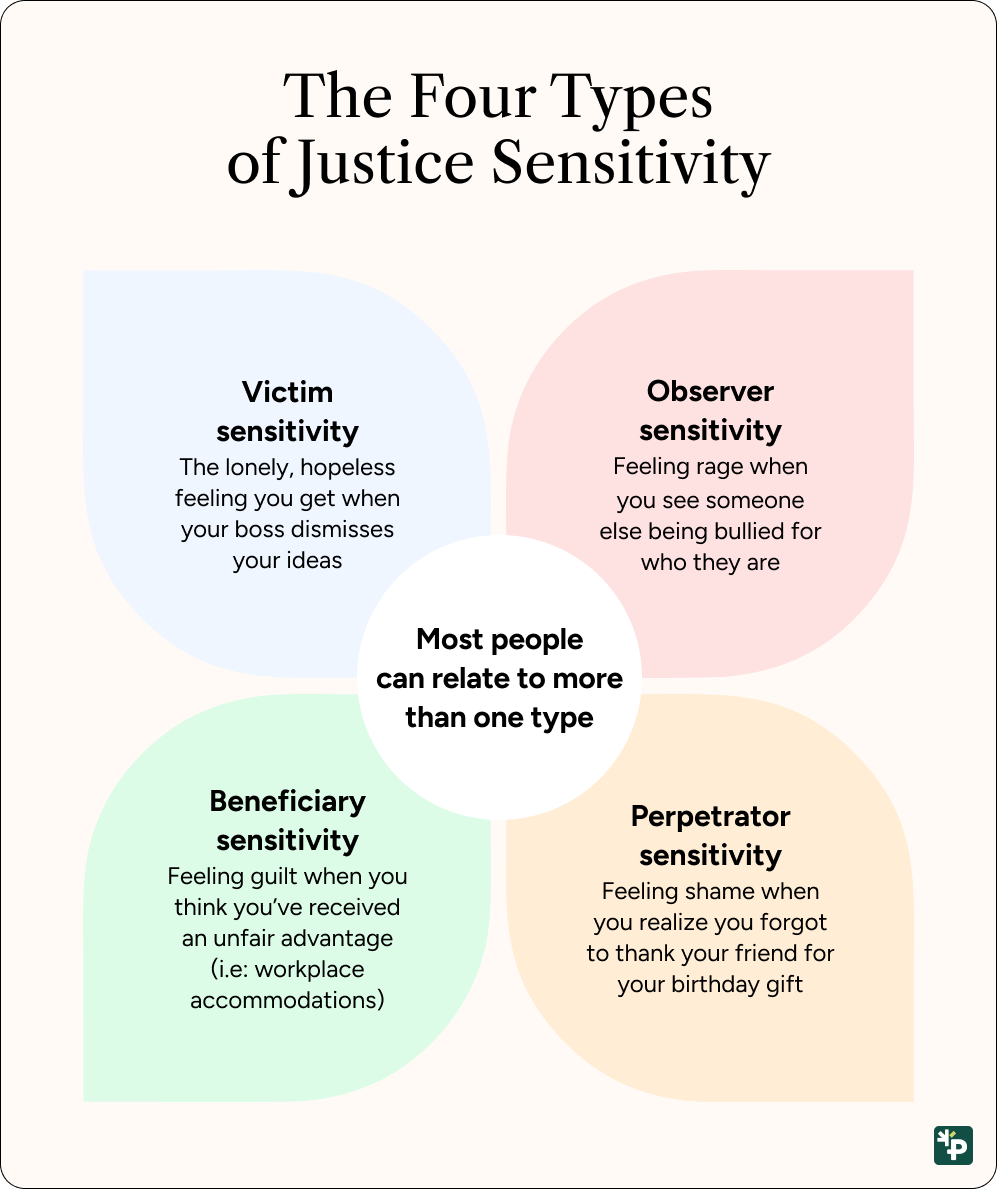
Researchers have identified four distinct types of justice sensitivity, based on the person’s connection to the injustice. Keep in mind that these types aren’t mutually exclusive, as it’s possible to recognize yourself in more than one.
Victim sensitivity
Description: An individual experiences distress from directly being treated unfairly.
Example: An autistic adult isn’t included in an after-hours workplace get-together. Whether this was accidental or intentional, this may cause them to ruminate over this perceived slight for several days and possibly feel even more isolated.
Observer sensitivity
Description: An individual feels a heightened reaction to witnessing someone else being treated unfairly.
Example: Witnessing someone being mistreated either in real life or on social media. Brown says what affects her the most when this occurs is the “imbalance of power.” Watching someone “be dismissed, discriminated against, or denied basic dignity can stay with me long after the moment has passed,” she shares.
Beneficiary sensitivity
Description: An individual feels discomfort or guilt over unfairly benefiting from an opportunity denied to others.
Example: A neurodivergent adult received an accommodation at work for noise-canceling headphones. But they feel guilty that they can block out ambient noise now, and most of their coworkers still can’t.
Perpetrator sensitivity
Description: An individual feels guilt or shame over having wronged someone else, even if it was unintentional.
Example: The flip side of the “victim sensitivity” example could be the workplace get-together organizer realizing they accidentally forgot to include their colleague. After ruminating over this faux pas for a couple of days, they profusely apologize and offer to buy the colleague lunch.
Justice sensitivity may feel exhausting and challenging, but don’t forget that this trait contains some real strengths like empathy, ethical clarity, and a drive to advocate for the neurodivergent community.
“I wish more people understood that being direct about an injustice doesn’t automatically make someone aggressive or unreasonable,” says Brown. “Sometimes the problem isn’t how loudly someone is pointing out what’s wrong. Sometimes the problem is that nobody was listening until they did.”
When justice sensitivity becomes dysregulating
Justice sensitivity itself isn’t the problem, but without adequate support, some autistic and ADHD adults may tip into exhausting and/or harmful patterns.
“There’s a real emotional cost to caring so deeply,” says Brown. “It can be exhausting to live in a world where you’re constantly aware of things that aren’t fair, especially when you know you can’t fix most of them.”
Below, we explore four common response patterns to injustice, with Dr. Shinall unpacking how certain scenarios might trigger one of these patterns. Remember these patterns can vary, and that your justice sensitivity response is not a personal failing or a sign of being “too much.”
Rage or shutdown: A workplace situation where someone receives credit for another person’s work, witnessing discrimination, or seeing someone break a rule without consequences can either potentially trigger rage in someone who is autistic and/or has ADHD — or cause someone to shut down, or withdraw.
Rumination/fixation: Dr. Shinall notes that any of the above injustices (discrimination, rule-breaking without consequences, etc.) can also trigger a rumination/fixation response in people who are autistic and/or have ADHD. “One person might become extremely angry or overwhelmed and need to withdraw, while someone else might replay the situation repeatedly, research it for hours, feel unable to focus on anything else, or feel an urgent responsibility to do something about it.”
Compulsive advocacy: Although advocacy itself is not a problem, the inability to disengage may lead to burnout, especially if your desire to fix every injustice significantly affects your sleep, relationships, work, or well-being.
Doomscrolling: Repeatedly seeking out injustice-related content may begin as a desire to stay informed, but doomscrolling usually has little return on investment. Eventually, you’re likely to find yourself consuming more and more upsetting information without feeling any more prepared or empowered to act.
Managing justice sensitivity
When we talk about “managing” justice sensitivity, we don’t mean becoming easier for others to tolerate. “Caring deeply about fairness is not something that needs to be treated or changed,” assures Dr. Shinall. “It can be a tremendous strength and can motivate people to advocate for themselves and others.”
Instead, the strategies below focus on protecting your energy and wellbeing — and helping you be a more productive advocate.
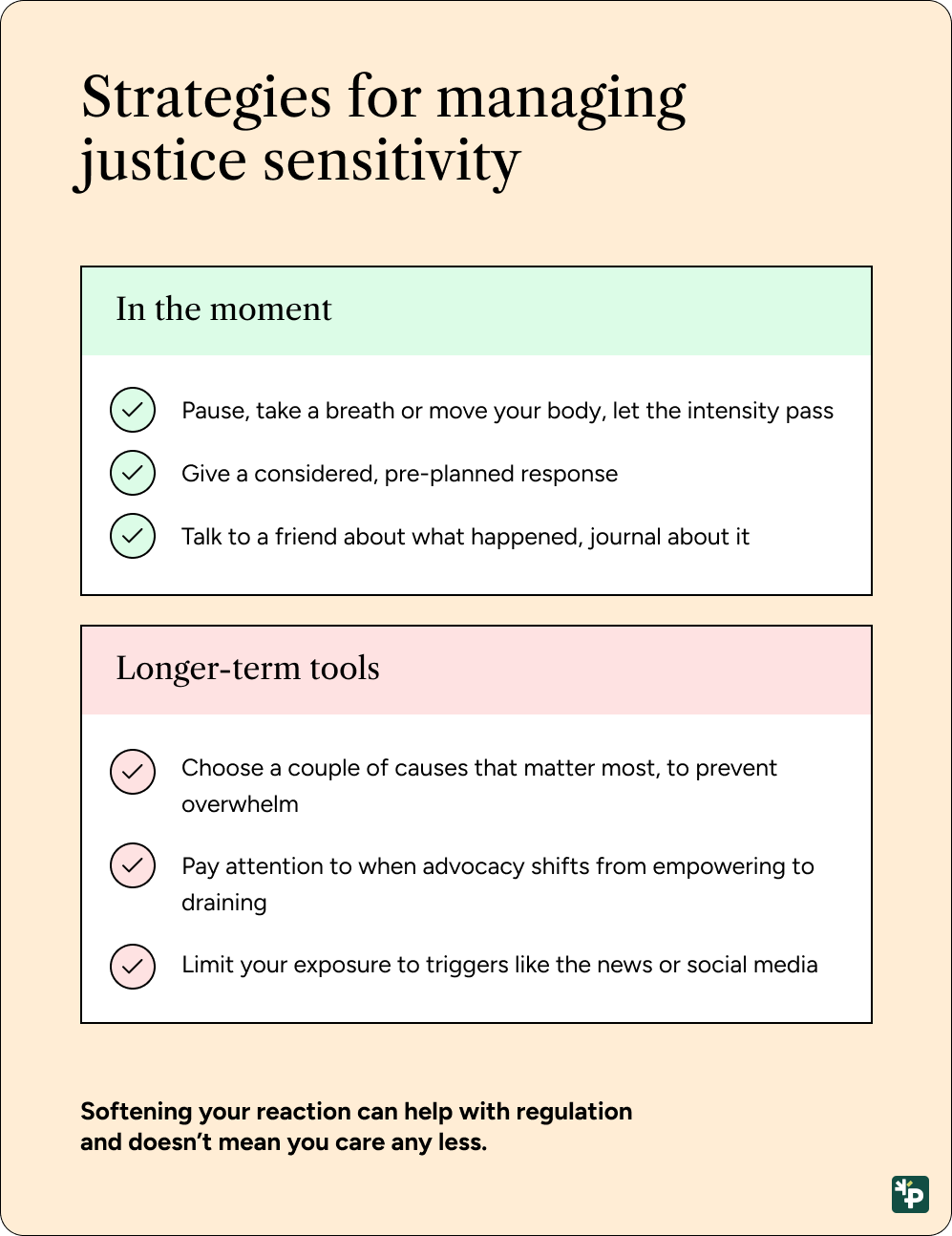
In-the-moment tools
“The first step may simply be recognizing that you are activated and giving yourself some space before deciding what, if anything, you want to do,” advises Dr. Shinall. This can begin with:
A brief pause practice before reacting: As you process what happened, she recommends the following action steps:
- Stepping away from social media
- Writing down what happened
- Moving your body
- Talking with someone you trust
The next strategy can be:
Interrogating the reaction before acting on it: This can look like “waiting until the intensity has come down,” says Dr. Shinall, which “can make it easier to decide how you actually want to respond.”
Finally:
Have pre-planned language ready: This way, you’re not trying to compose an articulate response from scratch under stress. In the moment, keep it simple, like, “That’s not fair” or “I don’t think you’re working with all the facts.”
Longer-term tools
The goal here is more control and less overwhelm. So in the longer term, Dr. Shinall recommends trying to “distinguish between what you care deeply about and what you personally have the ability or responsibility to change.” That begins with:
Creating structured, limited channels for advocacy: Dr. Shinall advises choosing specific causes where you want to direct your energy, instead of trying to advocate for injustice 24/7.
Reducing regular exposure to injustice-related content online and in real life: In addition to setting limits on news and social media, stay attuned to your physical and mental health while standing up to injustice.
“Recognizing when advocacy is becoming exhausting rather than productive can allow you to stay connected to your values without feeling responsible for fixing every unfair thing you encounter,” says Dr. Shinall.
She continues: “You do not have to stop caring about injustice in order to protect your own well-being.”
Getting more support with justice sensitivity
Even though justice sensitivity is a trait that does not need to be eliminated, some people with autism and a sense of justice may still need extra support.
Dr. Shinall recommends seeking help when the “intensity of these reactions is causing significant distress or making it difficult to sleep, work, maintain relationships, or disengage from upsetting situations.”
Neurodiversity-affirming therapy, which is available through Prosper Health, along with telehealth autism evaluations, “can help someone understand what tends to activate these reactions,” says Dr. Shinall. Through therapy, she continues, neurodivergent adults can “develop ways to regulate the emotional intensity without asking them to become less compassionate or care less about the things that matter to them.”
“Support should focus less on teaching neurodivergent people to be quieter or more agreeable and more on helping us manage that emotional toll,” echoes Brown. “There’s a difference between learning to regulate your emotions and being expected to tolerate mistreatment.”
The bottom line
Justice sensitivity may feel exhausting for some autistic and ADHD adults, but at the same time, this trait can provide strength and motivation to become a productive advocate.
By adopting strategies that support your physical and mental health, you can maintain your sense of justice and prevent overwhelm and burnout.
Frequently asked questions (FAQs)
Can you have justice sensitivity without ADHD or autism?
Yes, you can have justice sensitivity without ADHD because justice sensitivity affects both neurotypical and neurodivergent people. While autistic and ADHD adults may discuss justice sensitivity more regularly, the research connecting this trait to autism and ADHD is still limited.
Is there a test to measure justice sensitivity?
Yes, the Justice Sensitivity Short Scales-8 (JSS-8), which originated in German (but is available in an English translation), can measure four different types of justice sensitivity (victim, observer, beneficiary, or perpetrator). This test has proved useful in research settings, helping to identify patterns in how someone reacts to injustice.
Is justice sensitivity linked to anxiety?
Justice sensitivity may be linked to anxiety: A 2020 study of 904 participants published in the Journal of Affective Disorders found a connection between justice sensitivity and anxiety. The study also suggested that justice sensitivity may be a “stress factor” that may add to both “developing” and “maintaining” anxiety symptoms. Therefore, experts recommend that autistic and ADHD adults who experience justice sensitivity adopt strategies for preserving their physical and mental health.
How do I explain justice sensitivity to a partner or family member who doesn't experience it this way?
One way to explain justice sensitivity to others is to frame it as a difference, not a deficit. Having this trait doesn’t necessarily mean someone has a stronger moral compass than others. What it may mean, however, is that they have a stronger emotional response to unfairness, and those feelings might linger longer after others have moved on.
Sources
https://pmc.ncbi.nlm.nih.gov/articles/PMC8967910/
https://www.prosperhealth.io/blog/what-is-audhdhttps://pubmed.ncbi.nlm.nih.gov/24878677/
https://pmc.ncbi.nlm.nih.gov/articles/PMC9399749/
https://pubmed.ncbi.nlm.nih.gov/24878677/
https://pubmed.ncbi.nlm.nih.gov/23223013/
https://www.jneurosci.org/content/41/8/1699https://pmc.ncbi.nlm.nih.gov/articles/PMC11092219/
https://www.prosperhealth.io/blog/autism-and-relationships
https://link.springer.com/article/10.1007/s11211-021-00378-9
https://pmc.ncbi.nlm.nih.gov/articles/PMC10486169/
https://pmc.ncbi.nlm.nih.gov/articles/PMC4884733/
https://www.prosperhealth.io/blog/how-to-deal-with-autism-anger-in-adults
https://pmc.ncbi.nlm.nih.gov/articles/PMC9160326/
https://www.prosperhealth.io/blog/autism-meltdowns
https://pmc.ncbi.nlm.nih.gov/articles/PMC8419022/
https://pmc.ncbi.nlm.nih.gov/articles/PMC7047632/
https://www.prosperhealth.io/blog/autistic-burnout
https://www.prosperhealth.io/therapyhttps://pmc.ncbi.nlm.nih.gov/articles/PMC10627457/
https://pubmed.ncbi.nlm.nih.gov/32553359/


