


Key Takeaways
- Eye contact can be challenging for some autistic people due to documented differences in brain activity and stress responses, not rudeness or indifference to what someone else is saying.
- Some autistic adults may consciously maintain eye contact as part of their masking strategies, but this prolonged effort can lead to exhaustion or discomfort.
- Autism-related eye contact discomfort and social anxiety-related eye contact avoidance can look similar, but autistic eye contact patterns tend to be more prolonged, consisting of either complete avoidance or steady, intense attention.
- Forcing eye contact likely increases anxiety without improving communication. More effective approaches include alternative-gaze strategies (like looking at the eyebrows or nose) and environmental adjustments (like sitting at an angle).
- Short, prepared responses can help autistic individuals explain their communication style without apology while affirming that they are fully engaged in the conversation.
In elementary school, a girl would imitate me by looking up whenever she talked. I didn’t get it at first, but eventually I realized she was mocking me for not making eye contact.
When I became an adult, I had a therapist who always followed my face during our sessions, desperately trying to meet my eyes where they were — because they seldom landed on her own.
Many people have varying levels of comfort with making eye contact. I have social anxiety, so I know how awkward it can feel to be told, “Hey, eyes on me!” For some autistic people, the experience of forcing eye contact can be especially intense, quickly going from discomfort to overwhelm.
And some late-identifying autistic adults may be in the process of reconciling the childhood pressure to make eye contact while acknowledging that it never felt natural to do so.
All of these feelings are completely valid: Any kind of unease with eye contact is a real, physiological response. It is not a character flaw or a communication failure on your part.
So, why do some people with autism avoid eye contact?
After reading this article, you will have a better understanding of autism and eye contact: Specifically, why eye contact can feel so physically taxing for some autistic people, and that both avoidance and overcorrection are common autistic experiences. You’ll also learn concrete language and strategies for situations where eye contact is commonly expected.
Why does eye contact feel physically overwhelming for autistic people?
Eye contact discomfort in autistic people is linked to documented differences in brain activity. While various research-based explanations exist, the specific mechanism causing eye contact discomfort is still an active area of study. It’s also critical to remember that avoiding eye contact is not due to indifference or rudeness.
Threat/emotion response: A 2017 study published in Scientific Reports, co-authored by Nouchine Hadjikhani, MD, PhD, found that eye contact causes the subcortical system in autistic people to “abnormally” react not only to threat-related stimuli, but also to stimuli considered “positively engaging and socially rewarding.” The brain’s subcortical system plays a crucial role in emotional processing.
Reduced neural synchrony: Neural synchrony is the alignment of brainwave activity between individuals. A 2022 study conducted by researchers at Yale University, published in PLOS One, determined that during eye contact, this alignment is reduced between autistic and non-autistic people — much more so than it would be between two non-autistic people’s brains.
Involuntary response: Another 2017 study published in Scientific Reports found that differences in eye contact in autistic people suggest an involuntary, rather than conscious, response. Researchers noted that autistic people demonstrated different eye movement patterns than non-autistic people when presented with various stimuli — even when they were unaware they were looking at a face.
Though researchers don’t agree on the exact cause of autism eye contact discomfort yet, the existing evidence supports the idea that this is a real, physical response for some autistic people.
Masking can look like eye contact, too
Masking, or the hiding/suppression of autistic traits, can look like natural eye contact for some autistic people, because they’re consciously managing their social interactions.
So in cases like these, autism eye contact differences don’t necessarily present as avoidance, but rather some people may have more deliberate, prolonged eye contact.
“[Some autistic people] may remind themselves to look at someone, copy how other people use eye contact, deliberately look back at certain points in the conversation, or sometimes overcorrect and maintain eye contact longer than feels natural,” explains Amber Kovach, LCPC, LMHC, a licensed therapist with Prosper Health.
A 2024 study published in the Journal of Autism and Developmental Disorders, which interviewed nine autistic adults about eye contact, also found that masking-based, deliberate eye contact was not uncommon.
But this masking-based autistic eye contact can come at a cost. Kovach notes that some autistic people describe eye contact as “distracting, uncomfortable, or overwhelming.” Concentrating so much on where they are looking can make it challenging to “listen, process information, or formulate a response.”
Sustaining such high levels of conscious social monitoring, she says, “can also contribute to the exhaustion associated with masking,” which may lead to autistic burnout.
How is autism-related eye contact different from social anxiety?
As someone who avoids eye contact, I have often asked myself if it could be autism, or if my differences are based in social anxiety. You may be asking yourself the same question if you’re reading this article.
Both eye contact differences related to autism and social-anxiety related differences can “look very similar from the outside,” acknowledges Kovach, while also noting that people can experience both autism and social anxiety. And that “the reason behind the behavior matters more than simply noticing that someone looks away.”
Two studies, one published in 2017 in the Journal of Autism and Developmental Disorders, and another published in 2023 in Frontiers in Neuroscience, note the possibility of eye contact avoidance pattern differences between autistic people and people with social anxiety. These studies suggest that people with social anxiety are more likely to briefly make eye contact before looking away. Autistic people, however, are more likely to demonstrate more prolonged patterns: Either avoiding eye contact entirely or maintaining attention on the eyes without ever looking away.
In general terms, Kovach lays out some potential differences below, but these examples aren’t mutually exclusive:
Social anxiety: Avoiding eye contact may be more strongly connected to fear of being judged, embarrassed, or negatively evaluated.
Autism-related: Eye contact may instead feel distracting, overly intense, sensory-heavy, or interfere with processing what the other person is saying.
Note that this is a still-developing area of research: Both the data and Kovach’s examples are opportunities for reflection, not hard-and-fast rules about autism and eye contact vs. social anxiety.
Where the pressure to make eye contact often starts
This pressure often begins in childhood — especially in the United States and most Western cultures — when young people are taught that eye contact equals respect. (Note that such an emphasis on eye contact can vary in other cultures.)
Looking at someone means we are listening, paying attention, being respectful, or telling the truth.
But these social expectations can be challenging for an autistic child, says Kovach. Autistic children “may repeatedly hear things like, ‘Look at me when I’m talking to you,’ even if looking away actually helps them listen.”
If this sounds familiar to some readers, you’re not alone: In addition to being constantly told to look at the person speaking to you, you may have experienced formal, structured interventions that specifically target eye contact as a measurable behavior.
This overarching pressure, Kovach explains, can ultimately condition autistic children to the idea that “their natural way of communicating is being interpreted negatively.” That’s when they “begin consciously changing it to meet other people’s expectations.”
Does forcing eye contact actually help?
No, forcing eye contact does not help, even though it is a common masking technique for some autistic adults.
In their 2017 Scientific Reports study, Hadjikhani et al. noted that autistic individuals “often report” that making eye contact with others is “uncomfortable,” “terribly stressful,” or that “it burns” to do so.
In addition, Dr. Hadjikhani observed that “the findings indicate that forcing children with autism to look into the eyes in behavioral therapy may create a lot of anxiety for them.” As an alternative, Dr. Hadjikhani recommended a slow, more gradual approach to eye contact, which “may help them overcome this over-reaction.”
Since forced eye contact does little more than add discomfort and inauthenticity to a conversation, autistic adults may wish to consider more practical — and reasonable — social interaction strategies.
What can you do instead of forcing eye contact?
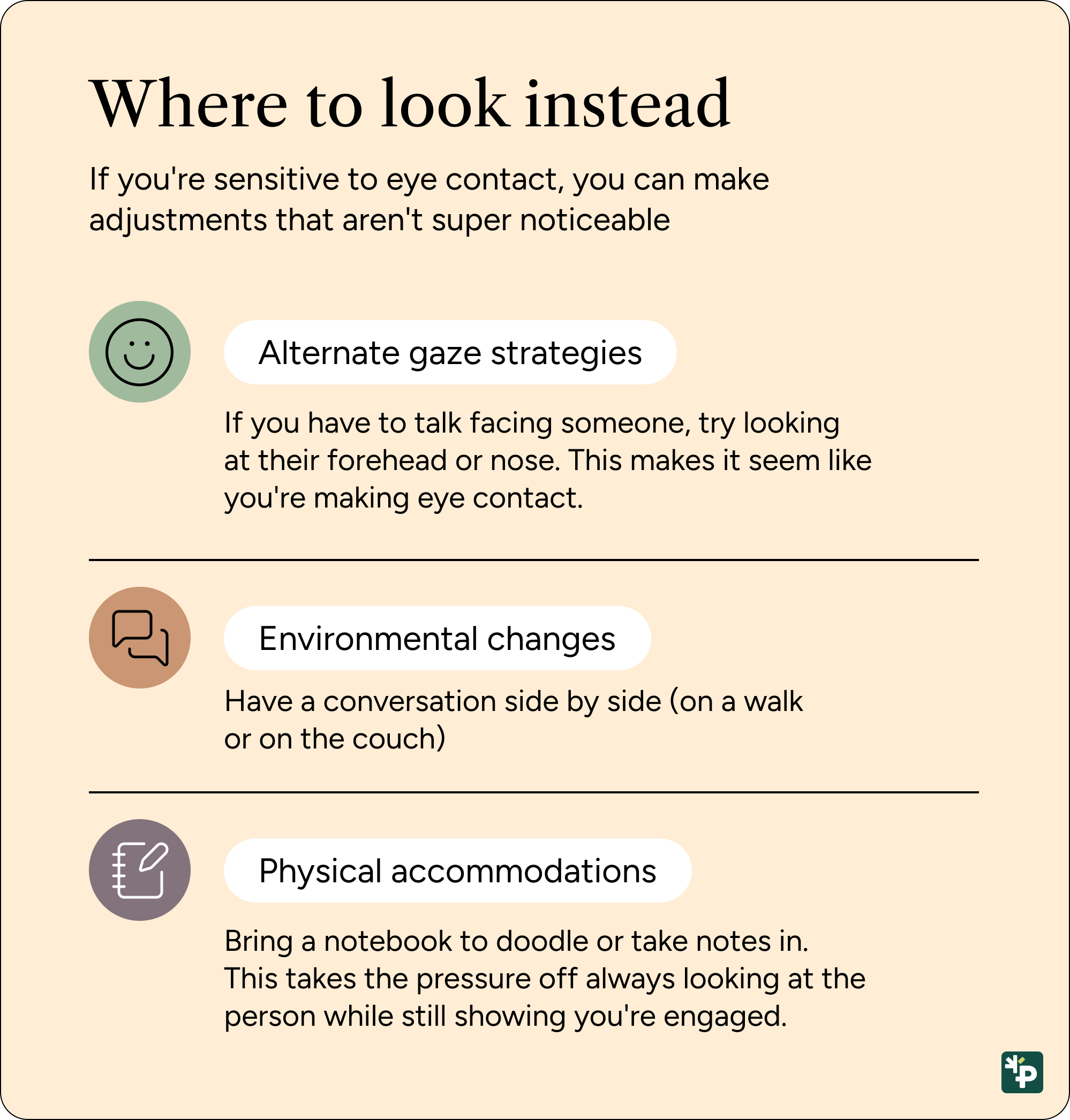
If you’re uncomfortable looking into a person’s eyes, a happy medium between complete avoidance and forced eye contact can include practical, alternative-gaze strategies and environmental adjustments.
“The goal should be effective communication, rather than achieving a certain amount of eye contact,” says Kovach, who recommends the following strategies:
Alternative-gaze strategies
- Look at a person’s eyebrows, nose, forehead, or general face instead of directly into their eyes.
- Brief glances at someone may also feel more manageable than trying to maintain continuous eye contact.
Environmental adjustments
- Sit at an angle or side-by-side
- Walk and talk
- Reduce other sensory distractions
- Take notes
- Use an appropriate fidget toy
Navigating eye contact in high-stakes moments
As useful as the above practical strategies are, sometimes you’ll find yourself in specific, high-stakes moments that may require more than just gazing at someone’s eyebrows.
Below, Kovach offers pragmatic advice for the following common scenarios:
Job interviews: Some employers view eye contact as a powerful nonverbal tool. (In some cases, lack of eye contact may negatively affect your job interview performance). Kovach advises focusing more on clearly communicating than monitoring your eyes throughout the interview. Another tip is to briefly look at the interviewer when they finish a question or while emphasizing a point. This may feel more manageable than sustained eye contact.
Recurring situations at work: If you’re concerned that your eye contact differences might reflect your workplace reputation, explain to your manager and/or coworkers that looking away or taking notes helps you to concentrate. Other options to reduce eye-contact pressure include sitting at an angle or communicating via written follow-ups. If your — or your manager’s — concerns are consistent, however, you may want to explore workplace accommodations.
Healthcare visits: Until autism-friendly healthcare becomes more widespread, strategies like briefly looking away, taking notes, or even bringing written questions to your appointment may make it easier to process complicated information. You can also directly tell your provider that you listen better when you don't maintain constant eye contact.
Dating: Since eye contact can play a significant role in dating — it often signals a mutual interest and/or attraction — it can help to explain that the amount of eye contact you make isn’t necessarily connected to how you feel about someone. This can help prevent a partner or date from interpreting looking away as disengagement.
Video calls: Thanks to the rise of technology, video calls are transforming traditional, audio-only phone calls. And with that comes the added stress of trying to maintain eye contact with not only one person, but possibly multiple people at once during online meetings. Practical options for video calls include looking into the camera instead of someone’s face onscreen, positioning your camera to a more comfortable angle, and turning the camera off periodically.
What do you say if someone comments on your eye contact?
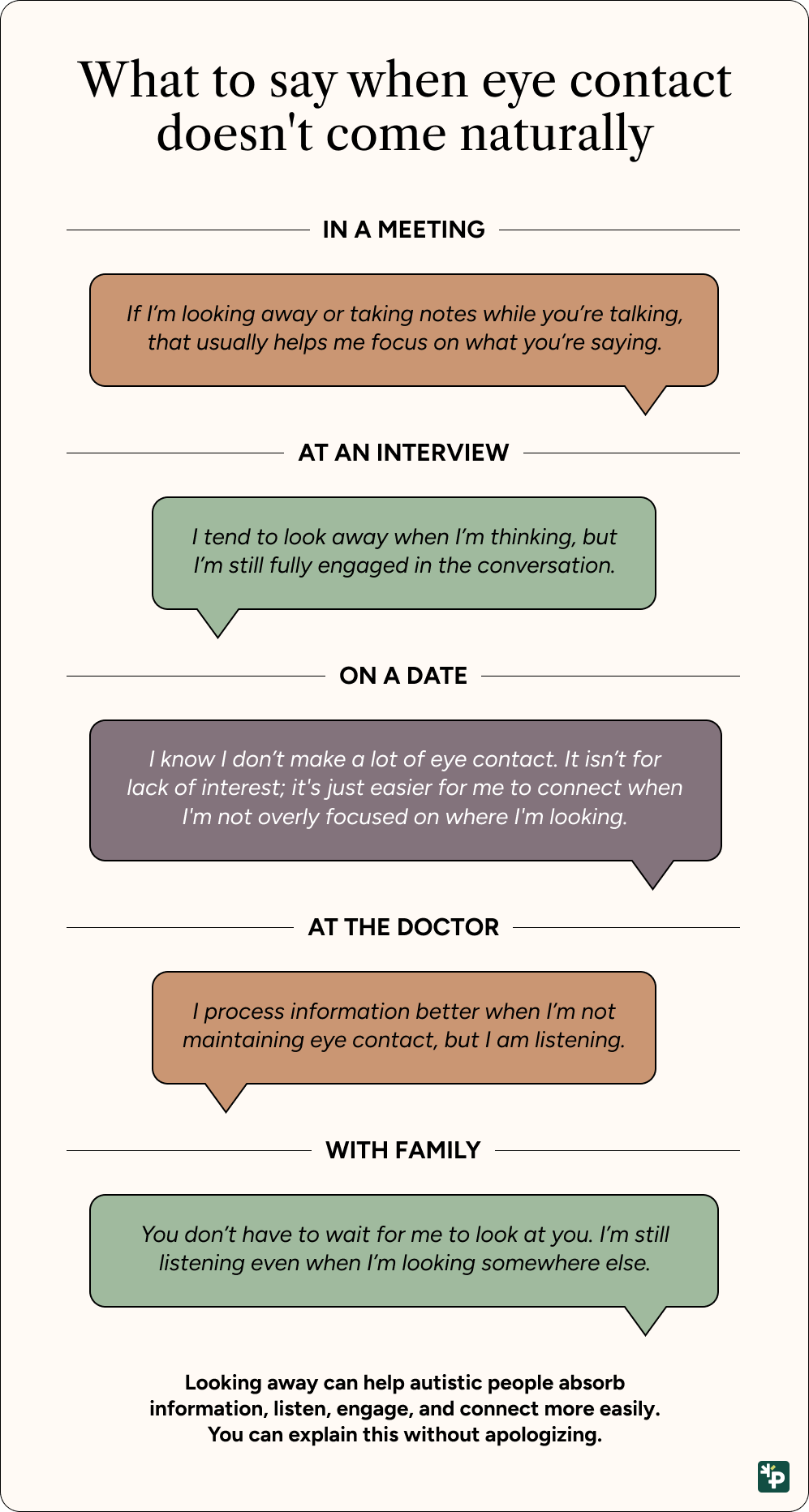
The situations in the table above, being more “high-stakes moments,” may feel easier to prepare for in advance. But what about those moments where you’re caught off-guard? Like when a friend casually remarks during your coffee date that your eyes are wandering. Or a stranger comments on your lack of eye contact.
Rather than using a single, fixed script, it’s a good idea to have a few short responses on hand that you can adapt to the situation. These responses are not only grounding, but they also offer explanation without apology.
Kovach suggests having these responses in your back pocket:
- “I’m listening. I just focus better without constant eye contact.”
- “Looking away sometimes helps me process what you’re saying.”
- “My eye contact may look a little different, but I’m still engaged.”
Getting more support
Navigating the subject of eye contact and autism doesn’t have to be a solitary experience, even though it may feel like it at first.
If you’re interested in connecting with like-minded people who have eye contact differences, several community spaces for autistic adults are available through the Association for Autism and Neurodiversity (AANE). The site features support groups, as well as self-advocacy resources for communicating preferences in professional and/or personal settings.
In addition, Prosper Health offers 100% telehealth adult autism evaluation services. Although a formal autism diagnosis is not required to validate your experience with eye contact challenges, it can provide clarity and self-understanding. Prosper Health also provides telehealth therapy, a potential next step for those who want support navigating eye contact differences.
The bottom line
Whether you avoid eye contact or deliberately prolong it, know that these differences are real, researched, and above all, not flaws that need correction.
You do not need to force eye contact in any social or work situation, and alternative options are available if you need further support, including neurodiversity-affirming therapy, practical strategies, and autistic community spaces.
Frequently asked questions (FAQs)
Can you have good eye contact and still have autism?
Yes, you can have good, or typical, eye contact and still have autism. The appearance of autistic traits varies by individual, and since autism is a spectrum, there is no one specific trait that identifies autism. In certain cases, some autistic people may make a conscious effort to maintain eye contact with others as part of their masking strategies.
Is eye contact easier with people I know well?
Not necessarily. Some autistic people may prefer not to make eye contact with friends, loved ones, or coworkers because avoidance or focusing their gaze elsewhere can sometimes help them listen to and process what others are saying.
Can coaching or therapy help if eye contact anxiety feels like it's holding me back?
Neurodiversity-affirming therapy, which Prosper Health offers, can support people navigating their eye contact-related anxiety. But eye contact differences aren’t flaws that need correction. Researchers have found, however, that certain types of interventions, such as therapy that forces eye contact, can potentially increase the person’s anxiety. A slow, gradual approach to eye contact is the preferred recommendation.
Is there a "right amount" of eye contact autistic adults should aim for?
No “right amount” of eye contact exists. Instead, experts advise a goal of effective communication, which can be achieved through various practical approaches like alternative-gaze strategies (briefly meeting someone’s eyes before looking away), environmental adjustments (sitting at an angle), or clear, concise explanations for why you’re not making eye contact (“I’m listening. Looking away helps me to focus”).
Sources
https://www.prosperhealth.io/blog/what-is-autism-spectrum-disorder
https://www.nature.com/articles/s41598-017-03378-5
https://www.sciencedirect.com/topics/neuroscience/subcortical-structurehttps://journals.plos.org/plosone/article?id=10.1371/journal.pone.0265798
https://www.sciencedirect.com/science/article/pii/S0896627306007276
https://www.nature.com/articles/s41598-017-13945-5
https://www.prosperhealth.io/blog/autism-masking
https://www.prosperhealth.io/blog/autistic-burnout
https://pmc.ncbi.nlm.nih.gov/articles/PMC12167331/
https://pubmed.ncbi.nlm.nih.gov/28000078/
https://pmc.ncbi.nlm.nih.gov/articles/PMC9876610/
https://pmc.ncbi.nlm.nih.gov/articles/PMC12781534/
https://pmc.ncbi.nlm.nih.gov/articles/PMC6411557/
https://pmc.ncbi.nlm.nih.gov/articles/PMC4340785/
https://www.reachlink.com/advice/autism-spectrum-disorder/what-forcing-eye-contact-actually-costs-autistic-people/
https://www.martinos.org/understanding-eye-contact-avoidance-in-people-with-autism/
https://www.themuse.com/advice/eye-contact-during-interview
https://www.prosperhealth.io/blog/mastering-autism-job-interviews
https://www.prosperhealth.io/blog/autism-in-the-workplace
https://pmc.ncbi.nlm.nih.gov/articles/PMC11305600/
https://www.prosperhealth.io/blog/dating-someone-with-autism
https://pmc.ncbi.nlm.nih.gov/articles/PMC10920202/
https://aane.org/
https://aane.org/services-programs/group-services/support-groups-community-connection/
https://aane.org/autism-info-faqs/autism-basics/disclosure-self-advocacy/
https://www.prosperhealth.io/diagnosis
https://www.prosperhealth.io/therapy


