.webp)

Key Takeaways
- Growing research suggests that while autistic people may be less likely to drink alcohol, those who do drink may be more likely to develop alcohol use disorder (AUD).
- Some autistic people are more vulnerable to alcohol misuse because they use it to fit in socially, regulate their senses, or numb strong emotions.
- Trauma and co-occurring conditions may also make an autistic person more likely to develop AUD.
- Alcohol can mask autistic traits, so some autistic people are only diagnosed after they stop using alcohol.
- It’s crucial that autistic people receive autistic-informed care that acknowledges their unique needs while addressing both the alcohol misuse and the reasons behind it.
Key Takeaways
- Growing research suggests that while autistic people may be less likely to drink alcohol, those who do drink may be more likely to develop alcohol use disorder (AUD).
- Some autistic people are more vulnerable to alcohol misuse because they use it to fit in socially, regulate their senses, or numb strong emotions.
- Trauma and co-occurring conditions may also make an autistic person more likely to develop AUD.
- Alcohol can mask autistic traits, so some autistic people are only diagnosed after they stop using alcohol.
- It’s crucial that autistic people receive autistic-informed care that acknowledges their unique needs while addressing both the alcohol misuse and the reasons behind it.
As a young teenager, Chelsey Flood felt drawn to alcohol for the reasons many people do. She felt that it gave her access to a more confident version of herself and the ability to relax in group settings.
Although she was never officially diagnosed with a disorder related to alcohol, Flood started to choose drinking over almost everything else. This kept her from living the life she truly wanted to live—enjoying hobbies, practicing healthy habits, and looking after herself.
After Flood became sober in her early 30s, she learned the main reason social settings came as such a struggle to begin with: she is autistic. Recent research suggests that alcohol addiction is more common among autistic people than previously believed.
While many people ask about the link between autism and alcoholism, we won’t use the latter term. Instead, we will use the term alcohol use disorder (AUD). This reflects that the condition is a treatable disorder and a clinically defined, spectrum-based term that is more precise and less stigmatizing.
In this article, we’ll explore the relationship between autism and drinking, why some autistic adults are more vulnerable to alcohol misuse, and why it can be especially risky for them. We'll also learn why standard recovery models can be tough for autistic adults, and what autism-affirming recovery support looks like.
What’s the connection between autism and alcohol use disorder (AUD)?
Alcohol use disorder (AUD) is a problematic pattern of alcohol use where excessive drinking leads to significant distress or impairment. It may be hard to manage and can lead to problems in work, school, relationships, family, or other areas of life.
Historically, autism was inaccurately considered “protective” against substance use and misuse. More recent research has shown that the truth is more complicated. Estimates of the prevalence of AUD among autistic people range from 1.6% in large population registers to 16.1% in certain specific clinical settings, according to a 2025 systematic review.
Some research suggests that alcohol use may be less common in autistic people, but that those who do use alcohol are more likely than neurotypical people to develop AUD. The jury is still out on this, though. While some studies indicate that AUD is more common among autistic people, others find that it is equally or less common, as noted in the 2025 review.
That said, the current research has several limitations. As the review points out, many of the studies don’t account for how autism and addiction may look different across different demographics and individuals. Women are also underrepresented, and many studies lack control groups or account for other variables that may affect the results.
Moreover, some cases of autism may be undiagnosed among people with AUD, and vice versa, says Dr. Kelly Whaling, Research Lead and Licensed Clinical Psychologist at Prosper Health.
Why are some autistic adults more vulnerable to alcohol misuse?
Whether autism itself is correlated with a higher rate of AUD or not, some autistic individuals use alcohol to try to feel more at peace in a world built for neurotypicals.
Masking and Social Survival
A 2019 study shows that one of the most common reasons autistic people use alcohol is to try to appear "not autistic" and fit in more comfortably with others. This is called masking, which is a common practice since the world isn’t always a welcoming, inclusive place for autistic people.
It can be tough to read social cues and navigate the social norms of neurotypicals, and this often leads to autistic people being excluded, rejected, or ridiculed. Like anyone facing repeated social stress, some autistic people may develop social anxiety and use alcohol to cope.
“I would be very quiet and very nervous about saying the wrong thing, because I have historically said the wrong thing a lot,” says Flood. When she drank, she found it easier to let down her guard and engage with other people.
Alcohol use may stem not only from a desire to act “typical” but to feel “typical.”
This can feel especially profound since alcohol often makes other people less attuned to social differences. “For someone who has felt closely evaluated or chronically ‘out of step,’ that shift can be an enormous weight lifted off their shoulders,” says Dr. Whaling.
It makes sense, then, that Flood also found alcohol useful for unmasking—letting her true personality shine through without fear of judgment.
Sensory regulation and emotional numbing
Many autistic people have higher-than-average sensitivity to sensory or emotional experiences. At times, this can lead to sensory overload, autistic burnout, or emotional overwhelm. In these situations, some people use alcohol to try to cope and get peace of mind.
That’s because alcohol “is a CNS (central nervous system) depressant, meaning it down-regulates one's CNS system to produce a feeling of calm and relief from stress,” says John Puls, LCSW, MCAP, a psychotherapist and addiction specialist at Full Life Comprehensive Care.
The downside? Alcohol doesn’t address the source of stress, and for some people, it can become a stressor in and of itself. Using alcohol this way can also make it more challenging to regulate emotions and sensory overwhelm without it. Plus, the temporary anxiety relief in the moment can be reinforcing and lead to more seeking of relief in the future.
Co-occurring conditions
Most autistic adults have at least one co-occurring condition. Some of these conditions make a person more vulnerable to alcohol misuse. One of the most common of these is ADHD.
A 2021 review estimated that 20% of adults with AUD have ADHD. It attributed this link to higher impulsivity and differences in the reward system among people with ADHD, which can make it harder to stop drinking.
Other common conditions among autistic people include anxiety and depression, both of which also have a significant link with alcohol use disorder. Some people turn to alcohol as a way to “self-medicate” their anxiety or depression, but it ends up making these conditions worse in the long run.
Trauma
Another common thread between autism and AUD is trauma. “Autistic people often experience a unique type of prolonged trauma or social trauma,” says Puls, referring to the high rates at which autistic people experience bullying, ostracism, and abuse. Many survivors of such traumas use alcohol to cope with their distress.
Brain Differences
Many autistic people show a pattern of focused, intense attention—sometimes described as “monotropism.” Someone might develop an intellectual interest in alcohol, but over time, “the line between studying and consuming can blur,” says Dr. Whaling.
Autistic people experience patterns of sustained or looping thinking, which, like many human coping tendencies, can sometimes make it harder to disengage from unhelpful habits, including alcohol use. This can apply to alcohol as a person tries to get sober. Emerging research has also suggested that autism and alcohol use disorder share some genetic pathways.
The connection between autism and alcohol effects
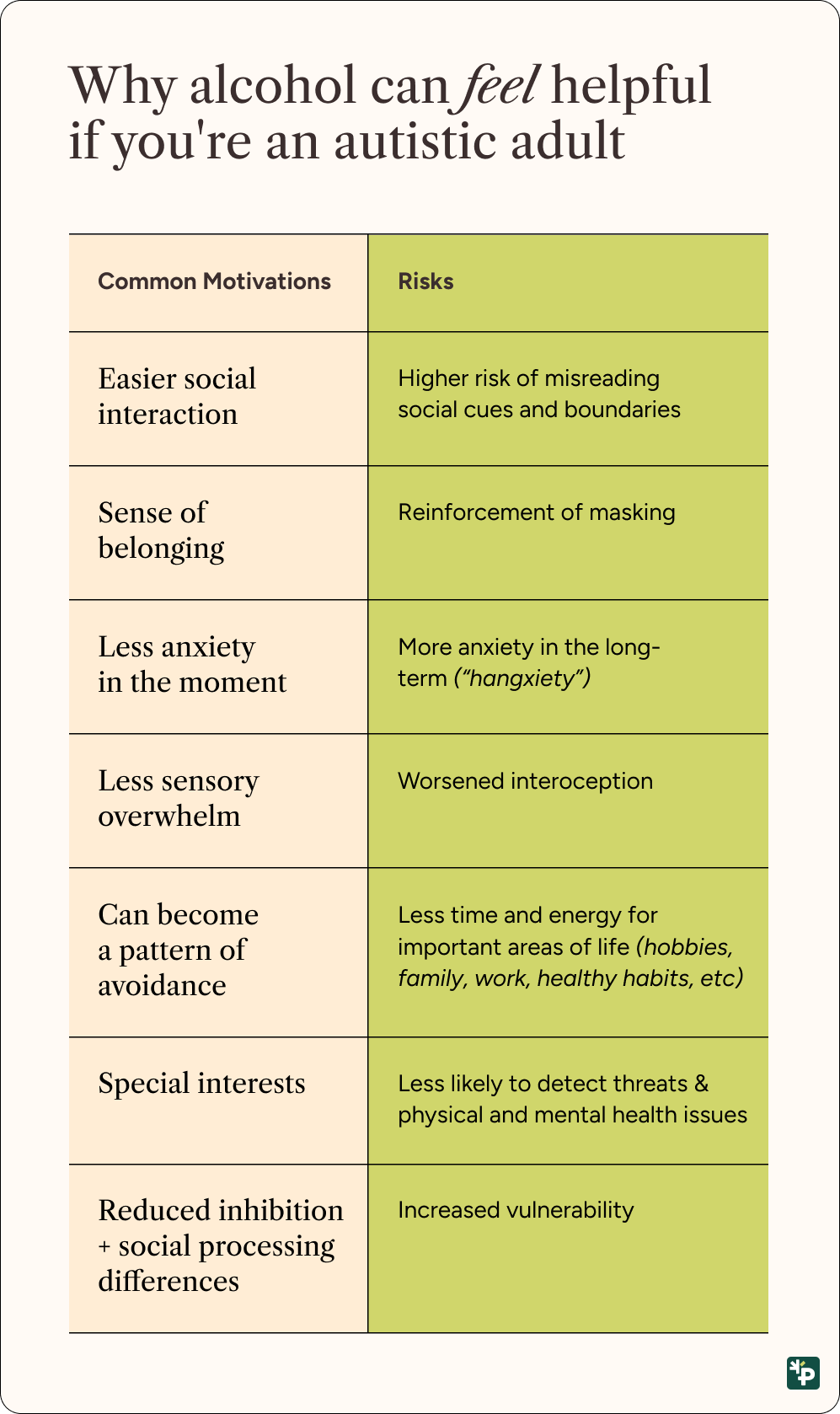
While many people use alcohol for the reasons above, using it as a coping tool comes with risks that may be especially high for autistic people.
One example is that alcohol can make it more difficult to read social cues. Thus, a person may be more likely to say or do something they don’t realize could come across as socially inappropriate or insensitive.
Additionally, a lot of autistic people struggle with interoception, which is the ability to sense and interpret internal body states. Alcohol interferes with interoception even further, which can make it hard for an autistic person to realize just how intoxicated they are. “That can increase the risk of binge drinking, blackouts, or alcohol poisoning simply because the body’s warning system is harder to access,” says Dr. Whaling.
Alcohol can also make it harder to detect threats and unsafe situations. This “can increase exposure to coercion, exploitation, and assault,” says Dr. Whaling, who emphasizes that autistic people don’t bring these risks on themselves. “Autistic people are never responsible for someone else’s violence or coercion. Accountability rests entirely with the person who causes harm.”
Both in the short- and long-term, alcohol can interfere with safety, work, relationships, and both physical and mental health. “What begins as a way of coping can gradually become another thing to cope with,” confirms Dr. Whaling.
Can alcohol use disorder look different in autistic adults?
Yes. In fact, AUD can look so different among autistic people that clinicians may overlook it altogether.
According to Dr. Whaling, “the diagnostic criteria and screening tools we use to identify alcohol use disorder were not developed with autistic people in mind.” This means autistic people may not interpret the language as intended when they’re given an evaluation.
Not only that, but the criteria tend to measure impairment against neurotypical norms. Dr. Whaling points out that an autistic person “can be drinking in ways that are causing genuine harm while presenting as unimpaired, socially engaged, and in control.” Their AUD might be missed since it doesn’t fit the template.
What’s more, autistic people are more likely to drink by themselves. When this is the case, other people in their lives may be less likely to notice warning signs of AUD, because they don’t often see the drinking firsthand.
In addition, some autistic traits can make it hard to change harmful drinking patterns once they’ve been established. For example, core aspects of autism include sensitivity to change and a strong preference for sameness and routine. These traits make it more challenging to implement lifestyle changes.
Why autism often goes undiagnosed in people with alcohol use disorder
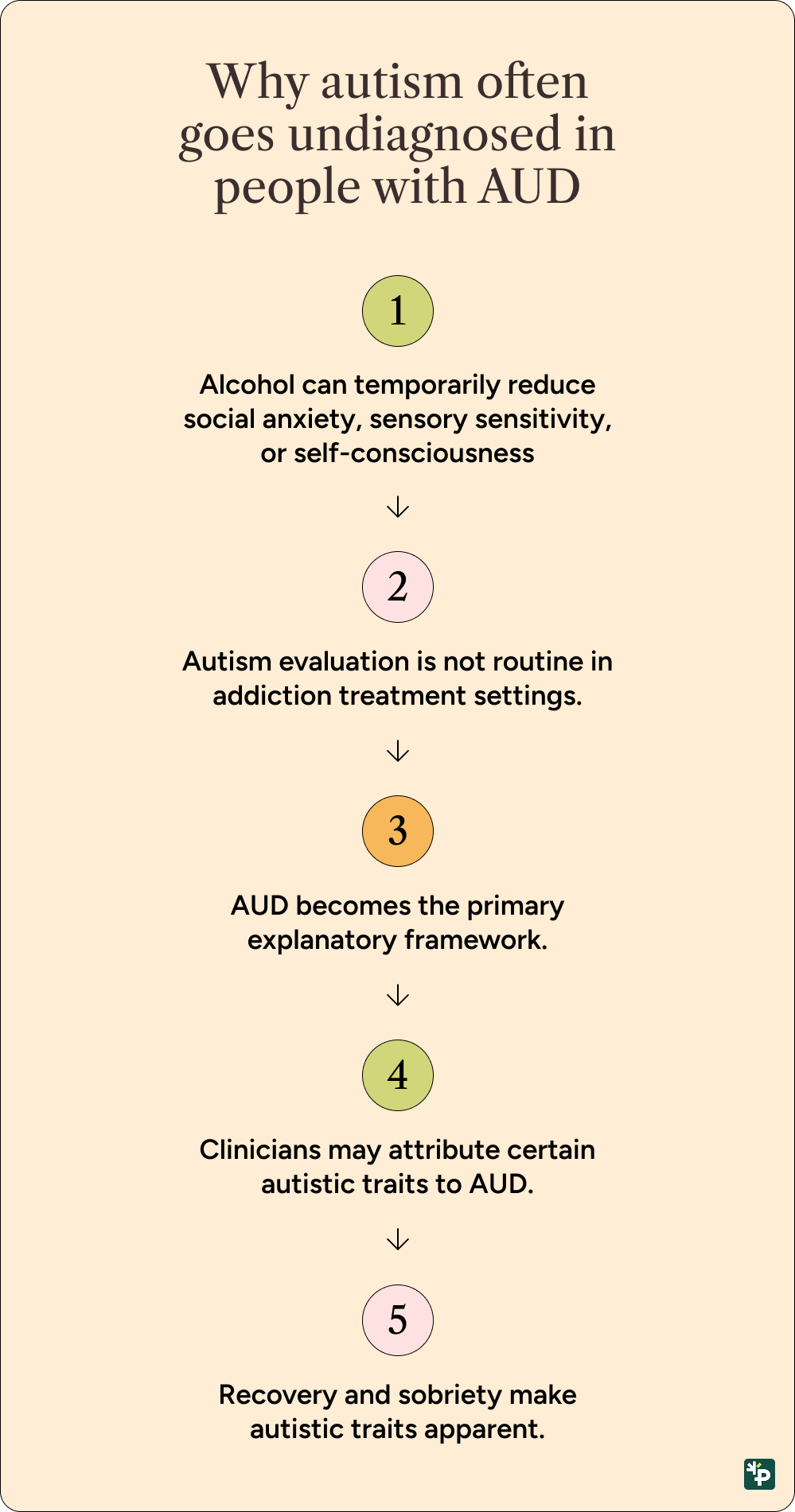
A major reason autism goes undiagnosed in people with AUD is that autism is underdiagnosed in general. This is especially true for people who don’t fit the common idea of what autistic people are expected to look like.
Autistic people who drink socially, for example, may have lower support needs and have less classically presenting characteristics of autism. There’s a misconception that autistic people don’t care for social interaction. Add in the fact that alcohol may mask their autistic traits, and it is even less likely that their autism is detected.
Not only that, but if someone is already diagnosed with AUD, clinicians are often less likely to consider an additional autism diagnosis.
This may be because, as Dr. Whaling explains, AUD can cause someone to present with traits that are common among autistic people. These include differences in executive functioning and social and emotional expression. Thus, clinicians may attribute these traits to AUD instead of considering the possibility of autism.
Some people, such as Flood (who doesn’t label herself as having had AUD), receive a late autism diagnosis only after they become sober and their autistic traits come to the fore.
Why traditional recovery models can be hard for autistic people
Traditional recovery models for AUD are built with non-autistic people in mind. It’s understandable, then, that some characteristics of these models are uncomfortable for many autistic people.
Consider the typical Alcoholics Anonymous meeting, for example. Flood often found the bright lights and group setting overwhelming. She is not an outlier. “I’ve had clients tell me they left meetings feeling more dysregulated than when they arrived,” observes Dr. Whaling.
Even in individual therapy, misaligned expectations can be a roadblock if the autistic person is undiagnosed or their clinician is unfamiliar with autism. Autistic people may communicate differently and need more processing time.
A clinician might not communicate effectively if they rely on abstract emotional language, implied meaning, or rapid conversational shifts. They may also perceive an autistic client as being difficult even though the client is just expressing themselves and processing treatment differently.
“Without awareness of autism, both parties can leave sessions feeling misunderstood,” adds Dr. Whaling. This can slow down recovery. Fortunately, though, there are effective ways to treat AUD among autistic clients.
What autism-affirming support for alcohol use disorder can look like
Just like everybody else, autistic people require support that fits their individual needs.
Individual Therapy
The ideal therapist has experience in treating alcohol use disorder among autistic people and works with clients to create individualized treatment plans that take autism into account. “Changes are often small and they can significantly improve alliance and outcomes,” says Dr. Whaling.
Everyone is different, but many autistic clients prefer clearer structure and more flexible timeframes. More or longer sessions may be necessary.
A clinician should also consider the client’s sensory needs. According to Puls, providers should offer sensory breaks and a low-stimulus environment that may include dim lighting, noise-cancelling headphones, or even a weighted blanket.
As a client, don’t be afraid to advocate for yourself during therapy. It’s critical that treatment addresses your alcohol use disorder, takes your needs as an autistic person into account, and creates healthy alternatives to the functions your alcohol use is serving.
Cognitive-Behavioral Therapy
Cognitive-behavioral therapy (CBT) is one of the most common treatments for AUD. It involves identifying and managing triggers, changing unhealthy thought patterns and behaviors, and developing strategies to manage situations that cause an urge to drink.
Clinicians may modify CBT for their autistic clients by making communication more concrete, explicit, visual, and routine-based, and focusing more on emotional regulation instead of abstract social concepts, notes Puls. CBT should also be more thorough and detailed.
Most importantly, Dr. Whaling notes that “affirming support needs to start by understanding the function that alcohol is serving—whether that's sensory regulation, social anxiety management, or something else—and then building alternative strategies around that specific function.” So, if someone uses alcohol as a social lubricant, treatment should address their social anxiety and interpersonal skills.
Community Support
Treatment should incorporate family and community support, since loneliness is often at the root of problematic alcohol use.
Social connections may also help people with other aspects of their lives, such as getting a job and finding housing. Clients should also be educated on autism, how it affects their lives, and how they can take care of themselves in a neurotypical world.
In Alcoholics Anonymous, Flood found the sponsorship model particularly useful. This involved one-on-one communication with a sponsor—a person who has made progress in the program and serves as a mentor.
“Without the sponsorship, I'm sure I wouldn't have lasted at all, but having a one-to-one relationship is how I've always done best,” says Flood. “You discuss what your limitations are, and you find workarounds.”
What to do if this article resonates with you
Recovering from problematic alcohol use can help you reclaim your life and live it according to your own terms. Wondering whether you should seek help to do so? Consider questions such as the following:
- Have you spent a lot of time drinking or having aftereffects from drinking?
- Have you wanted or tried to cut down on drinking, but felt unable to do so?
- Have you craved a drink so badly that you couldn’t think of anything else?
- Have you gotten into situations during or after drinking that were harmful or risky for yourself or others?
- Has drinking caused or worsened physical or mental health issues?
- Have you continued drinking after having had a blackout?
- Has your alcohol use significantly interfered with your work or school, taking care of your home, your relationships with family or friends, or other areas of your life?
It would be a good idea to seek support if you relate to one or more of the above, or have any other drinking-related problems that really concern you.
Keep in mind that if you suddenly stop drinking after drinking heavily for a prolonged period of time, your body can go into withdrawal. This is painful, dangerous, and potentially life-threatening. With appropriate medical help, you can plan a safe recovery.
The National Institute on Alcohol Abuse and Alcoholism (NIAAA) suggests speaking to your primary care provider about your alcohol use, as they may be able to provide medications or referrals.
If you haven’t been diagnosed with autism, but you or someone close to you believes you may be autistic, you may want to be assessed for autism, as well. “The sooner someone with an AUD can get properly diagnosed with autism and receive affirming care the better,” says Puls.
If you're interested in 12-step programs but don't feel comfortable with group formats, you may ask about sponsorship and other less socially demanding options. SMART Recovery® is another support program, and it has a virtual group specifically for autistic people.
A 2019 study points out that some people may need more support than what an outpatient environment can provide. In any case, the NIAAA has more information and guidance on finding treatment and support for AUD in the United States.
The bottom line
There are many reasons autistic people are drawn to alcohol use, such as social survival, sensory regulation, co-occurring conditions, and trauma. However, alcohol misuse can be especially risky for autistic people, so seeking appropriate treatment is paramount. Your provider should keep your autism in mind while treating your alcohol misuse.
If you would like to be assessed for autism, Prosper Health offers virtual diagnosis and mental health services for autistic people, covered by most insurance plans. Our neurodiverse and neuro-affirming therapists can help you develop tools to survive and thrive in a neurotypical world without the need for alcohol.
Frequently Asked Questions
Is there a correlation between autism and addiction?
Autism and addiction have a complex relationship, with some studies suggesting alcohol use disorder (AUD) is more common among autistic people, and others suggesting AUD is equally or less common. Either way, several factors—such as a need for belonging and sensory regulation—can make an individual autistic person more vulnerable to AUD.
How does alcohol affect a person with autism?
It depends on the person, but some autistic people report feeling calmer and more comfortable socializing. On the other hand, alcohol can have drawbacks such as “hangxiety,” reduced threat detection, and impulsivity.
Can alcohol hide autistic traits?
Yes, largely because alcohol can increase flexibility. This is due to the fact that alcohol may temporarily reduce anxiety, social inhibition, and sensory overwhelm. Some people only discover they’re autistic after they get sober.
Sources
https://www.psychiatry.org/patients-families/alcohol-use-disorder
https://pmc.ncbi.nlm.nih.gov/articles/PMC6472168/
https://www.sciencedirect.com/science/article/pii/S0149763423004050
https://pubmed.ncbi.nlm.nih.gov/34265320/
https://pmc.ncbi.nlm.nih.gov/articles/PMC8992908/
https://pmc.ncbi.nlm.nih.gov/articles/PMC3860395/
https://pmc.ncbi.nlm.nih.gov/articles/PMC7748121/
https://pmc.ncbi.nlm.nih.gov/articles/PMC6472168/
https://www.niaaa.nih.gov/sites/default/files/publications/NIAAA_RethinkingDrinking.pdf
https://www.prosperhealth.io/blog/autism-masking
https://www.prosperhealth.io/blog/autism-and-communication-differences-in-adults
https://www.prosperhealth.io/blog/social-anxiety-vs-autism
https://www.prosperhealth.io/blog/what-cooccurs-with-autism
https://www.prosperhealth.io/blog/autistic-burnout
https://www.prosperhealth.io/blog/sensory-overload-in-autistic-adults


