.webp)


Key Takeaways
- Autism is a recognized qualifying condition under Social Security’s rules for disability benefits for adults — but an autism diagnosis alone doesn’t guarantee approval.
- While a formal diagnosis is an essential foundation of a disability benefits application, eligibility depends on demonstrating how autism functionally impacts your daily life.
- Autistic adults may qualify for either Social Security Disability Insurance (SSDI; work-history-based), Supplemental Security Income (SSI; needs-based), or Disabled Adult Child (DAC) benefits through SSDI.
- Comprehensive documentation is critical for a strong application: Clinical summaries, standardized behavioral rating scales, and observations from people familiar with the applicant’s day-to-day functioning.
- Keep your expectations realistic: Although over 60% of initial Social Security disability applications were denied in 2024, a multi-step appeals process is available.
Key Takeaways
- Autism is a recognized qualifying condition under Social Security’s rules for disability benefits for adults — but an autism diagnosis alone doesn’t guarantee approval.
- While a formal diagnosis is an essential foundation of a disability benefits application, eligibility depends on demonstrating how autism functionally impacts your daily life.
- Autistic adults may qualify for either Social Security Disability Insurance (SSDI; work-history-based), Supplemental Security Income (SSI; needs-based), or Disabled Adult Child (DAC) benefits through SSDI.
- Comprehensive documentation is critical for a strong application: Clinical summaries, standardized behavioral rating scales, and observations from people familiar with the applicant’s day-to-day functioning.
- Keep your expectations realistic: Although over 60% of initial Social Security disability applications were denied in 2024, a multi-step appeals process is available.
If you've recently done an online search for the term “autism disability benefits”, you probably walked away with more questions than answers. Unfortunately, this happens because the search phrase “autism disability benefits” covers a very broad spectrum, and the resources your results pulled up may not even apply to your personal situation.
For example, one of the first results that usually comes up using this search term (as well as “Do you get disability for autism?”) is the Social Security Administration’s page for benefits for children with disabilities.
But if you made it to this page, you’re actually on the right path: “Autism disability benefits” almost always means Social Security. Yes, other types of government assistance exist, and we will cover those options, but let’s examine your potential Social Security benefits first.
After reading this article, you will understand how, as an autistic person, you may qualify for either Social Security Disability Insurance (SSDI) or Supplemental Security Income (SSI). We’ll also explore which pathway most likely fits your situation, what strengthens an application, what to expect if you are denied, and whether you can keep working while receiving support.
Is autism considered a disability under Social Security's rules?
Is autism a disability? Yes, autism is a recognized qualifying condition under Social Security’s rules for disability benefits. However, an autism diagnosis alone doesn’t guarantee approval.
The Social Security Administration (SSA) evaluates autism claims under its official medical reference guide, Disability Evaluation Under Social Security, colloquially known as the “Blue Book.” Autism spectrum disorder (ASD) is specifically evaluated under the Blue Book’s listing 12.10 (for adults) and listing 112.10 (for children).
There is a two-part standard required to meet the 12.10 listing for autism disability benefits for adults:
First required standard: Medical documentation of both of the following:
- Qualitative deficits in verbal communication, nonverbal communication, and social interaction
- Significantly restricted, repetitive patterns of behavior, interests, or activities
Second required standard: Extreme limitation of one, or marked limitation of two, of the following areas of mental functioning:
- Understanding, remembering, or applying information
- Interacting with others
- Concentrating, persisting, or maintaining pace
- Adapting or managing oneself
Please note that non-neurodiversity-affirming descriptors like “deficits” and “limitation” are technical terms used by the SSA in their official documentation.
Something else to remember when pursuing autism disability benefits for adults is that meeting these criteria isn’t the only path to qualifying. “Disability benefits are typically determined based primarily on functional impact, not the diagnosis alone,” says Hannah Jones, PsyD, a licensed clinical psychologist with Prosper Health.
Co-occurring diagnoses and your claim
Several other diagnoses commonly co-occur with autism, including attention-deficit hyperactivity disorder (ADHD), anxiety, and depression. If you have co-occurring ADHD or any of these other conditions, know that they are not incidental to a disability claim.
Since the SSA evaluates the combined effect of all documented impairments (the SSA’s official term) — not only autism in isolation — any co-occurring diagnoses may help meet the functional threshold necessary for Social Security benefits for autism.
“Documenting co-occurring conditions may support a disability benefits application because the combined impacts of multiple conditions may qualify a person for certain supports that may not be evident otherwise,” says Dr. Jones.
So if you have documentation for co-occurring diagnoses, it’s a good idea to submit everything you have on hand alongside any autism-specific documentation. There is nothing about ADHD, anxiety, depression, or any other diagnosed condition that should be treated as separate or lesser evidence.
As a caveat, though, Dr. Jones does note that sometimes “benefits may be denied or not approved to the extent requested because the impact a person attributes to autism may be determined by reviewers to be more attributable to another co-occurring condition not covered.” To clarify, co-occurring conditions do not have to appear in the Blue Book listings to still count toward a disability determination.
SSDI, SSI, and other pathways: Which one fits your situation?
Once you understand the qualifications for autism disability benefits for adults, the next step is figuring out which program best applies to you. The answer depends on your work history and life circumstances — not just your diagnosis.
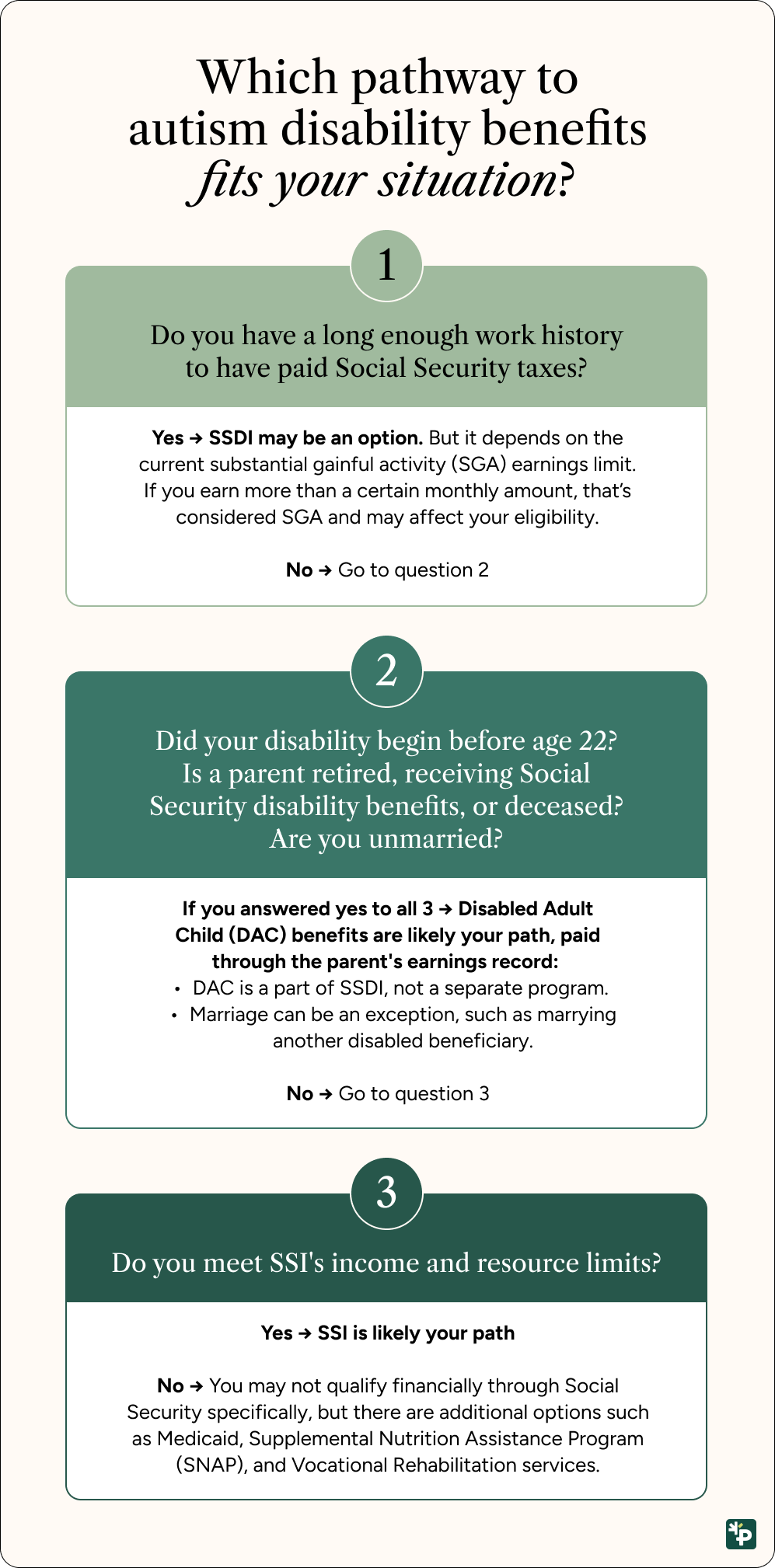
The three likely pathways to benefits are as follows:
- Social Security Disability Insurance (SSDI): Eligibility depends on your work history
- Supplemental Security Income (SSI): Eligibility is needs-based
- Disabled Adult Child (DAC): Available to adults whose disability began before age 22, through a parent's Social Security earnings record. Heads up that this option is part of SSDI, not a third option.
If you’re someone who had SSI as a child and are now either approaching or past age 18, you’ll want to keep in mind that you are now going through the same set of eligibility questions, just under the adult rules, not the child standard.
Answering the questions in the visual below should help you identify which situation most resembles your own and will guide you toward the type of benefits that best apply to you. While the visual reflects the general structure of the SSA’s rules, it's a starting point, not a determination of eligibility.
What strengthens a disability application
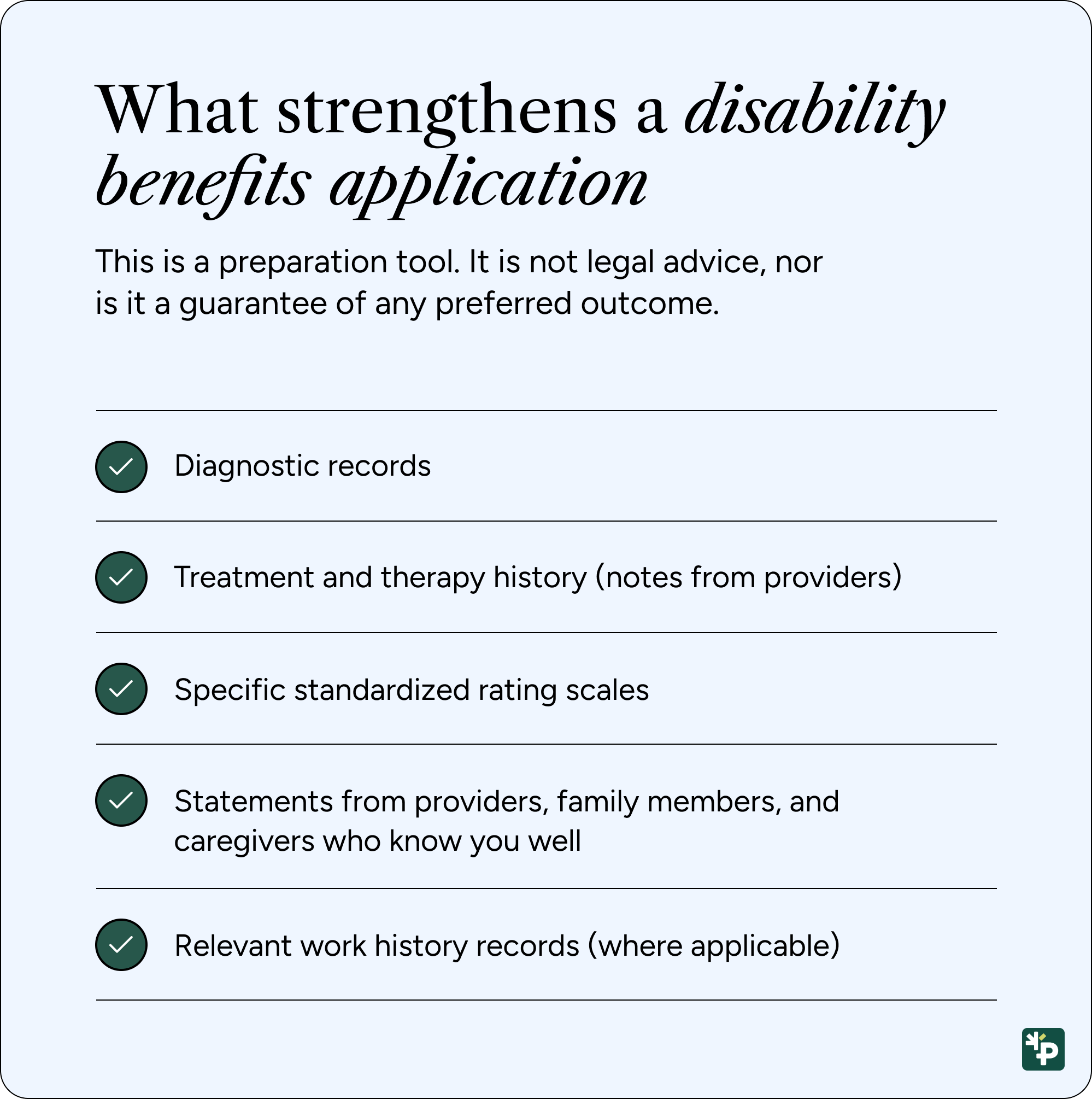
Now that you’ve (hopefully) identified the right benefits pathway for you, the next practical step is gathering the documentation that illustrates the functional impact of autism and any other co-occurring conditions in daily life.
“Having a complete, consistent paper trail that shows that autism has significantly impacted daily functioning over time can potentially strengthen a disability application,” reiterates Dr. Jones.
Again, “strengthen” doesn’t mean “guarantee.”
In addition to any diagnostic evaluation reports, other helpful documentation can include, per Dr. Jones:
- Any accounts of functional impacts across time
- A comprehensive summary from a clinician outlining the functional impacts of your diagnosis
- Specific standardized rating scales, if available, such as:
- Vineland Adaptive Behavior Scales (assesses communication, daily living, socialization, and motor skills)
- Adaptive Behavior Assessment System (assesses adaptive functioning)
- Multiple insights from people who have observed your day-to-day functioning: This can include medical and mental health providers, as well as caregivers who knew you during the early developmental stages. Anyone who knows you well and can speak to your functioning needs.
Depending on your situation, Dr. Jones notes that your application may need additional documentation such as cognitive functioning tests or specific measures of autism features. She advises speaking with an SSA representative who can clarify exactly what you would need to pursue benefits.
As you prepare your application, remember that consistency across your different sources of documentation is key: Having multiple people speak about how autism and any other co-occurring conditions directly impact your daily functioning strengthens your claim by creating a cohesive, trustworthy argument.
Does an autism diagnosis help with disability benefits?
We’ve already answered the “Does autism qualify for disability?” question. Now let’s examine the role a formal autism diagnosis can play in your application. If you are someone who is undiagnosed or self-identifies as autistic — and are weighing the pros and cons of pursuing a clinical evaluation — this section is intended to help you with your decision.
Qualification for adult autism disability benefits depends on documented functional limitations. However, a formal diagnosis is one of the strongest forms of documentation you can provide to support a claim.
“Typically, a formal diagnosis by a licensed medical professional who specializes in the diagnosis is a necessary base requirement for benefits,” says Dr. Jones. But since a diagnosis alone doesn’t automatically qualify someone for benefits, Dr. Jones advises viewing it more as an essential “foundation rather than a guarantee.”
As we established in the previous section, an autism disability benefits application’s strength lies in a comprehensive overview rather than a diagnostic label. According to Dr. Jones, an application’s potential success hinges on “multiple concrete examples” of how a person’s autism has a “history of functional impact across contexts and over time.”
The more relevant and consistent evidence you can provide, the stronger the overall record may be, which is why a formal diagnosis can bolster your claim.
“Thoroughly understanding [your application’s] requirements before submitting a claim can help ensure that you gather the necessary documentation and conserve energy, time, and resources,” notes Dr. Jones.
What happens if you're denied
Another thing to know before beginning the autism and Social Security benefits process?
Most initial disability applications are denied — nationally. According to data from the SSA, approximately 62% of all initial applications for both SSDI and SSI were denied in 2024 (these are the most recent estimates available).
It’s important to note when considering this data that this high denial rate reflects all disability claims, not just autism-specific ones.
Still, SSA benefits denial is a normal, expected part of the process; even Dr. Jones notes, “It is not uncommon for your initial application to be denied.” But that doesn’t mean your claim was illegitimate.
The good news is, the SSA has a multiple-step appeals process that gives you four opportunities to present your case:
- Stage One: Reconsideration: The first step is to request a reconsideration of your claim. According to the SSA, an examiner from a Disability Determination Services (DDS) office in your state — most initial disability claims are processed through local DDS offices — will review your request and original application.
You must file this request within 60 days of receiving your initial denial.
- Stage Two: Hearing by an administrative law judge: If your reconsidered request ends in another denial, the next step is to request a hearing with an administrative law judge. The hearing will be conducted either online, in person, or by phone. A judge will review your evidence, ask questions about your condition(s), and may call on clinical experts or witnesses for testimony.
As with the reconsideration request, you must file your request for a hearing with a judge within 60 days of receiving your second denial.
- Stage Three: Review with the Appeals Council: If you don’t agree with the hearing’s outcome, you can ask the SSA’s Appeals Council to review the judge’s decision. The Appeals Council has two choices: Either they will agree with the judge’s decision and deny your request, or they’ll decide to review your case. If they opt to review your case, the Appeals Council will either make its own decision or return the case to a judge for further review.
You must file your request for an Appeals Council review within 60 days of the
administrative law judge’s decision.
- Stage Four: File a federal district court action: If your Appeals Council review doesn’t go your way, you have one final opportunity to appeal your case. You can file a civil suit with a U.S. District Court in your area. At this point, you may wish to consider legal counsel. The U.S. District Court will review the evidence and the Appeals Council decision.
- Send the case back to the SSA, where a judge may be ordered to hold a new hearing and issue a new decision
- Direct the SSA to award benefits
- Dismiss the case
You must file an action in U.S. District Court within 60 days of the Appeals
Council’s decision.
Keeping work while receiving support
Take a look at any disability-related Reddit thread or Facebook page: There will be no shortage of people sharing their worries and confusion about whether they need to give up their jobs when receiving disability benefits.
In fairness, their confusion is warranted. According to the SSA, benefits eligibility depends less on whether you’re working a full- or part-time job, and more on whether you’re earning “substantial gainful activity” (SGA).
Working does not automatically disqualify someone from Social Security disability benefits, but employment and earnings can affect both eligibility and payment amounts. The rules differ for SSDI and SSI, and they may also depend on whether someone is applying for benefits or already receiving them. SSDI includes specific work incentives, such as a trial work period, while SSI generally adjusts payments based on countable income. Before making employment decisions, applicants and beneficiaries should review the rules for their particular benefit program.
Below are some additional SSA resources to help you achieve your work-related goals:
The Plan to Achieve Self-Support (PASS): A PASS is available to people either on or eligible for SSI, allowing them to set aside income or resources toward a specific work goal. The income/resources would pay for education, professional training, transportation, child care, or anything else someone might need to achieve their professional goals.
If the SSA approves your PASS — which includes a written plan of action laying out your intentions — the money spent on your professional goals will not count against SSI eligibility.
The Ticket to Work program: This is a free and voluntary program available to adults ages 18-64 receiving SSDI and/or SSI. Ticket to Work can connect you with employment support services that can meet you wherever you are regarding your work situation. This can include career counseling, vocational rehabilitation, as well as job placement and training.
Impairment-Related Work Expenses (IRWE): These are costs for necessary items or services that you need to work. They can include, but are not limited to, specialized equipment or transportation modifications. The SSA will then deduct the costs of IRWE from your countable income when determining your Social Security disability benefits, allowing you to continue working while remaining under SGA limits.
Beyond Social Security: Other support worth knowing about
Although Social Security is the primary federal benefit covered in this article, it isn’t the only form of government assistance for autistic adults.
Here are some other benefit options for autistic adults worth exploring:
- Medicaid: Medicaid can potentially cover several medical, behavioral, and therapeutic services for autistic adults.
- Supplemental Nutrition Assistance Program (SNAP): Autistic adults receiving Social Security disability benefits like SSDI or SSI may also be eligible for SNAP. You can apply for these benefits through your current state of residence.
- Vocational rehabilitation services: These are publicly funded federal programs that assist disabled people with finding and maintaining employment. As with SNAP, you will need to apply for these benefits through your state.
Getting support with your application
Even though we’ve laid out the necessary steps throughout the article, it’s understandable if submitting an autism disability benefits application still feels overwhelming.
When preparing your application, Dr. Jones recommends these additional tips:
- Keeping your expectations realistic: “It is very common for initial applications to be denied, so it may be helpful to expect this and plan to appeal if necessary.”
- Keeping your claim diagnosis-centered: “Applicants should try to frame their support for their claims around what they have difficulty doing consistently specifically due to the diagnosis (e.g., sustaining employment, managing daily living tasks such as handling finances/maintaining a sustainable weight/driving, handling sensory/social demands).”
- Keeping your claim consistent: “[Applicants] should also gather multiple sources who can provide consistent information — for example, combining clinician summaries and standardized testing results with statements from informants who know them well.”
But the best thing any applicant can do, says Dr. Jones, is “seek support from an SSI/SSDI representative who can clarify procedures and requirements, and help with creating an itemized list of next steps.”
In addition to speaking with an SSA employee for clarification, you can ask your local Social Security office to connect you with potential representatives through legal aid services and local bar associations. These organizations provide free services or can direct you toward qualified representatives.
Other support options include:
- Friends
- Relatives
- Employers
- Fellow autistic adults
- Members of an advocacy group or organization
While help with the legal and practical aspects of filing a benefits claim is essential, so is support for self-understanding and building a stronger, documented case. That’s where Prosper Health’s services can play a valuable role in your application. Getting a formal clinical autism assessment and diagnosis can potentially help reinforce your benefits claim.
The bottom line
The autism disability benefits claims process can certainly feel intimidating. But the more knowledge you have from the start — including a realistic mindset about initial Social Security benefits denials — the better. Knowing which program to apply for (SSDI or SSI), having all essential documentation on hand (including a formal autism diagnosis), and enlisting a strong support system is half the battle.
Frequently asked questions (FAQs)
Is it hard to get disability benefits with autism?
Obtaining disability benefits for autism can be a challenging process for several reasons: First, an autism diagnosis doesn’t guarantee eligibility. An application must demonstrate the functional impact that autism has on the applicant’s daily life (and a formal diagnosis can indeed help with that claim). Second, most Social Security disability benefits claims (whether they’re for autism or a different disability) are initially denied, so applicants should be prepared to undergo an appeals process.
How much is autism disability pay?
If you are eligible for autism disability pay, the amount will depend on which program you qualify for: Social Security Disability Insurance (SSDI) or Supplemental Security Income (SSI). SSDI eligibility depends on your work history, while SSI is needs-based.
For people receiving SSI, the monthly maximum federal amounts for 2026 are $994 for an eligible individual and $1,491 for an eligible individual with an eligible spouse. For people receiving SSDI, the average monthly payment is $1,630 in 2026, with the maximum monthly amount capping at $4,152.
Once you hit retirement age, your monthly payment amount likely will not change because Social Security sets your SSDI benefit as though you had reached full retirement age.
Can co-occurring conditions like ADHD or anxiety affect an autism disability claim?
Since several other diagnoses — like ADHD or anxiety — commonly co-occur with autism, it’s a good idea to include documentation for all of your conditions in your disability claim. These co-occurring conditions may help meet the functional threshold necessary for Social Security benefits for autism.
Does a spouse's income affect SSDI, or just SSI, for autism-related claims?
A spouse’s income would only affect SSI. SSDI benefits reflect the claimant’s work history, not the spouse’s. If you are married, however, and are eligible for SSI, your spouse’s income — and their own eligibility for SSI — may affect your payments since SSI is a needs-based program.
Sources
https://www.ssa.gov/disability/professionals/bluebook/12.00-MentalDisorders-Adult.htm
https://www.prosperhealth.io/diagnosis
https://disabilityadvice.org/qualifying-conditions/autism/
https://www.ssa.gov/disability/professionals/bluebook/
https://www.ssa.gov/disability/professionals/bluebook/112.00-MentalDisorders-Childhood.htm
https://www.ssa.gov/disability/professionals/bluebook/12.00-MentalDisorders-Adult.htm#12_10
https://www.sciencedirect.com/science/article/pii/S1750946724001338
https://www.prosperhealth.io/blog/what-cooccurs-with-autism
https://www.prosperhealth.io/blog/what-is-audhd
https://www.ssa.gov/OP_Home/cfr20/404/404-1523.htm
https://www.disabilitysecrets.com/resources/social-security-disability/multiple-disabilities-combined-effects.htm
https://www.ssa.gov/disability/professionals/bluebook/listing-impairments.htm
https://www.ssa.gov/pubs/EN-05-11001.pdf
https://www.ssa.gov/pubs/EN-05-10026.pdf
https://www.ssa.gov/ssi/eligibility
https://www.ssa.gov/oact/cola/sga.html
https://www.brockandstout.com/social-security/disabled-adult-child
https://www.ssa.gov/pubs/EN-05-11005.pdf
https://www.ssa.gov/policy/docs/issuepapers/ip2003-01.html
https://www.sciencedirect.com/topics/medicine-and-dentistry/vineland-adaptive-behavior-scale
https://pmc.ncbi.nlm.nih.gov/articles/PMC8218243/
https://www.ssa.gov/agency/contact/phone.html
https://www.trajectordisability.com/autism-disability-benefit-guide/
https://www.ssa.gov/policy/docs/statcomps/di_asr/2024/sect04.html
https://www.trajectordisability.com/disability-claim-denied-common-reasons/
https://www.ssa.gov/apply/appeal-decision-we-made
https://www.ssa.gov/apply/appeal-decision-we-made/request-reconsideration
https://www.ssa.gov/disability/determination.htm
https://www.ssa.gov/appeals/appeals_process.html
https://www.ssa.gov/apply/appeal-decision-we-made/request-review-hearing-decision
https://www.ssa.gov/apply/appeal-decision-we-made/file-review-federal-district-court
https://www.ssa.gov/ssi/text-appeals-ussi.htm
https://www.reddit.com/r/SSDI/comments/1rphtwd/apply_for_disability_before_or_after_quitting_my/
https://www.facebook.com/groups/1351911332368766/posts/2067914477435111/
https://www.ssa.gov/benefits/disability/qualify.html
https://www.ssa.gov/ssi/spotlights/spot-plans-self-support.htm
https://choosework.ssa.gov/about/how-it-works
https://www.prosperhealth.io/blog/autism-in-the-workplace
https://choosework.ssa.gov/Assets/cw/files/FAQ-impairment-related-work-expenses.pdf
https://www.ssa.gov/ssi/spotlights/spot-work-expenses.htm
https://www.medicaid.gov/medicaid/benefits/autism-services
https://www.fna.usda.gov/snap/eligibility/elderly-disabled-special-rules
https://rsa.ed.gov/about/programs/vocational-rehabilitation-state-grants
https://rsa.ed.gov/about/states


