.webp)


Key Takeaways
- Alexithymia is defined as a difficulty in naming, identifying, and expressing emotions. Two popular self-reporting testing options include the Toronto Alexithymia Scale (TAS-20) and the Online Alexithymia Questionnaire (OAQ-G2).
- While online alexithymia tests like the TAS-20 and OAQ-G2 can be helpful for self-reflective purposes, they cannot provide a clinical diagnosis.
- The most thorough assessment of alexithymia occurs as part of a comprehensive psychological evaluation, where clinicians integrate interviews, standardized measures, and clinical judgment.
- Alexithymia is a common trait of autism, but not all autistic people have this condition. Non-autistic people can have alexithymia as well.
- People with alexithymia do not lack empathy or emotion; they just have challenges recognizing their emotions.
You’re at a social gathering, but you only know maybe one or two people there. Suddenly, your stomach starts to feel fluttery. Is it because you’re nervous? You ate something funny? Or forgot to eat entirely?
It’s okay if you don’t know.
While some people can pinpoint the cause of something like stomach butterflies immediately, it’s not so easy for others. This distinct challenge of identifying emotions and differentiating them from bodily sensations has a name — alexithymia — and it commonly co-occurs with autism.
If you’ve arrived at this article because a lifetime of confusion about your emotions led you to take an online test — and the results suggest you may experience alexithymia — you’ve come to the right place. You deserve to understand what your online score actually means, and the recommended next steps.
The most important thing to know about an online alexithymia test is that it cannot offer a clinical diagnosis. Alexithymia is not considered an official diagnosis in the Diagnostic and Statistical Manual of Mental Disorders (DSM-5).
However, after reading this article, you will have a much better understanding of what alexithymia tests actually measure, the limitations of these questionnaires, and what you can do with the information they give you.
What is alexithymia?
Alexithymia is defined as the challenge of naming, recognizing, and expressing emotions. This trait can also appear as a difference in identifying emotions vs. bodily sensations. So thirst might be misconstrued as anger or irritability, or stomach butterflies due to nervousness could be misinterpreted as an upset stomach.
One of the core misconceptions of alexithymia is that a person with this trait either has low empathy, is suppressing their emotions, or doesn’t have emotions at all. Just because someone has difficulty identifying their feelings doesn’t mean those emotions don’t exist.
Alexithymia is also a common trait among autistic people: According to a 2019 study published in European Psychiatry, about 50% of autistic people experience alexithymia. But like autism itself, alexithymia exists on a spectrum as well.

Primary vs. secondary alexithymia
There are two types of alexithymia: Primary and secondary.
Primary alexithymia is a neurological form of information processing classified as a steady, unchanging trait. This is the type most associated with autism.
Secondary alexithymia usually occurs in response to a traumatic incident or emotional disruption, such as a car accident, a concussion, or a severe illness.
So if you’re an autistic adult (or believe you may be on the spectrum), and have been led to believe your emotional disconnect is the result of unprocessed trauma, know that this is not necessarily true. Primary alexithymia is generally considered a relatively stable trait with developmental or neurobiological origins.
Why alexithymia is so common in autistic adults
While alexithymia is not universal — or unique — among autistic people, it is a common trait.
As previously mentioned, research shows that about 50% of autistic adults meet the criteria for alexithymia. In addition, Jacqueline Shinall, PsyD, a clinical psychologist at Prosper Health, says that “individual studies have reported estimates ranging from about one-third to nearly two-thirds of autistic adults.”
She goes on to say, however, that researchers are still working to understand the links between autism, alexithymia, and differences in interoception (challenges recognizing internal bodily cues), emotional processing, sensory experiences, and neurodevelopment.
But even though not every autistic person has alexithymia, and not everyone with alexithymia is autistic, this condition can be worth investigating “because [these traits] may explain challenges with emotional awareness, communication, and mental health, allowing clinicians to make more individualized recommendations,” says Dr. Shinall.
How alexithymia is measured
Standardized self-report measures, which are generally non-diagnostic quizzes found online, ask about the following three core factors:
- Difficulty identifying feelings: Emotions and bodily sensations are confusing; is it hunger, or is it anxiety?
- Difficulty describing feelings: It’s a challenge finding the words that express how you feel.
- Externally oriented thinking: Focusing your energy on what’s happening around you, rather than what you’re feeling on the inside.
Since alexithymia tests can help you determine whether you have alexithymia traits, these quizzes can be useful tools for self-reflection and may help identify whether further evaluation would be worthwhile.
Comparing the major alexithymia assessment tools
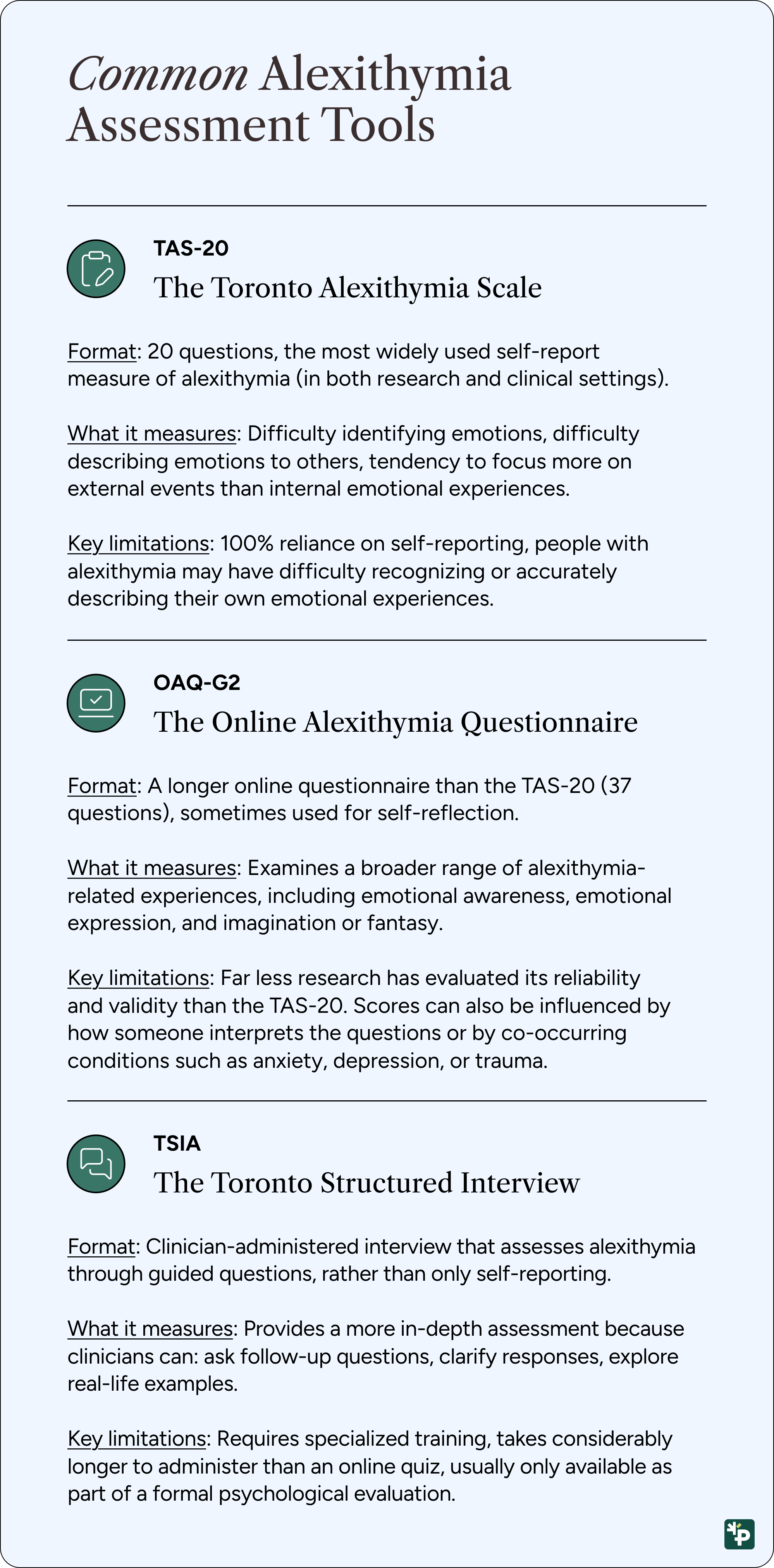
The next step is choosing the right alexithymia test for you. There are two common self-reporting tools available online for free, as well as a clinician-administered assessment usually part of a formal psychological evaluation. Below, Dr. Shinall breaks down the three major alexithymia assessment tools, along with their key strengths and limitations.
The real limitation of self-report (and why it matters more for some people)
The cruel irony of self-reporting quizzes is that people with alexithymia can be unreliable narrators.
“One of the biggest challenges with self-report measures is that they ask people to judge abilities they may naturally have difficulty evaluating,” explains Dr. Shinall. “Someone who struggles to identify or describe their emotions may also have difficulty recognizing the extent of those challenges, creating a bit of a paradox.”
Not only does alexithymia pose challenges to autistic adults when self-reporting, but differences in interoception, the ability to notice and interpret internal body signals, can make self-assessments “even more complicated,” says Dr. Shinall. Due to these common autism traits, “clinicians interpret alexithymia questionnaires alongside a clinical interview, developmental history, and broader patterns of emotional functioning rather than relying on a questionnaire by itself.”
What your score actually tells you (and what it doesn't)
Higher scores on self-reporting alexithymia tests like the TAS-20 or the OAQ-G2 generally suggest more alexithymic traits, but no online quiz can provide a clinical diagnosis.
“A high score does not automatically mean someone has alexithymia,” confirms Dr. Shinall. She also notes that co-occurring conditions like depression, chronic stress, trauma, anxiety disorders, burnout, and even periods of significant emotional overwhelm “can make it harder to identify or describe emotions, which may temporarily increase scores.”
Another factor to consider when self-reporting is the possibility of scoring lower than expected: This can occur if you’ve developed effective coping strategies over time.
“An autistic adult may have learned to identify emotions through therapy, journaling, or years of intentional self-reflection without experiencing emotions in the same intuitive way as someone who does not have alexithymia,” says Dr. Shinall. They may have a lower score on the Toronto Alexithymia Scale, but that score doesn’t reflect the necessary effort to understand and communicate their emotional experiences.
If you’ve taken an online alexithymia test and are still confused by the result, remember that it’s a single data point for self-understanding, not a definitive label. Your score may simply mean it’s time for further exploration.
.png)
Alexithymia testing as part of a broader autism evaluation
For autistic adults, or those questioning whether they’re autistic, a formal evaluation is worth considering following the results of an alexithymia test. This is because an official alexithymia assessment is often most useful as part of a comprehensive evaluation rather than a standalone test.
As Dr. Shinall explains further, alexithymia is not unique to autism: Secondary alexithymia can also present in people with depression, anxiety, PTSD, eating disorders, chronic medical conditions, and even some without a diagnosable mental health condition. Therefore, “a single alexithymia score provides very little information about why someone is having difficulty recognizing or expressing emotions.”
In a comprehensive autism evaluation, clinicians can determine whether difficulties with emotional identification fit within a broader lifelong pattern of autistic social communication differences, sensory processing differences, repetitive behaviors, developmental history, and everyday functioning. “Looking at the full clinical picture improves diagnostic accuracy and helps ensure recommendations are tailored to the person's actual needs rather than a single test result,” says Dr. Shinall.
While formal assessments do include standardized questionnaires, the key difference is the detailed clinical interview, which can help paint a much fuller diagnostic picture. “Rather than simply asking whether someone has difficulty identifying emotions,” says Dr. Shinall, “clinicians explore real-life examples, such as recognizing stress, communicating feelings to others, making decisions that involve emotions, and understanding emotional responses across different situations.”
If you’re someone whose questions go beyond “Do I have alexithymia?” and are moving toward queries about your actual neurotype, a formal autism evaluation may be an organic next step.
What helps once you've identified with alexithymia
Wherever you are on your alexithymia self-identification journey, there are several supportive strategies available.
Above all, these approaches are not about “fixing” or eliminating alexithymia, but instead building “practical skills for recognizing, understanding, and communicating emotions,” says Dr. Shinall.
They can include:
- Cognitive behavioral therapy
- Mindfulness-based interventions
- Emotion-identification exercises
- Interoceptive awareness interventions
- Visual emotion scales
- Journaling
- Expanding emotional vocabulary through structured practice
Dr. Shinall also highlights that many autistic adults benefit from learning to connect physical sensations with emotional experiences through external supports such as mood-tracking apps or feeling charts, and by working with neurodiversity-affirming therapists.
“The most effective interventions typically focus on increasing awareness rather than expecting emotions to be experienced in a particular way.”
When to consider a more thorough evaluation
So you’ve completed an online alexithymia test and you received a high score. Now what?
Perhaps this is a signal that it’s time to explore things more in-depth. These alexithymia traits may be one piece of a larger pattern worth examining, especially if your scores are accompanied by significant challenges in relationships, work, daily functioning, or mental health.
“An alexithymia self-test should not be used as a substitute for an autism evaluation,” reiterates Dr. Shinall. She also notes that if someone has longstanding differences in social communication, sensory processing, repetitive behaviors, highly focused interests, or lifelong patterns of feeling different that extend beyond emotional awareness, then “a comprehensive autism evaluation is likely to provide much more meaningful answers.”
If this feels like you, Prosper Health can help. We offer 100% virtual, insurance-covered autism assessments, as well as neurodiversity-affirming therapy for autistic adults.
Contact us today to get started.
The bottom line
Understanding alexithymia can be an intimidating process. Taking an online quiz like the TAS-20 is a good first step, but if your results leave you with more questions than answers, know that additional support is available. No, you’re not lacking empathy or emotion; you just may need help understanding your feelings.
A formal autism evaluation and/or neurodiversity-affirming therapy can help you navigate alexithymia by not only identifying these traits, but also with practical strategies for everyday life.
Frequently asked questions (FAQs)
How can I know if I have alexithymia?
The best way to know if you truly have alexithymia is to undergo a formal evaluation administered by a trained clinician. However, there are some research-backed, self-reporting online quizzes available, like the Toronto Alexithymia Scale (TAS-20), that can help you determine if a further assessment is necessary.
How common is alexithymia in autistic people?
About 50% of autistic people experience alexithymia, making it a common co-occurrence. However, alexithymia is not unique to autistic people. It can also present in response to a traumatic incident or emotional disruption.
What's the difference between primary and secondary alexithymia?
Primary alexithymia is generally considered a relatively stable trait and is more commonly associated with autism. Secondary alexithymia is usually a direct response to a traumatic incident or emotional disruption: Car accidents, concussions, severe illnesses, etc.
Does alexithymia mean I don’t feel empathy?
No. This is a core misconception of alexithymia. While you may have difficulty identifying and describing your own emotions, that does not mean you lack empathy or emotion. t You do likely feel empathy, but just have trouble understanding what those feelings mean.
Sources
https://www.prosperhealth.io/blog/alexithymia-explained
https://pmc.ncbi.nlm.nih.gov/articles/PMC6331035/
https://www.frontiersin.org/journals/psychology/articles/10.3389/fpsyg.2018.01196/full
https://www.prosperhealth.io/blog/what-is-autism-spectrum-disorder
https://old.jpsychopathol.it/wp-content/uploads/2015/07/08-Messina1.pdf
https://www.prosperhealth.io/blog/alexithymia-and-autism
https://neurodivergentinsights.com/alexithymia-traits-explained/?srsltid=AfmBOoqkNu1-WKsupk1NVrtmDAIMDNK0pP1SD1Myc4T_QZLsjIWeArzP
https://www.prosperhealth.io/blog/interoception-in-autism
https://psycnet.apa.org/doiLanding?doi=10.1037%2Ft65571-000


