.webp)


Key Takeaways
- Autism-related differences in reading social cues are more complicated than “not noticing” or “not caring.”
- There isn’t one reason reading social cues can be hard; it can range from a cue not registering to understanding the cue but not knowing how to respond.
- The double empathy problem suggests that misreading social cues can go both ways—challenging the idea that the autistic person is always the one who 'missed' something.
- How easy it is to pick up on cues can change from one situation to the next depending on fatigue, sensory load, and the setting.
- There are ways to make interactions easier that don’t involve masking, whether you’re at work, in a doctor’s office, or in a relationship scenario.
Consider this: a coworker asks you to complete a task, “whenever you get the chance,” and you take it at face value. Two days later, you find out the request was urgent, and your coworker assumed their tone made that obvious. Or another example: you're mid-conversation with a friend, and something in their face shifts. You notice it, and you're also tracking their tone, their words, and your own response, all at once. By the time it's processed, the moment to say something has passed.
If either scene felt familiar, you’ve probably been told that you missed something obvious. Maybe you’ve been called hard to read, rude, oblivious, cold, or “bad at people.” But inside, you know that’s not really what happened.
These messages put the entire problem on one person in a conversation between two people. This article looks at autism and social cues, including why social cues can be harder to read for some autistic adults, why misunderstanding is often mutual, and what can help in situations where it matters most.
What “missed” social cues actually means
According to Current Psychiatry Reports, social cues are the mix of nonverbal and contextual signals people use to communicate alongside their words.
They include facial expressions, tone of voice, body language, pauses, and unwritten norms about how a conversation is supposed to go. A raised eyebrow, a shift in pace, and a joke delivered completely deadpan are all examples. There is not one rulebook explaining these cues; they are usually implicit and assumed.
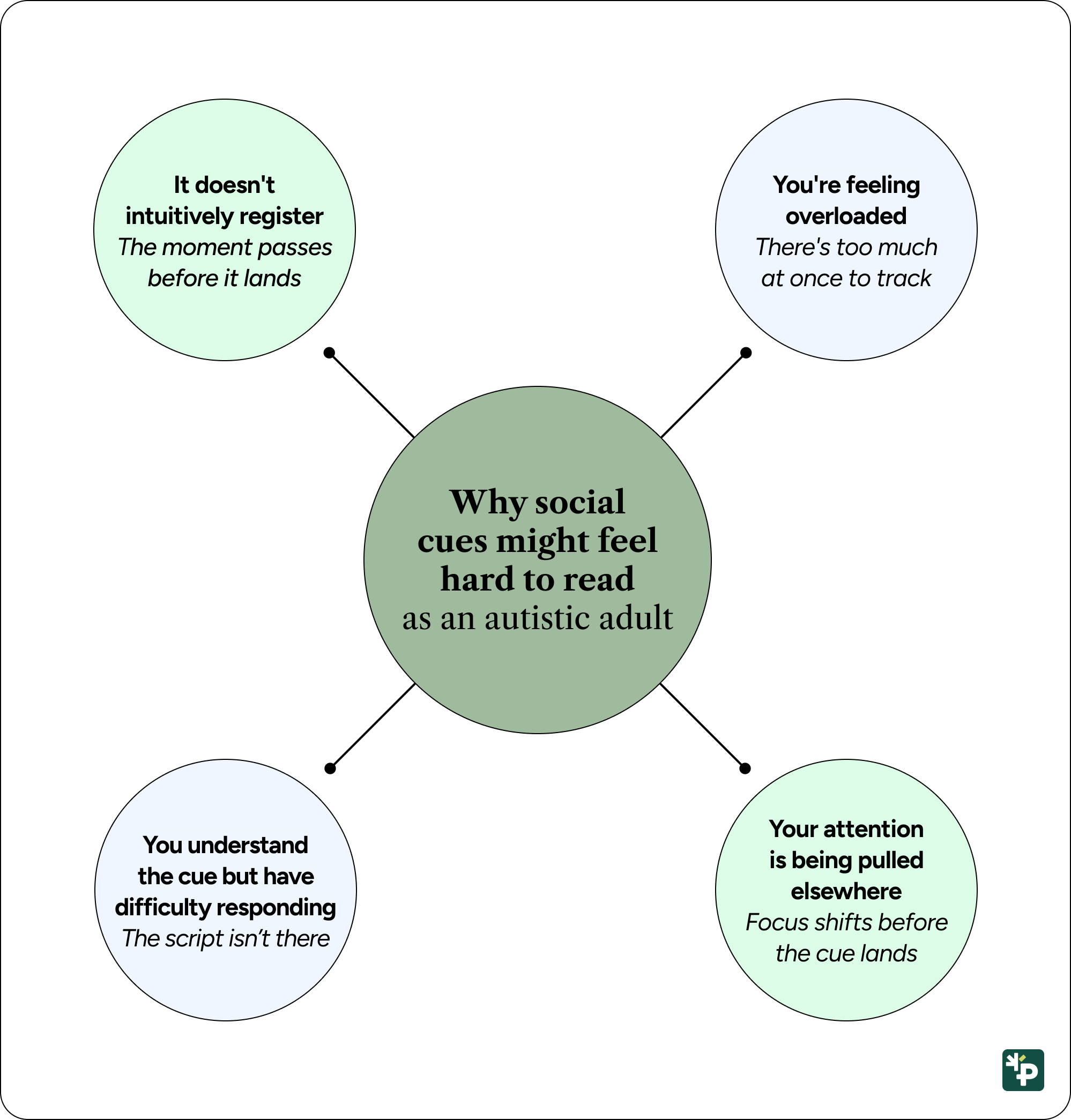
It is commonly believed that autistic people “miss” these signals. Like the information is right there; it's just not being picked up. But that’s not always what’s happening. Autism-related differences can affect how social information is processed, and that can look different from person to person. Sometimes, a cue might not register. Other times, it might register, but there’s so much else to process that responding right then and there becomes difficult.
Autism and social cues: Why they can feel difficult to read
Many autistic adults can recognize themselves in more than one reason why picking up on social cues can feel challenging. And you might find yourself shifting between reasons depending on the day, the setting, and who you’re talking to. So don’t treat this as a checklist to sort yourself into.
When the cue doesn’t register
Someone says “sure, no rush,” in a tone that was actually asking you to hurry, but you take the words at face value because that’s what they said. It’s not that the tone didn’t matter. The words simply carried the meaning for you, while the implied message in the tone or context didn’t register as separate information in that moment. For some autistic people, sarcasm, indirect requests, and hints may not automatically signal that there’s a second meaning beneath the literal one.
Feeling overloaded
A cue gets noticed, along with the tone, facial expression, words, and the need to formulate a response. That’s a lot to keep track of and process at once, according to a 2023 study published in Frontiers in Psychiatry. At some point, something is likely going to get missed, delayed, or pushed to the background.
“For some autistic adults, the pace of social interaction and communication can be hard to keep up with. Some clients tell me that they think of things to contribute to a conversation but not in time to share their thoughts. Or, they do have something to share but can’t find a place in the social back-and-forth to speak,” says Anna Kroncke, PhD, NCSP, Lead Psychologist at Prosper Health.
Reading the cue, but not knowing how to respond
Sometimes the cue is read correctly, but you’re not sure how to respond. You might pick up on the tension in someone's voice, or that a joke landed the wrong way. What’s missing isn’t the information, but a clear script for what to do with it. Do you name it? Let it pass? Ask directly? The moment often passes before an answer arrives.
When attention gets in the way
Difficulty sustaining attention or shifting focus may make it harder to notice or interpret social cues, regardless of whether someone is autistic. According to Neuroscience and Biobehavioral Reviews, this may be especially relevant for autistic adults because ADHD can co-occur with autism. “A high percentage of autistic adults also meet criteria for ADHD,” Kroncke says. “Some studies have said up to 70%.”
She adds, “ADHD relates to sustained attention, focus, and impulsivity. A person may have difficulty in a social situation because it is hard to pause and take the time to process all of the social cues before responding.” ADHD and autism are their own diagnosis, but they can occur together. And even when someone generally gets social cues, attention can still affect what happens in the moment. Fatigue, sensory load, and settings you’re unfamiliar with can all make the whole process harder too.
For example, a conversation with a close friend on a high-energy day may feel very different from a loud networking event after a long week.
What is the double empathy problem in autism?
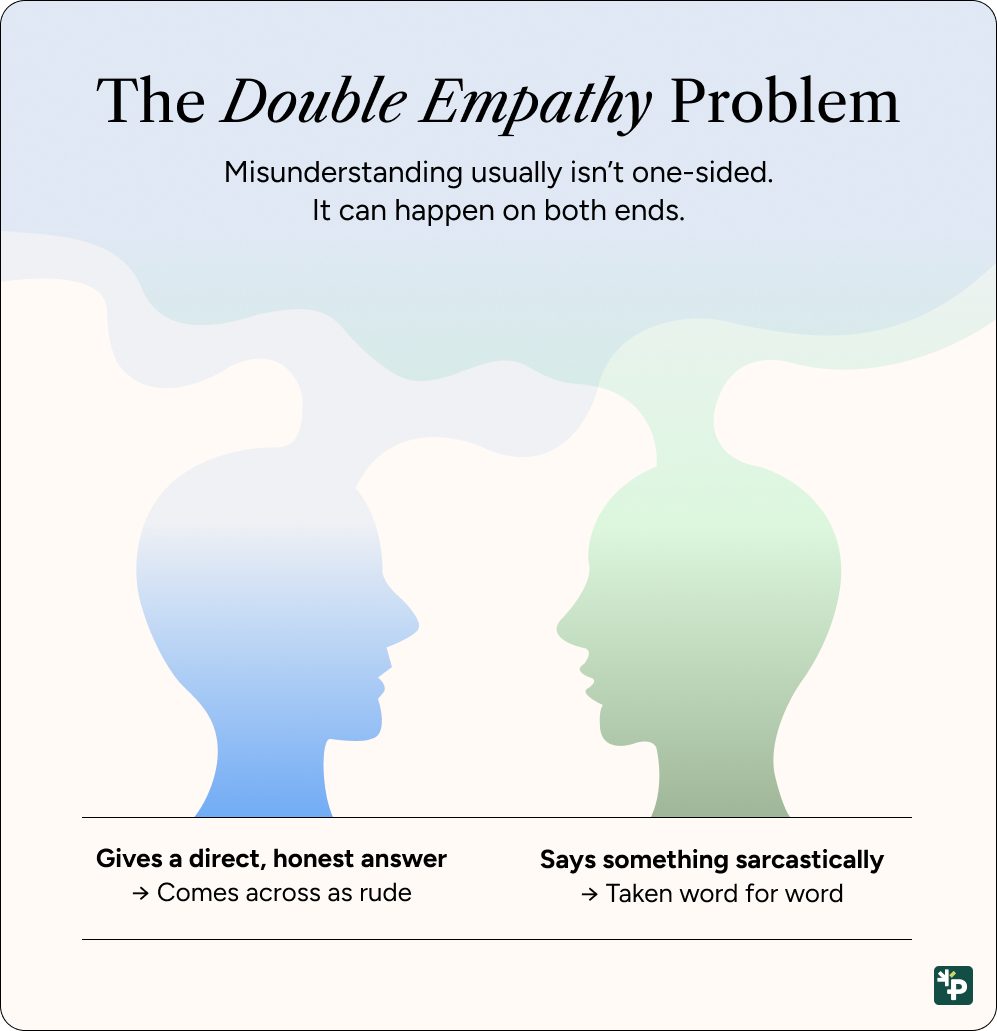
In 2012, researcher Damian Milton proposed what’s now known as the double empathy problem. According to a 2024 study published in JAMA Network Open, this perspective suggests that when an autistic person and a non-autistic person struggle to understand each other, it’s rarely because one side is failing to communicate correctly. Instead, both people may be communicating in ways that make sense to them, but those styles don’t always line up. That’s where the friction can come in.
Non-autistic people can also misinterpret autistic communication, which means the misunderstanding isn’t necessarily the autistic person’s problem to solve on their own, according to the same 2024 JAMA Network Open study. A direct answer can come across as blunt or cold when directness was actually the intent, just as a flat tone during a moment of engagement can be read as disinterest.
If you’ve spent time assuming every miscommunication was your fault or issue to fix, that assumption may not be accurate.
Sometimes, it might help to explain your communication style in basic terms instead of apologizing for it. For example, stating “I tend to say things directly, it’s not meant as harsh,” or “I process things a little slower in conversation, but I’m still following along,” might give the other person the context to close the gap from their side too.
How difficulty reading social cues can lead to avoidance and anxiety
Repeated experiences of misunderstanding, criticism, rejection, or uncertainty in social situations can make someone more self-conscious or anxious about future interactions. According to an analysis of research published in Autism , you might start watching yourself closely (self-monitoring). Thinking, was my tone okay? Did I talk too much? Did that person look annoyed? Or, you might go the other direction.
Avoidance is where you start withdrawing from social situations rather than risk another misread moment, according to a 2023 study in Frontiers in Psychiatry. Avoidance can make social situations feel even less familiar over time. Constantly monitoring yourself can make each interaction more exhausting. Either might turn into a cycle.
“When it’s hard to have conversations, communicate socially and understand the expectations, an autistic person becomes accustomed to failure,” Kroncke says. “They may be bullied growing up or have trouble making friends. This makes trying socially less appealing and even more difficult over time. Self-esteem is impacted, anxiety grows, often leading to more avoidance of social situations.”
Naming the cycle, choosing lower-stakes settings, and responding to yourself with self-compassion rather than self-criticism may help interrupt it.
Navigating social cues without masking
There isn’t one right way to handle social situations, and what works with a close friend may not work with your boss at work or your doctor. Some autistic people compensate for differences in cue-reading by closely monitoring things like eye contact, facial expressions, tone, timing, and how their response might come across. Trying to look more neurotypical (masking) can take a lot of effort.
But your goal shouldn’t be to perform more convincingly. Instead, it can be helpful to make communication clearer so you don’t have to do all of that monitoring yourself.
Sometimes the easiest way to reduce that effort is to make the communication more explicit. As Kroncke explains, “Having open communication with partners, supervisors and close friends can go a long way in finding common ground and reducing the need to spend so much time performing.” Practicing in different situations might be helpful.
Navigating social cues in the workplace
Work can get tricky when instructions are vague, or expectations aren’t spelled out. If you’re not sure what “whenever you get the chance” actually means, asking for a deadline gives you something concrete to work with.
It can also be helpful to tell others at work that you work best with direct feedback rather than hints. That can remove some of the guesswork before a misunderstanding happens.
Navigating social cues in healthcare settings
Medical appointments move fast and can carry real consequences if something is misunderstood. You can ask your provider to be clear about how urgent something is and next steps rather than expecting you to pick up on it from tone or implication.
Bringing written questions, requesting instructions in writing, or saying, “I process information best when it’s stated clearly, not implied or assumed,” are all ways to advocate for clearer communication.
Navigating social cues in dating and relationships
Relationships and dating can be especially tough because so much of it relies on implication. Are they interested? Are they upset? Are they joking? People don’t always say what they mean directly. It might be helpful to say early on how you communicate. It doesn’t have to be profound. Something as simple as, “I tend to take things literally, so tell me directly if something is bothering you,” can prevent a lot of guessing.
.png)
If you’re wondering whether this is a sign you’re autistic
If you’re reading this and thinking, “Wait, I do this,” you might also be wondering if it could be related to autism. Social-cue difficulties can be one of the signs of autism, but by itself, it doesn’t tell you whether you’re autistic.
Instead of trying to score yourself against this article, you may want to consider a few questions. Have you often felt confused by unspoken social rules that seemed obvious to everyone else? Have you been told you're "too direct" or "hard to read" by more than one person, in more than one context? Does socializing feel like work in a way that seems different from what other people describe?
These questions can be used as a starting point for reflection, and if you're curious about pursuing an adult autism evaluation or diagnosis, Prosper Health can help. Prosper offers neurodiversity-affirming autism evaluations and therapy via telehealth that can help you thrive and understand yourself.
Getting more support with social communication
If some of this sounds familiar, you do have a few options for getting more support and insight. Here are a few steps you might want to consider taking next:
- Evaluation and diagnosis. If you’re wondering whether you could be autistic, an evaluation could give you a clear answer. While you don’t need a diagnosis to validate your experience, you can still pursue evaluation.
- Peer or community support. Connecting with other autistic people can make communication feel easier and give you a place to share experiences without having to explain yourself.
- Self-advocacy resources. Tools for explaining your communication style when you need or want to can make conversations with partners, friends, coworkers, or healthcare providers easier.
- Neurodiversity-affirming social coaching. Unlike traditional social-skills training, this approach focuses on finding strategies that work for you rather than teaching you to act more neurotypical. This work is often done in the context of therapy.
The bottom line
Social cues aren’t something autistic people either “get” or “miss”. Different parts of the process can be tricky at different times. A cue might not register, there may simply be too much happening at once, or you might understand what someone actually means but not know how to respond quickly enough.
And more importantly, sometimes the misunderstanding isn’t yours alone.
Clear communication can reduce some of that friction without requiring you to become a different version of yourself.
Frequently Asked Questions (FAQs)
What are some social cues autistic people may “miss” or process differently?
This varies from person to person. Some autistic people may find mixed or unexpected cues, such as a facial expression that doesn't match someone's words, particularly difficult to interpret. Fast-paced situations with lots of social input can also make it harder to process relevant cues quickly, according to a 2023 study published in Frontiers in Psychiatry. Or, Kroncke says, when “a mix of sarcasm, humor, and other forms of joking is interspersed with direct and more logical information.”
Are social cues the same across cultures?
No. Social cues often vary widely by culture, which is worth keeping in mind when trying to sort out what's cultural versus what's related to neurodivergence. “Really learning about a person’s childhood and how they socialized within their culture can be really helpful in understanding what differences are cultural and where neurodivergence might play a part,” says Kroncke.
Can ADHD affect how someone reads social cues?
Yes. ADHD can affect sustained attention and impulse control, which may interrupt noticing, processing, or responding to social cues. ADHD and autism are distinct diagnoses that can co-occur.
Is it possible to get better at reading social cues over time?
Many autistic adults develop ways of making social interactions easier over time. That may include explicitly learning certain social patterns, asking for clarification, communicating more directly, or spending more time with people whose communication styles are easier to understand.
Sources
- https://pmc.ncbi.nlm.nih.gov/articles/PMC12271282/
- https://pmc.ncbi.nlm.nih.gov/articles/PMC9868406/
- https://pubmed.ncbi.nlm.nih.gov/38757626/
- https://www.tandfonline.com/doi/full/10.1080/09687599.2012.710008
- https://pubmed.ncbi.nlm.nih.gov/34563942/
- https://pmc.ncbi.nlm.nih.gov/articles/PMC11134975/
- https://pubmed.ncbi.nlm.nih.gov/37913872/


