


Key Takeaways
- Dermatophagia, also known as dermatodaxia, is a body-focused repetitive behavior (BFRB) that involves compulsive biting or chewing of the skin.
- Skin biting has a variety of triggers including stress and anxiety, OCD-spectrum patterns, and sensory-seeking or sensory-regulation needs.
- While research on dermatophagia in autistic adults is limited, some autistic individuals bite their skin for the sake of sensory regulation.
- Physical barriers, sensory substitution, and habit reversal training can all help reduce skin biting. Treatment may need to be adapted for autistic individuals.
If you’re here, you may relate to the feeling of catching yourself in the middle of chewing at the skin around your fingers without even realizing you’d started. It can come not only with physical pain, but a sense of confusion and shame. Rest assured that this isn’t a “gross habit” or a moral failing, but a common behavior known as dermatophagia (also called dermatodaxia in some recent sources).
“Dermatophagia can happen for a lot of different reasons,” says Amber Kovach, a licensed mental health counselor at Prosper Health. In any case, it doesn’t mean anything is wrong with you.
In this article, we'll discuss some factors that drive skin biting — such as stress, anxiety, OCD-spectrum patterns, and sensory-seeking — as well as concrete strategies to manage each cause. We'll also explore how autism and ADHD may play a part in the condition and what this may mean for treatment.
What is dermatophagia?
Dermatophagia is a body-focused repetitive behavior that involves compulsively biting, gnawing, or chewing your skin, often on the fingers and hands although it can also occur elsewhere.
The DSM-5-TR classifies it under the category of Other Specified Obsessive-Compulsive and Related Disorders. This means that while it’s under the Obsessive-Compulsive and Related Disorders umbrella, it doesn’t have its own distinct diagnosis.
Dermatophagia can cause lesions, typically on the forearm or hands, notes a 2022 study in Cureus. Hand biting may include biting fingers, biting fingertips, and biting cuticles. In any case, dermatophagia is more than simply picking a hangnail or occasionally biting on your nails.
To qualify as a disorder according to the DSM-5, a behavior has to bring significant distress or impairment in functioning. It must also persist despite repeated attempts to stop or cut back.
For some people, skin biting involves a noticeable urge that feels hard to resist. Others may bite automatically, without realizing they're doing it. While you’re likely not trying to harm yourself, the reasons behind skin biting can vary. It may temporarily relieve tension or provide sensory regulation, pleasure, or a satisfying sensation.
What causes skin biting?
Skin biting doesn’t have one single cause. People bite their skin for different reasons that may overlap.
Here are some examples. Note that this list is simply to help you recognize your experience, not a checklist you need to sort yourself into:
- Stress and emotional regulation: You might bite your skin to relieve tension, anxiety, or other difficult emotions, suggests a 2024 study in Autism. Over time, it might become automatic.
- OCD-related patterns and repetitive urges: Some people experience a strong urge or growing tension before they bite their skin, then feel temporary relief or satisfaction after they do so. Although dermatophagia is classified within the broader category of obsessive-compulsive and related disorders, skin biting isn't necessarily the result of obsessions or feared consequences. However, OCD can co-occur with body-focused repetitive behaviors, and obsessive thoughts or anxiety may sometimes influence when or why someone bites their skin.
- Impulsivity and difficulty noticing the behavior in the moment: A strong, hard-to-catch impulse might trigger you to bite your skin. You might not even realize you're doing it at first.
- Sensory-seeking: You might bite your skin in response to a sensory trigger like a hangnail, rough or dry skin, or a texture that feels different. Biting could also be a way to meet a need for oral or tactile stimulation when you're not doing anything else with your hands. These reasons are well-documented but don't receive as much coverage in existing resources.
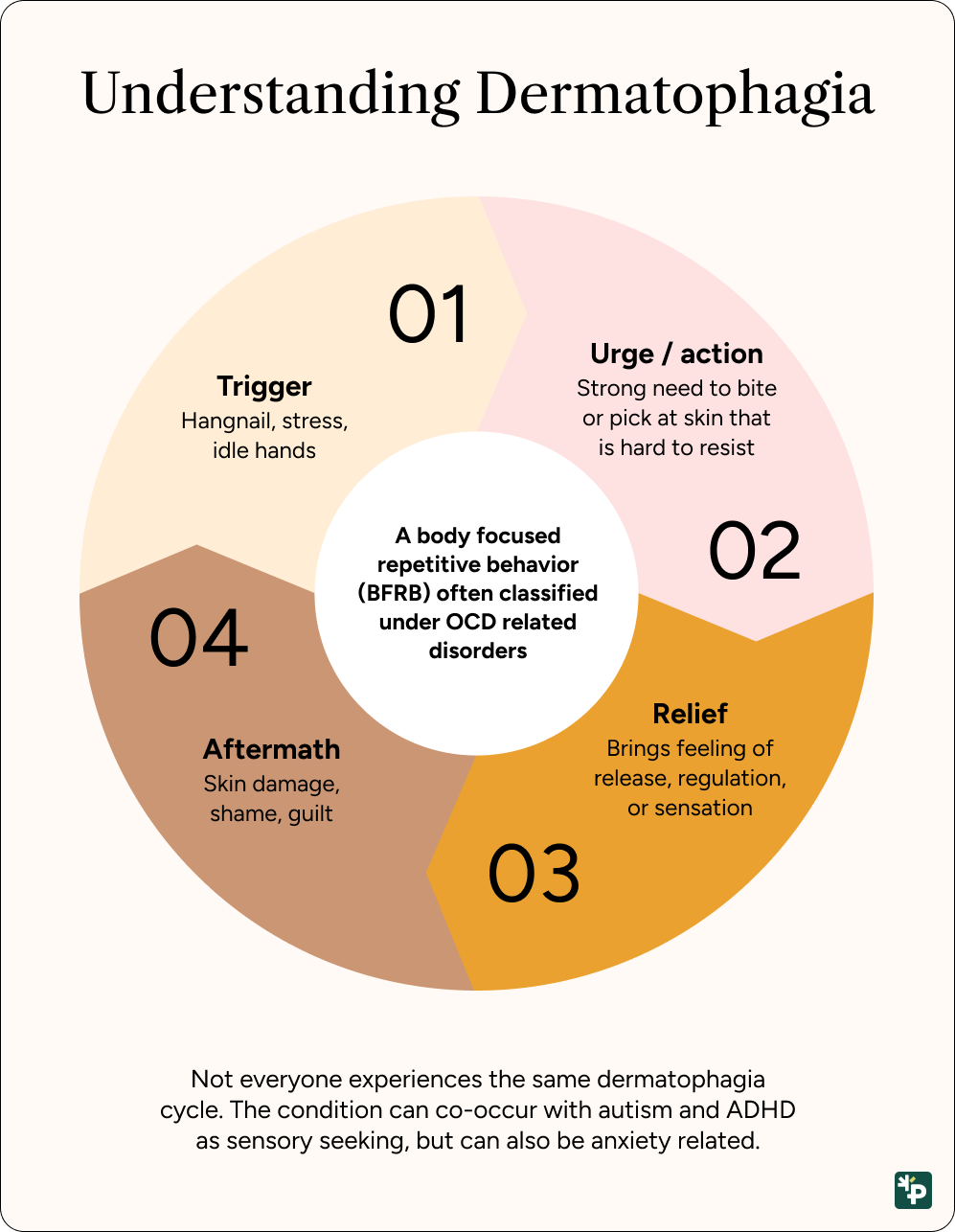
Skin biting, neurodivergence, and sensory processing
Sensory processing, stimming, and anxiety might play a part in skin biting among neurodivergent individuals.
Before we elaborate, it’s important to note there’s not a lot of research specifically exploring the link between dermatophagia and autism. As Kovach points out, “We know that autistic people can experience body-focused repetitive behaviors, especially things like skin picking or hair pulling, but dermatophagia itself has not been studied nearly as much as some behaviors.”
Therefore, we can’t make definitive statements about the relationship between neurodivergence and dermatophagia, but we can certainly discuss general patterns that may play a role.
Stimming
Biting skin can be a form of self-stimulatory behavior, also known as stimming, notes the aforementioned 2024 study in Autism. You may do it for the sake of sensory regulation or input, pressure, or repetitive movement, even when you're not anxious.
“For an adult with this presentation, it may be necessary to identify more appropriate sensory experiences that “match” the sensory experience that they are seeking,” says Dr. Karen Sheridan, clinical psychologist and owner of Access Autism Testing. A couple of examples include deep pressure and massage.
Anxiety disorders, which correlate with body-focused repetitive behaviors, are also common in autistic individuals. Some autistic people bite their skin to cope with anxiety. If this is true for you, you may benefit from anxiety management techniques such as breathing and relaxation.
Therapy Adaptations
If you’re neurodivergent, you might wonder if your dermatophagia treatment needs to be adapted. The truth is there's not enough research to definitively say whether adaptations are necessary for neurodivergent individuals.
In any case, Kovach suggests making triggers easier to identify, using visual reminders, and simplifying tracking. She also emphasizes the importance of “reducing harm and increasing control rather than assuming success has to mean completely eliminating every repetitive behavior.”
If you're only recently learning that long-term skin biting may be related to neurodivergence, you're not alone. Perhaps people have told you that your behavior is "just anxiety" or "just a bad habit." However, this is a common experience and it doesn't require a formal diagnosis to be meaningful.
How common is dermatophagia?
In a 2024 study in Psychological Medicine, approximately 9% of 1,481 adults surveyed online reported a history of skin biting severe enough to meet the researchers' criteria for a body-focused repetitive behavior disorder.
Thus, if you’re wondering if dermatophagia is rare, it might be more common than many people think. This may be because shame and secrecy around the condition might prevent some people from discussing it.
The study above found that 24% of participants had experienced body-focused repetitive disorders at some point. In addition to dermatophagia, these disorders include nail biting (the most common), skin picking, and lip cheek biting.
Interestingly, 97% of participants reported engaging in at least one body-focused repetitive behavior during their lifetime. For most of these participants, though, the behavior didn’t reach the level of a disorder.
What helps: Strategies for managing skin biting
There are several ways to manage skin biting. Which one works best for you depends on why you bite your skin to begin with. Here are some examples:
- Physical barriers: For an immediate, low-effort way to prevent skin biting, consider bandages, medical tape, gloves, or finger coverings. Wear them in situations you feel you might be tempted to bite your skin.
- Sensory substitutions: If you're seeking pressure, texture, or stimulation, Kovach suggests having a safer replacement to fulfill the same sensory needs. Examples include fidget tools, textured objects, and stress balls. If you need something to chew on, consider sugar-free gum, crunchy snacks, or ice chips.
- Habit reversal training: Habit reversal training (HRT), a form of cognitive behavioral therapy (CBT), is the most evidence-based dermatophagia treatment, says a 2022 review in Cognitive Therapy and Research. HRT replaces unwanted behaviors with safer ones. You develop awareness of when you're biting your skin, as well as warning signs that you're about to do so. Then, you decide on an alternative behavior to use during those moments. For example, you might sit on your hands so you can’t bite them.
- Anxiety management: If you bite your skin to cope with anxiety or stress, you might benefit from healthier strategies such as breathing exercises, grounding, and relaxation techniques, notes Dr. Sheridan.
- Immediate wound care: Apply direct pressure with a dry, clean cloth to stop the bleeding. Cleanse the wound with mild soap and warm, running water, then rinse it for three to five minutes. Reduce the risk of infection and further damage by applying antibacterial ointment and covering the wound with a dry, sterile bandage. Seek medical care if the bleeding is serious or doesn’t stop, the bite is deep or large, or there are other signs of physical damage like exposed muscle or bone.
- Skin care and wound management: It's important to take care of skin that's already damaged. This includes gentle cleansing, moisturizing, and keeping any wounds covered. You should also watch for signs of infection such as increased redness, warmth, discharge, or pain.
Getting support for skin biting
You can do many of the strategies listed above on your own, but there’s no shame in seeking support, either.
You might start with self-directed strategies if your skin biting is mild, not causing significant distress or injury, and you can interrupt it. “That might include tracking when it happens, protecting the area, trying a competing sensory option, or using habit-reversal strategies to become more aware of the urge and what tends to trigger it,” Kovach says.
On the other hand, you may prefer to get professional support if you’re not sure where to start, self-directed strategies aren’t helping, or it’s interfering with daily life. You should also consider support if your skin biting is causing bleeding, infection, scarring, pain, noticeable tissue damage, or significant distress.
Here are some support options:
- Medical or dermatological care: A medical provider can help assess and treat skin damage caused by repetitive biting. Seek prompt medical attention if you have serious bleeding or notice signs of infection, such as spreading redness, increasing swelling or pain, pus, red streaks, or fever. Medical attention is also important if bleeding doesn't stop, the wound is deep or large, or if you have other signs of physical damage such as exposed muscle or bone.
- Therapy: A therapist experienced in habit reversal training and other behavioral interventions for BFRBs can help you identify patterns, develop competing responses, and work toward reducing skin biting. Therapy may also address anxiety, mood symptoms, or other concerns that contribute to the behavior.
- The TLC Foundation for BFRBs directories: The TLC Foundation for BFRBs has online directories of BFRB providers and support groups.
- Prosper Health: If you’re autistic or believe you may be, know thatProsper Health offers adult autism evaluation and neurodiversity-affirming therapy via telehealth. Our therapists can take into account your neurodivergent traits and any co-occurring conditions while treating your BFRBs.
- 988: Most cases of skin biting aren't intentional self-harm, but if yours is, urgent mental health support is available at 988.
Frequently asked questions (FAQs)
What's the difference between dermatophagia and dermatillomania (skin picking)?
Dermatophagia and dermatillomania are both body-focused repetitive behaviors involving the skin (hence the prefix “derm” meaning skin). However, dermatophagia refers to skin biting, while dermatillomania refers to skin picking.
Is it normal for an autistic person to bite their skin?
Biting your skin isn’t a criterion for autism. However, many autistic people do have body-focused repetitive behaviors such as skin biting. For some autistic individuals, skin biting may serve as a form of stimming.
Can medication help with dermatophagia?
There are currently no FDA-approved medications specifically for dermatophagia. Researchers have studied several medications and supplements for other body-focused repetitive behaviors, particularly skin picking and hair pulling, but findings have been mixed, and research specifically examining medication for skin biting is limited.
That said, medication may help address co-occurring conditions, such as anxiety or OCD, that could contribute to the behavior. If skin biting is causing distress or interfering with your daily life, talk with your healthcare provider about whether medication or other treatment options might be appropriate for you.
Sources
https://pubmed.ncbi.nlm.nih.gov/38087951/
https://pmc.ncbi.nlm.nih.gov/articles/PMC9672630/
https://medlineplus.gov/ency/patientinstructions/000736.htm
https://ia800707.us.archive.org/15/items/info_munsha_DSM5/DSM-5.pdf
https://pmc.ncbi.nlm.nih.gov/articles/PMC11656632/
https://www.sciencedirect.com/science/article/abs/pii/S0022395624006903
https://pmc.ncbi.nlm.nih.gov/articles/PMC8932596/
https://www.dermatoljournal.com/articles/dermatologists-role-in-interdisciplinary-care-for-obsessive-compulsive-disorder-and-body-focused-repetitive-behaviors.html


