


Key Takeaways
- “Neurodivergent” is a non-diagnostic umbrella term for people whose brains function and process information differently from what is considered typical.
- The term comes from the neurodiversity movement and is a descriptive rather than formal clinical term.
- Autism is one condition commonly included under the neurodiversity umbrella, but the terms do not mean the same thing.
- You don’t need a diagnosis from a professional to call yourself neurodivergent, and identifying that way doesn’t necessarily mean you’re autistic.
- If you already have one neurodivergent identity, like ADHD, it’s still possible to be autistic too.
- A formal autism evaluation can offer clarity on which neurotype fits, plus autism-specific support, but it isn’t required to use either word to identify yourself.
“Neurodivergent” and “autistic” often get swapped for one another, in social captions, casual conversations, and sometimes even in settings where you might think people would know better.
Using the terms loosely isn't always a big deal. But it can matter more when you’re trying to figure out what these terms mean for you, especially if you’re wondering whether you might be autistic.
This is because the two terms really aren’t interchangeable, even though the mix-up can be common. Here’s how “neurodivergent” and “autism” relate, why the confusion happens in the first place, and what a next step might look like if you're seeking diagnosis.
Is autism neurodivergent? Is neurodivergent the same as autism?
Autism is a form of neurodivergence. But the words don’t mean the same thing. Autism is one specific type of neurotype, while neurodivergent is the broader category autism falls under.
According to a 2025 review published in Review Journal of Autism and Developmental Disorders, being neurodivergent means having a “neurocognitive” experience, something to do with how your brain processes information, that differs from what’s considered typical.
Autism fits that description, so it is a type of neurodivergence. The exact boundaries of the term “neurodivergent” vary, but it commonly includes neurodevelopmental conditions such as autism, ADHD, dyslexia, and Tourette syndrome.
Some communities use a broader definition that also includes acquired neurodivergence, such as PTSD or traumatic brain injuries, and mental health conditions such as bipolar disorder, OCD, or schizophrenia.
In short, neurodivergence can include many different conditions and experiences, including autism, so every autistic person is neurodivergent. But not every neurodivergent person is autistic.

What does “neurodivergent” actually mean?
The term neurodivergent isn’t a diagnosis; it’s a description that can apply to you whether or not you’ve ever seen a clinician about it.
“It is a very helpful term in identifying individuals who have brain differences, or neurological development that is not fitting a ‘typical pattern,’” says Anna Kroncke, Licensed Psychologist, CO, GA, and PSYPACT. According to the CDC, autism is a developmental disability caused by differences in the brain, which is part of why it fits so well under the neurodivergent umbrella.
And you don’t need a formal diagnosis to use either neurodivergent or autistic to describe yourself. Plenty of people identify as neurodivergent, or even autistic specifically, based on recognizing their own experience.
A 2026 study published in Autism in Adulthood found that self-identifying autistic adults report autistic traits, including social preferences, sensory sensitivity, and other focused interests that closely match those of formally diagnosed adults. Self-identifying isn’t inferior or less valuable than a formal diagnosis.
It’s also important to note that “neurodiversity,” a word people often use in place of “neurodivergent,” isn’t exactly the right term either. Neurodiversity is simply a way to say everyone’s brain is different, according to the Developmental Neurobiology review. It more accurately describes a group, like a classroom or workplace, than a single person.
These places are neurodiverse because the people in them think and process information in different ways. Humans as a whole are neurodiverse. A person within a group of humans, like an autistic person, can be neurodivergent.
Why do “neurodivergent” and “autistic” get used interchangeably?
Autism usually tends to be the most visible and talked-about form of neurodivergence. So it’s understandable that it’s become shorthand for the whole category in everyday language. When people say “neurodivergent,” they might be picturing autism specifically, but the word technically covers a lot more.
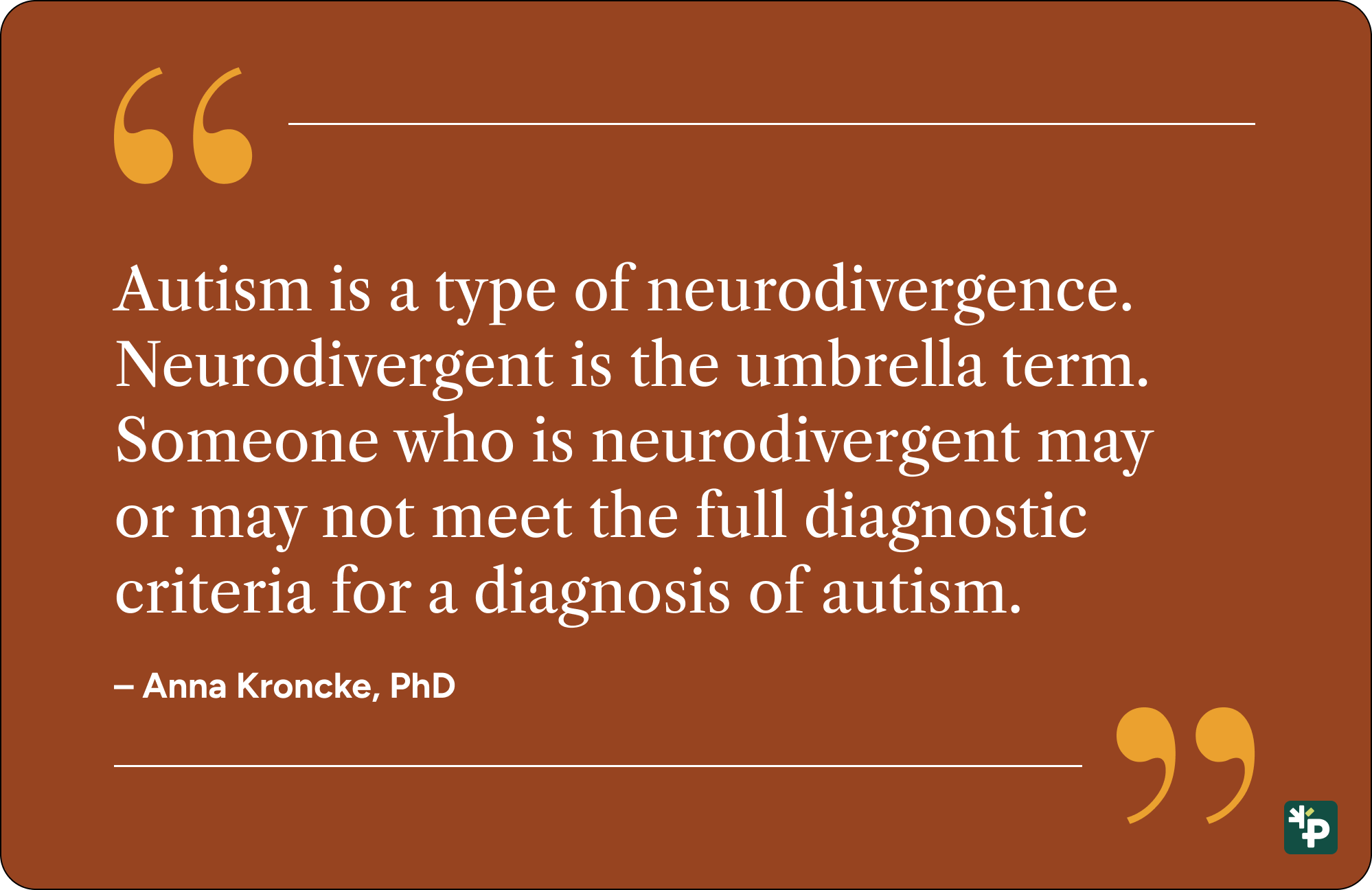
“Autism is a type of neurodivergence. Neurodivergent is the umbrella term. Someone who is neurodivergent may or may not meet the full diagnostic criteria for a diagnosis of autism,” explains Kroncke.
For many adults, especially those identified later in life, “neurodivergent” may have been the first word they ran into. A lot of online communities and social media content built around neurodivergence are where people find language and experiences that resonate with their own before they come across autism-specific information.
Kroncke explains, “I think neurodivergent has been embraced and is more widely accepted in schools and workplaces when individuals need access to various accommodations or have different interaction styles.”
The internet also uses both words loosely, which can reinforce the idea that they mean the same thing even though they don’t. Using the terms interchangeably isn’t necessarily a problem, but it can make the distinction between them harder to understand.
Where you might see yourself in this
People land on the comparison between “neurodivergent” vs. “autism” for many reasons, but you don’t need to identify perfectly with one for the information below to be helpful.
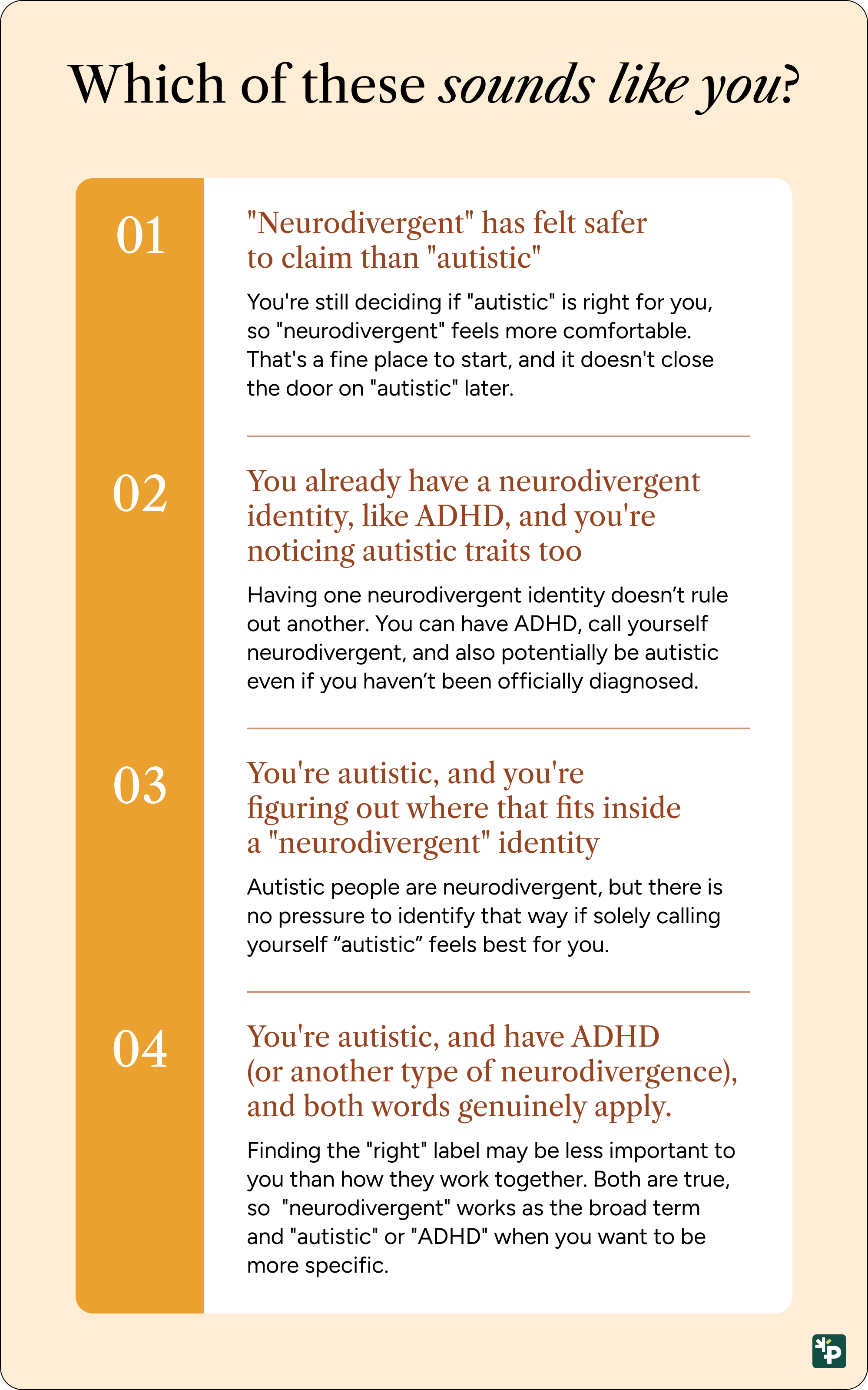
"Neurodivergent" has felt safer to claim than "autistic"
Maybe "neurodivergent" feels like the word you can use without fully committing to something bigger. It's less specific, which can feel lower stakes, especially if you're not sure yet, or you're worried about getting it wrong. Using "neurodivergent" for now is a reasonable place to start and doesn't close the door on figuring out whether "autistic" fits too. The two words aren't in competition.
You already have a neurodivergent identity, like ADHD, and you're noticing autistic traits too
Maybe you already have a diagnosis, like ADHD, and you're starting to notice patterns that sound less like ADHD and more like autism. Having one neurodivergent identity doesn't rule out another. This can be common, and it's often exactly what leads someone toward an autism-specific evaluation later on.
You're autistic, and you're figuring out where that fits inside a "neurodivergent" identity
You might already have the more specific word, autistic, and you're working out whether or how "neurodivergent" fits into how you talk about yourself. Claiming “autistic” doesn’t require also adopting “neurodivergent” as a personal identity term, and using one doesn’t mean you have to use the other.
You're autistic, and ADHD (or otherwise multiply neurodivergent), and both words genuinely apply
Maybe you already hold more than one label, and you're less interested in which term is more accurate than in how they function together. Being autistic and being neurodivergent aren't two separate facts competing for the top spot. One is a specific instance of the other.
If you want more on how autism and ADHD show up together, this guide to AuDHD covers that in full.
What a formal autism evaluation can offer
If “neurodivergent” feels right, but you’re still not sure which neurotype it is, or you already have one diagnosis and you’re noticing other things, a formal autism evaluation can provide a clearer answer. Whether you have no diagnosis at all, an existing one, or years of self-identifying without ever pursuing a formal assessment, an evaluation can help answer whether autism is part of the picture.
What the evaluation looks at
Kroncke says, “I love the formal evaluation process because it provides a deep assessment and understanding of each of the 9 trait areas used to diagnose autism.” These areas are just part of the broader criteria clinicians use when evaluating autism, not necessarily a nine-item checklist that can determine a diagnosis on its own.
She explains that the process looks at both childhood and adulthood experiences, including “social communication (relationships, social reciprocity, and nonverbal communication)” and “behaviors and interests (looking at repetitive behaviors, sameness and routines, interests, and sensory processing).”
The evaluation also considers the functional impact of these traits and differences. As Kroncke puts it, “I believe the formal evaluation process helps to identify therapy goals, areas of great strength and areas that prove more challenging.”
What makes it feel validating
For some people, that deeper look can be validating in its own right. Kroncke says, “It can be very validating for some individuals who have wondered why social interactions have felt different, or why sensory experiences may have an intensity that others do not identify with.”
That clarity can be useful even when someone doesn’t ultimately meet the full criteria for an autism diagnosis. “I think the process can be very enlightening and even therapeutic in some cases no matter what the diagnostic outcome,” says Kroncke.
If you’re unsure about pursuing diagnosis
If you’re holding back because you’re not sure your traits are “enough” to justify an evaluation, or because you’re worried that seeking one somehow undermines your self-identification, that hesitation is common, but it doesn’t have to stop you.
Wanting clarity is a legitimate reason itself. Evaluation is also just one option among several, alongside community and self-advocacy resources, if that fits you better.
You don’t need a diagnosis to self-identify
Self-identifying as neurodivergent, or even as autistic, is valid without ever seeking a diagnosis.
Evaluation isn’t a requirement for using either word. It’s a tool for people who specifically want that kind of clarity, and it’s fine if that’s not you. Prosper Health offers autism evaluations for adults who want to explore whether autism fits their experience.
The bottom line
“Neurodivergent” and “autism” aren’t interchangeable, even though they might be used that way frequently. Autism is one specific neurotype inside the broader neurodivergent umbrella, not a synonym for the whole thing. You don’t need a diagnosis to use either word, and having one neurodivergent identity doesn’t rule out another.
If you want a clear answer about whether autism specifically fits you, an evaluation is one path to that, but not the only valid way to describe your own experience.
Frequently asked questions
Do I need a diagnosis to call myself neurodivergent?
No. "Neurodivergent" is a description, not a diagnosis, and it's commonly used by both diagnosed and self-identified people. The same goes for "autistic" specifically. One 2026 study on self-identifying autistic adults has found their traits closely match those of formally diagnosed adults. Recognizing your own experience counts for something real even without the formal label.
What are some examples of neurodivergence?
Autism is one example, but the umbrella also includes ADHD, dyslexia, dyspraxia, Tourette syndrome, and several other neurotypes. For a fuller breakdown of what falls under that umbrella, types of neurodiversity covers it in depth.
What's the difference between "neurodivergent" and "neurodiverse"?
"Neurodiverse" describes a group, since a group can only be diverse if it includes more than one kind of person. "Neurodivergent" describes an individual whose brain works differently from what's considered typical. A workplace can be neurodiverse. A specific person is neurodivergent.
Is AuDHD an actual diagnosis, or just a term for having both autism and ADHD?
AuDHD isn't a formal diagnosis on its own. It's a widely used term for having both autism and ADHD, which happens often. According to a 2022 review published in Frontiers in Psychiatry, somewhere between 50% and 70% of autistic people also meet criteria for ADHD. If you're AuDHD, this guide goes further into how the two conditions show up together.
If I already have an ADHD diagnosis, do I need a separate evaluation for autism?
If you want a formal autism diagnosis, yes, autism requires its own evaluation; an ADHD diagnosis doesn't establish whether you meet autism criteria. If you're noticing autistic traits alongside an existing ADHD diagnosis, checking what co-occurs with autism or pursuing a separate autism evaluation is the way to get clarity on that specifically.
Can you be neurodivergent without having autism, ADHD, or another diagnosed condition?
Yes. Neurodivergent isn't a diagnosis, so using the term doesn't require you to have a formal diagnosis of autism, ADHD, or another specific neurotype. Some people use “neurodivergent” because it describes their experience while they're still figuring out which, if any, specific neurotype fits.
Others may use it as a personal identity term without pursuing a formal evaluation. The important distinction is that identifying as neurodivergent doesn't tell you whether autism specifically applies to you.
Sources
https://link.springer.com/article/10.1007/s40489-025-00493-2
https://onlinelibrary.wiley.com/doi/10.1002/dneu.22960


